LIBER XII · CAPUT 1
THE EARLY HISTORY OF TREES
Latine · Mayhoff 1906
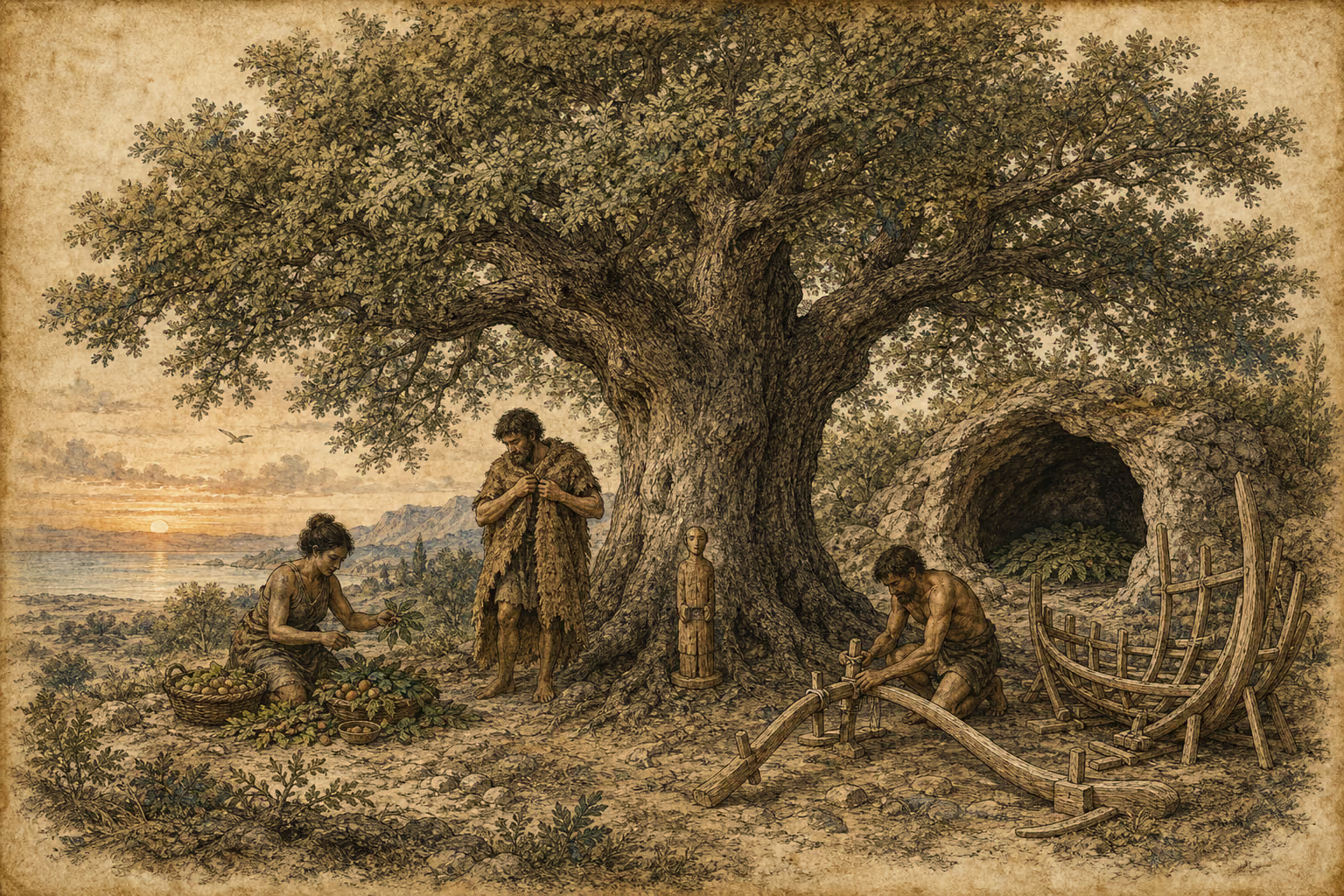
Animalium omnium quae nosci potuere naturae generatim membratimque ita se habent. restat ut neque ipsa anima carentia — quandoquidem nihil sine ea vivit —, terra edita et inde eruta, dicantur ac nullum sileatur rerum naturae opus. diu fuere occulta eius beneficia, summumque munus homini datum arbores silvaeque intellegebantur. hinc primum alimenta, harum fronde mollior specus, libro vestis. etiam nunc gentes sic degunt. quo magis ac magis admirari subit his a principiis caedi montes in marmora, vestes ad Seras peti, unionem in Rubri maris profunda, zmaragdum in ima tellure quaeri. ad hoc excogitata sunt aurium vulnera, nimirum quoniam parum erat collo, crinibus, manibus gestari, nisi infoderentur etiam corpori. quam ob rem sequi par est ordinem vitae et arbores ante alia dicere ac moribus primordia ingerere nostris.
Haec fuere numinum templa, priscoque ritu simplicia rura etiam nunc deo praecellentem arborem dicant. nec magis auro fulgentia atque ebore simulacra quam lucos et in iis silentia ipsa adoramus. arborum genera numinibus suis dicata perpetuo servantur, ut Iovi aesculus, Apollini laurus, Minervae olea, Veneri myrtus, Herculi populus. quin et Silvanos Faunosque et dearum genera silvis ac sua numina tamquam e caelo attributa credimus. arbores postea blandioribus fruge sucis hominem mitigavere. ex his recreans membra olei liquor viresque potus vini, tot denique sapores anni sponte venientes et mensae, depugnetur licet earum causa cum feris et pasti naufragorum corporibus pisces expetantur, etiam nunc tamen secundae. mille praeterea sunt usus earum, sine quis vita degi non possit. arbore sulcamus maria terrasque admovemus, arbore exaedificamus tecta. arborea et simulacra numinum fuere nondum pretio excogitato beluarum cadaveri atque ut, a diis nato iure luxuriae, eodem ebore numinum ora spectarentur et mensarum pedes. produnt Alpibus coercitas ut tum inexsuperabili munimento Gallias hanc primum habuisse causam superfundendi se Italiae, quod Helico ex Helvetiis civis earum fabrilem ob artem Romae commoratus ficum siccam et uvam oleique ac vini promissa remeans secum tulisset. quapropter haec vel bello quaesisse venia sit.
Sed quis non iure miretur arborem umbrae gratia tantum ex alieno petitam orbe? platanus haec est, in mare Ionium Diomedis insula tenus eiusdem tumuli gratia primum invecta, inde in Siciliam transgressa atque inter primas donata Italiae et iam ad Morinos usque pervecta ac tributarium etiam detinens solum, ut gentes vectigal et pro umbra pendant. Dionysius prior Siciliae tyrannus Regium in urbem transtulit eas domus suae miraculum, ubi postea factum gymnasium; nec potuisse in amplitudinem augescere aut alias fuisse in Italia ac nominatim Hispania apud auctores invenitur.
Hoc actum circa captae urbis aetatem, tantumque postea honoris increvit, ut mero infuso enutriantur. conpertum id maxime prodesse radicibus, docuimusque etiam arbores vina potare.
Celebratae sunt primum in ambulatione Academiae Athenis cubitorum XXXIII radice ramos antecedente. nunc est clara in Lycia fontis gelidi socia amoenitate, itineri adposita, domicilii modo cava octoginta atque unius pedum specu, nemorosa vertice et se vastis protegens ramis arbor um instar, agros longis obtinens umbris ac, ne quid desit speluncae imagini, saxea intus crepidinis corona muscosos conplexa pumices, tam digna miraculo, ut Licinius Mu- cianus ter consul et nuper provinciae eius legatus prodendum etiam posteris putaverit, epulatum intra eam se cum duodevicensimo comite, large ipsa toros praebente frondis, ab omni adflatu securum, optantem imbrium per folia crepitus, laetiorem quam marmorum nitore, picturae varietate, laquearium auro cubuisse in eadem. aliud exemplum Gai principis in Veliterno rure mirati unius tabulata laxeque ramorum trabibus scamna patula et in ea epulati, cum ipse pars esset umbrae, quindecim convivarum ac ministerii capaci triclinio, quam cenam appellavit ille nidum. est Gortynae in insula Creta iuxta fontem platanus una insignis utriusque linguae monimentis, numquam folia dimittens, statimque ei Graeciae fabulositas superfuit Iovem sub ea cum Europa concubuisse, ceu vero non alia eiusdem generis esset in Cypro. sed ex ea primum in ipsa Creta, ut est natura hominum novitatis avida, platani satae regeneravere vitium, quandoquidem commendatio arboris eius non alia maior est quam soles aestate arcere, hieme admittere. inde in Italiam quoque ad surburbana sua Claudio principe Marcelli Aesernini libertus, sed qui se potentiae causa Caesaris libertis adoptasset, spado Thessalicus praedives, ut merito dici possit is quoque Dionysius, transtulit id genus. durantque et in Italia portenta terrarum praeter illa scilicet quae ipsa excogitavit Italia.
English · Bostock & Riley 1855–57
Such, then, is the history, according to their various species and their peculiar conformations, of all the animals within the compass of our knowledge. It now remains for us to speak of the vegetable productions of the earth, which are equally far from being destitute of a vital spirit, (for, indeed, nothing can live without it), that we may then proceed to describe the minerals extracted from it, and so none of the works of Nature may be passed by in silence. Long, indeed, were these last bounties of hers concealed beneath the ground, the trees and forests being regarded as the most valuable benefits conferred by Nature upon mankind. It was from the forest that man drew his first aliment, by the leaves of the trees was his cave rendered more habitable, and by their bark was his clothing supplied; even at this very day, there are nations that live under similar circumstances to these. Still more and more, then, must we be struck with wonder and admiration, that from a primæval state such as this, we should now be cleaving the mountains for their marbles, visiting the Seres to obtain our clothing, seeking the pearl in the depths of the Red Sea, and the emerald in the very bowels of the earth. For our adornment with these precious stones it is that we have devised those wounds which we make in our ears; because, forsooth, it was deemed not enough to carry them on our hands, our necks, and our hair, if we did not insert them in our very flesh as well. It will be only proper, then, to follow the order of human inventions, and to speak of the trees before treating of other subjects; thus may we trace up to their very origin the manners and usages of the present day.
The trees formed the first temples of the gods, and even at the present day, the country people, preserving in all their simplicity their ancient rites, consecrate the finest among their trees to some divinity; indeed, we feel ourselves inspired to adoration, not less by the sacred groves and their very stillness, than by the statues of the gods, resplendent as they are with gold and ivory. Each kind of tree remains immutably consecrated to its own peculiar divinity, the beech to Jupiter, the laurel to Apollo, the olive to Minerva, the myrtle to Venus, and the poplar to Hercules: besides which, it is our belief that the Sylvans, the Fauns, and various kinds of goddess Nymphs, have the tutelage of the woods, and we look upon those deities as especially appointed to preside over them by the will of heaven. In more recent times, it was the trees that by their juices, more soothing even than corn, first mollified the natural asperity of man; and it is from these that we now derive the oil of the olive that renders the limbs so supple, the draught of wine that so efficiently recruits the strength, and the numerous delicacies which spring up spontaneously at the various seasons of the year, and load our tables with their viands—tables to replenish which, we engage in combat with wild beasts, and seek for the fishes which have fattened upon the dead corpse of the shipwrecked mariner—indeed, it is only at the second course, after all, that the produce of the trees appears.
But, in addition to this, the trees have a thousand other uses, all of which are indispensable to the full enjoyment of life. It is by the aid of the tree that we plough the deep, and bring near to us far distant lands; it is by the aid of the tree, too, that we construct our edifices. The statues, even, of the deities were formed of the wood of trees, in the days when no value had been set as yet on the dead carcase of a wild beast, and when, luxury not yet deriving its sanction from the gods themselves, we had not to behold, resplendent with the same ivory, the heads of the divinities and the feet of our tables. It is related that the Gauls, separated from us as they were by the Alps, which then formed an almost insurmountable bulwark, had, as their chief motive for invading Italy, its dried figs, its grapes, its oil, and its wine, samples of which had been brought back to them by Helico, a citizen of the Helvetii, who had been staying at Rome, to practise there as an artizan. We may offer some excuse, then, for them, when we know that they came in quest of these various productions, though at the price even of war.
But who is there that will not, with good reason, be surprised to learn that a tree has been introduced among us from a foreign clime for nothing but its shade? I mean the plane, which was first brought across the Ionian Sea to the Isle of Diomedes, there to be planted at his tomb, and was afterwards imported thence into Sicily, being one of the very first exotic trees that were introduced into Italy. At the present day, however, it has penetrated as far as the country of the Morini, and occupies even a tributary soil; in return for which those nations have to pay a tax for the enjoyment of its shade. Dionysius the Elder, one of the tyrants of Sicily, had plane-trees conveyed to the city of Rhegium, where they were looked upon as the great marvel of his palace, which was afterwards converted into a gymnasium. These trees did not, however, in that locality, attain any very great height. I find it also stated by some authors, that there were some other instances, in those days even, of plane-trees being found in Italy, and I find some mentioned by name as existing in Spain.
This circumstance took place about the time of the capture of the City of Rome; and to such high honour, in the course of time, did the plane-tree attain, that it was nurtured by pouring wine upon it, it being found that the roots were greatly strengthened by doing so. Thus have we taught the very trees, even, to be wine-bibbers!
The first plane-trees that were spoken of in terms of high admiration were those which adorned the walks of the Academy at Athens—[in one of which], the roots extended a distance of thirty-three cubits, and spread far beyond its branches. At the present day, there is a very famous plane in Lycia, situate in close proximity to a fountain of the most refreshing coolness; standing near the road, with the cavity in its interior, it forms a species of house eighty-one feet in width. Its summit, too, presents the foliage of a grove, while it shields itself with huge branches, each of which would equal an ordinary tree in size, as it throws its lengthened shade across the fields. In addition to this, that nothing may be wanting to its exact resemblance to a grotto, there is a circle of seats within, formed of stone, intermingled with pumice overgrown with moss. This tree was looked upon as so worthy of remark, that Licinius Mucianus, who was three times consul, and recently the legatus of that province, thought it a circumstance deserving of transmission even to posterity, that he, together with eighteen persons of his retinue, had sat down to a banquet in the interior of it. Its leaves afforded material for their couches in the greatest abundance, while he himself, sheltered from every gust of wind, and trying in vain to hear the pattering of the rain on the leaves, took his meal there, and enjoyed himself more than he would have done amid the resplendence of marble, a multiplicity of paintings, and beneath a cieling refulgent with gold.
Another curious instance, again, was that afforded in the reign of the Emperor Caius. That prince was so struck with admiration on seeing a plane in the territory of Veliternum, which presented floor after floor, like those of the several stories of a house, by means of broad benches loosely laid from branch to branch, that he held a banquet in it—himself adding very materially to the shade it threw—the triclinium being formed for the reception of fifteen guests and the necessary attendants: to this singular dining-room he gave the name of his “nest.”
At Gortyna, in the Isle of Crete, there is, in the vicinity of a fountain there, a single plane-tree, which has been long celebrated in the records of both the Greek and the Latin language: it never loses its leaves, and from an early period one of the fabulous legends of Greece has been attached to it, to the effect that it was beneath this tree that Jupiter lay with Europa; just as if there had not been another tree of a similar nature in the island of Cyprus. Slips of the tree at Gortyna—so fond is man by nature of novelty—were at an early period planted at different places in Crete, and reproduced the natural imperfections of the tree; though, indeed, there is no higher recommendation in the plane than the fact that in summer it protects us from the rays of the sun, while in winter it admits them. In later times, during the reign of the Emperor Claudius, a Thessalian eunuch, the freedman of Marcellus Æserninus, who, however, from motives of ambition had enrolled himself in the number of the freedmen of the emperor, and had acquired very considerable wealth, introduced this plane into Italy, in order to beautify his country-seat: so that he may not inappropriately be styled a second Dionysius. These monstrosities of other lands are still to be seen in Italy, independently of those which that country has herself devised.