LIBER XIV · CAPUT 16
THE USES OF THE WILD VINE. WHAT JUICES ARE NATURALLY THE COLDEST OF ALL
Latine · Mayhoff 1906
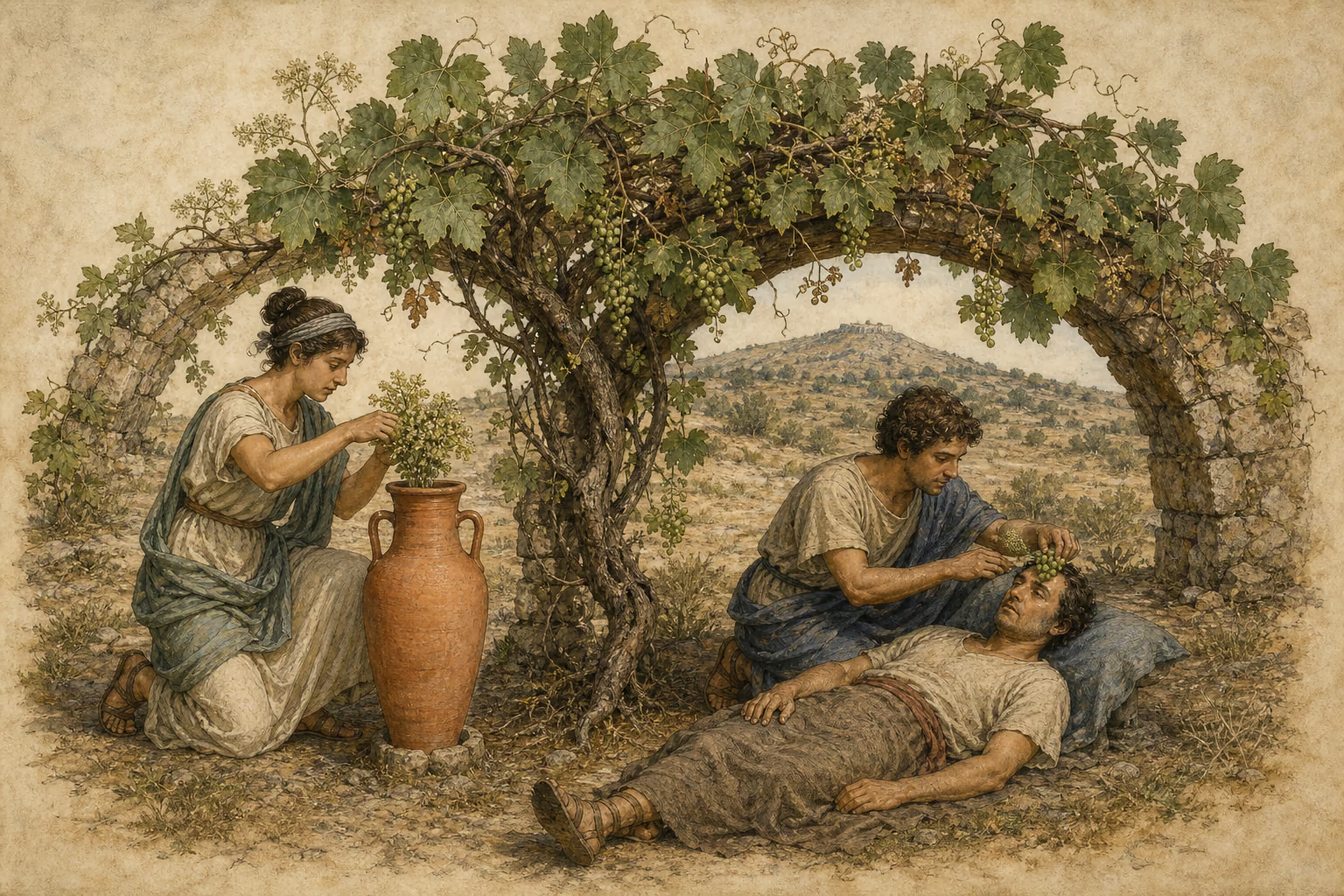
Itaque non miror innumerabilia paene genera ficticii reperta multis ante saeculis, quae nunc dicemus, omnia ad medicinae usum pertinentia. omphacium quo modo fieret, propter unguenta diximus priore libro. fit e labrusca, hoc est vite silvestri, quod vocatur oenanthinum, floris eius libris duabus in musti cado maceratis. post dies XXX utuntur. praeter hoc radix labruscae, acini coria perficiunt. hi paulo post quam defloruere singulare remedium habent ad refrigerandos in morbis corporum ardores, gelidissima, ut ferunt, natura. pars eorum aestu moritur prius quam reliqua, quae solstitiales dicuntur. universi numquam maturescunt, et si prius quam tota inarescat uva incocta detur cibo gallinaceo generi, fastidium gignit uvas adpetendi.
Ficticiorum primum fit ex ipso vino (quod vocant adynamon) hoc modo: albi musti sextarii XX, aquae dimidium fervent, donec excoquatur aquae mensura. alii marinae sextarios X, tantundem pluviae in sole XL diebus torrent. dant aegris quibus vini noxiam timent.
Proximum fit e milii semine maturi cum ipsa stipula, libra quadrante in congios duos musti, macerato et post septimum mensem transfuso. ex loto arbore, frutice, herba dictum est ubi quaeque fierent.
Fiunt et e pomis, quae dicemus interpretationibus non nisi necessariis additis, primumque e palmis, quo Parthi, Indi utuntur et oriens totus, mitiorum quas vocant chydaeas modio in aquae congiis tribus macerato expressoque. sic fit et sycites e fico, quem alii pharnuprium, alii trochin vocant, aut si dulce esse non libeat, pro aqua tantundem vinaceorum adicitur. e Cypria fico et acetum fit praecellens atque Alexandrino quoque melius. vinum fit et e siliqua Syriaca et e piris malorumque omnibus generibus — sed e Punicis rhoiten vocant — et e cornis, mespilis, sorvis, moris siccis, nucleis pineis. hi musto madidi exprimuntur, superiora per se mitia. myrtiten Cato quem ad modun fieri docuerit mox paulo indicabimus, Graeci et alio modo. ramis teneris cum suis foliis in salso musto coctis tunsis, libram in tribus musti congiis defervefaciunt, done duo supersint. quod ita e silvestris myrti bacis factum est, myrtidanum vocatur. hoc manus tinguit.
Ex his quae in hortis gignuntur fit vinum e radice asparagi, cunila, origano, api semine, habrotono, mentastro, ruta, nepeta, serpyllo, marruvio. manipulos binos condunt in cadum musti et sapae sextarium et aquae marinae heminam. e napis fit duum denariorum pondere in sextarios binos musti addito, item e scillae radice; inter flores ex rosae foliis tusis in linteolo in mustum collatis cum pondusculo, ut sidat, $X$ L pondere in sextarios musti vicenos— vetant ante tres menses vas aperiri —, item e nardo Gallico et aliud e silvestri.
Aromatiten quoque invenio factitatum tantum non unguentorum compositione, primo ex murra, ut diximus, mox et nardo Celtico, calamo, bitumine, offis in mustum aut dulce vinum deiectis, alibi calamo, iunco, costo, nardo Syriaco, amomo, casia, cinnamo, croco, palma, asaro, similiter in offa. apud alios nardi etiam et malobathri selibris in musti congios duos additis, qualia nunc quoque fiunt pipere et melle addito, quae alii condita, alii piperata appellant. invenitur et nectarites ex herba quam alii Helenion, alii Medicam, alii symphyton, alii Idaeam, alii Orestion, alii nectariam vocant, radice ponderis $X$ L in sextarios sex musti addita, similiter in linteo. ex ceteris herbis fit absinthites in XL sextariis musti absinthi Pontici libra decocta ad tertias partes vel scopis absinthi in vinum additis. similiter hyssopites e Cilicio hyssopo unciis tribus in duos congios musti coiectis aut tusis in vinum. fiunt utraque et alio modo, circa radices vitium sato. sic et elleboriten fieri ex veratro nigro Cato docet. sic fit et scammonites, mira vitium natura saporem alienum in se trahendi, quare et salicem redolent Patavinorum in palustribus vindemiae. sic et elleborum seritur in Thaso aut cucumis silvester aut scammonia, quod vinum phthorium vocatur, quoniam abortus facit.
Fit et ex herbis, quarum naturae suo loco dicentur: e stoechade et radice Gentianae et tragorigano et dictamno, asaro, dauco, elelisphaco, panace, acoro, thymo, mandragora, iunco. vocarunt et scyzinum et itaeomelin et lectisphagiten, quorum iam oblitterata ratio est.
E fruticun vero genere cedri utriusque, cupressus, laurus, iunipiri, terebinthi, calami, lentisci bacae aut lignum recens in musto decocuntur, item chamelaeae et chamaepityis, chamaedryis lignum. eodem modo et ex flore, in congium musti decem $X$ pondere addito.
English · Bostock & Riley 1855–57
I am not surprised, then, that for these many ages there have been invented almost innumerable varieties of artificial wines, of which I shall now make some mention; they are all of them employed for medicinal purposes. We have already stated in a former Book how omphacium, which is used for unguents, is made. The liquor known as “œnanthinum” is made from the wild vine, two pounds of the flowers of which are steeped in a cadus of must, and are then changed at the end of thirty days. In addition to this, the root and the husks of the grapes are employed in dressing leather. The grapes, too, a little after the blossom has gone off, are singularly efficacious as a specific for cooling the feverish heat of the body in certain maladies, being, it is said, of a nature remarkable for extreme coldness. A portion of these grapes wither away, in consequence of the heat, before the rest, which are thence called solstitial grapes; indeed, the whole of them never attain maturity; if one of these grapes, in an unripe state, is given to a barn-door fowl to eat, it is productive of a dislike to grapes for the future.
The first of the artificial wines has wine for its basis; it is called “adynamon,” and is made in the following manner. Twenty sextarii of white must are boiled down with half that quantity of water, until the amount of the water is lost by evaporation. Some persons mix with the must ten sextarii of sea-water and an equal quantity of rain-water, and leave the whole to evaporate in the sun for forty days. This beverage is given to invalids to whom it is apprehended that wine may prove injurious.
The next kind of artificial wine is that made of the ripe grain of millet; a pound and a quarter of it with the straw is steeped in two congii of must, and the mixture is poured off at the end of six months. We have already stated how various kinds of wine are made from the tree, the shrub, and the herb, respectively known as the lotus.
From fruit, too, the following wines are made, to the list of which we shall only add some necessary explanations:—First of all, we find the fruit of the palm employed for this purpose by the Parthians as well as the Indians, and, indeed, throughout all the countries of the East. A modius of the kind of ripe date called “chydææ” is added to three congii of water, and after being steeped for some time, they are subjected to pressure. Sycites is a preparation similarly made from figs: some persons call it “palmiprimum,” others, again, “catorchites:” if sweetness is not the maker’s object, instead of water there is added the same quantity of husk juice of grapes. Of the Cyprian fig a very excellent vinegar, too, is made, and of that of Alexandria a still superior.
A wine is made, too, of the pods of the Syrian carob, of pears, and of all kinds of apples. That known as “rhoites” is made from pomegranates, and other varieties are prepared from cornels, medlars, sorb apples, dried mulberries, and pine-nuts these last are left to steep in must, and are then pressed; the others produce a sweet liquor of themselves. We shall have occasion before long to show how Cato has pointed out the method of making myrtites: the Greeks, however, adopt a different method in making it. They first boil tender sprigs of myrtle with the leaves on in white must, and after pounding them, boil down one pound of the mixture in three congii of must, until it is reduced to a couple of congii. The beverage that is prepared in this manner with the berries of wild myrtle is known as “myrtidanum;” it will stain the hands.
Among the garden plants we find wines made of the following kinds: the radish, asparagus, cunila, origanum, parsley-seed, abrotonum, wild mint, rue, catmint, wild thyme, and horehound. A couple of handfuls of these ingredients are put into a cadus of must, as also one sextarius of sapa, and half a sextarius of sea-water. A wine is made of the naphew turnip by adding two drachms of naphew to two sextarii of must. A wine is made also from the roots of squills. Among the flowers, that of the rose furnishes a wine: the leaves are put in a linen cloth and then pounded, after which they are thrown into must with a small weight attached to make them sink to the bottom, the proportion being forty drachms of leaves to twenty sextarii of must; the vessel in which it is kept must not be opened before the end of three months. A wine, too, is made of Gallic nard, and another kind of the wild variety of that plant.
I find, also, that various kinds of aromatites are prepared, differing but very little in their mode of composition from that of the unguents, being made in the first instance, as I have already stated, of myrrh, and then at a later period of Celtic nard, calamus, and aspalathus, of which cakes are made, and are then thrown into either must or sweet wine. Others, again, make these wines of calamus, scented rush, costus, Syrian nard, amomum, cassia, cinnamon, saffron, palm-dates, and foal-foot, all of which are made up into cakes in a similar manner. Other persons, again, put half a pound of nard and malobathrum to two congii of must; and it is in this manner that at the present day, with the addition of pepper and honey, the wines are made by some known as confection wines, and by others as peppered wines. We find mention made of nectarites also, a beverage extracted from a herb known to some as “helenion,” to others as “Medica,” and to others, again, as symphyton, Idæa, Orestion, or nectaria, the root of which is added in the proportion of forty drachms to six sextarii of must, being first similarly placed in a linen cloth.
As to other kinds of herbs, we find wormwood wine, made of Pontic wormwood in the proportion of one pound to forty sextarii of must, which is then boiled down until it is reduced to one third, or else of slips of wormwood put in wine. In a similar manner, hyssop wine is made of Cilician hyssop, by adding three ounces of it to two congii of must, or else by pounding three ounces of hyssop, and adding them to one congius of must. Both of these wines may be made also in another method, by sowing these plants around the roots of vines. It is in this manner, too, that Cato tells us how to make hellebore wine from black hellebore; and a similar method is used for making scammony wine. The vine has a remarkable propensity of contracting the flavour of any plant that may happen to be growing near it; and hence it is that in the marshy lands of Patavium, the grape has the peculiar flavour of the willow. So, in like manner, we find at Thasos hellebore planted among the vines, or else wild cucumber, or scammony; the wine that is produced from these vines is known by the name of “phthorium,” it being productive of abortion.
Wines are made, too, of other herbs, the nature of which will be mentioned in their respective places, the stœchas for instance, the root of gentian, tragoriganum, dittany, foal-foot, daucus, elelisphacus, panax, acorus, conyza, thyme, mandragore, and sweet rush. We find the names mentioned, also, of scyzinum, itæomelis, and lectisphagites, compounds of which the receipt is now lost.
The wines that are made from the shrubs are mostly extracted from the two kinds of cedar, the cypress, the laurel, the juniper, the terebinth, and in Gaul the lentisk. To make these wines, they boil either the berries or the new wood of the shrub in must. They employ, also, the wood of the dwarf olive, the ground-pine, and the germander for a similar purpose, adding at the same time ten drachms of the flower to a congius of must.