LIBER XVIII · CAPUT 31
THE VINTAGE, AND THE WORKS OF AUTUMN
Latine · Mayhoff 1906
Sequitur ex divisione temporum autumnus a fidiculae occasu ad aequinoctium ac deinde vergiliarum occasum initiumque hiemis. in his intervallis significant prid. id. Aug. Atticae equus oriens vespera, Aegypto et Caesari delphinus occidens. XI kal. Sept. Caesari et Assyriae stella, quae vindemitor appellatur, exoriri mane incipit vindemiae maturitatem promittens. eius argumentum erunt acini colore mutati. Assyriae v kal. et sagitta occidit et etesiae desinunt. vindemitor Aegypto nonis exoritur, Atticae arcturus matutino, et sagitta occidit mane. v id. Sept. Caesari capella oritur vesperi, arcturus vero medius prid. id. vehementissimo significatu terra marique per dies quinque. ratio eius haec traditur: si delphino occidente imbres fuerint, non futuros per arcturum. signum orientis eius sideris servetur hirundinum abitus; namque deprehensae intereunt. XVI kal. Oct. Aegypto spica, quam tenet virgo, exoritur matutino etesiaeque desinunt. hoc idem Caesari XIIII kal., XII Assyriae significant, et XI kal. Caesari commissura piscium occidens ipsumque aequinocti sidus VIII kal. Oct. dein consentiunt, quod est rarum, Philippus, Callippus, Dositheus, Parmeniscus, Conon, Criton, Democritus, Eudoxus IV kal. Oct. capellam matutino exoriri et III kal. haedos. VI non. Oct. Atticae corona exoritur mane, Asiae et Caesari V heniochus occidit matutino. IV Caesari corona exoriri incipit, et postridie occidunt haedi vespere. VIII id. Oct. Caesari fulgens in corona stella exoritur, et VI id. vergiliae vesperi, idibus corona tota. XVII kal. Nov. suculae vesperi exoriuntur. prid. kal. Caesari arcturus occidit et suculae exoriuntur cum sole. IIII non. arcturus occidit vesperi. V id. Nov. gladius Orionis occidere incipit. dein III id. vergiliae occidunt.
In his temporum intervallis opera rustica: rapa, napos serere quibus diximus diebus. vulgus agreste rapa post ciconiae discessum male seri putat, nos omnino post Vulcanalia, et praecocia cum panico, a fidiculae autem occasu viciam, passiolos, pabulum. hoc silente luna seri iubent. et frondis praeparandae tempus hoc est. unus frondator quattuor frondarias fiscinas complere in die iustum habet. si decrescente luna praeparetur, non putrescit. aridam colligi non oportet.
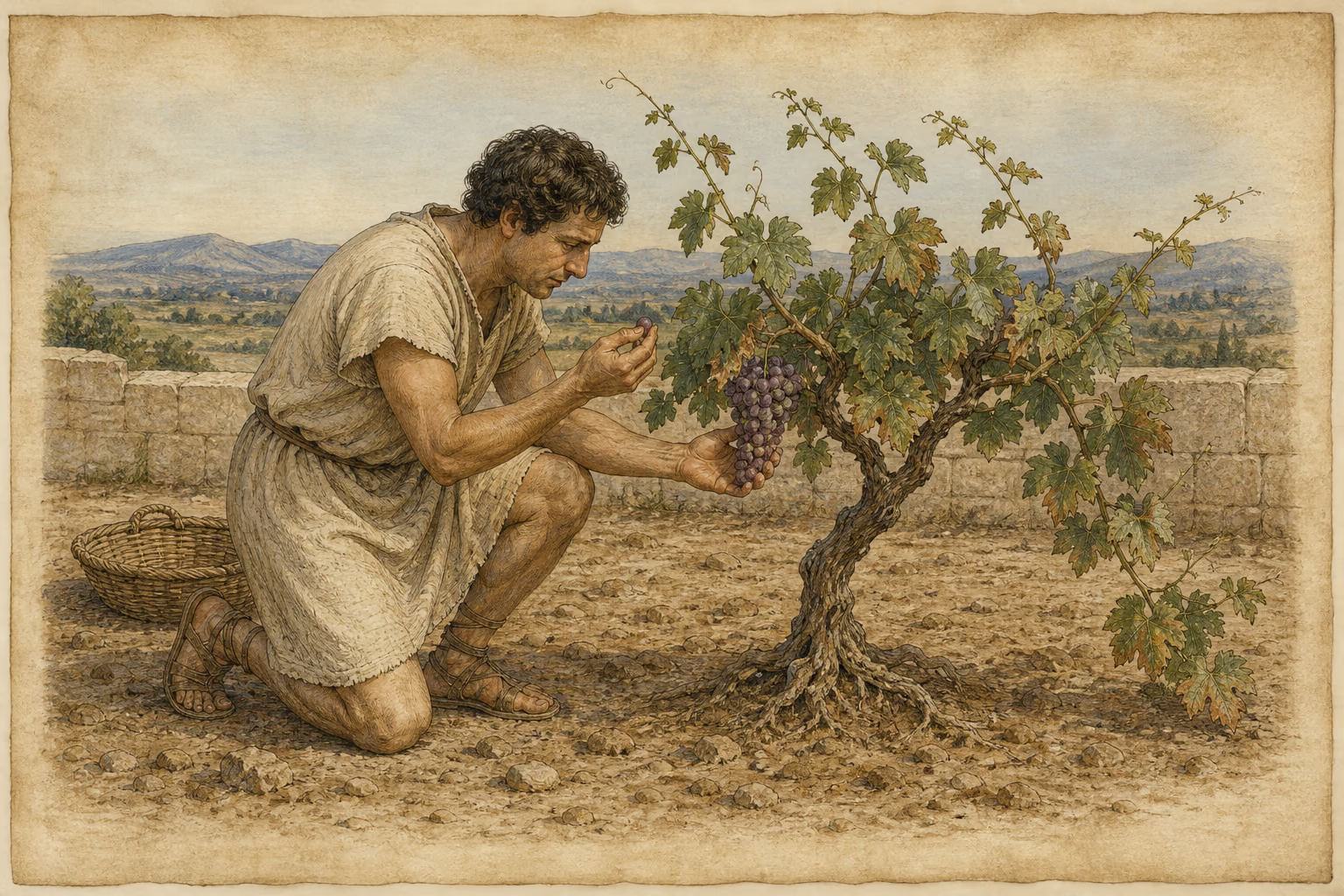
Vindemiam antiqui numquam existimavere maturam ante aequinoctium; iam passim rapi cerno. quamobrem et huius tempora notis argumentisque signentur. leges ita se habent: uvam caldam ne legito, hoc est nimia siccitate ac nisi imber intervenerit. uvam rorulentam ne legito, hoc est si ros nocturnus fuerit nec prius quam sole discutiatur. vindemiare incipito, cum ad palmitem pampinus procumbere coeperit aut cum exempto acino ex densitate intervallum non conpleri apparuerit ac iam non augeri acinos. plurimum refert, si contingat crescente luna vindemiare. pressura una culleos XX implere debet. hic est pes iustus. ad totidem culleos et lacus XX iugeribus unum sufficit torculum. premunt aliqui singulis, utilius binis, licet magna sit vastitas singulis. longitudo in his refert, non crassitudo. spatiosa melius premunt. antiqui funibus vittisque loreis ea detrahebant et vectibus. intra c annos inventa Graecanica, mali rugis per cocleam ambulantibus, ab aliis adfixa arboris stella, aliis areas lapidum adtollente secum arbore, quod maxime probatur. intra XXII hos annos inventum parvis prelis et minore torculario aedificio, breviore malo in media derecto, tympana inposita vinaceis superne toto pondere urguere et super prela construere congeriem. hoc et poma colligendi tempus, observato cum aliquod maturitate, non tempestate, deciderit; hoc et faeces exprimendi, hoc et defrutum coquendi silente luna noctu aut, si interdiu, plena, ceteris diebus aut ante exortum lunae aut post occasum, nec de novella vite aut palustri, nec nisi e matura uva. si ligno contingatur vas, adustum et fumosum fieri putant. iustum vindemiae tempus ab aequinoctio ad vergiliarum occasum dies XLIIII. ab eo die oraculum occurrit frigidum picari pro nihilo ducentium. sed iam et kal. Ian. defectu vasorum vindemiantes vidi piscinisque musta condi aut vina effundi priora, ut dubia reciperentur. hoc non tam saepe proventu nimio evenit quam segnitia aut avaritia insidiantium caritati. civilis, aequi patrisfamilias modus est annona cuiusque anni uti. id peraeque etiam lucrosissimum. reliqua de vinis adfatim dicta sunt, item vindemia facta olivam esse rapiendam et quae ad oleum pertinent quaeque a vergiliarum occasu agi debent.
English · Bostock & Riley 1855–57
In accordance with the ordinary divisions of the year, we now come to autumn, a period which extends from the setting of the Lyre to the autumnal equinox, and from that to the setting of the Vergiliæ and the beginning of winter. In these intervals, the more important periods are marked by the rising of the Horse to the people of Attica, in the evening of the day before the ides of August; upon which day also the Dolphin sets in Egypt, and, according to Cæsar, in Italy. On the eleventh before the calends of September, the star called the Vintager begins to rise in the morning, according to Cæsar’s reckoning, and to the people of Assyria: it announces the ripening of the vintage, a sure sign of which is the change of colour in the grape. On the fifth before the calends of September, the Arrow sets in Assyria, and the Etesian winds cease to blow: on the nones of September, the Vintager rises in Egypt, and in the morning of that day, Arcturus rises to the people of Attica: on the same morning, too, the Arrow sets. In the fifth before the ides of September, according to Cæsar, the She-Goat rises in the evening; and one half of Arcturus becomes visible on the day before the ides of September, being portentous of boisterous weather for five days, both by land and sea.
The theory relative to the effects produced by Arcturus, is stated in the following terms: if showers prevail, it is said, at the setting of the Dolphin, they will not cease so long as Arcturus is visible. The departure of the swallows may be looked upon as the sign of the rising of Arcturus; for if overtaken by it, they are sure to perish.
On the sixteenth day before the calends of October, the Ear of Corn, which Virgo holds, rises to the people of Egypt in the morning, and by this day the Etesian winds have quite ceased to blow. According to Cæsar, this constellation rises on the fourteenth before the calends, and it affords its prognostics to the Assyrians on the thirteenth. On the eleventh before the calends of October, the point of junction in Pisces disappears, and upon the eighth is the autumnal equinox. It is a remarkable fact, and rarely the case, that Philippus, Callippus, Dositheus, Parmeniscus, Conon, Criton, Democritus, and Eudoxus, all agree that the She-Goat rises in the morning of the fourth before the calends of October, and on the third the Kids. On the sixth day before the nones of October, the Crown rises in the morning to the people of Attica, and upon the morning of the fifth, the Charioteer sets. On the fourth before the nones of October, the Crown, according to Cæsar’s reckoning, begins to rise, and on the evening of the day after is the setting of the constellation of the Kids. On the eighth before the ides of October, according to Cæsar, the bright star rises that shines in the Crown, and on the evening of the sixth before the ides the Vergiliæ, rise. Upon the ides of October, the Crown has wholly risen. On the seventeenth before the calends of November, the Suculæ rise in the evening, and on the day before the calends, according to Cæsar’s reckoning, Arcturus sets, and the Suculæ rise with the sun. In the evening of the fourth day before the nones of November, Arcturus sets. On the fifth before the ides of November, Orion’s Sword begins to set; and on the third before the ides the Vergiliæ set.
In this interval of time, the rural operations consist in sowing rape and turnips, upon the days which have been mentioned on a previous occasion. The people in the country are of opinion, that it is not a good plan to sow rape after the departure of the stork; but for my own part, I am of opinion that it should be sown after the Vulcanalia, and the early kind at the same time as panic. After the setting of the Lyre, vetches should be sown, kidney-beans and hay-grass: it is generally recommended that this should be done while the moon is in conjunction. This, too, is the proper time for gathering in the leaves: it is fair work for one woodman, to fill four baskets in the day. If the leaves are gathered while the moon is on the wane, they will not decay; they ought not to be dry, however, when gathered.
The ancients were of opinion, that the vintage is never ripe before the equinox; but at the present day I find that it is gathered in before that period; it will be as well, therefore, to give the signs and indications by which the proper moment may be exactly ascertained. The rules for getting in the vintage are to the following effect: Never gather the grape in a heated state, or in other words, when the weather is dry, and before the rains have fallen; nor ought it to be gathered when covered with dew,—or in other words, when dews have fallen during the night,—nor yet before the dews have been dispelled by the sun. Commence the vintage when the bearing-shoots begin to recline upon the stem, or when, after a grape is removed from the bunch, the space left empty is not filled up; this being a sure proof that the berry has ceased to increase in size. It is of the greatest consequence to the grape, that it should be gathered while the moon is on the increase. Each pressing should fill twenty culei, that being the fair proportion. To fill twenty culei and vats from twenty jugera of vineyard, a single press will be enough. In pressing the grape, some persons use a single press-board, but it is a better plan to employ two, however large the single ones may be. It is the length of them that is of the greatest consequence, and not the thickness: if wide, however, they press the fruit all the better. The ancients used to screw down the press-boards with ropes and leather thongs, worked by levers. Within the last hundred years the Greek press has been invented, with thick spiral grooves running down the stem. To this stem there are spokes attached, which project like the rays of a star, and by means of which the stem is made to lift a box filled with stones—a method that is very highly approved of. It is only within the last two-and-twenty years, that a plan has been discovered of employing smaller press-boards, and a less unwieldy press: to effect this, the height has been reduced, and the stem of the screw placed in the middle, the whole pressure being concentrated upon broad planks placed over the grapes, which are covered also with heavy weights above.
This is the proper time for gathering fruit; the best moment for doing so is when it has begun to fall through ripeness, and not from the effects of the weather. This is the season, too, for extracting the lees of wine, and for boiling defrutum: this last must be done on a night when there is no moon, or if it is a full moon, in the day-time. At other times of the year, it must be done either before the moon has risen, or after it has set. The grapes employed for this purpose should never be gathered from a young vine, nor yet from a tree that is grown in a marshy spot, nor should any grapes be used but those that are perfectly ripe: the liquor, too, should never be skimmed with anything but a leaf, for if the vessel should happen to be touched with wood, the liquor, it is generally thought, will have a burnt and smoky flavour.
The proper time for the vintage is between the equinox and the setting of the Vergiliæ, a period of forty-four days. It is a saying among the growers, that to pitch wine-vessels after that day, in consequence of the coldness of the weather, is only so much time lost. Still, however, I have seen, before now persons getting in the vintage on the calends of January even, in consequence of the want of wine-vessels, and putting the must into receivers, or else pouring the old wine out of its vessels, to make room for new liquor of a very doubtful quality. This, however, happens not so often in consequence of an over-abundant crop, as through carelessness, or else the avarice which leads people to wait for a rise in prices. The method that is adopted by the most economical managers, is to use the produce supplied by each year, and this, too, is found in the end the most lucrative mode of proceeding. As for the other details relative to wines, they have been discussed at sufficient length already; and it has been stated on a previous occasion, that as soon as the vintage is got in, the olives should at once be gathered, with other particulars relative to the olive after the setting of the Vergiliæ.