LIBER XVIII · CAPUT 33
THE THEORY OF THE WINDS
Latine · Mayhoff 1906
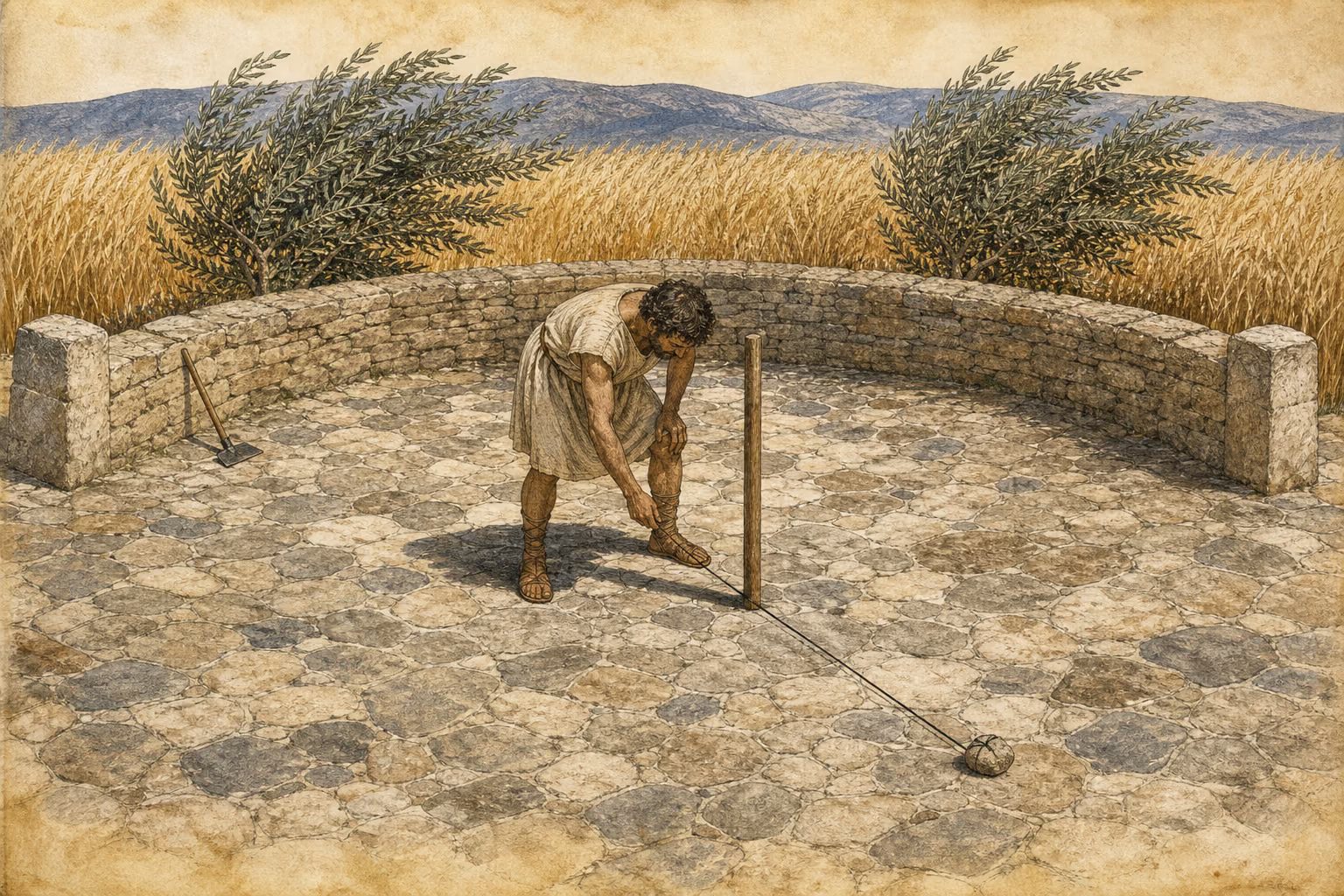
Observato solis ortu quocumque die libeat stantibus hora diei sexta sic, ut ortum eum a sinistro umero habeant, contra mediam faciem meridies et a vertice septentrio erit. qui ita limes per agrum curret, cardo appellabitur. circumagi deinde melius est, ut umbram suam quisque cernat; alioquin post hominem erit. ergo permutatis lateribus, ut ortus illius diei ab dextro umero fiat, occasus a sinistro, tune erit hora sexta, cum minima umbra contra medium fiet hominem. per huius mediam longitudinem duci sarculo sulcum vel cultro liniam verbi gratia pedum XX conveniat mediamque mensuram, hoc est in decimo pede, circumscribi circulo parvo, qui vocetur umbilicus. quae pars fuerit a vertice umbrae, haec erit venti septentrionis. illo tibi, putator, arborum plagae ne spectent, neve arbusta vineaeve nisi in Africa, Cyrenis, Aegypto. illinc flante ne arato,quaeque alia praecipiemus.quae pars liniae fuerit a pedibus umbrae meridiem spectans, haec ventum austrum dabit, quem a Graecis notum diximus vocari. illinc flatu veniente materiam vinumque, agricola, ne tractes. umidus aut aestuosus Italiae est, Africae quidem incendia cum serenitate adfert. in hunc Italiae palmites spectent, sed non plagae arborum vitiumve. hic oleae timeatur vergiliarum quadriduo, hunc caveat insitor calamis gemmisque inoculator. de ipsa regionis eius hora praemonuisse conveniat. frondem medio die, arborator, ne caedito. cum meridiem adesse senties, pastor, [aestate] contrahente se umbra, pecudes a sole in opaca cogito. cum aestate pasces, in occidentem spectent ante meridiem, post meridiem in orientem; aliter noxium, sicut hieme et vere in rorulentum educere: [nec contra septentrionem paveris supra dictum] cluduntur ita lippiuntque ab adflatu et alvo cita pereunt. qui feminas concipi voles, in hunc ventum spectantes iniri cogito.
English · Bostock & Riley 1855–57
The theory of the winds is of a somewhat more intricate nature. After observing the quarter in which the sun rises on any given day, at the sixth hour of the day take your position in such a manner as to have the point of the sun’s rising on your left; you will then have the south directly facing you, and the north at your back: a line drawn through a field in this direction is called the “cardinal” line. The observer must then turn round, so as to look upon his shadow, for it will be behind him. Having thus changed his position, so as to bring the point of the sun’s rising on that day to the right, and that of his setting to the left, it will be the sixth hour of the day, at the moment when the shadow straight before him is the shortest. Through the middle of this shadow, taken lengthwise, a furrow must be traced in the ground with a hoe, or else a line drawn with ashes, some twenty feet in length, say; in the middle of this line, or, in other words, at the tenth foot in it, a small circle must then be described: to this circle we may give the name of the “umbilicus,” or “navel.” That point in the line which lies on the side of the head of the shadow will be the point from which the north wind blows. You who are engaged in pruning trees, be it your care that the incisions made in the wood do not face this point; nor should the vine-trees or the vines have this aspect, except in the climates of Africa, Cyrenæ, or Egypt. When the wind blows, too, from this point, you must never plough, nor, in fact, attempt any other of the operations of which we shall have to make mention.
That part of the line which lies between the umbilicus and the feet of the shadow will look towards the south, and indicate the point from which the south wind blows, to which, as already mentioned, the Greeks have given the name of Notus. When the wind comes from this quarter, you, husbandman, must never fell wood or touch the vine. In Italy this wind is either humid or else of a burning heat, and in Africa it is accompanied with intense heat and fine clear weather. In Italy the bearing branches should be trained to face this quarter, but the incisions made in the trees or vines when pruned must never face it. Let those be on their guard against this wind upon the four days at the rising of the Vergiliæ, who are engaged in planting the olive, as well as those who are employed in the operations of grafting or inoculating.
It will be as well, too, here to give some advice, in reference to the climate of Italy, as to certain precautions to be observed at certain hours of the day. You, woodman, must never lop the branches in the middle of the day; and you, shepherd, when you see midday approaching in summer, and the shadow gradually decreasing, drive your flocks from out of the sun into some well-shaded spot. When you lead the flocks to pasture in summer, let them face the west before midday, and after that time, the east: if this precaution is not adopted, calamitous results will ensue; the same, too, if the flocks are led in winter or spring to pastures covered with dew. Nor must you let them feed with their faces to the north, as already mentioned; for the wind will either close their eyes or else make them bleared, and they will die of looseness. If you wish to have females, you should let the dams have their faces towards the north while being covered.