LIBER II · CAPUT 73
WHEN AND WHERE THERE ARE NO SHADOWS
Latine · Mayhoff 1906
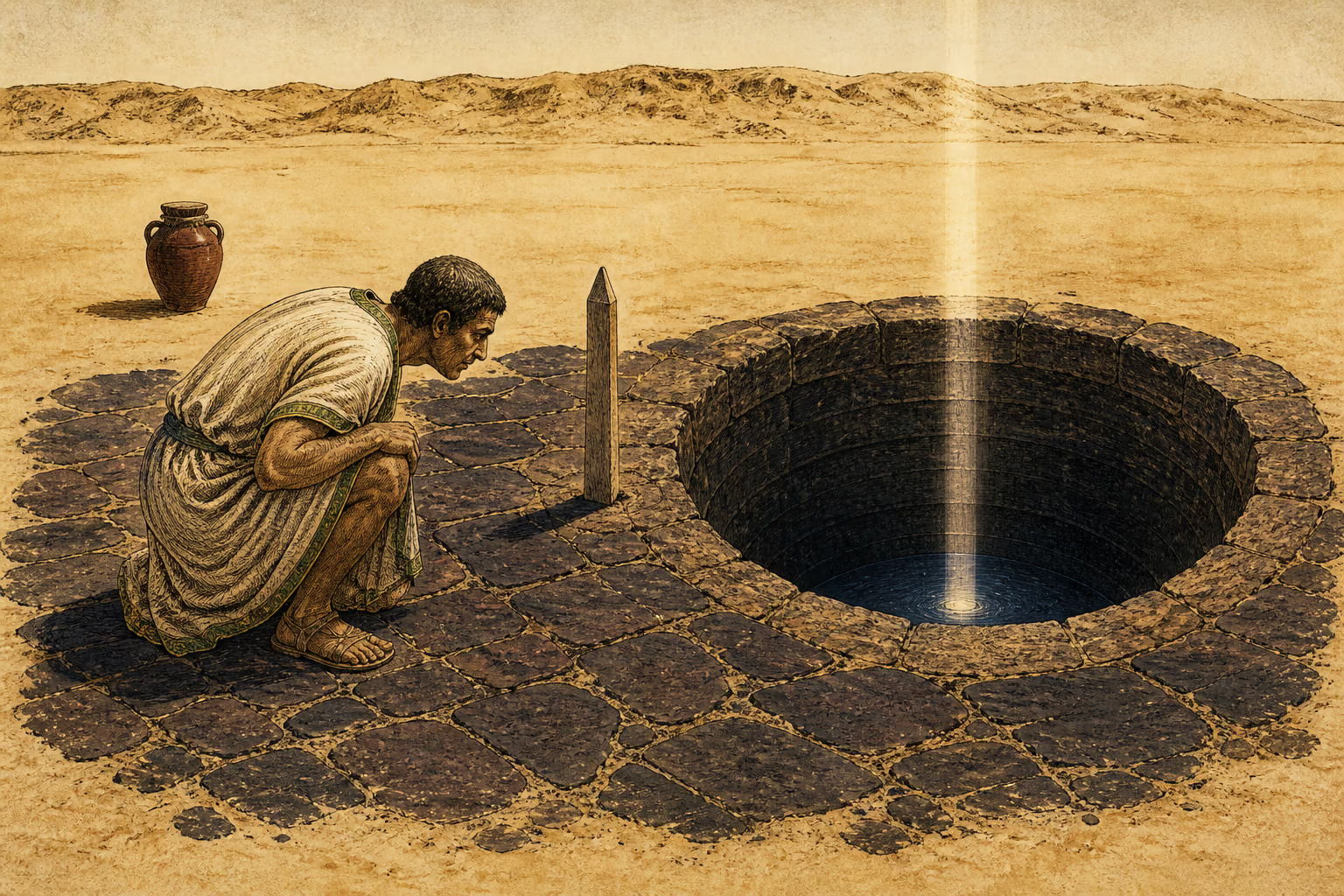
Simili modo tradunt in Syene oppido, quod est supra Alexandriam quinque milibus stadium, solstiti die medio nullam umbram iaci puteumque eius experimenti gratia factum totum inluminari. ex quo apparere tum solem illi loco supra verticem esse, quod et in India supra flumen Hypasim fieri tempore eodem Onesicritus scribit. constatque in Berenice urbe Trogodytarum, et inde stadiis IIII.DCCCXX in eadem gente Ptolemaide oppido, quod in margine Rubri maris ad primos elephantorum venatus conditum est, hoc idem ante solstitium quadragenis quinis diebus totidemque postea fieri, et per eos XC dies in meridiem umbras iaci. rursus in Merö— insula haec caputque gentis Aethiopum V milibus stadium a Syene in amne Nilo habitatur — bis anno absumi umbras, sole duodevicesimam tauri partem et quartam decimam leonis tunc obtinente. in Indiae gente Oretum mons est Maleus nomine, iuxta quem umbrae aestate in austrum, hieme in septentrionem iaciuntur. quindecim tantum noctibus ibi apparet septentrio. in eadem India Patalis, celeberrimo portu, sol dexter oritur, umbrae in meridiem cadunt. septentrionem ibi Alexandro morante adnotatum prima tantum parte noctis aspici. Onesicritus, dux eius, scripsit, quibus in locis Indiae umbrae non sint, septentrionem non conspici, et ea loca appellari ascia, nec horas dinumerari ibi.
English · Bostock & Riley 1855–57
It is likewise said, that in the town of Syene, which is 5000 stadia south of Alexandria, there is no shadow at noon, on the day of the solstice; and that a well, which was sunk for the purpose of the experiment, is illuminated by the sun in every part. Hence it appears that the sun, in this place, is vertical, and Onesicritus informs us that this is the case, about the same time, in India, at the river Hypasis. It is well known, that at Berenice, a city of the Troglodytæ, and 4820 stadia beyond that city, in the same country, at the town of Ptolemais, which was built on the Red Sea, when the elephant was first hunted, this same thing takes place for forty-five days before the solstice and for an equal length of time after it, and that during these ninety days the shadows are turned towards the south. Again, at Meroë, an island in the Nile and the metropolis of the Æthiopians, which is 5000 stadia from Syene, there are no shadows at two periods of the year, viz. when the sun is in the 18th degree of Taurus and in the 14th of Leo. The Oretes, a people of India, have a mountain named Maleus, near which the shadows in summer fall towards the south and in winter towards the north. The seven stars of the Great Bear are visible there for fifteen nights only. In India also, in the celebrated sea-port Patale, the sun rises to the right hand and the shadows fall towards the south. While Alexander was staying there it was observed, that the seven northern stars were seen only during the early part of the night. Onesicritus, one of his generals, informs us in his work, that in those places in India where there are no shadows, the seven stars are not visible; these places, he says, are called “Ascia,” and the people there do not reckon the time by hours.