LIBER XXIV · CAPUT 16
DIFFERENT OPINIONS ON THE DRACONTIUM
Latine · Mayhoff 1906
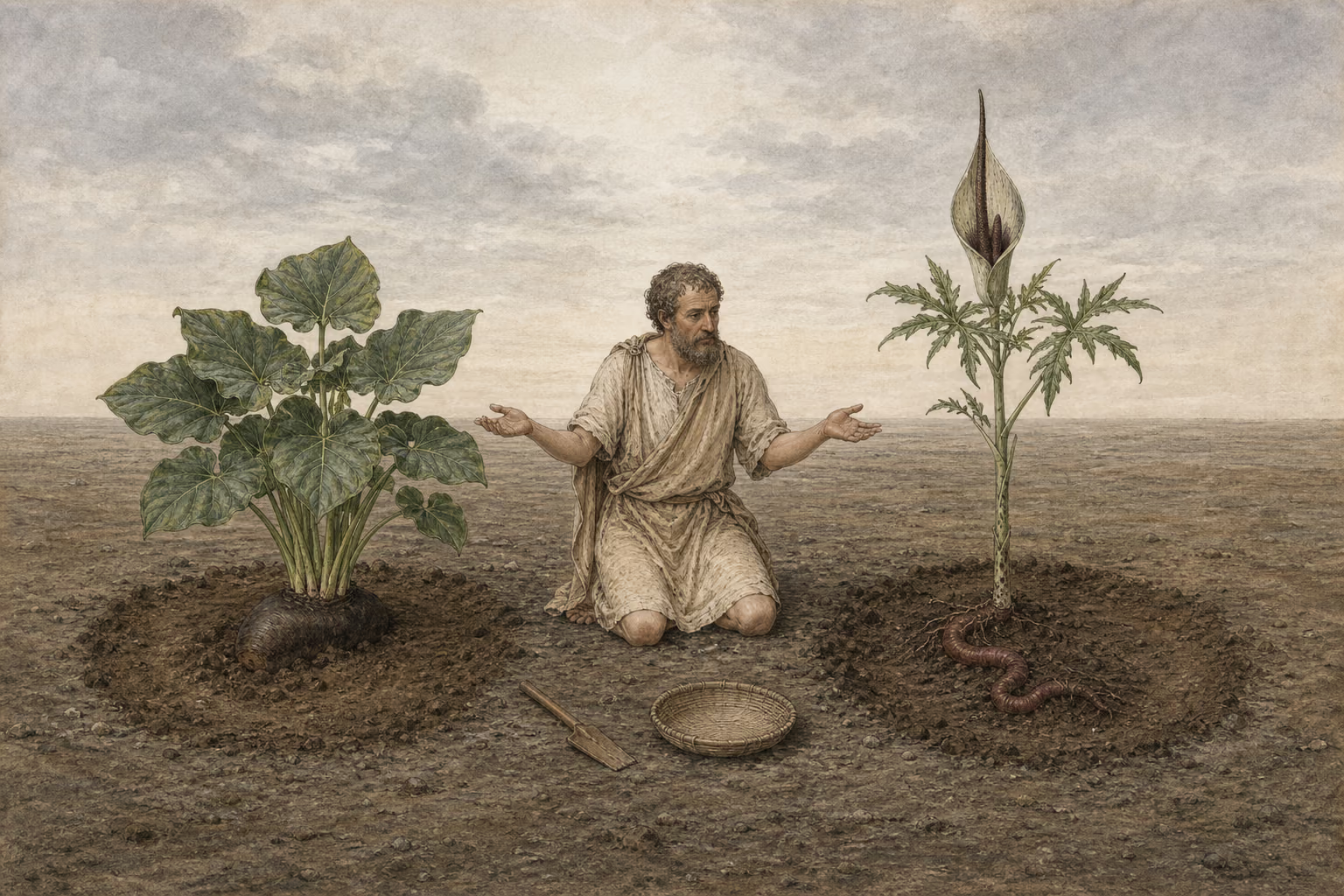
Aegyptus hanc maxime gignit, quae et aron, de qua inter bulbos diximus, magnae cum dracontio litis; quidam enim eandem esse dixere. Glaucias satu discrevit, dracontium silvestrem aron pronuntiando. aliqui radicem aron appellarunt, caulem vero dracontium, in totum alium, si modo hic est qui apud nos dracunculus vocatur. namque aros radicem nigram in latitudinem rotundam habet multoque maiorem et qua manus inpleatur, dracunculus subrutilam et draconis convoluti modo, unde et nomen. quin et ipsi Graeci inmensam posuere differentiam: semen dracunculi fervens mordaxque tradendo tantumque et virus, ut olfactum gravidis abortum inferret, aron miris laudibus tulere, primum in cibis feminam praeferentes, quoniam mas durior esset et in coquendo lentior; pectoris vitia purgare, aridum potioni inspersum aut ecligmate urinam et menses ciere, sic et in oxymelite potum. stomacho interaneisque exulceratis ex lacte ovillo bibendum, ad tussim in cinere coctum dedere ex oleo. alii coxere in lacte, ut decoctum biberetur. epiphoris elixum inposuere, item suggillatis, tonsillis.Glaucias ex oleo haemorrhoidum vitio infudit, lentigines ex melle inlinens. laudavit et pro antidoto contra venena, pleuriticis, peripneumonicis quo tussientibus modo. semen intritum cum oleo aut rosaceo infudit aurium dolori. Dieuches tussientibus aut suspiriosis et orthopnoicis et pura excreantibus farinae permixtum pane cocto dedit, Diodotus phthisicis e mnelle ecligmate et pulmonis vitiis, ossibus etiam fractis inposuit. partus omnium animalium extrahit naturae circumlitum. sucus radicis cum melle Attico oculorum caligines, stomachi vitia discutit, tussim decocti ius cum melle. ulcera omnium generum, sive phagedaenae sint sive carcinomata sive serpant sive polypi in naribus, sucus mire sanat. folia ambustis prosunt ex vino et oleo cocta. alvum inaniunt ex sale et aceto sumpta et luxatis cum melle cocta prosunt, item articulis podagricis cum sale recentia vel sicca. Hippocrates utralibet ad collectiones cum melle inposuit. ad menses trahendos seminis vel radicis drachmae II in vini cyathis II sufficiunt. eadem potio, si a part non purgentur, et secundas trahit. Hippocrates et radicem ipsam adposuit. dicunt et in pestilentia salutarem esse in cibis. ebrietatem discutit. serpentes nidore, cum crematur, privatim aspidas, fugat aut inebriat ita, ut torpentes inveniantur. perunctos quoque aro e laureo oleo fugiunt. ideo et contra ictus dari potui in vino nigro putant utile. in foliis ari caseus optime servari traditur.
Dracunculus, quem dixi, hordeo maturescente effoditur luna crescente. omnino habentem serpentes fugiunt. adeo percussis prodesse potum aiunt; maiorem vim esse, si ferro non attingatur. sucus eius et aurium dolori prodest. id autem, quod Graeci dracontion vocant, triplici effigie demonstratum mihi est: foliis betae, non sine thyrso, flore purpureo; hoc est simile aro. alii radice longa veluti signata articulosaque monstravere, ternis omnino cauliculis, foliis, decoqui ex aceto contra serpentium ictus iubentes. tertia demonstratio fuit folio maiore quam cornus, radicis harundineae, totidem, ut adfirmabant, geniculatae nodis, quot haberet annos, totidemque esse folia; hi ex vino vel aqua contra serpentes dabant.
Est et aris, quae in eadem Aegypto nascitur, similis aro, minor tantum minoribusque foliis et utique radice, quae tamen olivae grandis magnitudinem inpleat, alba geminum caulem, altera unum tantum emittens. medetur utraque ulceribus manantibus, item ambustis ac fistulis collyrio inmisso. nomas sistunt inlitu decoctarum in aqua et postea tritarum rosaceo addito. sed unum miraculum ingens, contacto genitali cuiusque feminini sexus animal in perniciem agi.
Myriophyllon, quod nostri milifolium vocant, caulis est teneri, similis feniculo, plurimis foliis, unde et nomen accepit. nascitur in palustribus, magnifici usus ad vulnera cum aceto. bibitur ad difficultates urinae et vesicae aut suspiria praecipitatisque ex alto. eadem efficacissima ad dentium dolores. Etruria hoc nomine appellat herbam in pratis tenuem, a lateribus capillamenti modo foliosam, eximii usus ad vulnera, boum nervos abscisos vomere solidari ea rursusque iungi addita axungia adfirmans.
Pseudobunion napi folia habet, fruticans palmi altitudine, laudatissima in Creta. contra tormina, stranguriam, laterum praecordiorumque dolores bibuntur rami eius quini senive.
Myrris, quam alii myrrizan, alii myrran vocant, simillima est cicutae caule foliisque et flore, minor tantum et exilior, cibo non insuavis. ciet menstrua et partus cum vino. aiunt eandem potam in pestilentia salutarem esse. subvenit et phthisicis in sorbitione data. aviditatem cibi facit, phalangiorum morsus restinguit. ulcera quoque in facie aut capite sucus eius in aqua triduo maceratae sanat.
Oenobreches folia lentis habet, longiora paulo, florem rubentem, radicem exiguam et gracilem. nascitur circa fontes. siccata in farinae modum et inspersa vino albo strangurias finit, alvum sistit. sucus eius perunctis cum oleo sudores movet.
English · Bostock & Riley 1855–57
It is Egypt more particularly that produces the clematis known as the “aron,” of which we have already made some mention when speaking of the bulbs. Respecting this plant and the dracontium, there have been considerable differences of opinion. Some writers, indeed, have maintained that they are identical, and Glaucias has made the only distinction between them in reference to the place of their growth, assuming that the dracontium is nothing else than the aron in a wild state. Some persons, again, have called the root “aron,” and the stem of the plant “dracontium:” but if the dracontium is the same as the one known to us as the “dracunculus,” it is a different plant altogether; for while the aron has a broad, black, rounded root, and considerably larger,—large enough, indeed, to fill the hand,—the dracunculus has a reddish root of a serpentine form, to which, in fact, it owes its name.
The Greeks themselves, in fact, have established an immense difference between these two plants, in attributing to the seed of the dracunculus certain hot, pungent properties, and a fetid odour so remarkably powerful as to be productive of abortion, while upon the aron, on the other hand, they have bestowed marvellous encomiums. As an article of food, however, they give the preference to the female plant, the male plant being of a harder nature, and more difficult to cook. It carries off, they say, all vicious humours from the chest, and powdered and taken in the form either of a potion or of an electuary, it acts as a diuretic and emmenagogue. Powdered and taken in oxymel, it is good for the stomach; and we find it stated that it is administered in ewe’s milk for ulcerations of the intestines, and is sometimes cooked on hot ashes and given in oil for a cough. Some persons, again, are in the habit of boiling it in milk and administering the decoction; and it has been used also in a boiled state as a topical application for defluxions of the eyes, contusions, and affections of the tonsillary glands. * * * * prescribes it with oil, as an injection for piles, and recommends it as a liniment, with honey, for freckles.
Cleophantus has greatly extolled this plant as an antidote for poisons, and for the treatment of pleurisy and peripneumony, prepared the same way as for coughs. The seed too, pounded with olive oil or oil of roses, is used as an injection for pains in the ears. Dieuches prescribes it, mixed in bread with meal, for the cure of coughs, asthma, hardness of breathing, and purulent expectorations. Diodotus recommends it, in combination with honey, as an electuary for phthisis and diseases of the lungs, and as a topical application even for fractured bones. Applied to the sexual parts, it facilitates delivery in all kinds of animals; and the juice extracted from the root, in combination with Attic honey, disperses films upon the eyes, and diseases of the stomach. A decoction of it with honey is curative of cough; and the juice is a marvellous remedy for ulcers of every description, whether phagedænic, carcinomatous, or serpiginous, and for polypus of the nostrils. The leaves, boiled in wine and oil, are good for burns, and, taken with salt and vinegar, are strongly purgative; boiled with honey, they are useful also for sprains, and used either fresh or dried, with salt, for gout in the joints.
Hippocrates has prescribed the leaves, either fresh or dried, with honey, as a topical application for abscesses. Two drachmæ of the seed or root, in two cyathi of wine, are a sufficient dose to act as an emmenagogue, and a similar quantity will have the effect of bringing away the after-birth, in cases where it is retarded. Hippocrates used to apply the root also, for the purpose. They say too, that in times of pestilence the employment of aron as an article of food is very beneficial. It dispels the fumes of wine; and the smoke of it burnt drives away serpents, the asp in particular, or else stupefies them to such a degree as to reduce them to a state of torpor. These reptiles also will fly at the approach of persons whose bodies have been rubbed with a preparation of aron with oil of laurel: hence it is generally thought a good plan to administer it in red wine to persons who have been stung by serpents. Cheese, it is said, keeps remarkably well, wrapped in leaves of this plant.
The plant which I have spoken of as the dracunculus, is taken out of the ground just when the barley is ripening, and at the moon’s increase. It is quite sufficient to have this plant about one, to be safe from all serpents; and it is said, that an infusion of the larger kind taken in drink, is very useful for persons who have been stung by those reptiles: it is stated also that it arrests the catamenia when in excess, due care being taken not to let iron touch it. The juice of it too is very useful for pains in the ears.
As to the plant known to the Greeks by the name of “dracontion,” I have had it pointed out to me under three different forms; the first having the leaves of the beet, with a certain proportion of stem, and a purple flower, and bearing a strong resemblance to the aron. Other persons, again, have described it as a plant with a long root, embossed to all appearance and full of knots, and consisting of three stems in all; the same parties have recommended a decoction of the leaves in vinegar, as curative of stings inflicted by serpents. The third plant that has been pointed out to me has a leaf larger than that of the cornel, and a root resembling that of the reed. This root, I have been assured, has as many knots on it as the plant is years old, the leaves, too, being as many in number. The plant is recommended also for the stings of serpents, administered either in wine or in water.
There is a plant also called the “arisaros,” which grows in Egypt, and is similar to the aron in appearance, only that it is more diminutive, and has smaller leaves; the root too is smaller, though fully as large as a good-sized olive. The white arisaros throws out two stems, the other kind only one. They are curative, both of them, of running ulcers and burns, and are used as an injection for fistulas. The leaves, boiled in water, and then beaten up with the addition of oil of roses, arrest the growth of corrosive ulcers. But there is one very marvellous fact connected with this plant—it is quite sufficient to touch the sexual parts of any female animal with it to cause its instantaneous death.
The myriophyllon, by our people known as the “millefolium” has a tender stem, somewhat similar to fennel-giant in appearance, with vast numbers of leaves, to which circumstance it is indebted for its name. It grows in marshy localities, and is remarkably useful for the treatment of wounds. It is taken in vinegar for strangury, affections of the bladder, asthma, and falls with violence; it is extremely efficacious also for tooth-ache.
In Etruria, the same name is given to a small meadow-plant, provided with leaves at the sides, like hairs, and particularly useful for wounds. The people of that country say that, applied with axle-grease, it will knit together and unite the tendons of oxen, when they have been accidentally severed by the plough-share.
The pseudobunion has the leaves of the turnip, and grows in a shrub-like form, about a palm in height; the most esteemed being that of Crete. For gripings of the bowels, strangury, and pains of the thoracic organs, some five or six sprigs of it are administered in drink.
The myrrhis, otherwise known as the myriza or myrrha, bears a strong resemblance to hemlock in the stem, leaves, and blossom, only that it is smaller and more slender: it is by no means unpleasant to the palate. Taken with wine, it acts as an emmenagogue, and facilitates parturition: they say too that in times of pestilence it is very wholesome, taken in drink. It is very useful also for phthisis, administered in broth. It sharpens the appetite, and neutralizes the venom of the phalangium. The juice of this plant, after it has been macerated some three days in water, is curative of ulcers of the face and head.
The onobrychis has leaves like those of the lentil, only somewhat longer; the blossom is red, and the root small and slender. It is found growing in the vicinity of springs. Dried and reduced to powder, and sprinkled in white wine, it is curative of strangury, and arrests looseness of the bowels. The juice of it, used as a friction with oil, acts as a sudorific.