LIBER XXVI · CAPUT 10
APHRODISIACS AND ANTAPHRODISIACS
Latine · Mayhoff 1906
Venerem in totum adimit, ut diximus, nymphaea Heraclia, eadem semel pota in XL dies, insomnia quoque veneris a ieiuno pota et in cibo sumpta. inlita quoque radix genitalibus inhibet non solum venerem, sed et affluentiam geniturae; ob id corpus alere vocemque dicitur. adpetentiam veneris facit radix e xiphio superior data potui in vino, item quam cremnon agrion appellant, orminos agrios cum polenta contritus.
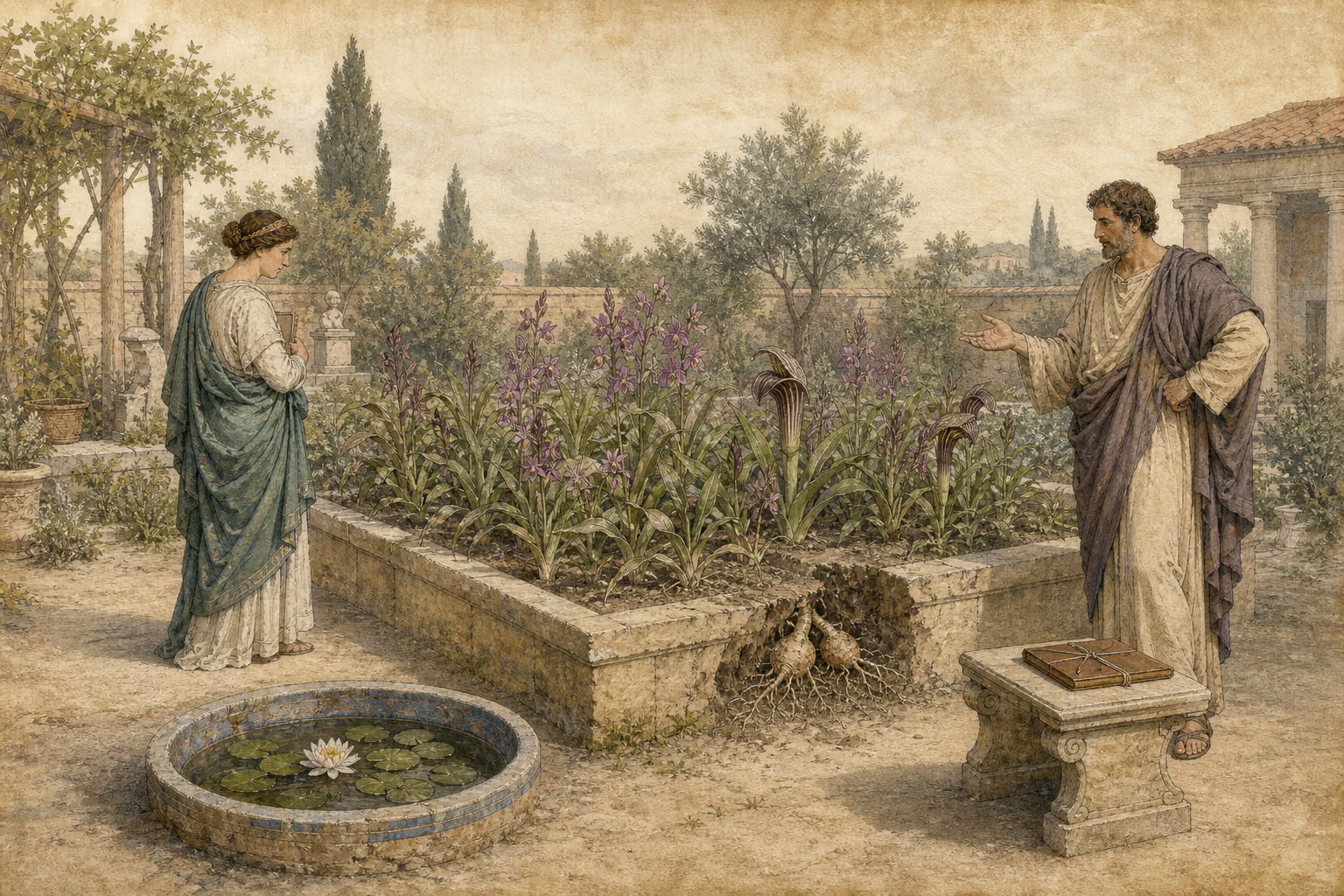
Sed inter pauca mirabilis est orchis herba sive serapias, foliis porri, caule palmeo, flore purpureo, gemina radice testiculis simili, ita ut maior sive, ut aliqui dicunt, tenuior ex aqua pota excitet libidinem, minor sive mollior e lacte caprino inhibeat. quidam folio scillae esse dicunt leviore ac minore, caule spinoso. radices sanant oris ulcera, thoracis pituitas, alvum sistunt e vino potae.
Concitatricem vim habetet satyrion. duo eius genera: longioribus foliis quam oleae, caule IIII digitorum, flore purpureo, radice gemina ad formam hominis testium, alternis annis intumescente ac residente. altera satyrios orchis cognominatur et femina esse credita est. distinguitur internodiis et ramosiore frutice, radice fascini. nascitur fere iuxta mare. haec tumores et vitia partium earum cum polenta inlita sedat vel per se trita. superioris radix in lacte ovis colonicae data nervos intendit, eadem ex aqua remittit. Graeci satyrion foliis lilii rubris, minoribus et III non amplius e terra exeuntibus tradunt, caule levi, cubitali, nudo, radice gemina, cuius inferior pars et maior mares gignat, superior ac minor feminas. et aliud genus satyrii erythraicon appellant, semine viticis maiore, levi, duro, radicis cortice rufo; intus album includi sapore subdulce, fere in montuosis inveniri. venerem, etiam si omnino manu teneatur radix, stimulari, adeo si bibatur in vino austero; arietibus quoque et hircis segnioribus in potu dari, et a Sarmatia equis ob adsiduum laborem pigrioribus in coitu, quod vitium prosedamum vocant. restinguit vim eius aqua mulsa aut lactuca sumpta. in totum quidem Graeci, cum concitationem hanc volunt significare, satyrion appellant, sic et crataegin cognominantes et thelygonon et arrhenogonon, quarum semen testibus simile est. tithymalli quoque ramorum medullam habentes ad venerem proniores fieri dicuntur. prodigiosa sunt quae circa hoc tradit Theophrastus, auctor alioqui gravis, septuageno coitu durasse libidinem contactu herbae, cuius nomen genusque non posuit. — Sideritis adalligata varices minuit et sine dolore praestat.
Podagrae morbus rarior solebat esse non modo patrum avorumque memoria, verum etiam nostra, peregrinus et ipse, nam si Italiae fuisset antiquitus, Latinum nomen invenisset. insanabilis non est credendus, quippe quoniam et in multis sponte desiit et in pluribus cura. medentur radices panacis cum uva passa, sucus hyoscyami cum farina vel semen, scordion ex aceto, Hiberis uti dictum est, verbenaca cum axungia trita, cyclamini radix, cuius decoctum et pernionibus. podagras refrigerat radix e xiphio, semen e psyllio, cicuta cum lithargyro aut axungia, aizoum in primo impetu podagrae rubentis, hoc est calidae. utrilibet vero convenit erigeron cum axungia, plantaginis folia trita addito sale modico, argemonia tusa ex melle. medetur et verbenaca inlita aut si pedes macerentur in aqua, in qua decocta sit, et lappago, similis anagallidi, nisi esset ramosior ac pluribus foliis, gravis odoris. quae talis est, mollugo vocatur; similis, sed asperioribus foliis asperugo. superioris et sucus pondere $X$ I in vini II cyathis cotidie sumitur. — Praecipue vero liberat eo malo phycos thalassion, id est fucus marinus, lactucae similis, qui conchyliis substernitur, non podagrae modo, sed omnibus articulorum morbis inpositus, priusquam arefiat. tria autem genera eius: latum et alterum longius, quadamtenus rubens, tertium crispis foliis, quo in Creta vestes tingunt, omnia eiusdem usus. Nicander ea et adversus serpentes in vino dedit. salutare est et semen eius herbae, quam psyllion appellavimus, madefactum aqua admixtis in heminam seminis resinae Colophoniae coclearibus II, turis uno. laudantur et mandragorae folia cum polenta tunsa.
English · Bostock & Riley 1855–57
Nymphæa heraclia, used as already stated, acts most powerfully as an antaphrodisiac; the same too if taken once every forty days in drink. Taken in drink fasting, or eaten with the food, it effectually prevents the recurrence of libidinous dreams. The root too, used in the form of a liniment and applied to the generative organs, not only represses all prurient desires, but arrests the seminal secretions as well; for which reason, it is said to have a tendency to make flesh and to improve the voice.
The upper part of the root of xiphion, taken in wine, acts as an aphrodisiac. The same is the case too with the wild crethmos, or agrios as it is called, and with horminum, beaten up with polenta.
But there are few plants of so marvellous a nature as the orchis or serapias, a vegetable production with leaves like those of the leek, a stem a palm in height, a purple flower, and a twofold root, formed of tuberosities which resemble the testes in appearance. The larger of these tuberosities, or, as some say, the harder of the two, taken in water, is provocative of lust; while the smaller, or, in other words, the softer one, taken in goat’s milk, acts as an antaphrodisiac. Some persons describe this plant as having a leaf like that of the squill, only smoother and softer, and a prickly stem. The roots heal liberations of the mouth, and are curative of pituitous discharges from the chest; taken in wine they act astringently upon the bowels.
Satyrion is also a powerful stimulant. There are two kinds of it: the first has leaves like those of the olive, but longer, a stem four fingers in length, a purple flower, and a double root, resembling the human testes in shape. This root swells and increases in volume one year, and resumes its original size the next. The other kind is known as the “satyrios orchis,” and is supposed to be the female plant. It is distinguished from the former one by the distance between its joints, and its more branchy and shrublike form. The root is employed in philtres: it is mostly found growing near the sea. Beaten up and applied with polenta, or by itself, it heals tumours and various other affections of the generative organs. The root of the first kind, administered in the milk of a colonic sheep, causes tentigo; taken in water it produces a contrary effect.
The Greeks give the name of “satyrion” to a plant with red leaves like those of the lily, but smaller, not more than three of them making their appearance above ground. The stem, they say, is smooth and bare and a cubit in length, and the root double; the lower part, which is also the larger, promoting the conception of male issue, the upper or smaller part, that of female.
They distinguish also another kind of satyrion, by the name of “erythraïcon:” it has seed like that of the vitex, only larger, smooth, and hard; the root, they say, is covered with a red rind, and is white within and of a sweetish taste: it is mostly found in mountainous districts. The root, we are told, if only held in the hand, acts as a powerful aphrodisiac, and even more so, if it is taken in rough, astringent wine. It is administered in drink, they say, to rams and he-goats when inactive and sluggish; and the people of Sarmatia are in the habit of giving it to their stallions when fatigued with covering, a defect to which they give the name of “prosedamum.” The effects of this plant are neutralized by the use of hydromel or lettuces.
The Greeks, however, give the general name of “satyrion” to all substances of a stimulating tendency, to the cratægis for example, the thelygonon, and the arrenogonon, plants, the seed of which bears a resemblance to the testes. Persons who carry the pith of branches of tithymalos about them, are rendered more amorous thereby, it is said. The statements are really incredible, which Theophrastus, in most cases an author of high authority, makes in relation to this subject; thus, for instance, he says that by the contact only of a certain plant, a man has been enabled, in the sexual congress, to repeat his embraces as many as seventy times even! The name and genus, however, of this plant, he has omitted to mention.
Sideritis, attached to the body as an amulet, reduces varicose veins, and effects a painless cure. Gout used to be an extremely rare disease, not in the times of our fathers and grandfathers only, but within my own memory even. Indeed, it may justly be considered a foreign complaint; for if it had been formerly known in Italy, it would surely have found a Latin name. It should, however, by no means be looked upon as an incurable malady; for before now, in many instances, it has quitted the patient all at once, and still more frequently, a cure has been effected by proper treatment.
For the cure of gout, roots of panaces are used, mixed with raisins; juice of henbane, or the seed, combined with meal; scordion, taken in vinegar; iberis, as already mentioned; vervain, beaten up with axle-grease; or root of cyclaminos, a decoction of which is good also for chilblains.
As cooling applications for gout, root of xiphion is used; seed of psyllion; hemlock, with litharge or axle-grease; and, at the first symptoms of red gout, or, in other words, hot gout, the plant aizoüm. For either kind of gout, erigeron, with axle-grease, is very useful; leaves of plantago, beaten up with a little salt; or argemonia, pounded with honey. An application of vervain is also remedial, and it is a good plan to soak the feet in a decoction of that plant in water.
Lappago is employed also for this disease; a plant similar to the anagallis, were it not that it is more branchy, bristling with a greater number of leaves, covered with rugosities, full of a more acrid juice, and possessed of a powerful smell. The kind that resembles anagallis most closely, is known as mollugo. Asperugo is a similar plant, only with a more prickly leaf. The juice of the first is taken daily, in doses of one denarius, in two cyathi of wine.
But it is the phycos thalassion, or sea-weed, more particularly, that is so excellent a remedy for the gout. It resembles the lettuce in appearance, and is used as the basis in dyeing tissues with the purple of the murex. Used before it becomes dry, it is efficacious as a topical application not only for gout, but for all diseases of the joints. There are three kinds of it; one with a broad leaf, another with a longer leaf of a reddish hue, and a third with a crisped leaf, and used in Crete for dyeing cloths. All these kinds have similar properties; and we find Nicander prescribing them in wine as an antidote to the venom of serpents even. The seed also of the plant which we have spoken of as “psyllion,” is useful for the cure of gout: it is first steeped in water, and one hemina of the seed is then mixed with two spoonfuls of resin of Colophon, and one spoonful of frankincense. Leaves of mandragora, too, are highly esteemed for this purpose, beaten up with polenta.