LIBER XXVI · CAPUT 3
THE NEW SYSTEM OF MEDICINE: ASCLEPIADES THE PHYSICIAN
Latine · Mayhoff 1906
Durabat tamen antiquitas firm magnasque confessae rei vindicabat reliquias, donec Asclepiades aetate Magni Pompei orandi magister nec satis in arte ea quaestuosus, ut ad alia quam forum sagacis ingenii, huc se repente convertit atque, ut necesse erat homini qui nec id egisset nec remedia nosset oculis usuque percipienda, torrenti ac meditata cotidie oratione blandiens omnia abdicavit totamque medicinam ad causas revocando coniecturae fecit, quinque res maxume communium auxiliorum professus, abstinentiam cibi, alias vini, fricationem corporis, ambulationem, gestationes, quae cum unusquisque semet ipsum sibi praestare posse intellegeret, faventibus cunctis, ut essent vera quae facillima erant, universum prope humanum genus circumegit in se non alio modo quam si caelo demissus advenisset.
Trahebat praeterea mentes artificio inani, alias vinum promittendo aegris dandoque tempestive, iam frigidam aquam et, quoniam causas morborum scrutari prius Herophilus instituerat, vini rationem inlustraverat Cleophantus apud priscos, ipse cognominari se frigida danda praeferens, ut auctor est M. Varro. alia quoque blandimenta excogitabat, iam suspendendo lectulos, quorum iactatu aut morbos extenuaret aut somnos adliceret, iam balneas avidissima homninum cupidine instituendo et alia multa dictu grata atque iucunda, magna auctoritate nec minore fama, cum occurrisset ignoto funeri, relato homine ab rogo atque servato, ne quis levibus momentis tantam conversionem factam existimet. id solum possumus indignari, unum hominem e levissima gente, sine opibus ullis orsum, vectigalis sui causa repente leges salutis humano generi dedisse, quas tamen postea abrogavere multi. Asclepiaden adiuvere multa in antiquorum cura nimis anxia et rudia, ut obruendi aegros veste sudoresque omni modo ciendi, nunc corpora ad ignes torrendi solesve adsiduo quaerendi in urbe nimbosa, immo vero tota Italia imbrici- trice, tum primum pensili balinearum usu ad infinitum blandiente. praeterea in quibusdam morbis mnedendi cruciatus detraxit, ut in anginis, quas curabant in fauces organo demisso. damnavit merito et vomitiones tune supra modum frequentes. arguit et medicamentorum potus stomacho inimicos, quod est magna ex parte verum. itaque nos in primis quae sunt stomacho utilia signamus.
English · Bostock & Riley 1855–57
Still, however, the ancient theories remained unshaken, based as they were upon the still existing grounds of universally acknowledged experience; until, in the time of Pompeius Magnus, Asclepiades, a professor of rhetoric, who considered himself not sufficiently repaid by that pursuit, and whose readiness and sagacity rendered him better adapted for any other than forensic practice, suddenly turned his attention to the medical art. Having never practised medicine, and being totally unacquainted with the nature of remedies—a knowledge only to be acquired by personal examination and actual experience—as a matter of course, he was obliged to renounce all previously-established theories, and to trust rather to his flowing periods and his well-studied discourses, for gaining an influence upon the minds of his audience.
Reducing the whole art of medicine to an estimation solely of primary causes, he made it nothing but a merely conjectural art, and established it as his creed, that there are five great principles of treatment for all diseases in common; diet, use or non-use of wine, frictions, exercise on foot, and exercise in a carriage or on horseback. As every one perceived that each of these methods of treatment lay quite within his own reach, all, of course, with the greatest readiness gave their assent, willing as they were to believe that to be true which was so easy of acquisition; and hence it was that he attracted nearly all the world about him, as though he had been sent among mankind on a special mission from heaven.
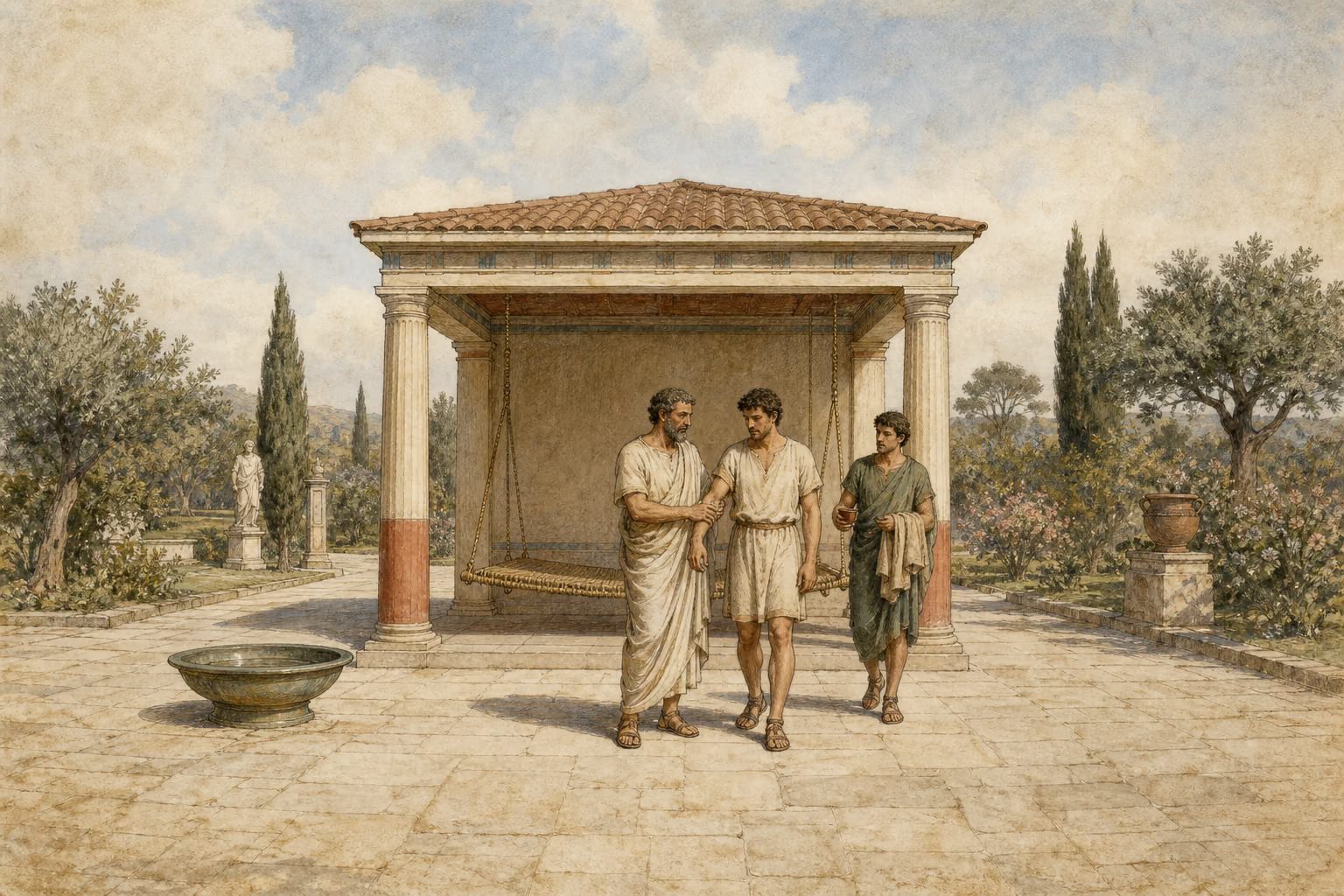
In addition to this, he had a wonderful tact in gaining the full confidence of his patients: sometimes he would make them a promise of wine, and then seize the opportune moment for administering it, while on other occasions, again, he would prescribe cold water: indeed, as Herophilus, among the ancients, had been the first to enquire into the primary causes of disease, and Cleophantus had brought into notice the treatment of diseases by wine, so did Asclepiades, as we learn from M. Varro, prefer to be indebted for his surname and repute to the extensive use made by him of cold water as a remedy. He employed also various other soothing remedies for his patients; thus, for instance, it was he that introduced swinging beds, the motion of which might either lull the malady, or induce sleep, as deemed desirable. It was he, too, that brought baths into such general use,—a method of treatment that was adopted with the greatest avidity—in addition to numerous other modes of treatment of a pleasant and soothing nature. By these means he acquired a great professional reputation, and a no less extended fame; which was very considerably enhanced by the following incident: meeting the funeral procession of a person unknown to him, he ordered the body to be removed from the funeral pile and carried home, and was thus the means of saving his life. This circumstance I am the more desirous to mention, that it may not be imagined that it was on slight grounds only that so extensive a revolution was effected in the medical art.
There is, however, one thing, and one thing only, at which we have any ground for indignation,—the fact, that a single individual, and he belonging to the most frivolous nation in the world, a man born in utter indigence, should all on a sudden, and that, too, for the sole purpose of increasing his income, give a new code of medical laws to mankind; laws, however, be it remembered, which have been annulled by numerous authorities since his day. The success of Asclepiades was considerably promoted by many of the usages of ancient medicine, repulsive in their nature, and attended with far too much anxiety: thus, for instance, it was the practice to cover up the patient with vast numbers of clothes, and to adopt every possible method of promoting the perspiration; to order the body to be roasted before a fire; or else to be continually sending the patient on a search for sunshine, a thing hardly to be found in a showery climate like that of this city of ours; or rather, so to say, of the whole of Italy, so prolific as it is of fogs and rain. It was to remedy these inconveniences, that he introduced the use of hanging baths, an invention that was found grateful to invalids in the very highest degree.
In addition to this, he modified the tortures which had hitherto attended the treatment of certain maladies; as in quinzy for instance, the cure of which before his time had been usually effected by the introduction of an instrument into the throat. He condemned, and with good reason, the indiscriminate use of emetics, which till then had been resorted to in a most extraordinary degree. He disapproved also of the practice of administering internally potions that are naturally injurious to the stomach, a thing that may truthfully be pronounced of the greater part of them. Indeed it will be as well to take an early opportunity of stating what are the medicaments which act beneficially upon the stomach.