LIBER XXVIII · CAPUT 12
REMEDIES FOR DISEASES OF THE FACE
Latine · Mayhoff 1906
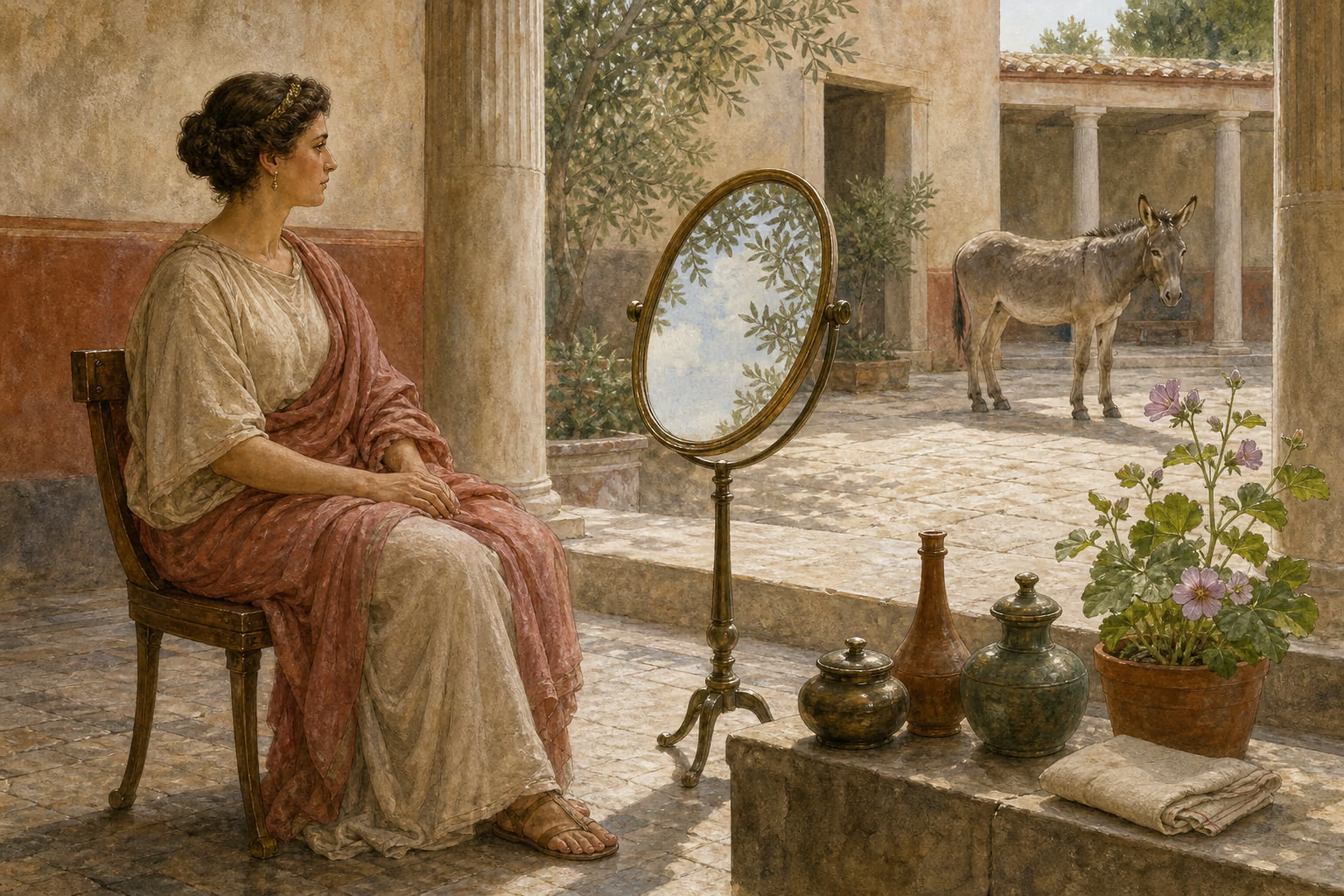
Cutem in facie erugari et tenerescere candore lacte asinino putant, notumque est quasdam cottidie septies genas custodito numero fovere. Poppaea hoc Neronis principis instituit, balnearum quoque solia sic temperans, ob hoc asinarum gregibus eam comitantibus. impetus pituitae in facie butyro inlito tolluntur, efficacius cum cerussa, sincero vero ea vitia, quae serpunt, superinposita farina hordeacia, ulcera in facie membrana e partu bovis madida. frivolum videatur, non tamen omittendum propter desideria mulierum, talum candidi iuvenci XL diebus noctibusque, done resolvatur in liquorem, decoctum et inlitum linteolo candorem cutisque erugationem praestare. fimo taurino malas rubescere aiunt, non ut crocodileam inlini melius sit; foveri frigida et ante et postea iubent. testas et quae decolorem faciunt cutem fimum vituli cum oleo et cummi manu subactum emendat; ulcera oris ac rimas sebum vituli vel bovis cum adipe anserino et ocimi suco. est et alia mixtura sebo vituli cum medulla cervi et albae spinae foliis una tritis. idem praestat et medulla cum resina vel, si vaccina sit, et ius e cane vaccina. lichenas oris praestantissime vincit glutinum factum e genitalibus vitulorum, liquatum aceto cum sulpure vivo, ramo ficulneo permixtum, ita ut bis die recens inlinatur, item lepras ex melle et aceto decoctum, quas et iocur hirci calidum inlitum tollit, sicut elephantiasin fel caprinum; etiamnum lepras ac furfures tauri fel addito nitro, urina asini circa canis ortum; maculas in facie fel utriusque per sese aqua infractum evitatisque solibus ac ventis post detractam cutem. similis effectus et in taurino vitulinove felle cum semine cunilae, cinere e cornu cervino, si canicula exoriente conburatur. asinino sebo cicatricibus, a lichene leprisque maxime, color redditur. hirci fel et lentigines tollit admixto caseo cum vivo sulpure spongeaque cinere, ut sit mellis crassitudo. aliqui inveterato felle maluere uti, mixtis calidis furfuribus pondere oboli unius IIIIque mellis, prius defricatis maculis. efficax eiusdem et sebum cum melanthio et sulpure et iride, labrorum fissuris cum anserino adipe ac medulla cervina resinaque et calce.—Invenio aput auctores iis, qui lentigines habeant, negari magices sacrificiorum usus.—
Lacte bubulo aut caprino tonsillae et arteriae exulceratae iuvantur. gargarizatur tepidum, ut est usus, expressum aut calefactum. caprinum utilius cum malva decoctum et sale exiguo. linguae exulcerationi et arteriarum prodest ius omasi gargarizatum, tonsillis autem privatim renes vulpium aridi cum melle triti inlitique, anginae fel taurinum vel caprinum cum melle, iocur melis ex aqua. oris gravitatem ulceraque butyrum emendat. spinam aliudve quid faucibus adhaerens felis extrinsecus fimo perfricatis aut reddi aut delabi tradunt. strumas discutit fel aprunum vel bubulum tepidum inlitum—nam coagulum leporis e vino in linteolo exulceratis dumtaxat inponitur—, discutit et ungulae asini vel equi cinis ex oleo vel aqua inlitus et urina calefacta et bovis ungulae cinis ex aqua, fimum quoque fervens ex aceto, item sebum caprinum cum calce aut fimum ex aceto decoctum, testes volpini. prodest et sapo, Galliarum hoc inventum rutilandis capillis. fit ex sebo et cinere, optimus fagino et caprino, duobus modis, spissus ac liquidus, uterque apud Germanos maiore in usu viris quam ferinis.
Cervicium dolores butyro aut adipe ursino perfricentur, rigores bubulo sebo, quod et strumis prodest cum oleo. dolorem inflexibilem—opisthotonum vocant —levat urina caprae auribus infusa aut fimum cum bulbis inlitum; ungues contusos fel cuiuscumque animalis circumligatum; pterygia digitorum fel tauri aridum aqua calida dissolutum. quidam adiciunt sulpur et alumen pari pondere omnium.
Tussim iocur lupi ex vino tepido sanat, ursinum fel admixto melle aut ex cornus bubuli summis partibus cinis vel saliva equi triduo pota—ecum mori tradunt— pulmo cervinus cum gula sua arefactus in fumo, dein tusus ex melle cottidiano ecligmate; efficacior ad id subulo cervorum generis. sanguinem expuentes cervini cornus cinis, coagulum leporis tertia parte denarii cum terra Samia et vino myrteo potum sanat; eiusdem fimi cinis in vino vesperi potus nocturnas tussis, pili quoque leporis suffiti extrahunt pulmonibus difficiles excreationes. purulentas autem exulcerationes pectoris pulmonisque et a pulmone graveolentiam halitus butyrum efficacissime iuvat cum pari modo mellis Attici decoctum, donec rufescat, et matutinis sumptum ad mensuram lingulae; quidam pro melle laricis resinam addere maluere. si sanguis reiciatur, efficacem tradunt bubulum sanguinem, modice et cum aceto sumptum. nam de taurino credere temerarium est; sed glutinum taurinum III obolis cum calida aqua bibitur in vetere sanguinis excreatione.
English · Bostock & Riley 1855–57
It is generally believed that asses’ milk effaces wrinkles in the face, renders the skin more delicate, and preserves its whiteness: and it is a well-known fact, that some women are in the habit of washing their face with it seven hundred times daily, strictly observing that number. Poppæa, the wife of the Emperor Nero, was the first to practise this; indeed, she had sitting-baths, prepared solely with asses’ milk, for which purpose whole troops of she-asses used to attend her on her journies. Purulent eruptions on the face are removed by an application of butter, but white lead, mixed with the butter, is an improvement. Pure butter, alone, is used for serpiginous eruptions of the face, a layer of barley-meal being powdered over it. The caul of a cow that has just calved, is applied, while still moist, to ulcers of the face.
The following recipe may seem frivolous, but still, to please the women, it must not be omitted; the pastern-bone of a white steer, they say, boiled forty days and forty nights, till it is quite dissolved, and then applied to the face in a linen cloth, will remove wrinkles and preserve the whiteness of the skin. An application of bull’s dung, they say, will impart a rosy tint to the cheeks, and not crocodilea even is better for the purpose; the face, however, must be washed with cold water, both before and after the application. Sun-burns and all other discolorations of the skin, are removed by the aid of calves’ dung kneaded up by hand with oil and gum; ulcerations and chaps of the mouth, by an application of veal or beef-suet, mixed with goose-grease and juice of ocimum. There is another composition, also, made of veal-suet with stag’s marrow and leaves of white-thorn, the whole beaten up together. Marrow, too, mixed with resin, even if it be cow marrow only, is equally good; and the broth of cow-beef is productive of similar effects. A most excellent remedy for lichens on the face is a glutinous substance prepared from the genitals of a male calf, melted with vinegar and live sulphur, and stirred together with the branch of a fig-tree: this composition is applied twice a day, and should be used quite fresh. This glue, similarly prepared from a decoction of honey and vinegar, is a cure for leprous spots, which are also removed by applying a he-goat’s liver warm.
Elephantiasis, too, is removed by an application of goats’ gall; and leprous spots and furfuraceous eruptions by employing bull’s gall with the addition of nitre, or else asses’ urine about the rising of the Dog-star. Spots on the face are removed by either bull’s gall or ass’s gall diluted in water by itself, care being taken to avoid the sun or wind after the skin has peeled off. A similar effect is produced, also, by using bull’s gall or calf’s gall, in combination with seed of cunila and the ashes of a deer’s horn, burnt at the rising of Canicula.
Asses’ fat, in particular, restores the natural colour to scars and spots on the skin caused by lichen or leprosy. A he-goat’s gall, mixed with cheese, live sulphur, and sponge reduced to ashes, effectually removes freckles, the composition being brought to the consistency of honey before being applied. Some persons, however, prefer using dried gall, and mix with it warm bran, in the proportion of one obolus to four oboli of honey, the spots being rubbed briskly first. He-goat suet, too, is highly efficacious, used in combination with gith, sulphur, and iris; this mixture being also employed, with goose-grease, stag’s marrow, resin, and lime, for the cure of cracked lips. I find it stated by certain authors, that persons who have freckles on the skin are looked upon as disqualified from taking any part in the sacrifices prescribed by the magic art.
Cow’s milk or goat’s milk is good for ulcerations of the tonsillary glands and of the trachea. It is used in the form of a gargle, warm from the udder or heated, goat’s milk being the best, boiled with mallows and a little salt. A broth made from tripe is an excellent gargle for ulcerations of the tongue and trachea; and for diseases of the tonsillary glands, the kidneys of a fox are considered a sovereign remedy, dried and beaten up with honey, and applied externally. For quinzy, bull’s gall or goat’s gall is used, mixed with honey. A badger’s liver, taken in water, is good for offensive breath, and butter has a healing effect upon ulcerations of the mouth. When a pointed or other substance has stuck in the throat, by rubbing it externally with cats’ dung, the substance, they say, will either come up again or pass downwards into the stomach.
Scrofulous sores are dispersed by applying the gall of a wild boar or of an ox, warmed for the purpose: but it is only when the sores are ulcerated that hare’s rennet is used, applied in a linen cloth with wine. The ashes of the burnt hoof of an ass or horse, applied with oil or water, is good for dispersing scrofulous sores; warmed urine also; the ashes of an ox’s hoof, taken in water; cow-dung, applied hot with vinegar; goat-suet with lime; goats’ dung, boiled in vinegar; or the testes of a fox. Soap, too, is very useful for this purpose, an invention of the Gauls for giving a reddish tint to the hair. This substance is prepared from tallow and ashes, the best ashes for the purpose being those of the beech and yoke-elm: there are two kinds of it, the hard soap and the liquid, both of them much used by the people of Germany, the men, in particular, more than the women.
For pains in the neck, the part should be well rubbed with butter or bears’ grease; and for a stiff neck, with beef suet, a substance which, in combination with oil, is very useful for the cure of scrofula. For the painful cramp, attended with inflexibility, to which people give the name of “opisthotony,” the urine of a she-goat, injected into the ears, is found very useful; as also a liniment made of the dung of that animal, mixed with bulbs.
In cases where the nails have been crushed, it is an excellent plan to attach to them the gall of any kind of animal. Whitlows upon the fingers should be treated with dried bull’s gall, dissolved in warm water. Some persons are in the habit of adding sulphur and alum, of each an equal weight.
A wolf’s liver, administered in mulled wine, is a cure for cough; a bear’s gall also, mixed with honey; the ashes of the tips of a cow’s horn; or else the saliva of a horse, taken in the drink for three consecutive days—in which last case the horse will be sure to die, they say. A deer’s lights are useful for the same purpose, dried with the gullet of the animal in the smoke, and then beaten up with honey, and taken daily as an electuary: the spitter deer, be it remarked, is the kind that is the most efficacious for the purpose.
Spitting of blood is cured by taking ashes of burnt deer’s horns, or else a hare’s rennet in drink, in doses of one-third of a denarius, with Samian earth and myrtle-wine. The dung of this last animal, reduced to ashes and taken in the evening, with wine, is good for coughs that are recurrent at night. The smoke, too, of a hare’s fur, inhaled, has the effect of bringing off from the lungs such humours as are difficult to be discharged by expectoration. Purulent ulcerations of the chest and lungs, and bad breath proceeding from a morbid state of the lungs, are successfully treated with butter boiled with an equal quantity of Attic honey till it assumes a reddish hue, a spoonful of the mixture being taken by the patient every morning: some persons, however, instead of honey prefer using larch-resin for the purpose. In cases where there are discharges of blood, cow’s blood, they say, is good, taken in small quantities with vinegar; but as to bull’s blood, it would be a rash thing to believe in any such recommendation. For inveterate spitting of blood, bull-glue is taken, in doses of three oboli, in warm water.