LIBER III · CAPUT 1
THE BOUNDARIES AND GULFS OF EUROPE FIRST SET FORTH IN A GENERAL WAY
Latine · Mayhoff 1906
Hactenus de situ et miraculis terrae aquarumque et siderum ac ratione universitatis atque mensura. nunc de partibus, quamquam infinitum id quoque existimatur nec temere sine aliqua reprehensione tractatum, haut ullo in genere venia iustiore, si modo minime mirum est hominem genitum non omnia humana novisse. quapropter auctorem neminem unum sequar, sed ut quemque verissimum in quaque parte arbitrabor, quoniam commune ferme omnibus fuit, ut eos quisque diligentissime situs diceret, in quibus ipse prodebat. ideo nec culpabo aut coarguam quemquam. locorum nuda nomina et quanta dabitur brevitate ponentur, claritate causisque dilatis in suas partes; nunc enim sermo de toto est. quare sic accipi velim, ut si vidua fama sua nomina, qualia fuere primordio ante ullas res gestas, nuncupentur et sit quaedam in his nomenclatura quidem, sed mundi rerumque naturae.
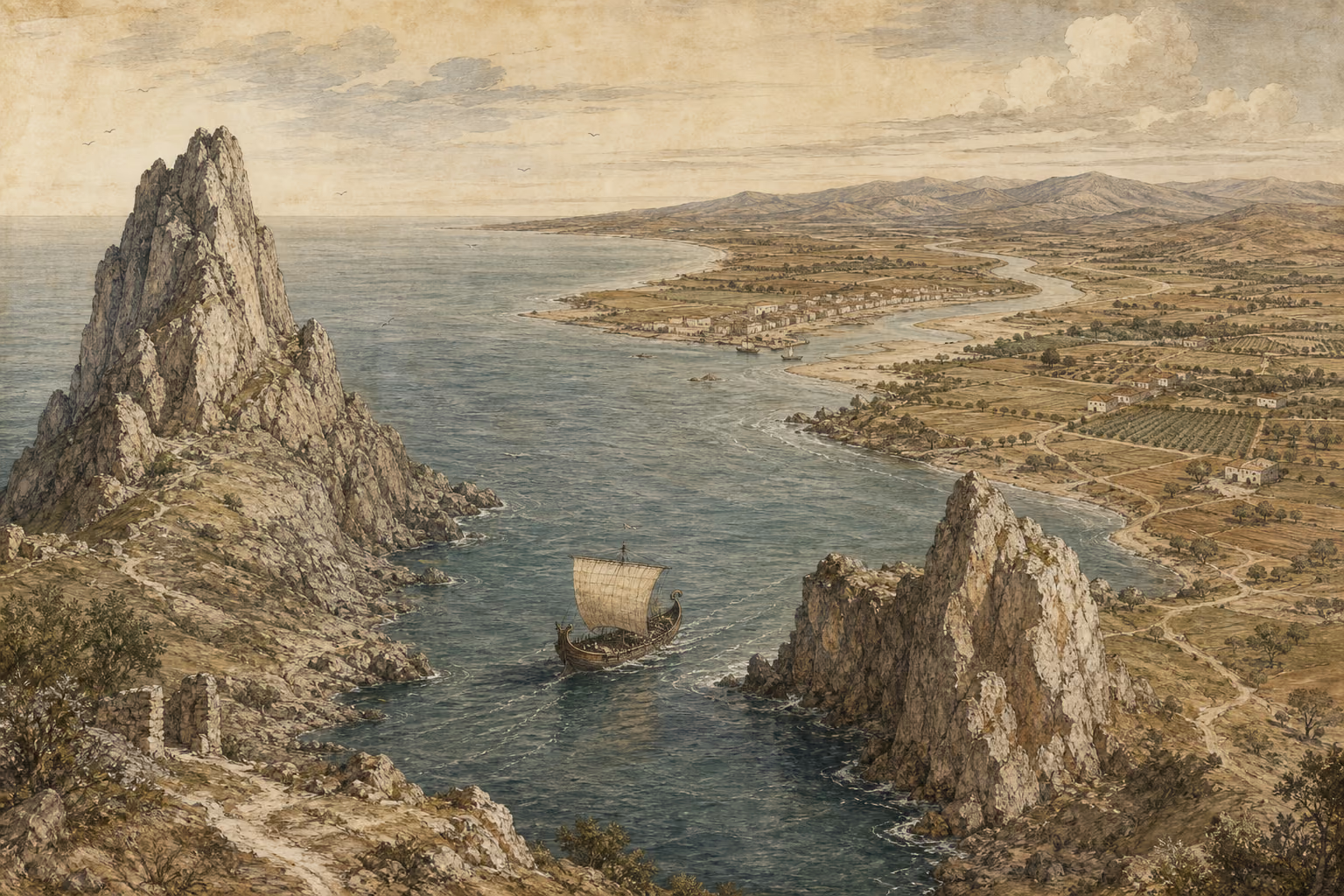
Terrarum orbis universus in tres dividitur partes, Europam, Asiam, Africam. origo ab occasu solis et Gaditano freto, qua inrumpens oceanus Atlanticus in maria interiora diffunditur. hinc intranti dextera Africa est, laeva Europa, inter has Asia. termini amnes Tanais et Nilus. XV p. in longitudinem quas diximus fauces oceani patent, V??? in latitudinem, a vico Mellaria Hispaniae ad promunturium Africae Album, auctore Turranio Gracile iuxta genito. T. Livius ac Nepos Cornelius latitudinis tradiderunt minusVII p., ubi vero plurumum, X: tam modico ore tam inmensa aequorum vastitas panditur. nec profunda altitudo miraculum minuit. frequentes quippe taeniae candicantis vadi carinas territant. qua de causa limen interni maris multi eum locum appellavere. proximis autem faucibus utrimque inpositi montes coercent claustra, Abila Africae, Europae Calpe, laborum Herculis metae, quam ob causam indigenae columnas eius dei vocant creduntque perfossas exclusa antea admisisse maria et rerum naturae mutasse faciem.
Primum ergo de Europa, altrice victoris omnium gentium populi longeque terrarum pulcherrima, quam plerique merito non tertiam portionem fecere, verum aequam, in duas partes ab amne Tanai ad Gaditanum fretum universo orbe diviso. oceanus a quo dictum est spatio Atlanticum mare infundens et avido meatu terras, quaecunque venientem expavere, demergens resistentes quoque flexuoso litorum anfractu lambit, Europam vel maxime recessibus crebris excavans, sed in quattuor prae- cipuos sinus, quorum primus a Calpe Hispaniae extimo, ut dictum est, monte Locros, Bruttium usque promunturium, inmenso ambitu flectitur.
In eo prima Hispania terrarum est, ulterior appellata, eadem Baetica, mox a fine Murgitano citerior eademque Tarraconensis ad Pyrenaei iuga. ulterior in duas per longitudinem provincias dividitur, si quidem Baeticae latere septentrionali praetenditur Lusitania, amne Ana discreta. ortus hic in Laminitano agro citerioris Hispaniae et modo in stagna se fundens, modo in angustias resorbens aut in totum cuniculis condens et saepius nasci gaudens in Atlanticum oceanum effunditur. Tarraconensis autem, adfixa Pyrenaeo totoque eius a latere decurrens et simul ad Gallicum oceanum Hiberico a mari transversa se pandens, Solorio monte et Oretanis iugis Carpetanisque et Asturum a Baetica atque Lusitania distinguitur.
Baetica, a flumine mediam secante cognominata, cunctas provinciarum diviti cultu et quodam fertili ac peculiari nitore praecedit. iuridici conventus ei IIII, Gaditanus, Cordubensis, Astigitanus, Hispalensis. oppida omnia numero CLXXV, in iis coloniae VIIII, municipia c. R. X, Latio antiquitus donata XXVII, libertate VI, foedere III, stipendiaria CXX. ex his digna memoratu aut Latio sermone dictu facilia, a flumine Ana litore oceani oppidum Ossonoba, Aestu- aria cognominatum, inter confluentes Luxiam et Vrium, Hareni montes, Baetis fluvius, litus Curense inflexo sinu, cuius ex adverso Gadis inter insulas dicenda, promunturium lunonis, portus Baesippo, oppidum Baelo, Mellaria, fretum ex Atlantico mari, Carteia, Tartesos a Graecis dicta, mons Calpe. dein litore interno oppida Barbesula cum fluvio, item Salduba, oppidum Suel, Malaca cum fluvio foederatorum. dein Maenuba cum fluvio, Sexi cognomine Firmum Iulium, Sel, Abdara, Murgi, Baeticae finis. oram eam in universum originis Poenorum existimavit M. Agrippa; ab Ana autem Atlantico oceano obversa Bastulorum Tur- dulorumque est. in universam Hispaniam M. Varro pervenisse Hiberos et Persas et Phoenicas Celtasque et Poenos tradit. lusum enim Liberi patris aut lyssam cum eo bac- chantium nomen dedisse Lusitaniae et Pana praefectum eius universae. at quae de Hercule ac Pyrene vel Saturno traduntur fabulosa in primis arbitror.
Baetis, in Tarraconensis provinciae non, ut aliqui dixere, Mentesa oppido, sed Tugiensi exoriens saltu— iuxta quem Tader fluvius, qui Carthaginiensem agrum rigat —, Ilorci refugit Scipionis rogum versusque in occasum oceanum Atlanticum, provinciam adoptans, petit, modicus primo, sed multorum fluminum capax, quibus ipse famam aquasque aufert. Baeticae primum ab Ossigitania infusus, amoeno blandus alveo, crebris dextra laevaque accolitur oppidis.
Celeberrima inter hunc et oceani oram in mediterraneo Segida quae Augurina cognominatur, Vlia quae Fiden- tia, Vrgao quae Alba, Ebora quae Cerialis, Iliberri quod Florentini, Ilipula quae Laus, Artigi quod Iulienses, Vesci quod Faventia, Singili, Ategua, Arialdunum, Agla Minor, Baebro, Castra Vinaria, Cisimbrium, Hippo Nova, Ilurco, Osca, Oscua, Sucaelo, Vnditanum, Tucci Vetus, omnia Baste- taniae vergentis ad mare. conventus vero Cordubensis circa flumen ipsum Ossigi quod cognominatur Latonium, Iliturgi quod Forum Iulium, Ipra, Isturgi quod Triumphales, Vcia et XIIII p. remotum in mediterraneo Obulco quod Ponti- ficense appellatur, mox Ripa, Epora foederatorum, Sacili Martialium, Onuba et dextra Corduba colonia Patricia cognomine, inde primum navigabili Baete oppida Carbula, Detumo, fluvius Singilis, eodem Baetis latere incidens.
Oppida Hispalensis conventus Celti, Axati, Arua, Ca- nama, Naeva, Ilipa cognomine Ilpa, Italica et a laeva Hispal colonia cognomine Romulensis, ex adverso oppidum Osset quod cognominatur Iulia Constantia, Lucurgentum quod luli Genius, Orippo, Caura, Siarum, fluvius Maenuba, Baeti et ipse a dextro latere infusus. at inter aestuaria Baetis oppida Nabrissa cognomine Veneria et Colobana, coloniae Hasta quae Regia dicitur et in mediterraneo Asido quae Caesarina.
Singilis fluvius, in Baetim quo dictum est ordine inrumpens, Astigitanam coloniam adluit, cognomine Augustam Firmam, ab ea navigabilis. huius conventus sunt reliquae coloniae inmunes Tucci quae cognominatur Augusta Gemella, Ituci quae Virtus Iulia, Vcubi quae Claritas Iulia, Vrso quae Genetiva Vrbanorum, inter quae fuit Munda, cum Pompeio filio rapta; oppida libera Astigi vetus, Ostippo; stipendiaria Callet, Callicula, Castra Gemina, Ilipula Minor, Marruca, Sacrana, Obulcula, Oningi, Sabora, Ventippo. Maenubam 5 amnem, et ipsum navigabilem, haut procul accolunt Olontigi, Laelia, Lastigi.
Quae autem regio a Baete ad fluvium Anam tendit extra praedicta, Baeturia appellatur, in duas divisa partes totidemque gentes: Celticos, qui Lusitaniam attingunt, Hispalensis conventus, Turdulos, qui Lusitaniam et Tarraconensem accolunt, iura Cordubam petunt. Celticos a Celtiberis ex Lusitania advenisse manifestum est sacris, lingua, oppidorum vocabulis, quae cognominibus in Baetica distinguntur: Seriae adicitur Fama Iulia, Nertobrigae Concordia Iulia, Segidae Restituta lulia, Contributa Iulia Vgultuniae, cum qua et Curiga nunc est, Lacimurgae Constantia lulia, Stere- sibus Fortunales et Callensibus Aeneanici. praeter haec in Celtica Acinippo, Arunda, Arunci, Turobriga, Lastigi, Salpesa, Saepone, Serippo. altera Baeturia, quam diximus Turdulorum et conventus Cordubensis, habet oppida non ignobilia Arsam, Mellariam, Mirobrigam Reginam, Sosintigi, Sisaponem. Gaditani conventus civium Romanorum Regina, Latinorum Laepia Regia, Carisa cognomine Aurelia, Vrgia cognominata Castrum Iulium, item Caesaris Salutariensis; stipendiaria Besaro, Belippo, Barbesula, Blacippo, Baesippo, Callet, Cappa cum Oleastro, Iptuci, Ibrona, Lascuta, Saguntia, Saudo, Vsaepo.
Longitudinem universam eius prodidit M. Agrippa CCCCLXXV p., latitudinem CCLVIII, sed cum termini Carthaginem usque procederent: quae causa magnos errores conputatione mensurae saepius parit, alibi mutato provinciarum modo, alibi itinerum, auctisque aut deminutis passibus. incubuere maria tam longo aevo, alibi processere litora, torsere se fluminum aut correxere flexus. praeterea aliunde aliis exordium mensurae est et alia meatus. ita fit ut nulli duo concinant.
English · Bostock & Riley 1855–57
I shall first then speak of Europe, the foster-mother of that people which has conquered all other nations, and itself by far the most beauteous portion of the earth. Indeed, many persons have, not without reason, considered it, not as a third part only of the earth, but as equal to all the rest, looking upon the whole of our globe as divided into two parts only, by a line drawn from the river Tanais to the Straits of Gades. The ocean, after pouring the waters of the Atlantic through the inlet which I have here described, and, in its eager progress, overwhelming all the lands which have had to dread its approach, skirts with its winding course the shores of those parts which offer a more effectual resistance, hollowing out the coast of Europe especially into numerous bays, among which there are four Gulfs that are more particularly remarkable. The first of these begins at Calpe, which I have previously mentioned, the most distant mountain of Spain; and bends, describing an immense curve, as far as Locri and the Promontory of Bruttium.
The first land situate upon this Gulf is that which is called the Farther Spain or Bætica; next to which, beginning at the frontier town of Urgi, is the Nearer, or Tarraconensian Spain, extending as far as the chain of the Pyrenees. The Farther Spain is divided lengthwise into two provinces, Lusitania and Bætica, the former stretching along the northern side of the latter, and being divided from it by the river Ana.
The source of this river is in the district of Laminium, in the Nearer Spain. It first spreads out into a number of small lakes, and then again contracts itself into a narrow channel, or entirely disappears under ground, and after frequently disappearing and again coming to light, finally discharges itself into the Atlantic Ocean. Tarraconensian Spain lies on one side, contiguous to the Pyrenees, running downwards along the sides of that chain, and, stretching across from the Iberian Sea to the Gallic ocean, is separated from Bætica and Lusitania by Mount Solorius, the chains of the Oretani and the Carpetani, and that of the Astures.
Bætica, so called from the river which divides it in the middle, excels all the other provinces in the richness of its cultivation and the peculiar fertility and beauty of its vegetation.
It consists of four jurisdictions, those of Gades, of Corduba, of Astigi, and of Hispalis. The total number of its towns is 175; of these nine are colonies, and eight municipal towns; twenty-nine have been long since presented with the old Latin rights; six are free towns, three federate, and 120 tributary.
In this district, the things that more especially deserve notice, or are more easily explained in the Latin tongue, are the following, beginning at the river Ana, along the line of the sea-shore; the town of Onoba, surnamed Æstuaria; the rivers Luxia and Urium, flowing through this territory between the Ana and the Bætis; the Marian Mountains; the river Bætis; the coast of Corum, with its winding bay; opposite to which is Gades, of which we shall have occasion to speak among the islands. Next comes the Promontory of Juno, and the port of Bæsippo; the towns of Bœlo and Mellaria, at which latter begin the Straits of the Atlantic; Carteia, called by the Greeks Tartessos; and the mountain of Calpe.
Along the coast of the inland sea is the town of Barbesula with its river; also Salduba; the town of Suel; and then Malaca, with its river, one of the federate towns. Next to this comes Mænoba, with its river; then Sexifirmum, surnamed Julium; Selambina; Abdera; and Murci, which is at the boundary of Bætica. M. Agrippa supposed that all this coast was peopled by colonists of Punic origin. Beyond the Anas, and facing the Atlantic, is the country of the Bastuli and the Turditani. M. Varro informs us, that the Iberians, the Persians, the Phœnicians, the Celts, and the Carthaginians spread themselves over the whole of Spain; that the name “Lusitania” is derived from the games ( lusus ) of Father Bacchus, or the fury ( lyssa ) of his frantic attendants, and that Pan was the governor of the whole of it. But the traditions respecting Hercules and Pyrene, as well as Saturn, I conceive to be fabulous in the highest degree.
The Bætis does not rise, as some writers have asserted, near the town of Mentisa, in the province of Tarraco, but in the Tugiensian Forest; and near it rises the river Tader, which waters the territory of Carthage. At Ilorcum it turns away from the Funeral Pile of Scipio; then taking a sweep to the left, it falls into the Atlantic Ocean, giving its name to this province: at its source it is but small, though during its course it receives many other streams, which it deprives as well of their waters as their renown. It first enters Bætica in Ossigitania, and glides gently, with a smooth current, past many towns situate on either side of its banks.
Between this river and the sea-shore the most celebrated places inland are Segida, also surnamed Augurina; Julia, called Fidentia; Urgao or Alba, Ebora or Cerealis, Iliberri or Liberini, Ilipula or Laus, Artigi or Julienses, Vesci or Faventia, Singili, Attegua, Arialdunum, Agla Minor, Bæbro, Castra Vinaria, Cisimbrium, Hippo Nova or New Hippo, Ilurco, Osca, Escua, Sucubo, Nuditanum, Old Tuati; all which towns are in that part of Bastitania which extends towards the sea, but in the jurisdiction of Corduba. In the neighbourhood of the river itself is Ossigi, also surnamed Laconicum, Iliturgi or Forum Julium, Ipasturgi or Triumphale, Setia, and, fourteen miles inland, Obulco, which is also called Pontificense.
Next to these comes Epora, a federate town, Sacili Martialium, and Onoba. On the right bank is Corduba, a Roman colony, surnamed Patricia; here the Bætis first becomes navigable. There are also the towns of Carbula and Detunda, and the river Singulis, which falls into the Bætis on the same side.
The towns in the jurisdiction of Hispalis are the following: Celti, Arua, Canama, Evia, Ilipa, surnamed Illa, and Italica. On the left of the river is the colony of Hispalis named Romuliensis, and, on the opposite side, the town of Osset, surnamed Julia Constantia, Vergentum, or Julî Genius, Orippo, Caura, Siarum, and the river Menoba, which enters the Bætis on its right bank. Between the æstuaries of the Bætis lie the towns of Nebrissa, surnamed Veneria, and of Colobona. The colonies are, Asta, which is also called Regia, and, more inland, that of Asido, surnamed Cæsariana.
The river Singulis, discharging itself into the Bætis at the place already mentioned, washes the colony of Astigi, surnamed Augusta Firma, at which place it becomes navigable. The other colonies in this jurisdiction which are exempt from tribute are Tucci, surnamed Augusta Gemella, Itucci called Virtus Julia, Attubi or Claritas Julia, Urso or Genua Urbanorum; and among them in former times Munda, which was taken with the son of Pompey. The free towns are Old Astigi and Ostippo; the tributary towns are Callet, Callecula, Castra Gemina, the Lesser Ilipula, Merucra, Sacrana, Obulcula, and Oningis. As you move away from the sea-coast, near where the river Menoba is navigable, you find, at no great distance, the Alontigiceli and the Alostigi.
The country which extends from the Bætis to the river Anas, beyond the districts already described, is called Bæturia, and is divided into two parts and the same number of nations; the Celtici, who border upon Lusitania, in the jurisdiction of Hispalis, and the Turduli, who dwell on the verge of Lusitania and Tarraconensis, and are under the protection of the laws of Corduba. It is evident that the Celtici have sprung from the Celtiberi, and have come from Lusitania, from their religious rites, their language, and the names of their towns, which in Bætica are distinguished by the following epithets, which have been given to them. Seria has received the surname of Fama Julia, Nertobriga that of Concordia Julia, Segida that of Restituta Julia, and Contributa that of Julia. What is now Curiga was formerly Ucultuniacum, Constantia Julia was Laconimurgis, the present Fortunales were the Tereses, and the Emanici were the Callenses. Besides these, there are in Celtica the towns of Acinippo, Arunda, Aruci, Turobriga, Lastigi, Salpesa, Sæpone, and Serippo.
The other Bæturia, which we have mentioned, is inhabited by the Turduli, and, in the jurisdiction of Corduba, has some towns which are by no means inconsiderable; Arsa, Mellaria, Mirobriga, and Sisapo, in the district of Osintias.
To the jurisdiction of Gades belongs Regina, with Roman citizens; and Læpia, Ulia, Carisa surnamed Aurelia, Urgia or Castrum Julium, likewise called Cæsaris Salutariensis, all of which enjoy the Latian rights. The tributary towns are Besaro, Belippo, Barbesula, Lacippo, Bæsippo, Callet, Cappacum, Oleastro, Ituci, Brana, Lacibi, Saguntia, and Audorisæ.
M. Agrippa has also stated the whole length of this province to be 475 miles, and its breadth 257; but this was at a time when its boundaries extended to Carthage, a circumstance which has often caused great errors in calculations; which are generally the result either of changes effected in the limits of provinces, or of the fact that in the reckoning of distances the length of the miles has been arbitrarily increased or diminished. In some parts too the sea has been long making encroachments upon the land, and in others again the shores have advanced; while the course of rivers in this place has become more serpentine, in that more direct. And then, besides, some writers begin their measurements at one place, and some at another, and so proceed in different directions; and hence the result is, that no two accounts agree.