LIBER XXXIV · CAPUT 17
STANNUM. ARGENTARIUM
Latine · Mayhoff 1906
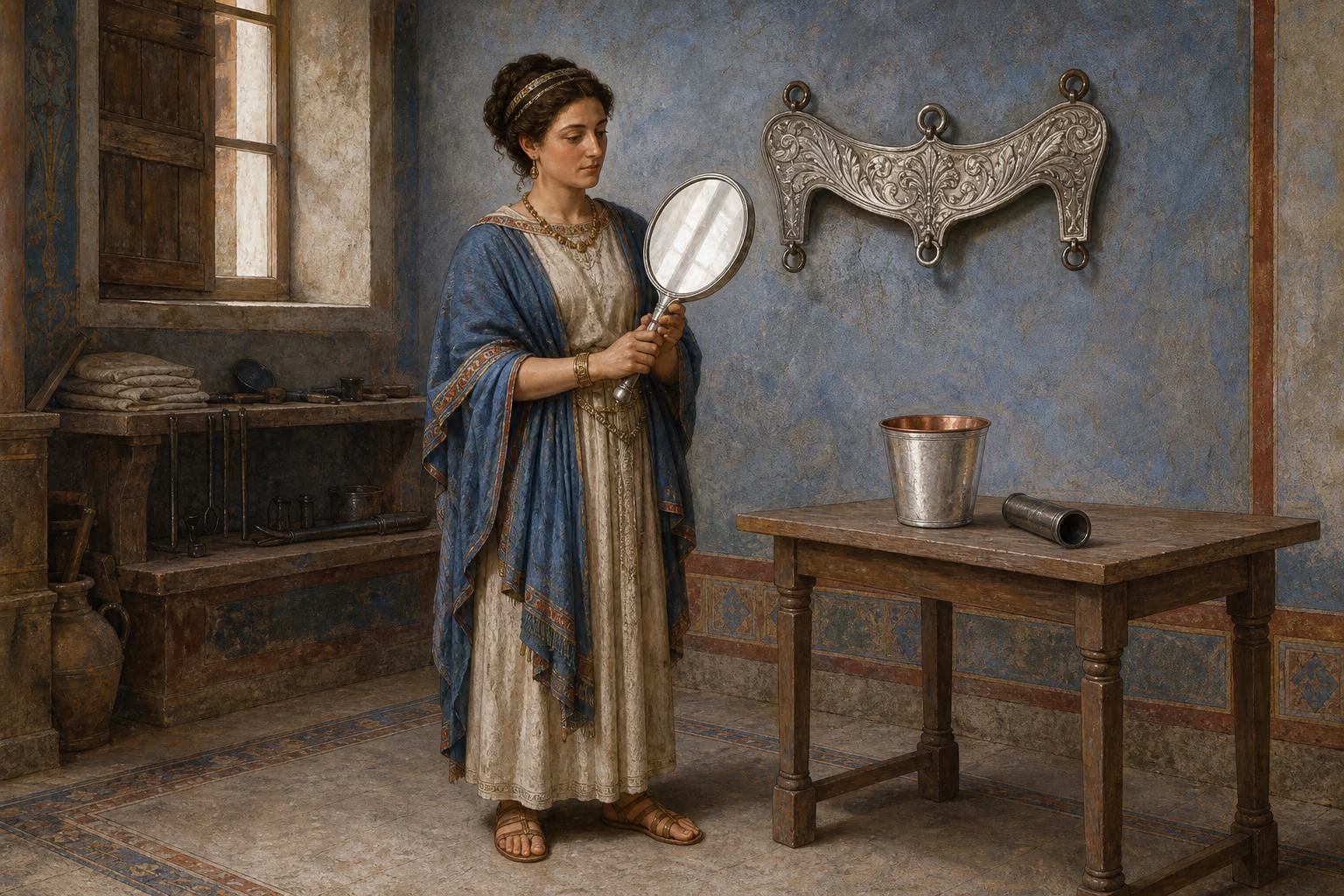
Stagnum inlitum aereis vasis saporem facit gratiorem ac compescit virus aeruginis, mirumque, pondus non auget. specula etiam ex eo laudatissima, ut diximus, Brundisi temperabantur, donec argenteis uti coepere et ancillae. nunc adulteratur stagnum addita aeris candidi tertia portione in plumbum album. fit et alio modo mixtis albi plumbi nigrique libris; hoc nunc aliqui argentarium appellant. iidem et tertiarium vocant, in quo duae sunt nigri portiones et tertia albi. pretium eius inlibras $X$ XX. hoc fistulae solidantur. inprobiores ad tertiarium additis partibus aequis albi argentarium vocant et eo quae volunt incoquunt. pretium huius faciunt in p. $X$ LXX. albo per se sincero pretium sunt $X$ LXXX, nigro $X$ VII.
Albi natura plus aridi habet, contraque nigri tota umida est. ideo album nulli rei sine mixtura utile est. neque argentum ex eo plumbatur, quoniam prius liquescat argentum, confirmantque, si minus albo nigri, quam satis sit, misceatur, erodi ab eo argentum. album incoquitur aereis operibus Galliarum invento ita, ut vix discerni possit ab argento, eaque incoctilia appellant. deinde et argentum incoquere simili modo coepere equorum maxime ornamentis iumentorumque ac iugorum in Alesia oppido; reliqua gloria Biturigum fuit. coepere deinde et esseda sua colisataque ac petorita exornare simili modo, quae iam luxuria ad aurea quoque, non modo argentea, staticula pervenit, quaeque in scyphis cerni prodigum erat, haec in vehiculis adteri cultus vocatur. plumbi albi experimentum in charta est, ut liquefactum pondere videatur, non calore, rupisse. India neque aes neque plumbum habet gemmisque ac margaritis suis haec permutat.
Nigro plumbo ad fistulas lamnasque utimur, laboriosius in Hispania eruto totasque per Gallias, sed in Brittannia summo terrae corio adeo large, ut lex ultro dicatur, ne plus certo modo fiat. nigri generibus haec sunt nomina: Iovetanum, Caprariense, Oleastrense, nec differentia ulla scoria modo excocta diligenter. mirum in his solis metallis, quod derelicta fertilius revivescunt. hoc videtur facere laxatis spiramentis ad satietatem infusus aër, aeque ut feminas quasdam fecundiores facere abortus. nuper id conpertum in Baetica Samariensi metallo, quod locari solitum $X$cc annuis, postquam obliteratum erat, $X$ CCLV locatum est. simili modo Antonianum in eadem provincia pari locatione pervenit ad HSCCCC vectigalis. mirum et addita aqua non liquescere vasa e plumbo, eadem, si in aquam addantur calculus vel aereus quadrans, peruri.
English · Bostock & Riley 1855–57
When copper vessels are coated with stannum, they produce a less disagreeable flavour, and the formation of verdigris is prevented; it is also remarkable, that the weight of the vessel is not increased. As already mentioned, the finest mirrors were formerly prepared from it at Brundisium, until everybody, our maid-servants even, began to use silver ones. At the present day a counterfeit stannum is made, by adding one-third of white copper to two-thirds of white lead. It is also counterfeited in another way, by mixing together equal parts of white lead and black lead; this last being what is called “argentarium.” There is also a composition called “tertiarium,” a mixture of two parts of black lead and one of white: its price is twenty denarii per pound, and it is used for soldering pipes. Persons still more dishonest mix together equal parts of tertiarium and white lead, and, calling the compound “argentarium,” coat articles with it melted. This last sells at sixty denarii per ten pounds, the price of the pure unmixed white lead being eighty denarii, and of the black seven.
White lead is naturally more dry; while the black, on the contrary, is always moist; consequently the white, without being mixed with another metal, is of no use for anything. Silver too, cannot be soldered with it, because the silver becomes fused before the white lead. It is confidently stated, also, that if too small a proportion of black lead is mixed with the white, this last will corrode the silver. It was in the Gallic provinces that the method was discovered of coating articles of copper with white lead, so as to be scarcely distinguishable from silver: articles thus plated are known as “incoctilia.” At a later period, the people of the town of Alesia began to use a similar process for plating articles with silver, more particularly ornaments for horses, beasts of burden, and yokes of oxen: the merit, however, of this invention belongs to the Bituriges. After this, they began to ornament their esseda, colisata, and petorita in a similar manner; and luxury has at last arrived at such a pitch, that not only are their decorations made of silver, but of gold even, and what was formerly a marvel to behold on a cup, is now subjected to the wear and tear of a carriage, and this in obedience to what they call fashion!
White lead is tested, by pouring it, melted, upon paper, which ought to have the appearance of being torn rather by the weight than by the heat of the metal. India has neither copper nor lead, but she procures them in exchange for her precious stones and pearls.
Black lead is used in the form of pipes and sheets: it is extracted with great labour in Spain, and throughout all the Gallic provinces; but in Britannia it is found in the upper stratum of the earth, in such abundance, that a law has been spontaneously made, prohibiting any one from working more than a certain quantity of it. The various kinds of black lead are known by the following names—the Ovetanian, the Caprariensian, and the Oleastrensian. There is no difference whatever in them, when the scoria has been carefully removed by calcination. It is a marvellous fact, that these mines, and these only, when they have been abandoned for some time, become replenished, and are more prolific than before. This would appear to be effected by the air, infusing itself at liberty through the open orifices, just as some women become more prolific after abortion. This was lately found to be the case with the Santarensian mine in Bætica; which, after being farmed at an annual rental of two hundred thousand denarii, and then abandoned, is now rented at two hundred and fifty-five thousand per annum. In the same manner, the Antonian mine in the same province has had the rent raised to four hundred thousand sesterces per annum.
It is a remarkable fact, that if we pour water into a vessel of lead, it will not melt; but that if we throw into the water a pebble or a copper quadrans, the vessel will be penetrated by the fire.