LIBER VII · CAPUT 48
THE GREATEST LENGTH OF LIFE
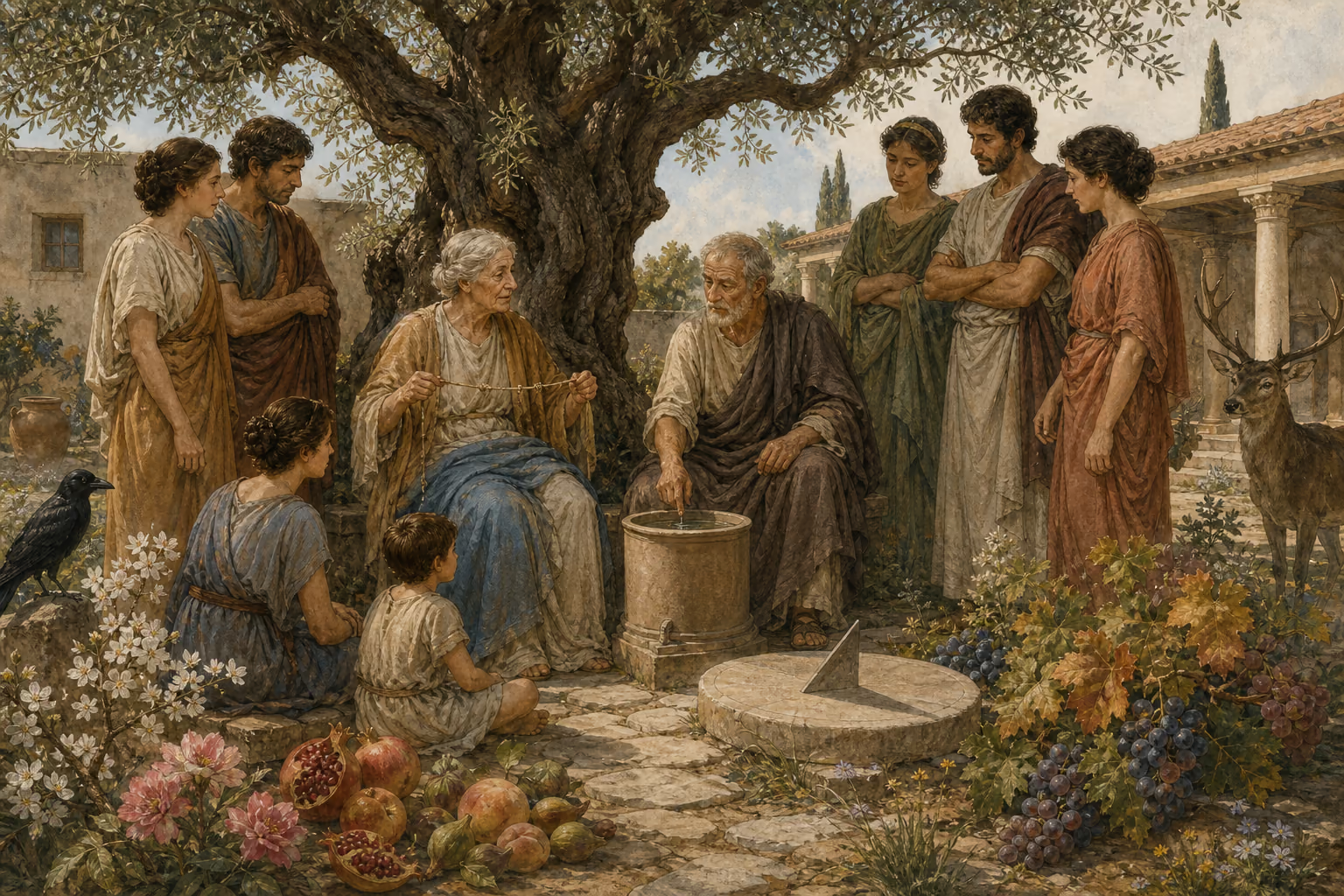
Latine · Mayhoff 1906
De spatio atque longinquitate vitae homiuum non locorum modo situs, verum ettempora ac sua cuique sors nascendi incertum fecere. Hesiodus, qui primus aliqua de hoc prodidit, fabulose, ut reor, multa hominum aevo praeferens, cornici novem nostras attribuit aetates, quadruplum eius cervis, id triplicatum corvis, et reliqua fabulosius in phoenice ac Nymphis. Anacreon poeta Arganthonio Tartesiorum regi CL tribuit annos, Cinyrae Cypriorum decem annis amplius, Aegimio CC, Theopompus Epimenidi Gnosio CLVII; Hellanicus quosdam in Aetolia Epiorum gentis ducenos explere, cui adstipulatur Damastes memorans Pictoreum ex his praecipuum corpore viribusque etiam CCC vixisse, Ephorus Arcadum reges tricenis annis, Alexander Cornelius Dandonem quendam in Illyrico D vixisse, Xenophon in periplo Lutmiorum insulae regem DC atque, ut parce mentitus, filium eius DCCC. quae omnia inscitia temporum acciderunt. annum enim alii aestate determinabant et alterum hieme, alii quadripertitis temporibus, sicut Arcades, quorum anni trimenstres fuere, quidam lunae senio, ut Aegyptii. itaque apud eos et singula milia annorum vixisse produntur. sed ut ad confessa transeamus, Arganthonium Gaditanum LXXX annis regnasse prope certum est; putant quadragensimo coepisse. Masinissam LX annis regnasse indubitatum est, Gorgian Siculum CVIII vixisse. Q. Fabius Maximus LXIII annis augur fuit. M. Perpenna et nuper L. Volusius Saturninus omnium, quos in consulatu sententiam rogaverant, superstites fuere. Perpenna septem reliquit ex iis quos censor legerat; vixit annos LXXXXVIII. qua in re et illud adnotare succurrit, unum omnino quinquennium fuisse quo senator nullus moreretur, cum Flaccus et Albinus censores lustrum condidere, usque ad proximos censores, ab anno urbis DLXXVIIII. M. Valerius Corvinus centum annos inplevit, cuius inter primum et sextum consulatum XLVI anni fuere. idem sella curuli semel ac viciens sedit, quotiens nemo alius. aequavit eius vitae spatia Metellus pontifex.
Et ex feminis Livia Rutili LXXXXVII annos excessit, Statilia Claudio principe ex nobili domo LXXXXVIIII, Terentia Ciceronis CIII, Clodia Ofili CXV, haec quidem etiam enixa quindeciens. Lucceia mima C annis in scaena pronuntiavit. Galeria Copiola emboliaria reducta est in scaenam C. Poppaeo Q. Sulpicio cos. ludis pro salute Divi Augusti votivis annum CIIII agens; producta fuerat tirocinio a M. Pomponio aedile plebis C. Mario Cn. Carbone cos. ante annos XCI, a Magno Pompeio magni theatri dedicatione anus pro miraculo reducta. Sammullam quoque CX annis vixisse auctor est Pedianus Asconius. minus miror Stephanionem, qui primus togatus saltare instituit, utrisque saecularibus ludis saltavisse, Divi Augusti et quos Claudius Caesar consulatu suo quarto fecit, quando LXIII non amplius anni interfuere, quamquam et postea diu vixit. in Tmoli montis cacumine, quod vocant Tempsin, CL annis vivere Mucianus auctor est, totidem annorum censum Claudi Caesaris censura T. Fullonium Bononiensem, idque collatis censibus, quos ante detulerat, vitaeque argumentis — etenim curae principiid erat — verum apparuit.
English · Bostock & Riley 1855–57
Not only the differences of climate, but the multitude of instances named, and the peculiar destiny attached to each of us from the moment of his birth, tend to render one very uncertain in forming any general conclusion respecting the length and duration of human life. Hesiod, who was the first to make mention of this subject, while he states many circumstances about the age of man, which appear to me to be fabulous, gives to the crow nine times the ordinary duration of our life, to the stag four times the length of that of the crow, to the raven three times the length of that of the stag, besides other particulars with reference to the phœnix and the Nymphs of a still more fabulous nature. The poet Anacreon gives one hundred and fifty years to Arganthonius, the king of the Tartessii; ten more to Cinaras, the king of Cyprus, and two hundred to Ægimius. Theopompus gives one hundred and fifty-three years to Epimenides of Cnossus; according to Hellenicus, some of the nation of the Epii, in Ætolia, have completed their two hundredth year; and his account is confirmed by Damastes, who relates that Pictoreus, one of this nation, who was remarkable for his size and strength, lived even to his three hundredth year. Ephorus says that some kings of Arcadia have lived three hundred years; Alexander Cornelius, that there was one Dandon, in Illyricum, who lived five hundred years. Xenophon, in his Periplus, gives to a king of the island of the Lutmii six hundred years, and, as though in that instance he had lied too sparingly, to his son eight hundred. All these statements, however, have originated in a want of acquaintance with the accurate measurement of time. For some nations reckon the summer as one year, and the winter as another; others again, consider each of the four seasons a year; the Arcadians, for instance, whose years were of three months each. Others, such as the Egyptians, calculate by the moon, and hence it is that some individuals among them are said to have lived as many as one thousand years.
Let us proceed, however, to what is admitted to be true. It is pretty nearly certain, that Arganthonius of Gades reigned eighty years, and he is supposed to have commenced his reign when he was forty. Masinissa, beyond a doubt, reigned sixty years, and Gorgias, the Sicilian, lived one hundred and eight. Quintus Fabius Maximus was an augur for sixty-three years. M. Perperna, and more recently, L. Volusius Saturninus, survived all those whose suffrages each had solicited on the occasion of his consulship; Perperna lived ninety-eight years, and left after him only seven of those whose names, when censor, he had enrolled. Connected with this fact, it also suggests itself, and deserves to be remarked, that it has happened only once, that five successive years have ever passed without the death of a senator taking place; this was the case from the occasion on which the censors Flaccus and Albinus performed the lustration, in the year of the City 579, until the time of the succeeding censors. M. Valerius Corvinus completed one hundred years, forty-six of which intervened between his first and sixth consulship. He occupied the curule chair twenty-one times, a thing that was never the case with any one besides. The pontiff Metellus also attained the same age.
Among women also, Livia, the wife of Rutilius, exceeded her ninety-sixth year; during the reign of Claudius, Statilia, a member of a noble family, died at the age of ninety-nine; Terentia, the wife of Cicero, lived one hundred and three years, and Clodia, the wife of Ofilius, one hundred and fifteen; she had fifteen children.
Lucceia, an actress in the mimes, performed on the stage when one hundred years old, and Galeria Copiola returned to the stage, to perform in the interludes, at the votive games which were celebrated for the health of the deified Augustus, in the consulship of C. Poppæus and Q. Sulpicius. She had made her first appearance when eight years of age, just ninety-one years before that time, when M. Pomponius was ædile of the people, in the consulship of C. Marius and Cn. Carbo. When Pompeius Magnus dedicated his great theatre, he brought her upon the stage, as being quite a wonder, considering her old age. Asconius Pedianus informs us, that Sammula also lived one hundred and ten years. I consider it less wonderful that Stephanio, who was the first to dance on the stage in comedy descriptive of Roman manners, should have danced at the two secular games, those celebrated by the deified Augustus, and by Claudius Cæsar, in his fourth consulship, considering that the interval that elapsed between them was no more than sixty-three years; indeed, he lived a considerable time after the last period. We are informed by Mutianus, that, on the peak of Mount Tmolus, which is called Tempsis, the people live one hundred and fifty years, and that T. Fullonius, of Bononia, was set down as of the same age, in the registration which took place under the censorship of Claudius Cæsar; and this appeared to be confirmed by comparing the present with former registrations, as well as many other proofs that he had been alive at certain periods—for that prince greatly interested himself in ascertaining the exact truth of the matter.