LIBER VII · CAPUT 56
THE INVENTORS OF VARIOUS THINGS
Latine · Mayhoff 1906
Consentaneum videtur, priusquam digrediamur a natura hominum, indicare quae cuiusque inventa sint. emere ac vendere Mercurius, vindemiare instituit Liber pater; idem diadema, regium insigne, et triumphum invenit; Ceres frumenta, cum antea glande vescerentur, eadem molere et conficere in Attica, ut alii, et in Sicilia, ob id dea iudicata. eadem prima leges dedit, ut alii putavere, Rhadamanthus.
Litteras semper arbitror Assyrias fuisse, sed alii apud Aegyptios a Mercurio, ut Gellius, alii apud Syros repertas volunt, utrique in Graeciam attulisse e Phoenice Cadmum sedecim numero, quibus Troiano bello Palameden adiecisse quattuor hac figura ζυφχ, totidem post eum Simoniden melicumψξωθ, quarum omnium vis in nostris recognoscitur. Aristoteles decem et octo priscas fuisse et duas ab Epicharmo additas χζ quam a Palamede mavult. Anticlides in Aegypto invenisse quendam nomine Menen tradit, XV annorum ante Phoronea, antiquissimum Graeciae regem, idque monumentis adprobare conatur. e diverso Epigenes apud Babylonios D???CCXX annorum observationes siderum coctilibus laterculis inscriptas docet, gravis auctor in primis; qui minimum, Berosus et Critodemus, CCCCXC. ex quo apparet aeternus litterarum usus. in Latium eas attulerunt Pelasgi.
Laterarias ac domus constituerunt primi Euryalus et Hyperbius fratres Athenis; antea specus erant pro domibus. Gellio Toxius Caeli filius lutei.aedificii inventor placet, exemplo sumpto ab hirundinum nidis. oppidum Cecrops a se appellavit Cecropiam, quae nunc est arx Athenis. aliqui Argos a Phoroneo rege ante conditum volunt, quidam et Sicyonem, Aegyptii vero multo ante apud ipsos Diospolin. tegulas invenit Cinyra, Agriopae filius, et metalla aeris, utrumque in insula Cypro, item forcipem, martulum, vectem, incudem; puteos Danaus ex Aegypto advectus in Graeciam qua vocabatur Argos Dipsion; lapicidinas Cadmus Thebis aut, ut Theophrastus, in Phoenice; Thrason muros; turres, ut Aristoteles, Cyclopes, Tirynthii, ut Theophrastus; Aegyptii textilia, inficere lanas Sardibus Lydi, fusos in lanificio Closter, filius Arachnae, linum et retia Arachne, fulloniam artem Nicias Megarensis, sutrinam Tychius Boeotius. medicinal Aegyptii apud ipsos volunt repertam, alii per Arabum, Babylonis et Apollinis filium, herbariam et medicamentariam a Chirone, Saturni et Philyrae filio. aes conflare et temperate Aristoteles Lydum Scythen monstrasse, Theophrastus Delam Phrygem putant, aerariam fabricam alii Chalybas, alii Cyclopas, ferrum Hesiodus in Creta eos qui vocati sunt Dactyli Idaei. argentum invenit Erichthonius Atheniensis, ut alii, Aeacus; auri metalla et flaturam Cadmus Phoenix ad Pangaeum montem, ut alii, Thoas aut Aeacus in Panchaia aut Sol Oceani filius, cui Gellius medicinae quoque inventionem ex metallis assignat. plumbum ex Cassitetride insula primus adportavit Midacritus. fabricam ferrariam invenerunt Cyclopes, figlinas Coroebus Atheniensis, in iis orbem Anarcharsis Scythes, ut alii, Hyperbius Corinthius. fabricam materiariam Daedalus et in ea serram, asciam, perpendiculum, terebram, glutinum, ich- thyocollam; normam autem et libellam et tornum et clavem Theodorus Samius, mensuras et pondera Phidon Argivus aut Palamedes, ut maluit Gellius; ignem e silice Pyrodes Cilicis filius, eundem adservare ferula Prometheus; vehiculum cum quattuor rotis Phryges, mercaturas Poeni, culturas vitium et arborum Eumolpus Atheniensis, vinum aquae misceri Staphylus Sileni filius, oleum et trapetas Aristaeus Atheniensis, idem mella; bovem et aratrum Buzyges Atheniensis, ut alii, Triptolemus; regiam civitatem Aegyptii, popularem Attici post Theseum. tyrannus primus fuit Phalaris Agraganti. servitium invenere Lacedaemonii. iudicium capitis in Areopago primum actum est.
Proelium Afri contra Aegyptios primi fecere fustibus, quos vocant phalangas. clupeos invenerunt Proetus et Acrisius inter se bellantes sive Chalcus Athamantis filius,loricam Midias Messenius, galeam, gladium, hastam Lacedaemonii, ocreas et cristas Cares. arcum et sagittam Scythen Iovis filium, alii sagittas Persen Persei filium invenisse dicunt, lanceas Aetolos, iaculum cum ammento Aetolum Martis filium, hastas velitares Tyrrenum, eundem pilum, Penthesileam Amazonem securim, Pisaeum venabula et in tormentis scorpionem, Cretas catapultam, Syrophoenicas ballistam et fundam, aeneam tubam Pisaeum Tyrreni, testudines Artemonem Clazomenium, equum (qui nunc aries appellatur) in muralibus machinis Epium ad Troiam, equo vehi Bellerophontem, frenos et strata equorum Pelethronium, pugnare ex equo Thessalos, qui Centauri appellati sunt, habitantes secundum Pelium monte. bigas prima iunxit Phrygum natio, quadrigas Erichthonius. ordinem exercitus, signi dationem, tesseras, vigilias Palamedes invenit Troiano bello, specularum significationem eodem Sinon, inducias Lycaon, foedera Theseus.
Auguria ex avibus Car, a quo Caria appellata; adiecit ex ceteris animalibus Orpheus, aruspicia Delphus, ignispicia Amphiaraus, extispicia avium Tiresias Thebanus, interpretationem ostentorum et somniorum Amphictyon. astrologiam Atlans Libyae filius, ut alii, Aegyptii, ut alii, Assyrii, sphaeram in ea Milesius Anaximander, ventorum rationem Aeolus Hellenis filius. musicam Amphiors, fistulam et monaulum Pan Mercuri, obliquam tibiam Midas in Phrygia, geminas tibias Marsyas in eadem gente, Lydios modulos Amphion, Dorios Thamyras Thrax, Phrygios Marsyas Phryx, citharam Amphion, ut alii, Orpheus, ut alii, Linus. septem chordis primum cecinit III ad IIII primas additis Terpander, octavam Simonides addidit, nonam Timotheus. cithara sine voce cecinit Thamyris primus, cum cantu Amphion, ut alii, Linus. citharoedica carmina conposuit Terpander. cum tibiis canere voce Troezenius Ardalus instituit. saltationem armatam Curetes docuere, pyrrichen Pyrrus, utramque in Creta. versum heroum Pythio oraculo debemus. de poematum origine magna quaestio; ante Troianum bellum probantur fuisse. prosam orationem condere Pherecydes Syrius instituit Cyri regis aetate, historiam Cadmus Milesius; ludos gymnicos in Arcadia Lycaon, funebres Acastus in Iolco,post eum Theseus in Isthmo, Hercules Olympiae; athleticam Pittheus, pilam lusoriam Gyges Lydus; picturam Aegyptii et in Graecia Euchir, Daedali cognatus, ut Aristoteli placet, ut Theophrasto, Polygnotus Atheniensis.
Nave primus in Graeciam ex Aegypto Danaus advenit; antea ratibus navigabatur inventis in mari Rubro inter insulas a rege Erythra. reperiuntur qui Mysos et Troianos priores excogitasse in Hellesponto putent, cum transirent adversus Thracas. etiam nunc in Britannico oceano vitiles corio circumsutae fiunt, in Nilo ex papyro ac scirpo et harundine. longa nave lasonem primum navigasse Philostephanus auctor est, Hegesias Parhalum, Ctesias Samiramin, Archemachus Aegaeonem, biremem Damastes Erythraeos fecisse, triremem Thucydides Aminoclen Corinthium, quadriremem Aristoteles Carthaginienses, quinqueremem Mnesigiton Salaminios, sex ordinum Xenagoras Syracusios, ab ea ad decemremem Mnesigiton Alexandrum Magnum, ad duodecim ordines Philostephanus Ptolemaeum Soterem, ad quindecim Demetrium Antigoni, ad XXX Ptolemaeum Philadelphum, ad XL Ptolemaeum Philopatorem, qui Tryphon cognominatus est. onerariam Hippus Tyrius invenit, lembum Cyrenenses, cumbam Phoenices, celetem Rhodii, cercyrum Cyprii. siderum observationem in navigando Phoenices, remum Copae, latitudinem eius Plataeae, vela Icarus, malum et antennam Daedalus, hippegum Samii aut Pericles Atheniensis, tectas longas Thasii; antea ex prora tantum et puppi pugnabatur. rostra addidit Pisaeus Tyrreni, ancoram Eupalamus, eandem bidentem Anacharsis, harpagones et manus Pericles Atheniensis, adminicula gubernandi Tiphys. classe princeps depugnavit Minos.— Animal occidit primus Hyperbius Martis filius, Prometheus bovem.—
English · Bostock & Riley 1855–57
Before we quit the consideration of the nature of man, it appears only proper to point out those persons who have been the authors of different inventions. Father Liber was the first to establish the practice of buying and selling; he also invented the diadem, the emblem of royalty, and the triumphal procession. Ceres introduced corn, the acorn having been previously used by man for food; it was she, also, who introduced into Attica the art of grinding corn and of making bread, and other similar arts into Sicily; and it was from these circumstances that she came to be regarded as a divinity. She was the first also to establish laws; though, according to some, it was Rhadamanthus. I have always been of opinion, that letters were of Assyrian origin, but other writers, Gellius, for instance, suppose that they were invented in Egypt by Mercury: others, again, will have it that they were discovered by the Syrians; and that Cadmus brought from Phœnicia sixteen letters into Greece. To these, Palamedes, it is said, at the time of the Trojan war, added these four, Θ, Ξ, Φ, and Χ. Simonides, the lyric poet, afterwards added a like number, Ζ, Η, Ψ, and Ω; the sounds denoted by all of which are now received into our alphabet.
Aristotle, on the other hand, is rather of opinion, that there were originally eighteen letters, Α Β Γ Δ Ε Ζ Ι Κ Λ Μ Ν Ο Π Ρ Σ Τ Υ Φ, and that two, Θ namely and Χ, were introduced by Epicharmus, and not by Palamedes. Aristides says, that a certain person of the name of Menos, in Egypt, invented letters fifteen years before the reign of Phoroneus, the most ancient of all the kings of Greece, and this he attempts to prove by the monuments there. On the other hand, Epigenes, a writer of very great authority, informs us that the Babylonians have a series of observations on the stars, for a period of seven hundred and twenty thousand years, inscribed on baked bricks. Berosus and Critodemus, who make the period the shortest, give it as four hundred and ninety thousand years. From this statement, it would appear that letters have been in use from all eternity. The Pelasgi were the first to introduce them into Latium.
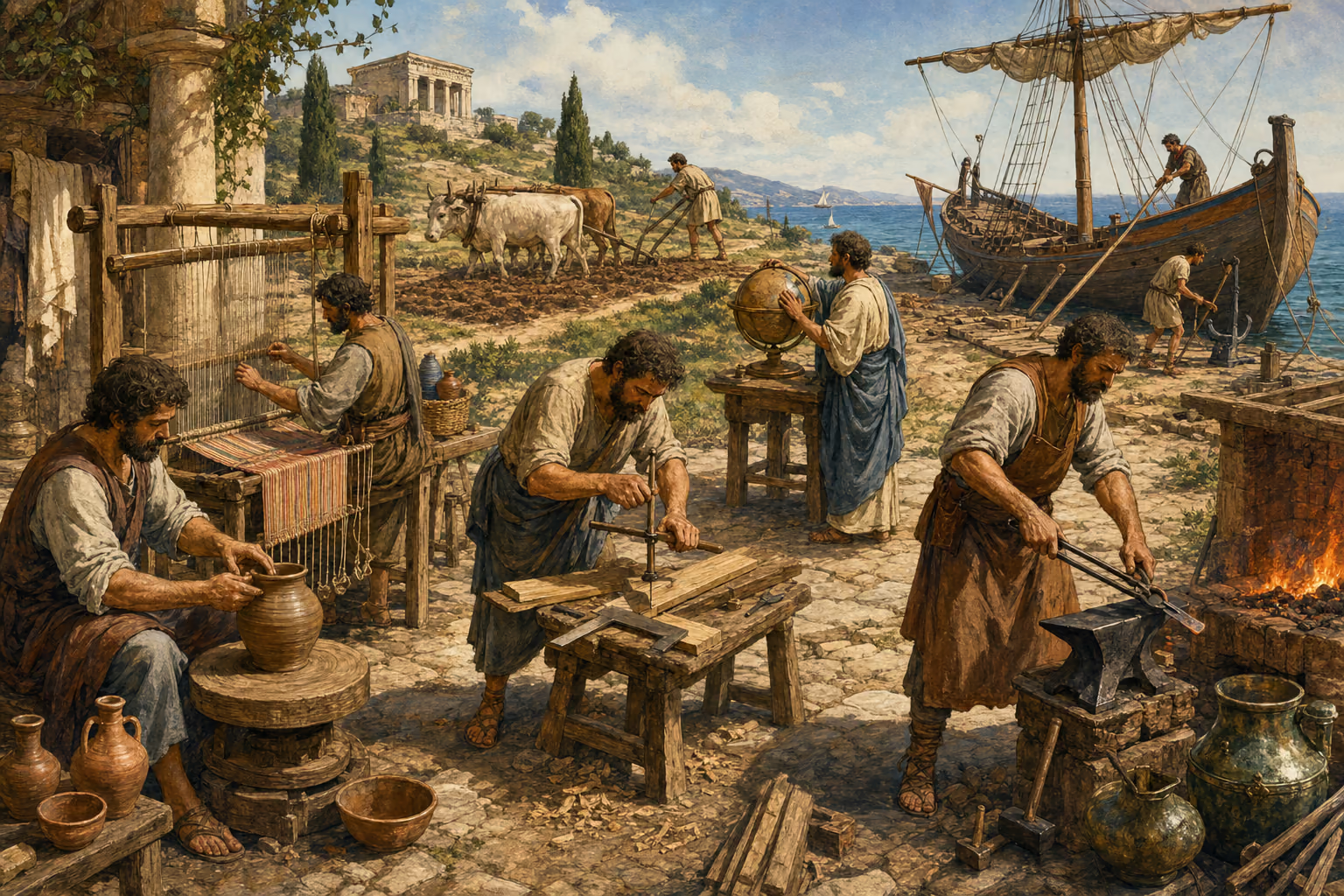
The brothers Euryalus and Hyperbius were the first who constructed brick-kilns and houses at Athens; before which, caves in the ground served for houses. Gellius is inclined to think that Toxius, the son of Cælus, was the first inventor of mortar, it having been suggested to him by the nest of the swallow. Cecrops gave to a town the name of Cecropia, after himself; this is now the citadel of Athens. Some persons will have it, that Argos had been founded before this period by King Phoroneus; others, again, that Sicyon had been previously built; while the Egyptians declare that their own city, Diospolis, had been in existence long before them. Cinyra, the son of Agriopas, invented tiles and discovered copper-mines, both of them in the island of Cyprus; he also invented the tongs, the hammer, the lever, and the anvil. Wells were invented by Danaus, who came from Egypt into that part of Greece which had been previously known as Argos Dipsion.
The first stone-quarries were opened by Cadmus at Thebes, or else, according to Theophrastus, in Phœnicia. Walls were first built by Thrason; according to Aristotle, towers were first erected by the Cyclopes, but according to Theophrastus, by the Tirynthii. The Egyptians invented weaving; the Lydians of Sardis the art of dyeing wool. Closter, the son of Arachne, invented the spindle for spinning wool; Arachne herself, linen cloth and nets; Nicias of Megara, the art of fulling cloth; and Tychius, the Bœotian, the art of making shoes. The Egyptians will have it that the medical art was first discovered among them, while others attribute it to Arabus, the son of Babylonis and Apollo; botany and pharmacy are ascribed to Chiron, the son of Saturn and Philyra.
Aristotle supposes that Scythes, the Lydian, was the first to fuse and temper copper, while Theophrastus ascribes the art to Delas, the Phrygian. Some persons ascribe the working of copper to the Chalybes, others to the Cyclopes. Hesiod says, that iron was discovered in Crete, by the Idæan Dactyli. Erichthonius, the Athenian, or, as some people say, Æacus, discovered silver. Gold mines, and the mode of fusing that metal, were discovered by Cadmus, the Phœnician, at the mountain of Pangæus, or, according to other accounts, by Thoas or Eaclis, in Panchaia; or else by Sol, the son of Oceanus, whom Gellius mentions as having been the first who employed honey in medicine. Midacritus was the first who brought tin from the island called Cassiteris. The Cyclopes invented the art of working iron. Choræbus, the Athenian, was the first who made earthen vessels; but Anacharsis, the Scythian, or, according to others, Hyperbius, the Corinthian, first invented the potter’s wheel. Dædalus was the first person who worked in wood; it was he who invented the saw, the axe, the plummet, the gimlet, glue, and isinglass; the square, the level, the turner’s lathe, and the key, were invented by Theodorus, of Samos. Measures and weights were invented by Phidon, of Argos, or, according to Gellius, by Palamedes. Pyrodes, the son of Cilix, was the first to strike fire from the flint, and Prometheus taught us how to preserve it, in the stalk of giant-fennel.
The Phrygians first taught us the use of the chariot with four wheels; the Carthaginians the arts of merchandize, and Eumolpus, the Athenian, the cultivation of the vine, and of trees in general. Staphylus, the son of Silenus, was the first to mix water with wine; olive-oil and the oil-press, as also honey, we owe to Aristæus, the Athenian; the use of oxen and the plough to Buzyges, the Athenian, or, according to other accounts, to Triptolemus.
The Egyptians were the first who established a monarchical government, and the Athenians, after the time of Theseus, a democracy. Phalaris, of Agrigentum, was the first tyrant that existed; the Lacedæmonians were the introducers of slavery; and the first capital punishment inflicted was ordered by the Areiopagus. The first battles were fought by the Africans against the Egyptians, with clubs, which they are in the habit of calling phalangæ. Prœtus and Acrisius were the first to use shields, in their contests with each other; or, as some say, Chalcus, the son of Athamas. Midias, the Messenian, invented the coat of mail, and the Lacedæmonians the helmet, the sword, and the spear. Greaves and crests were first used by the Carians; Scythes, the son of Jupiter, it is said, invented the bow and arrows, though some say that arrows were invented by Perses, the son of Perseus. Lances were invented by the Ætolians; the javelin, with the thong attached, by Ætolus, the son of Mars; the spear of the light infantry by Tyrrhenus; the dart by Penthesilea, the Amazon; the axe by Pisæus; the hunting-spear, and the scorpion to hurl missiles, by the Cretans; the catapulta, the balista, and the sling, by the Syrophœnicians. Pisæus, the Tyrrhenian, was the first to invent the brazen trumpet, and Artemon, of Clazomenæ, the use of the testudo. The battering-horse, for the destruction of walls, which is at the present day styled the “ram,” was invented by Epeus, at Troy. Bellerophon was the first who mounted the horse; bridles and saddles for the horse were invented by Pelethronius. The Thessalians, who are called Centauri, and who dwell along Mount Pelion, were the first to fight on horse-back. The people of Phrygia were the first who used chariots with two horses; Erichthonius first used four. Palamedes, during the Trojan war, was the first who marshalled an army, and invented watchwords, signals, and the use of sentinels. Sinon, at the same period, invented the art of correspondence by signals. Lycaon was the first to think of making a truce, and Theseus a treaty of alliance.
The art of divination by means of birds we owe to Car, from whom Caria derives its name; Orpheus extended it to other animals. Delphus taught us the art of divining by the inspection of entrails; Amphiaraüs divination by fire; and Tiresias, the Theban, presages from the entrails of birds. We owe to Amphictyon the interpretation of portents and of dreams, and to Atlas, the son of Libya, the art of astrology, or else, according to other accounts, to the Egyptians or the Assyrians. Anaximander, the Milesian, invented the astronomical sphere; and Æolus, the son of Hellen, gave us the theory of the winds.
Amphion was the inventor of music; Pan, the son of Mercury, the music of the reed, and the flute with the single pipe; Midas, the Phrygian, the transverse flute; and Marsyas, of the same country, the double-pipe. Amphion invented the Lydian measures in music; Thamyris the Thracian, the Dorian, and Marsyas the Phrygian, the Phrygian style. Amphion, or, according to some accounts, Orpheus, and according to others, Linus, invented the lyre. Terpander, adding three to the former four, increased the number of strings to seven; Simonides added an eighth, and Timotheus a ninth. Thamyris was the first who played on the lyre, without the accompaniment of the voice; and Amphion, or, as some say, Linus, was the first who accompanied it with the voice. Terpander was the first who composed songs expressly for the lyre; and Ardalus, the Trœzenian, was the first who taught us how to combine the voice with the music of the pipe. The Curetes taught us the dance in armour, and Pyrrhus, the Pyrrhic dance, both of them in Crete.
We are indebted to the Pythian oracle for the first heroic verse. A very considerable question has arisen, as to what was the origin of poetry; it is well known to have existed before the Trojan war. Pherecydes of Scyros, in the time of King Cyrus, was the first to write in prose, and Cadmus, the Milesian, was the first historian.
Lycaon first instituted gymnastic games, in Arcadia; Acastus funereal games, at Iolcos; and, after him, Theseus instituted them at the Isthmus. Hercules first instituted the athletic contests at Olympia. Pythus invented the game of ball. Painting was invented in Egypt by Gyges, the Lydian, or, according to Aristotle, in Greece, by Euchir, a kinsman of Dædalus; according to Theophrastus, again, it was invented by Polygnotus, the Athenian.
Danaüs was the first who passed over in a ship from Egypt to Greece. Before his time, they used to sail on rafts, which had been invented by King Erythras, to pass from one island to another in the Red Sea. There are some writers to be found, who are of opinion that they were first thought of by the Mysians and the Trojans, for the purpose of crossing the Hellespont into Thrace. Even at the present day, they are made in the British ocean, of wicker-work covered with hides; on the Nile they are made of papyrus, rushes, and reeds.
We learn from Philostephanus, that Jason was the first person who sailed in a long vessel; Hegesias says it was Paralus, Ctesias, Semiramis, and Archemachus, Ægæon. According to Damastes, the Erythræi were the first to construct vessels with two banks of oars; according to Thucydides, Aminocles, the Corinthian, first constructed them with three banks of oars; according to Aristotle, the Carthaginians, those with four banks; according to Mnesigiton, the people of Salamis, those with five banks; and, according to Xenagoras, the Syracusans, those with six; those above six, as far as ten, Mnesigiton says were first constructed by Alexander the Great. From Philostephanus, we learn that Ptolemy Soter made them as high as twelve banks; Demetrius, the son of Antigonus, with fifteen; Ptolemy Philadelphus, with thirty; and Ptolemy Philopater, who was surnamed Tryphon, with forty. Hippus, the Tyrian, was the first who invented merchant-ships; the Cyrenians, the pinnace; the Phœnicians, the passage-boat; the Rhodians, the skiff; and the Cyprians, the cutter.
We are indebted to the Phœnicians for the first observation of the stars in navigation; the Copæ invented the oar, and the Platæans gave it its broad blade. Icarus was the person who invented sails, and Dædalus the mast and yards; the Samians, or else Pericles, the Athenian, transports for horses, and the Thracians, long covered vessels, —before which time they used to fight only from the prow or the stern. Pisæus, the Tyrrhenian, added the beak to ships; Eupalamus, the anchor; Anacharsis, that with two flukes; Pericles, the Athenian, grappling-irons, and hooks like hands; and Tiphys, the helm and rudder. Minos was the first who waged war by means of ships; Hyperbius, the son of Mars, the first who killed an animal; and Prometheus, the first who slew the ox.