LIBER VIII · CAPUT 25
THE CROCODILE
Latine · Mayhoff 1906
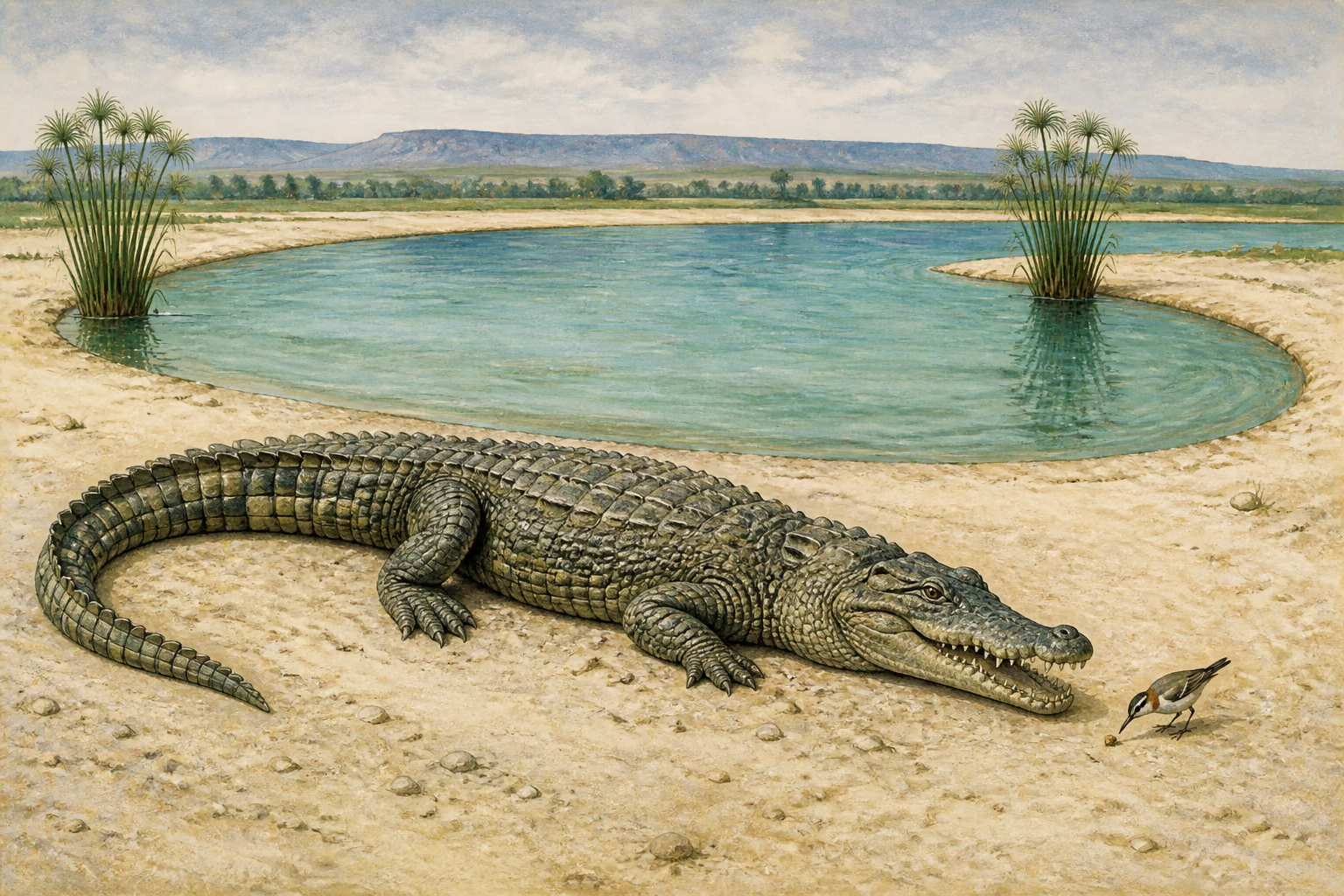
Crocodilum habet Nilus, quadripes malum et terra pariter ac flumine infestum. unum hoc animal terrestre linguae usu caret, unum superiore mobili maxilla inprimit morsum, alias terribile pectinatim stipante se dentium serie. magnitudine excedit plerumque duodeviginti cubita. parit ova quanta anseres, eaque extra eum locum semper incubat praedivinatione quadam, ad quem summo auctu eo anno egressurus est Nilus. nec aliud animal ex minore origine in maiorem crescit magnitudinem. et unguibus autem armatus est, contra omnes ictus cute invicta. dies in terra agit, noctes in aqua, teporis utrumque ratione. hunc saturum cibo piscium et semper esculento ore in litore somno datum parva avis, quae trochilos ibi vocatur, rex avium in Italia, invitat ad hiandum pabuli sui gratia, os primum eius adsultim repurgans, mox dentes et intus fauces quoque ad hanc scabendi dulcedinem quam maxime hiantes, in qua voluptate somno pressum conspicatus ichneumon, per easdem fauces ut telum aliquod inmissus, erodit alvum.
Similis crocodilo, sed minor etiam ichneumone, est in Nilo natus scincos, contra venena praecipuus antidotis, itemad inflammandam virorum venerem.
Verum in crocodilo maior erat pestis quam ut uno esset eius hoste natura contenta. itaque et delphini inmeantes Nilo, quorum dorso tamquam ad hunc usum cultellata inest pinna, abigentes eos praedam ac velut in suo tantum amne regnantes, alioqui inpares viribus ipsi, astu interimunt. callent enim in hoc cuncta animalia sciuntque non sua modo commoda, verum et hostium adversa, norunt sua tela, norunt occasiones partesque dissidentium inbelles. in ventre mollis est tenuisque cutis crocodilo: ideo se ut territi mergunt delphini subeuntesque alvum illa secant spina. quin et gens hominum est huic beluae adversa in ipso Nilo, a Tentyri insula, in qua habitat, appellata. mensura eorum parva, sed praesentia animi in hoc tantum usu mira. terribilis haec contra fugaces belua est, fugax contra sequentes. sed adversum ire soli hi audent, quin et flumini innatant dorsoque equitantium modo inpositi hiantibus resupino capite ad morsum addita in os clava, a dextra ac laeva tenentes extrema eius utrimque, ut frenis in terram agunt captivos ac voce etiam sola territos cogunt evomere recentia corpora ad sepulturam. itaque uni ei insulae crocodili non adnant olfactu- que eius generis hominum, ut Psyllorum serpentes, fugantur. hebetes oculos hoc animal dicitur habere in aqua, extra acerrimi visus, quattuorque menses hiemis semper inedia tramittere in specu. quidam hoc unum quamdiu vivat crescere arbitrantur; vivit autem longo tempore.
Maior altitudine in eodem Nilo belua hippopotamius editur, ungulis binis quales hubus, dorso equi et iuba et hinnitu, rostro resimo, cauda et dentibus aprorum aduncis, sed minus noxiis, tergoris ad scuta galeasque inpenetrabilis, praeterquam si umore madeant. depascitur segetes destinatione ante, ut ferunt, determinatas in diem et ex agro ferentibus vestigiis, ne quae revertenti insidiae comparentur.
English · Bostock & Riley 1855–57
The Nile produces the crocodile also, a destructive quadruped, and equally dangerous on land and in the water. This is the only land animal that does not enjoy the use of its tongue, and the only one that has the upper jaw moveable, and is capable of biting with it; and terrible is its bite, for the rows of its teeth fit into each other, like those of a comb. Its length mostly exceeds eighteen cubits. It produces eggs about the size of those of the goose, and, by a kind of instinctive foresight, always deposits them beyond the limit to which the river Nile rises, when at its greatest height. There is no animal that arrives at so great a bulk as this, from so small a beginning. It is armed also with claws, and has a skin, that is proof against all blows. It passes the day on land, and the night in the water, in both instances on account of the warmth. When it has glutted itself with fish, it goes to sleep on the banks of the river, a portion of the food always remaining in its mouth; upon which, a little bird, which in Egypt is known as the trochilus, and, in Italy, as the king of the birds, for the purpose of obtaining food, invites the crocodile to open its jaws; then, hopping to and fro, it first cleans the outside of its mouth, next the teeth, and then the inside, while the animal opens its jaws as wide as possible, in consequence of the pleasure which it experiences from the titillation. It is at these moments that the ichneumon, seeing it fast asleep in consequence of the agreeable sensation thus produced, darts down its throat like an arrow, and eats away its intestines.
Like the crocodile, but smaller even than the ichneumon, is the scincus, which is also produced in the Nile, and the flesh of which is the most effectual antidote against poisons, and acts as a powerful aphrodisiac upon the male sex. But so great a pest was the crocodile to prove, that Nature was not content with giving it one enemy only; the dolphins, therefore, which enter the Nile, have the back armed with a spine, which is edged like a knife, as if for this very purpose; and although these animals are much inferior in strength, they contrive to destroy the crocodile by artifice, which on the other hand attempts to drive them from their prey, and would reign alone in its river as its peculiar domain. For all animals have an especial instinct in this respect, and are able to know not only what is for their own advantage, but also what is to the disadvantage of their enemies; they fully understand the use of their own weapons, they know their opportunity, and the weak parts of those with which they have to contend.
The skin of the belly of the crocodile is soft and thin; aware of this, the dolphins plunge into the water, as if in great alarm, and diving beneath its belly, tear it open with their spines. There is a race of men also, who are peculiarly hostile to this animal; they are known as the Tentyritæ, from an island in the Nile which they inhabit. These men are of small stature, but of wonderful presence of mind, though for this particular object only. The crocodile is a terrible animal to those who fly from it, while at the same time it will fly from those who pursue it; these, however, are the only people who dare to attack it. They even swim in the river after it, and mount its back like so many horsemen; and just as the animal turns up its head for the purpose of biting them, they insert a club into its mouth, holding which at each end, with the two hands, it acts like a bit, and by these means they drive the captured animal on shore. They also terrify the crocodile so much by their voice alone even, as to force it to disgorge the bodies which it has lately swallowed, for the purpose of burial. This island, therefore, is the only place near which the crocodile never swims; indeed, it is repelled by the odour of this race of men, just as serpents are by that of the Psylli. The sight of this animal is said to be dull when it is in the water, but, when out of the water, piercing in the extreme; it always passes the four winter months in a cave, without taking food. Some persons say, that this is the only animal that continues to increase in size as long as it lives; it is very long-lived.
The Nile produces the hippopotamus, another wild beast, of a still greater size. It has the cloven hoof of the ox; the back, the mane, and the neighing of the horse; and the turned-up snout, the tail, and the hooked teeth of the wild boar, but not so dangerous. The hide is impenetrable, except when it has been soaked with water; and it is used for making shields and helmets. This animal lays waste the standing corn, and determines beforehand what part it shall ravage on the following day; it is said also, that it enters the field backwards, to prevent any ambush being laid for it on its return.