LIBER VIII · CAPUT 48
THE DIFFERENT KINDS OF WOOL, AND THEIR COLOURS
Latine · Mayhoff 1906
lana autem laudatissima Apula et quae in Italia Graeci pecoris appellatur, alibi Italica; tertium locum Milesiae oves optinent. Apulae breves villo nec nisi paenulis celebres; circa Tarentum Canusiumque summam nobilitatem habent, in Asia vero eodem genere Laudiceae. alba Circumpadanis nulla praefertur, nec libra centenos nummos ad hoc aevi excessit ulla. oves non ubique tondentur; durat quibusdam in locis vellendi mos. colorum plura genera, quippe cum desint etiam nominaiis quas nativas appellant aliquot modis: Hispania nigri velleris praecipuas habet, Pollentia iuxta Alpes cani, Asia rutili, quas Erythraeas vocant, item Baetica, Canusium fulvi, Tarentum et suae pulliginis. sucidis omnibus medicata vis. Histriae Liburniaeque pilo propior quam lanae, pexis aliena vestibus et quam Salacia scutulato textu commendat in Lusitania. similis circa Piscinas provinciae Narbonensis, similis et in Aegypto, ex qua vestis detrita usu pingitur rursusque aevo durat. est et hirtae pilo crasso in tapetis antiquissima gratia iam; certe iis usos Homerus auctor est. aliter haec Galli pingunt, aliter Parthorum gentes. lanae et per se coactae vestem faciunt et, si addatur acetum, etiam ferro resistunt, immo vero etiam ignibus novissimo sui purgamento. quippe aenis polientium extracta in tomenti usum veniunt, Galliarum, ut arbitror; invento; certe Gallicis hodie nominibus discernitur. nec facile dixerim qua id aetate coeperit; antiquis enim torus e stramento erat, qualiter etiam nunc in castris. gausapae patris mei memoria coepere, amphimallia nostra sicut villosa etiam ventralia. nam tunica lati clavi in modum gausapae texi nunc primum incipit. lanarum nigrae nullum colorem bibunt. de reliquarum infectu suis locis dicemus in conchyliis maris aut herbarum natura.
Lanam in colu et fuso Tanaquilis, quae eadem Gaia Caecilia vocata est, in templo Sancus durasse prodente se auctor est M. Varro factamque ab ea togam regiam undulatam in aede Fortunae, qua Ser. Tullius fuerat usus. inde factum ut nubentes virgines comitaretur colus compta 5 et fusus cum stamine. ea prima texuit rectam tunicam, quales cum toga pura tironi induuntur novaeque nuptae. undulata vestis prima e lautissimis fuit; inde sororiculata defluxit. togas rasas Phryxianasque Divi Augusti novissimis temporibus coepisse scribit Fenestella. crebrae papaveratae antiquiorem habent originem iam sub Lucilio poeta in Torquato notatae. praetextae apud Etruscos originem invenere. trabeis usos accipio reges; pictae vestes iam apud Homerum suntiis, etinde triumphales natae. acu facere id Phryges invenerunt, ideoque Phrygioniae appellatae sunt. aurum intexere in eadem Asia invenit Attalus rex, unde nomen Attalicis. colores diversos picturae intexere Babylon maxime celebravit et nomen inposuit. plurimis vero liceis texere, quae polymita appellant, Alexandria instituit, scutulis dividere Gallia. Metellus Scipio tricliniaria Babylonica sestertium octingentis milibus venisse iam tune ponit in Catonis criminibus, quae Neroni principi quadragiens sestertio nuper stetere. Servi Tulli praetextae, quibus signum Fortunae ab eo dicatae coopertum erat, duravere ad Seiani exitum, mirumque fuit neque diffluxisse eas neque teredinum iniurias sensisse annis quingentis sexaginta. vidimus iam et viventium vellera purpura, cocco, conchylio sesquipedalibus libris infecta, velut illa sic nasci cogente luxuria.
In ipsa ove satis generositas ostenditur brevitate crurum, ventris vestitu. is quibus nudus esset, apicas vocabant damnabantque. Syriae cubitales ovium caudae plurimumque in ea parte lanicii. castrari agnos nisi quinquemenstres praematurum existimatur.
English · Bostock & Riley 1855–57
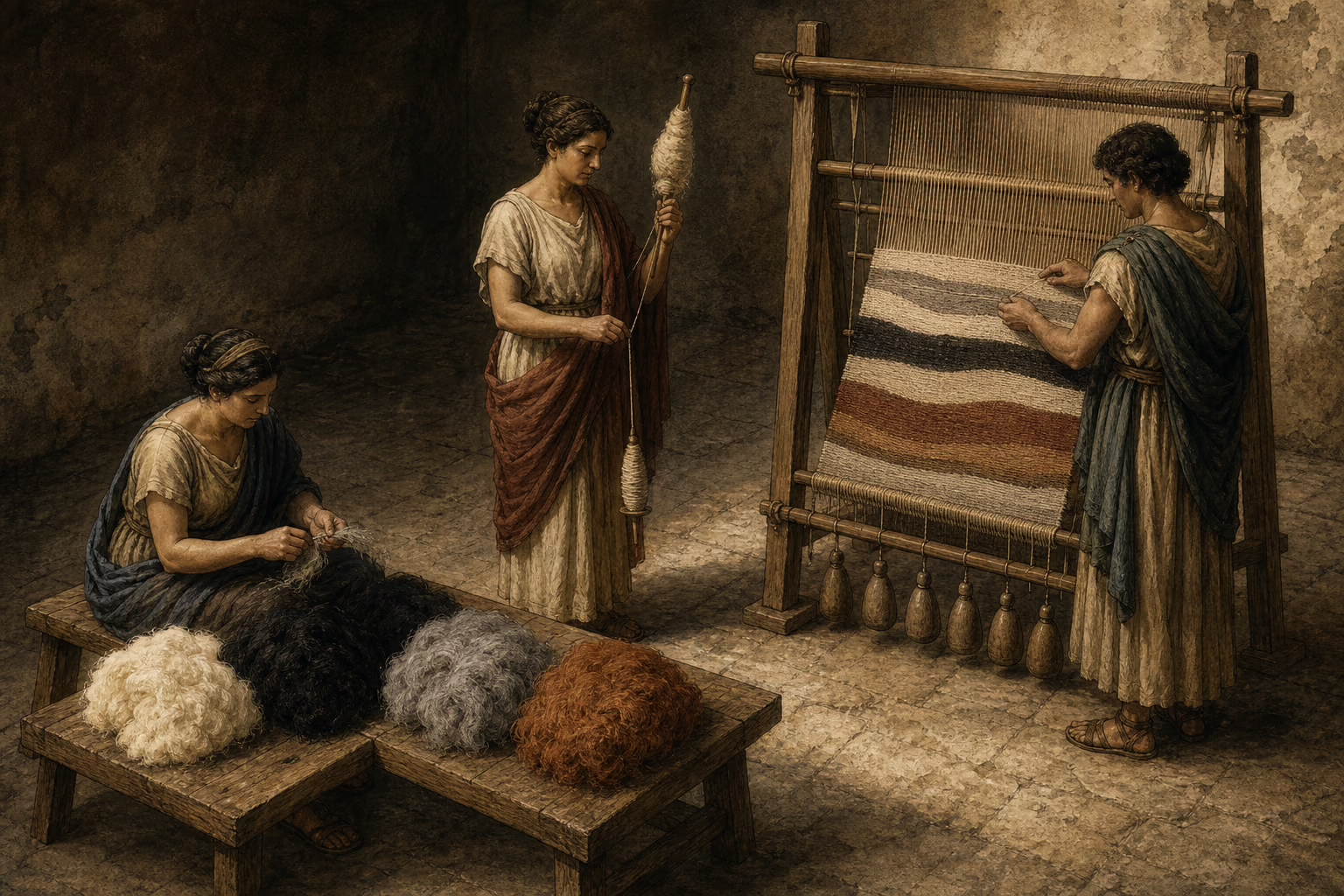
The most esteemed wool of all is that of Apulia, and that which in Italy is called Grecian wool, in other countries Italian. The fleeces of Miletus hold the third rank. The Apulian wool is shorter in the hair, and only owes its high character to the cloaks that are made of it. That which comes from the vicinity of Tarentum and Canusium is the most celebrated; and there is a wool from Laodicea, in Asia, of a similar quality. There is no white wool superior to that of the countries bordering on the Padus, nor up to the present day has any wool exceeded the price of one hundred sesterces per pound. The sheep are not shorn in all countries; in some places it is still the custom to pull off the wool. There are various colours of wool; so much so, indeed, that we want terms to express them all. Several kinds, which are called native, are found in Spain; Pollentia, in the vicinity of the Alps, produces black fleeces of the best quality; Asia, as well as Bætica, the red fleeces, which are called Erythræan; those of Canusium are of a tawny colour; and those of Tarentum have their peculiar dark tint. All kinds of wool, when not freed from the grease, possess certain medicinal properties. The wool of Istria is much more like hair than wool, and is not suitable for the fabrication of stuffs that have a long nap; so too is that which Salacia, in Lusitania, finds the most useful for making its chequered cloths. There is a similar wool, too, found about Piscenæ, in the province of Narbonensis, as also in Egypt; a garment, when it has been worn for some time, is often embroidered with this wool, and will last for a considerable time.
The thick, flocky wool has been esteemed for the manufacture of carpets from the very earliest times; it is quite clear, from what we read in Homer, that they were in use in his time. The Gauls embroider them in a different manner from that which is practised by the Parthians. Wool is compressed also for making a felt, which, if soaked in vinegar, is capable of resisting iron even; and, what is still more, after having gone through the last process, wool will even resist fire; the refuse, too, when taken out of the vat of the scourer, is used for making mattresses, an invention, I fancy, of the Gauls. At all events, it is by Gallic names that we distinguish the different sort of mattresses at the present day; but I am not well able to say at what period wool began to be employed for this purpose. Our ancestors made use of straw for the purpose of sleeping upon, just as they do at present when in camp. The gausapa has been brought into use in my father’s memory, and I myself recollect the amphimalla and the long shaggy apron being introduced; but at the present day, the laticlave tunic is beginning to be manufactured, in imitation of the gausapa. Black wool will take no colour. I shall describe the mode of dyeing the other kinds of wool when speaking of the sea-purple, or of the nature of various plants.
Varro informs us, he himself having been an eye-witness, that in the temple of Sancus, the wool was still preserved on the distaff and spindle of Tanaquil, who was also called Caia Cæcilia; and he says that the royal waved toga, formerly worn by Servius Tullius, and now in the temple of Fortune, was made by her. Hence was derived the custom, on the marriage of a young woman, of carrying in the procession a dressed distaff and a spindle, with the thread arranged upon it. Tanaquil was the first who wove the straight tunic, such as our young people wear with the white toga; newly-married women also. Waved garments were at first the most esteemed of all: after which those composed of various colours came into vogue. Fenestella informs us, that togas with a smooth surface, as well as the Phryxian togas, began to be used in the latter part of the reign of Augustus. Thick stuffs, in the preparation of which the poppy was used, are of more ancient date, being mentioned by the poet Lucilius, in his lines on Torquatus. The prætexta had its origin among the Etrurians. I find that the trabea was first worn by the kings; embroidered garments are mentioned by Homer, and in this class originated the triumphal robes. The Phrygians first used the needle for this purpose, and hence this kind of garment obtained the name of Phrygionian. King Attalus, who also lived in Asia, invented the art of embroidering with gold, from which these garments have been called Attalic. Babylon was very famous for making embroidery in different colours, and hence stuffs of this kind have obtained the name of Babylonian. The method of weaving cloth with more than two threads was invented at Alexandria; these cloths are called polymita; it was in Gaul that they were first divided into chequers. Metellus Scipio, in the accusation which he brought against Cato, stated that even in his time Babylonian covers for couches were selling for eight hundred thousand sesterces, and these of late, in the time of the Emperor Nero, had risen to four millions. The prætextæ of Servius Tullius, with which the statue of Fortune, dedicated by him, was covered, lasted until the death of Sejanus; and it is a remarkable fact, that, during a period of five hundred and sixty years, they had never become tattered, or received injury from moths. I myself have seen the fleece upon the living animal dyed purple, scarlet, and violet,—a pound and a half of dye being used for each,—just as though they had been produced by Nature in this form, to meet the demands of luxury.
In the sheep, it is considered a proof of its being of a very fair breed, when the legs are short, and the belly is covered with wool; when this part is bare, they used to be called apicæ, and were looked upon as worthless. The tail of the Syrian sheep is a cubit in length, and it is upon that part that most of the wool is found. It is considered too early to castrate lambs before they are five months old.