LIBER X · CAPUT 33
THE INSTINCTIVE CLEVERNESS DISPLAYED BY BIRDS IN THE CONSTRUCTION OF THEIR NESTS. THE WONDERFUL WORKS OF THE SWALLOW. THE BANK-SWALLOW
Latine · Mayhoff 1906
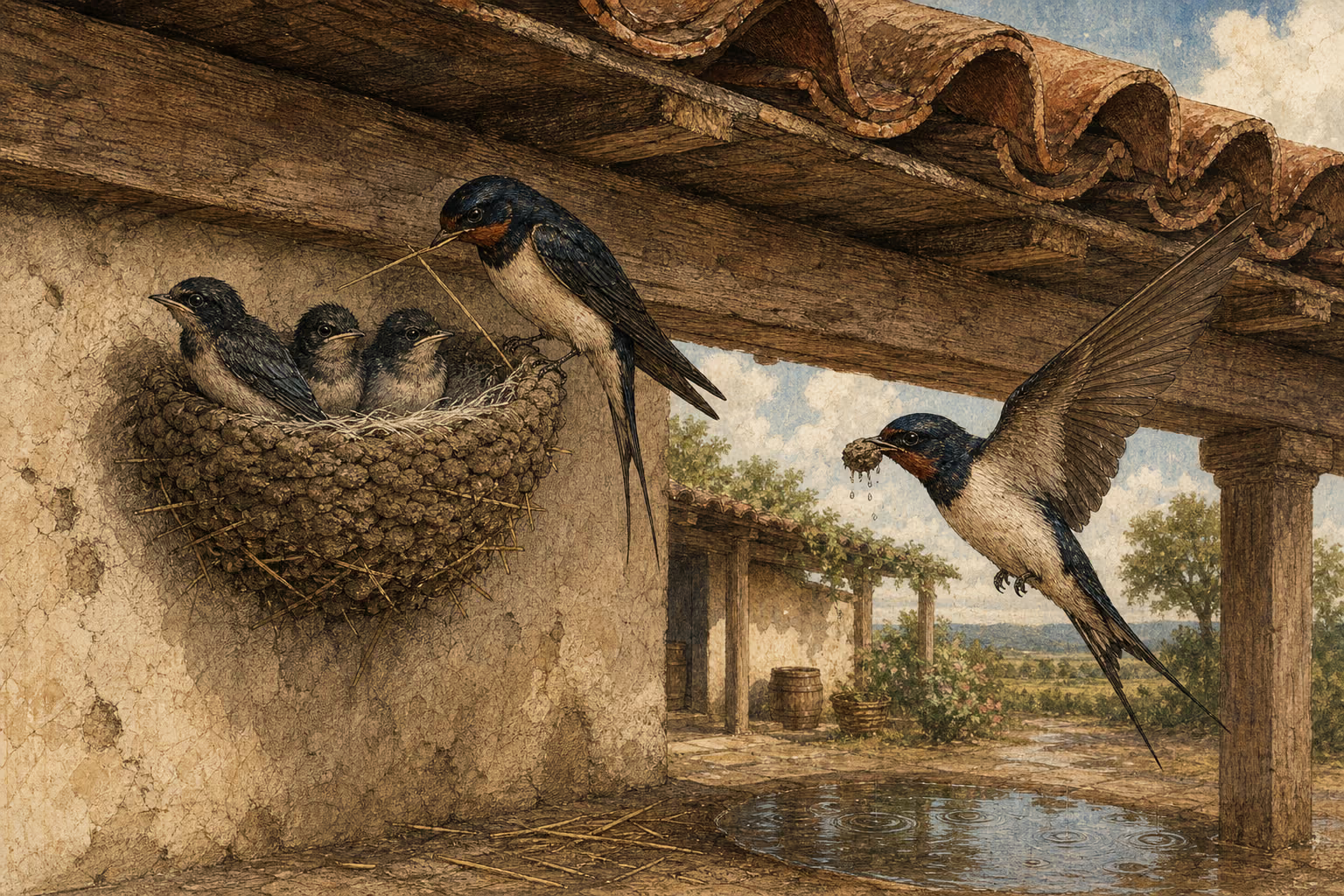
Halcyonum nidi figura reliquarum quoque sollertiae admonet, neque alia parte ingenia avium magis admiranda sunt. hirundines luto construunt, stramento roborant. si quando inopia est luti, madefactis multa aqua pinnis pulverem spargunt; ipsum vero nidum mollibus plumis floccisque consternunt tepefaciendis ovis, simul ne durus sit infantibus pullis. in fetu summa aequitate alternant cibum. notabili munditia egerunt excrementa pullorum adultioresque circumagi docent et foris saturitatem emittere. alterum est hirundinum genus rusticarum et agrestium, quae raro in domibus diversos figura, sed eadem materia confingunt nidos, totos supinos, faucibus porrectis in angustum, utero capaci, mirum qua peritia et occultandis habiles pullis et substernendis molles. in Aegypti Heracleotico ostio molem continuatione nidorum evaganti Nilo inexpugnabilem opponunt stadii fere unius spatio, quod humano opere perfici non posset. in eadem Aegypto iuxta oppidum Copton insula est sacra Isidi, quam ne laceret amnis idem, muniunt opere, incipientibus vernis diebus palea et stramento rostrum eius firmantes, continuatis per triduum noctibus tanto labore, ut multas in opere emori constet; eaque militia illis cum anno redit semper. tertium est earum genus: excavant ripas atque ita internidificant.— (Harum pulli ad cinerem ambusti mortifero faucium malo multisque aliis morbis humani corporis medentur) — non faciunt hae nidos migrantque multis diebus ante, si futurum est, ut auctus amnis attingat.
In genere vitiparrarum est cui nidus ex musco arido ita absoluta perficitur pila, ut inveniri non possit aditus. acanthyllis appellatur eadem figura ex lino intexens. Picorum aliquis suspenditur surculo primis in ramis cyathi modo, ut nulla quadripes possit accedere. galgulos quidem ipsos dependentes pedibus somnum capere confirmant, quia tutiores ita se sperent. iam publicum quidem omnium est tabulata ramorum sustinendo nido provide eligere, camarare ab imbri aut fronde protegere densa. in Arabia cinnamolgus avis appellatur cinnami surculis nidificans; plumbatis eos sagittis decutiunt indigenae mercis gratia. in Scythis avis magnitudine otidis binos parit in leporina pelle semper in cacuminibus ramorum suspensa. picae cum diligentius visum ab homine nidum sensere, ova transgerunt alio. hoc in iis avibus, quarum digiti non sint accommodati conplectendis transferendisque ovis, miro traditur modo. namque surculo super bina ova inposito ac feruminato alvi glutino, subdita cervice medio, aequa utrimque libra deportant alio.
Nec vero iis minor sollertia, quae cunabula in terra faciunt corporis gravitate prohibitae sublime petere. merops vocatur genitores suos reconditos pascens, pallido intus colore pinnarum, superne cyaneo, prioreparte subrutilo. nidificat in specu sex pedum defossa altitudine.
Perdices spina et frutice sic muniunt receptaculum, ut contra feram abunde vallentur. ovis stragulum molle pulvere contumulant nec in quo loco peperere incubant: ne cui frequentior conversatio suspecta sit, transferunt alio. illae quidem et maritos suos fallunt, quoniam intemperantia libidinis frangunt earum ova, ne incubando detineantur. tunc inter se dimicant mares desiderio feminarum; victum aiunt venerem pati. id quidem et coturnices Trogus et gallinaceos aliquando, perdices vero a domitis feros et novos aut victos iniri promiscue. capiuntur quoque pugnacitate eiusdem libidinis, contra aucupis inlicem exeunte in proelium duce totius gregis. capto eo procedit alter ac subinde singuli. rursus circa conceptum feminae capiuntur contra aucupum feminam exeuntes, ut rixando abigant eam. nec in alio animali par opus libidinis. si contra mares steterint, feminae aura ab iis flante praegnantes fiunt, hiantes autem exerta lingua per id tempus aestuant. concipiunt et supervolantium adflatu, saepe voce tantum audita masculi, adeoque vincit libido etiam fetus caritatem, ut illa furtim et in occulto incubans, cum sensit feminam aucupis accedentem ad marem, recanat revocetque et ultro praebeat se libidini. rabie quidem tanta feruntur, ut in capite aucupantium saepe caecae motu sedeant. si ad nidum is coepit accedere, procurrit ad pedes eius feta, praegravem aut delumbem sese simulans, subitoque in procursu aut brevi aliquo volatu cadit, ut fracta ala aut pedibus, at procurrit iterum iamiam prehensurum effugiens spemque frustrans, donec in diversum abducat a nidis. eadem in pavore, libera ac materna vacans cura, in sulco resupina glaeba se terrae pedibus adprehensa operit. perdicum vita et ad sedecim annos durare existimatur.
English · Bostock & Riley 1855–57
The form of the nest built by the halcyon reminds me also of the instinctive cleverness displayed by other birds; and, indeed, in no respect is the ingenuity of birds more deserving of our admiration. The swallow builds its nest of mud, and strengthens it with straws. If mud happens to fail, it soaks itself with a quantity of water, which it then shakes from off its feathers into the dust. It lines the inside of the nest with soft feathers and wool, to keep the eggs warm, and in order that the nest may not be hard and rough to its young when hatched. It divides the food among its offspring with the most rigid justice, giving it first to one and then to another. With a remarkable notion of cleanliness, it throws out of the nest the ordure of the young ones, and when they have grown a little older, teaches them how to turn round, and let it fall outside of the nest.
There is another kind of swallow, also, that frequents the fields and the country; its nest is of a different shape, though of the same materials, but it rarely builds it against houses. The nest has its mouth turned straight upwards, and the entrance to it is long and narrow, while the body is very capacious. It is quite wonderful what skill is displayed in the formation of it, for the purpose of concealing the young ones, and of presenting a soft surface for them to lie upon. At the Heracleotic Mouth of the Nile in Egypt, the swallows present an insuperable obstacle to the inroads of that river, in the embankment which is formed by their nests in one continuous line, nearly a stadium in length; a thing that could not possibly have been effected by the agency of man. In Egypt, too, near the city of Coptos, there is an island sacred to Isis. In the early days of spring, the swallows strengthen the angular corner of this island with chaff and straw, thus fortifying it in order that the river may not sweep it away. This work they persevere in for three days and nights together, with such unremitting labour, that it is a well-known fact that many of them die with their exertions. This, too, is a toil which recurs regularly for them every year.
There is, again, a third kind of swallow, which makes holes in the banks of rivers, to serve for its nest. The young of these birds, reduced to ashes, are a good specific against mortal maladies of the throat, and tend to cure many other diseases of the human body. These birds do not build nests, and they take care to migrate a good many days before, if it so happens that the rise of the river is about to reach their holes.
Belonging to the genus of birds known as the “vitiparræ,” there is one whose nest is formed of dried moss, and is in shape so exactly like a ball, that it is impossible to discover the mouth of it. The bird, also, that is known as the acanthyllis, makes its nest of a similar shape, and interweaves it with pieces of flax. The nest of one of the woodpeckers, very much like a cup in shape, is suspended by a twig from the end of the branch of a tree, so that no quadruped may be able to reach it. It is strongly asserted, that the witwall sleeps suspended by its feet, because it fancies that by doing so it is in greater safety. A thing, indeed, that is well-known of them all, is the fact that, in a spirit of foresight, they select the projecting branches of trees that are sufficiently strong, for the purpose of supporting their nests, and then arch them over to protect them from the rain, or else shield them by means of the thickness of the foliage.
In Arabia there is a bird known as the “cinnamolgus.” It builds its nest with sprigs of cinnamon; and the natives knock them down with arrows loaded with lead, in order to sell them. In Scythia there is a bird, the size of the otis, which produces two young ones always, in a hare’s skin suspended from the top branches of a tree. Pies, when they have observed a person steadily gazing at their nest, will immediately remove their eggs to another place. This is said to be accomplished in a truly wonderful manner, by such birds as have not toes adapted for holding and removing their eggs. They lay a twig upon two eggs, and then solder them to it by means of a glutinous matter secreted from their body; after which, they pass their neck between the eggs, and so forming an equipoise, convey them to another place.
No less, too, is the shrewdness displayed by those birds which make their nests upon the ground, because, from the extreme weight of their body, they are unable to fly aloft. There is a bird, known as the “merops,” which feeds its parents in their retreat: the colour of the plumage on the inside is pale, and azure without, while it is of a somewhat reddish hue at the extremity of the wings: this bird builds its nest in a hole which it digs to the depth of six feet.
Partridges fortify their retreat so well with thorns and shrubs, that it is effectually protected against beasts of prey. They make a soft bed for their eggs by burying them in the dust, but do not hatch them where they are laid: that no suspicion may arise from the fact of their being seen repeatedly about the same spot, they carry them away to some other place. The females also conceal themselves from their mates, in order that they may not be delayed in the process of incubation, as the males, in consequence of the warmth of their passions, are apt to break the eggs. The males, thus deprived of the females, fall to fighting among themselves; and it is said that the one that is conquered, is treated as a female by the other. Trogus Pompeius tells us that quails and dunghill cocks sometimes do the same; and adds, that wild partridges, when newly caught, or when beaten by the others, are trodden promiscuously by the tame ones. Through the very pugnacity thus inspired by the strength of their passions, these birds are often taken, as the leader of the whole covey frequently advances to fight with the decoy-bird of the fowler; as soon as he is taken, another and then another will advance, all of which are caught in their turn. The females, again, are caught about the pairing season; for then they will come forward to quarrel with the female decoy-bird of the fowler, and so drive her away. Indeed, in no other animal is there any such susceptibility in the sexual feelings; if the female only stands opposite to the male, while the wind is blowing from that direction, she will become impregnated; and during this time she is in a state of the greatest excitement, the beak being wide open and the tongue thrust out. The female will conceive also from the action of the air, as the male flies above her, and very often from only hearing his voice: indeed, to such a degree does passion get the better of her affection for her offspring, that although at the moment she is sitting furtively and in concealment, she will, if she perceives the female decoy-bird of the fowler approaching her mate, call him back, and summon him away from the other, and voluntarily submit to his advances.
Indeed, these birds are often carried away by such frantic madness, that they will settle, being quite blinded by fear, upon the very head of the fowler. If he happens to move in the direction of the nest, the female bird that is sitting will run and throw herself before his feet, pretending to be over-heavy, or else weak in the loins, and then, suddenly running or flying for a short distance before him, will fall down as though she had a wing broken, or else her feet; just as he is about to catch her, she will then take another fly, and so keep baffling him in his hopes, until she has led him to a considerable distance from her nest. As soon as she is rid of her fears, and free from all maternal disquietude, she will throw herself on her back in some furrow, and seizing a clod of earth with her claws, cover herself all over. It is supposed that the life of the partridge extends to sixteen years.