LIBER XI · CAPUT 45
THE NAILS
Latine · Mayhoff 1906
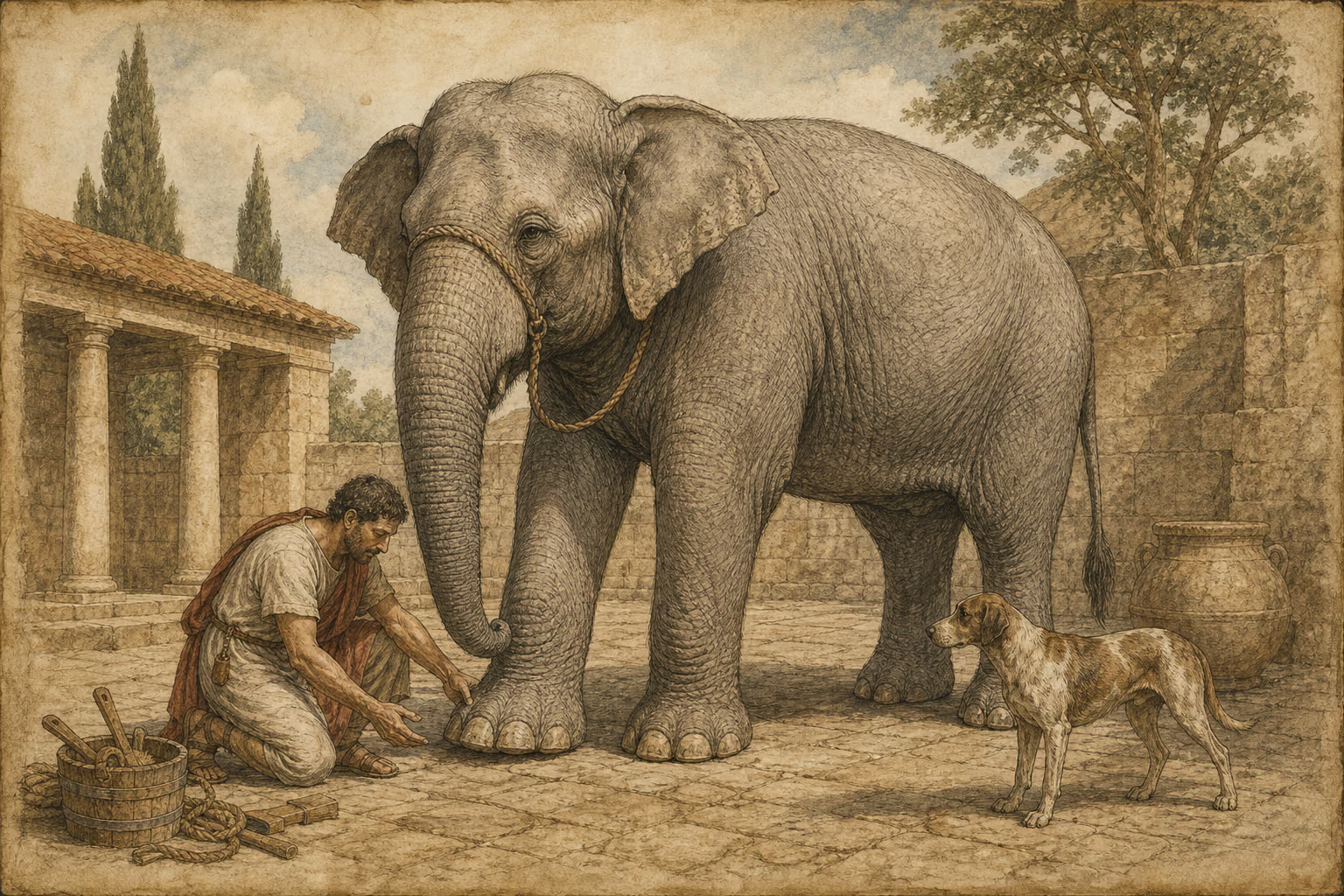
Vngues clausulae nervorum summae existimantur. omnibus hi quibus et digiti. sed simiae imbricati, hominibus lati — et defuncto crescunt —, rapacibus unci, ceteris recti, ut canibus, praeter eum qui a crure plerisque dependet. omnia digitos habent quae pedes, excepto elephanto; huic enim informes, numero quidem V, sed indivisi ac leviter discreti ungulisque, non unguibus, similes, et pedes maiores priores, in posterioribus articuli breves. idem poplites intus flectit hominis modo, cetera animalia in diversum posterioribus pedibus quam prioribus. nam quae animal generant, genua ante se flectunt et suffraginum artus in aversum.
Homini genua et cubita contraria, item ursis et simiarum generi, ob id minime pernicibus. ova parientibus quadripedum, crocodilo, lacertis, priora genua post curvantur, posteriora in priorem partem. sunt autem crura his obliqua, humani pollicis modo. sic et multipedibus praeterquam novissima salientibus. aves, ut quadripedes, alas in priora curvant, suffraginem in posteriora.
Hominis genibus quaedam et religio inest observatione gentium. haec supplices attingunt, ad haec manus tendunt, haec ut aras adorant, fortassis quia inest iis vitalitas. namque in ipsa genus utriusque commissura, dextra laevaque, a priore parte gemina quaedam buccarum inanitas inest, qua perfossa ceu iugulo spiritus fluit. inest et aliis partibus quaedam religio, sicut in dextera: osculis aversa adpetitur, in fide porrigitur. antiquis Graeciae in supplicando mentum attingere mos erat. est in aure ima memoriae locus, quem tangentes antestamur; est post aurem aeque dexteram Nemeseos, quae dea Latinum nomen ne in Capitolio quidem invenit, quo referimus tactum ore proximum a minimo digitum, veniam sermonis a diis ibi recondentes.
Varices in cruribus viro tantum, mulieri raro. C. Marium, qui VII consul fuit, stanti sibi extrahi passum unum hominum Oppius auctor est.
Omnia animalia a dextris partibus incedunt, sinistris incubant. reliqua ut libitum est gradiuntur, leo tantum et camelus pedatim, hoc est, ut sinister pes non transeat dextrum, sed subsequatur. pedes homini maximi, feminis tenuiores in omni genere. surae homini tantum et crura carnosa. reperitur apud auctores quendam in Aegypto non habuisse suras. vola homini tantum exceptis quibusdam. namque et hinc cognomina inventa Planci, Plauti, Pansae, Scauri, sicut a cruribus Vari, Vatiae, Vatini, quae vitia et in quadripedibus. solidas habent ungulas quae non sunt cornigera; igitur pro iis telum ungulae ictus est illis. nec talos habent eadem, at quae bisulca sunt, habent. iidem digitos habentibus non sunt, neque in prioribus omnino pedibus ulli. camelo tali similes bubulis, sed minores paulo; est enim bisulcum discrimine exiguo; pes in vestigio carnosus ut ursi, qua de causa in longiore itinere sine calceatu fatiscunt.
English · Bostock & Riley 1855–57
It is generally supposed that the nails are the terminations of the sinews. All animals which have fingers have nails as well. In the ape they are long and overlapping, like a tile, while in man they are broad: they will grow even after death. In the beasts of prey they are hooked, while in others, such as the dog, for instance, they are straight, with the exception, indeed, of the one which is attached to the leg in most of them. All the animals which have feet [and not hoofs], have toes as well, except the elephant; he, also, would appear to have toes, five in number, but rudely developed, undivided, and hardly distinct from one another, bearing a nearer resemblance, in fact, to hoofs than to claws. In the elephant the fore-feet are the largest, and in the hind-feet there are short joints. This animal is able, also, to bend the hams inward like a man, while in all the others the joints of the hinder legs bend in a contrary direction to those of the fore ones. Those animals which are viviparous bend the fore-leg forward, while the joint of the hind-leg is directed backward.
In man the knee and the elbow bend contrary ways; the same is the case, too, with the bear and the ape, and it is for this reason that they are not so swift of foot as other animals. Those quadrupeds which are oviparous, such as the crocodile and the lizard, bend the knee of the fore-leg backwards, and that of the hind-leg forwards; their thighs are placed on them obliquely, in a similar manner to a man’s thumb; which is the case also with the multipede insects, the hind-legs only excepted of such as leap. Birds, like quadrupeds, have the joints of the wings bending forwards, but those of the legs backwards.
In accordance with the usages of various nations, certain religious ideas have been attached to the knees. It is the knees that suppliants clasp, and it is to these that they extend their hands; it is the knees that they worship like so many altars, as it were; perhaps, because in them is centred the vital strength. For in the joint of either knee, the right as well as the left, there is on the fore-side of each a certain empty space, which bears a strong resemblance to a mouth, and through which, like the throat, if it is once pierced, the vital powers escape. There are also certain religious ideas attached to other parts of the body, as is testified in raising the back of the right hand to the lips, and extending it as a token of good faith. It was the custom of the ancient Greeks, when in the act of supplication, to touch the chin. The seat of the memory lies in the lower part of the ear, which we touch when we summon a witness to depose upon memory to an arrest. The seat, too, of Nemesis lies behind the right ear, a goddess which has never yet found a Latin name, no, not in the Capitol even. It is to this part that we apply the finger next the little finger, after touching the mouth with it, when we silently ask pardon of the gods for having let slip an indiscreet word.
Men only, in general, have varicose veins in the legs, women but very rarely. We are informed by Oppius, that C. Marius, who was seven times consul, was the only man ever known to be able to have them extracted in a standing position.
All animals take a right-hand direction when they first begin to walk, and lie down on the left side. While the other animals walk just as it may happen, the lion only and the camel walk foot by foot, or in such a way that the left foot never passes the right, but always comes behind it. Men have the largest feet; in every kind of animal the female has the smallest. Man only has calves, and flesh upon the legs: we find it stated by authors, however, that there was once an Egyptian who had no calves on his legs. All men, too, with some few exceptions, have a sole to the foot. It is from these exceptional cases that persons have obtained the names of Plancus, Plautus, Pansa, and Scaurus; just as, from the malformation of the legs, we find persons called Varus, Vacia, and Vatinius, all which blemishes are to be seen in quadrupeds also. Animals which have no horns have a solid hoof, from which circumstance it is used by them as a weapon of offence, in place of horns; such animals as these are also destitute of pastern bones, but those which have cloven hoofs have them; while those, again, which have toes have none, nor are they ever found in the fore-feet of animals. The camel has pastern bones like those of the ox, but somewhat smaller, the feet being cloven, with a slight line of division, and having a fleshy sole, like that of the bear: hence it is, that in a long journey, the animal becomes fatigued, and the foot cracks, if it is not shod.