LIBER XII · CAPUT 19
CINNAMOMUM. XYLOCINNAMUM
Latine · Mayhoff 1906
Cinnamonum et casias fabulose narravit antiquitas princepsque Herodotus avium nidis et privatim phoenicis, in quo situ Liber pater educatus esset, ex inviis rupibus arboribusque decuti carnis quam ipsae inferrent pondere aut plumbatis;agittis, item casiam circa paludes, propugnante unguibus ciro vespertilionum genere aligerisque serpentibus, his commentis augentes rerum pretia. comitata vero fabula est ad meridiani solis repercussus inenarrabilem quendam unversitatis halitum e tota paeninsula existere tot generum aurae spirante concentu, Magnique Alexandri classibus Arabiam primum odoribus nuntiatam in altum. omnia falsa, si quidem cinnamomum idemque cinnamum nascitur in Aethiopia Trogodytis conubio permixta. hi mercantes id a conterminis vehunt per maria vasta ratibus, quas neque gubernacula regant neque remi trahant vel inpellant vela, non ratio ulla adiuvet: omnium instar ibi sunt homo tantum et audacia. praeterea hibernum mare exigunt circa brumam, euris tum maxime flantibus. hi recto cursu per sinus inpellunt, atque a promunturii ambitu argestae deferunt in portum Gebbanitarum qui vocatur Ocilia. quam ob rem illi maxime id petunt, produntque vix quinto anno reverti negotiatores et multos interire. contra revehunt vitrea et aëna, vestes, fibulas cum armillis ac monilibus. ergo negotiatio illa feminarum maxime fide constat.
Ipse frutex duum cubitorum altitudine amplissimus palmique minimus, quattuor digitorum crassitudinis, station a terra VI digitis surculosus, arido similis, cum viret, non odoratus, folio origani, siccitate gaudens, sterilior imbre, caeduae naturae. gignitur in planis quidem, sed densissimis in vepribus rubisque, difficilis collectu. metitur non nisi permiserit deus. lovem hunc intellegunt aliqui, Assabinum illi vocant. XLIIII boum caprarumque et arietum extis impetratur venia caedendi, non tamen ut ante ortum solis aut post occasum liceat. sarmenta hasta dividit sacer- dos deoque partem ponit, reliquum mercator in massas condit. est et alia fama cum Sole dividi ternasque partes fieri, dein sorte gemina discerni quodque Soli cesserit relinqui ac sponte conflagrare. praecipua bonitas virgultorum tenuissimis partibus ad longitudinem palmi, secunda proximis breviore mensura, atque ita ordine. vilissimum quod radicibus proximum, quoniam ibi minimum corticis, in quo summa gratia, eaque de causa praeferuntur cacumina, ubi plurimus torpet. ipsum vero lignum in fastidio propter origani acrimoniam, xylocinnamomum vocatur. pretium ei in libras $X$ X. quidam cinnami duo genera tradidere, candidius nigriusque, et quondam praeferebatur candidum, >nunc contra nigrum laudatur atque etiam varium praeferunt candido. certissima tamen aestimatio, ne sit scabrum atque ut inter sese tritum tarde frietur; damnatur in primis molle aut cui labet cortex. ius eius a Gebbanitarum rege solo proficiscitur; is edicto mercatu vendit. pretia quondam fuere in libras denarium nilia. auctum id parte dimidia est incensis, ut ferunt, silvis ira barbarorum. id acciderit ob iniquitatem praepotentium an forte, non satis constat. austros ibi tam ardentes flare, ut aestatibus silvas accendant, invenimus apud auctores coronas ex cinnamo interrasili auro inclusas primus omnium in templis Capitolii atque Pacis dicavit Imperator Vespasianus Augustus. radicem eius magni ponderis vidimus in Palatii templo, quod fecerat Divo Augusto coniunx Augusta, aureae paterae inpositam, ex qua guttae editae annis omnibus in grana durabantur, donec id delubrum incendio consumptum est.
Frutex et casia est iuxtaque cinnami campos nascitur, sed in montibus crassiore sarmento, tenui cute verius quam cortice, quem contra atque in cinnamo diximus labare et exinaniri pretium est. amplitudo frutici trium cubitorum, colos triplex: cum primum emicat, candidus pedali mensura, dein rufescit addito semipede, ultra nigricans. haec pars maxime laudatur ac deinde proxima, damnatur vero candida. consecant surculos longitudine binum digitorum, mox praesuunt recentibus coriis quadripedum ob id interemptarum, ut putrescentibus vermiculi lignum erodant et excavent corticem, tutum amaritudine. probatur recens maxime et quae sit odoris longissimi gustuque quam minime fervens potiusque lento tepore leniter mordens, colore purpurae, quaeque plurima minimum ponderis faciat, brevi tunicarum fistula atque non fragili. ladam vocant talem barbaro nomine. alia est balsamodes, ab odore simili appellata, sed amara ideoque utilior medicis, sicut nigra unguentis. pretia nulli diversiora, optimae in libras $X$ L, ceteris $X$ V.
English · Bostock & Riley 1855–57
Fabulous antiquity, and Herodotus more particularly, have related that cinnamomum and cassia are found in the nests of certain birds, and principally that of the phœnix, in the districts where Father Liber was brought up; and that these substances either fall from the inaccessible rocks and trees in which the nests are built, in consequence of the weight of the pieces of flesh which the birds carry up, or else are brought down by the aid of arrows loaded with lead. It is said, also, that cassia grows around certain marshes, but is protected by a frightful kind of bat armed with claws, and by winged serpents as well. All these tales, however, have been evidently invented for the purpose of enhancing the prices of these commodities. Another story, too, bears them company, to the effect that under the rays of the noon-day sun, the entire peninsula exhales a certain indescribable perfume composed of its numerous odours; that the breezes, as they blow from it, are impregnated with these odours, and, indeed, were the first to announce the vicinity of Arabia to the fleets of Alexander the Great, while still far out at sea. All this, however, is false; for cinnamomum, or cinnamum, which is the same thing, grows in the country of the Æthiopians, who are united by intermarriages with the Troglodytæ. These last, after buying it of their neighbours, carry it over vast tracts of sea, upon rafts, which are neither steered by rudder, nor drawn or impelled by oars or sails. Nor yet are they aided by any of the resources of art, man alone, and his daring boldness, standing in place of all these; in addition to which, they choose the winter season, about the time of the equinox, for their voyage, for then a south easterly wind is blowing; these winds guide them in a straight course from gulf to gulf, and after they have doubled the promontory of Arabia, the north east wind carries them to a port of the Gebanitæ, known by the name of Ocilia. Hence it is that they steer for this port in preference; and they say that it is almost five years before the merchants are able to effect their return, while many perish on the voyage. In return for their wares, they bring back articles of glass and copper, cloths, buckles, bracelets, and necklaces; hence it is that this traffic depends more particularly upon the capricious tastes and inclinations of the female sex.
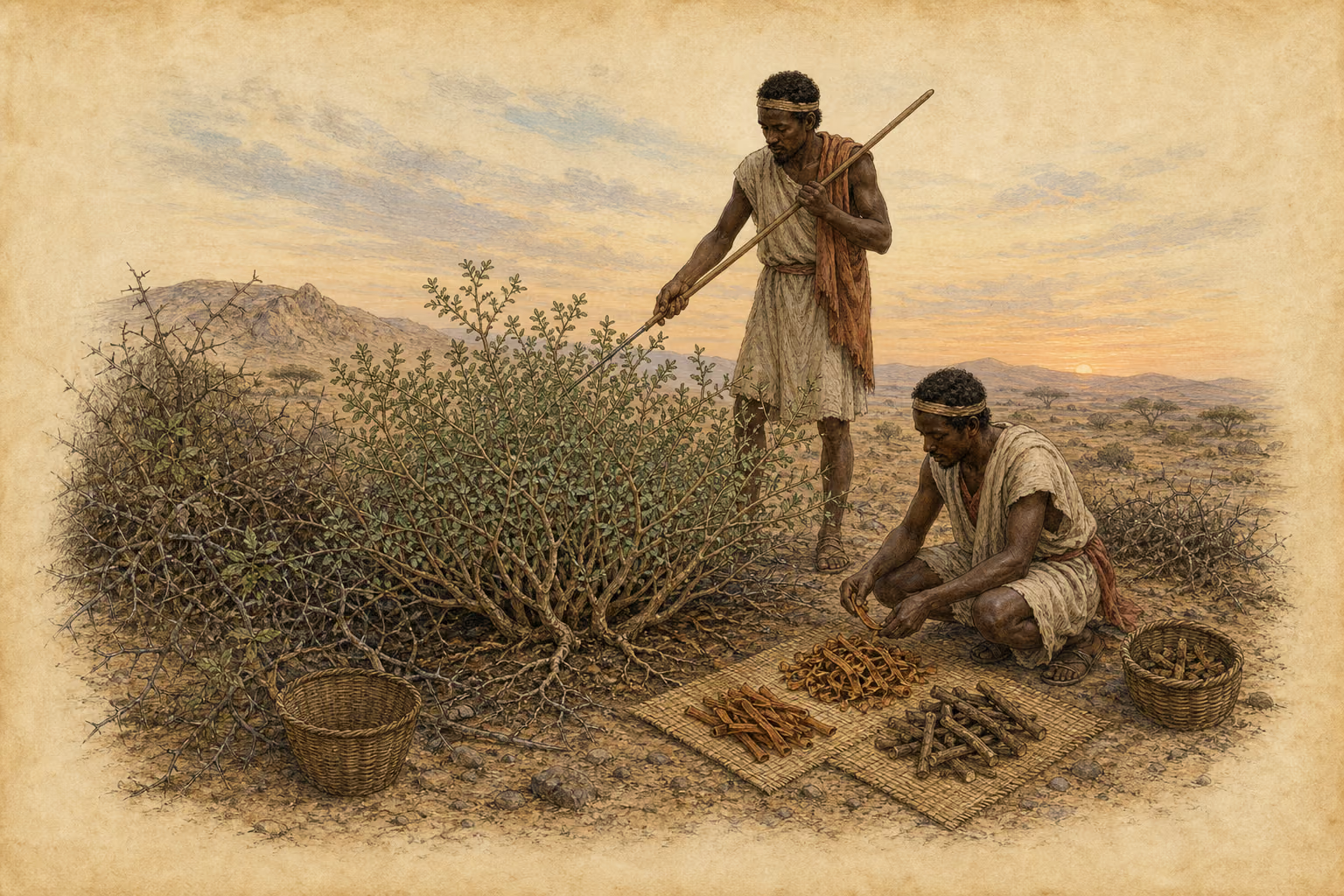
The cinnamon shrub is only two cubits in height, at the most, the lowest being no more than a palm in height. It is about four fingers in breadth, and hardly has it risen six fingers from the ground, before it begins to put forth shoots and suckers. It has then all the appearance of being dry and withered, and while it is green it has no odour at all. The leaf is like that of wild marjoram, and it thrives best in dry localities, being not so prolific in rainy weather; it requires, also, to be kept constantly clipped. Though it grows on level ground, it thrives best among tangled brakes and brambles, and hence it is extremely difficult to be gathered. It is never gathered unless with the permission of the god, by whom some suppose Jupiter to be meant; the Æthiopians, however, call him Assabinus. They offer the entrails of forty-four oxen, goats, and rams, when they implore his permission to do so, but after all, they are not allowed to work at it before sunrise or after sunset. A priest divides the branches with a spear, and sets aside one portion of them for the god; after which, the dealer stores away the rest in lumps. There is another account given, which states that a division is made between the gatherers and the sun, and that it is divided into three portions, after which lots are twice drawn, and the share which falls to the sun is left there, and forthwith ignites spontaneously.
The thinnest parts in the sticks, for about a palm in length, are looked upon as producing the finest cinnamon; the part that comes next, though not quite so long, is the next best, and so on downwards. The worst of all is that which is nearest the roots, from the circumstance that in that part there is the least bark, the portion that is the most esteemed: hence it is that the upper part of the tree is preferred, there being the greatest proportion of bark there. As for the wood, it is held in no esteem at all, on account of the acrid taste which it has, like that of wild marjoram; it is known as xylocinnamum. The price of cinnamomum is ten denarii per pound. Some writers make mention of two kinds of cinnamon, the white and the black: the white was the one that was formerly preferred, but now, on the contrary, the black is held in the highest estimation, and the mottled, even, is preferred to the white. The most certain test, however, of the goodness of cinnamon is its not being rough, and the fact that the pieces when rubbed together do not readily crumble to powder. That which is soft is more particularly rejected, which is the case, also, when the outer bark too readily falls off.
The right of regulating the sale of the cinnamon belongs solely to the king of the Gebanitæ, who opens the market for it by public proclamation. The price of it was formerly as much as a thousand denarii per pound; which was afterwards increased to half as much again, in consequence, it is said, of the forests having been set on fire by the barbarians, from motives of resentment; whether this took place through any injustice exercised by those in power, or only by accident, has not been hitherto exactly ascertained. Indeed, we find it stated by some authors, that the south winds that prevail in these parts are sometimes so hot as to set the forests on fire. The Emperor Vespasianus Augustus was the first to dedicate in the temples of the Capitol and the goddess Peace chaplets of cinnamon inserted in embossed gold. I, myself, once saw in the temple of the Palatium, which his wife Augusta dedicated to her husband the late emperor Augustus, a root of cinnamon of great weight, placed in a patera of gold: from it drops used to distil every year, which congealed in hard grains. It remained there until the temple was accidentally destroyed by fire.
Cassia is a shrub also, which grows not far from the plains where cinnamon is produced, but in the mountainous localities; the branches of it are, however, considerably thicker, than those of cinnamon. It is covered with a thin skin rather than a bark, and, contrary to what is the case with cinnamon, it is looked upon as the most valuable when the bark falls off and crumbles into small pieces. The shrub is three cubits in height, and the colours which it assumes are threefold: when it first shoots from the ground, for the length of a foot, it is white; after it has attained that height, it is red for half a foot, and beyond that it is black. This last is the part that is held in the highest esteem, and next to it the portion that comes next, the white part being the least valued of all. They cut the ends of the branches to the length of two fingers, and then sew them in the fresh skins of cattle that have been killed expressly for the purpose; the object being that the skins may putrefy, and the maggots generated thereby may eat away the woody parts, and so excavate the bark; which is so intensely bitter, that it is quite safe from their attacks. That which is the freshest is the most highly esteemed; it has a very delicate smell, and is so extremely hot to the taste, that it may be said to burn the tongue, rather than gradually warm the mouth. It is of a purple colour, and though of considerable volume, weighs but very little in comparison; the outer coat forms into short tubes which are by no means easily broken: this choice kind of cassia, the barbarians call by the name of lada. There is another sort, again, which is called balsamodes, because it has a smell like that of balsam, but it is bitter; for which reason it is more employed for medicinal purposes, just as the black cassia is used for unguents. There is no substance known that is subject to greater variations in price: the best qualities sell at fifty denarii per pound, others, again, at five.