LIBER XIII · CAPUT 15
THE TREES OF MOUNT ATLAS. THE CITRUS, AND THE TABLES MADE OF THE WOOD THEREOF
Latine · Mayhoff 1906
Atlans mons peculiari proditur silva, de qua diximus. confines ei Mauri, quibus plurima arbor citri et mensarum insania, quas feminae viris contra margaritas regerunt. exstat hodie M. Ciceroni in illa paupertate et (quod magis mirum est) illo aevo empta HS D???. memoratur et Galli Asini HS |X|. venumdatae sunt et duae ab Iuba rege pendentes, quarum alteri pretium fuit HS |XII|, alteri paulo minus. interiit nuper incendio a Cethegis descendens, HS |XIII| permutata, latifundii taxatione, si quis praedia tanti mercari malit. magnitudo amplissimis adhuc fuit uni commissae ex orbibus dimidiatis duobus a rege Mauretaniae Ptolemaeo quattuor pedes et semipedem per medium ambitum, crassitudine quadratali — maiusque miraculum in ea est artis latente iunctura quam potuisset esse naturae —, solidae autem a Nomio Caesaris liberto cognomen trahenti tribus sicilicis infra quattuor pedes totidemque infra pedem crassitudinis. qua in re non omittendum videtur Tiberio principi mensam quattuor pedes sextante et sicilico excedentem, tota vero crassitudine sescunciali, operimento lamnae vestitam fuisse, cum tam opima Nomio liberto eius esset. tuber hoc est radicis, maximeque laudatum quod sub terra totum fuerit, et rarius quam quae superne gignuntur etiam in ramis, proprieque quod tanti emitur arborum vitium est, quarum amplitude ac radices aestimari possunt ex orbibus. sunt autem cupresso feminae atque etiamnum silvestri similes folio, odore, caudice. Ancorarius mons vocatur citerioris Mauretaniae, qui laudatissimum dedit citrum, iam exhaustus.
Mensis praecipua dos in venam crispis vel in vertices parvos. illud oblongo evenit discursu ideoque tigrinum appellatur, hoc intorto et ideo tales pantherinae vocantur. sunt et undatim crispae, maiore gratia, si pavonum caudae oculos imitentur. magna, verum post has, gratia extra praedictas crispis densa veluti grani congerie, quas ob id a similitudine apiatas vocant. summa vero omnium in colore: hic maxime mulsi placet, vinis suis refulgens. post haec amplitude est: iam toti caudices iuvant, pluresque in una. mensae vitia lignum — ita vocatur materiae surda et indigesta simplicitas aut platani foliorum modo digesta —, item ilignae venae similitudo vel coloris et, quibus maxime obnoxias fecere aestus ventique, rimae aut capillamenta rimas imitata; postea murena nigro transcurrens limite variisque corticum punctis adprehensus papaverum modo et in totum atro propior colos maculaeve discolores. — Virides terra condunt barbari et inlinunt cera, artifices vero frumenti acervis inponunt septenis diebus totidem intermissis, mirumque ponderi quantum ita detrahatur. naufragia docuere nuper hanc quoque materiem siccatam mari, duritie incorrupta, cospissari non ullo modo vehementius. nutriuntur optime splendescuntque manus siccae fricatu a balineis maxime, nec vinis laeduntur ut iis genitae.
English · Bostock & Riley 1855–57
Mount Atlas is said to possess a forest of trees of a peculiar character, of which we have already spoken. In the vicinity of this mountain is Mauretania, a country which abounds in the citrus, a tree which gave rise to the mania for fine tables, an extravagance with which the women reproach the men, when they complain of their vast outlay upon pearls. There is preserved to the present day a table which belonged to M. Cicero, and for which, notwithstanding his comparatively moderate means, and what is even more surprising still, at that day too, he gave no less than one million sesterces: we find mention made also of one belonging to Gallus Asinius, which cost one million one hundred thousand sesterces. Two tables were also sold by auction which had belonged to King Juba; the price fetched by one was one million two hundred thousand sesterces, and that of the other something less. There has been lately destroyed by fire, a table which came down from the family of the Cethegi, and which had been sold for the sum of one million four hundred thousand sesterces, the price of a considerable domain, if any one, indeed, could be found who would give so large a sum for an estate.
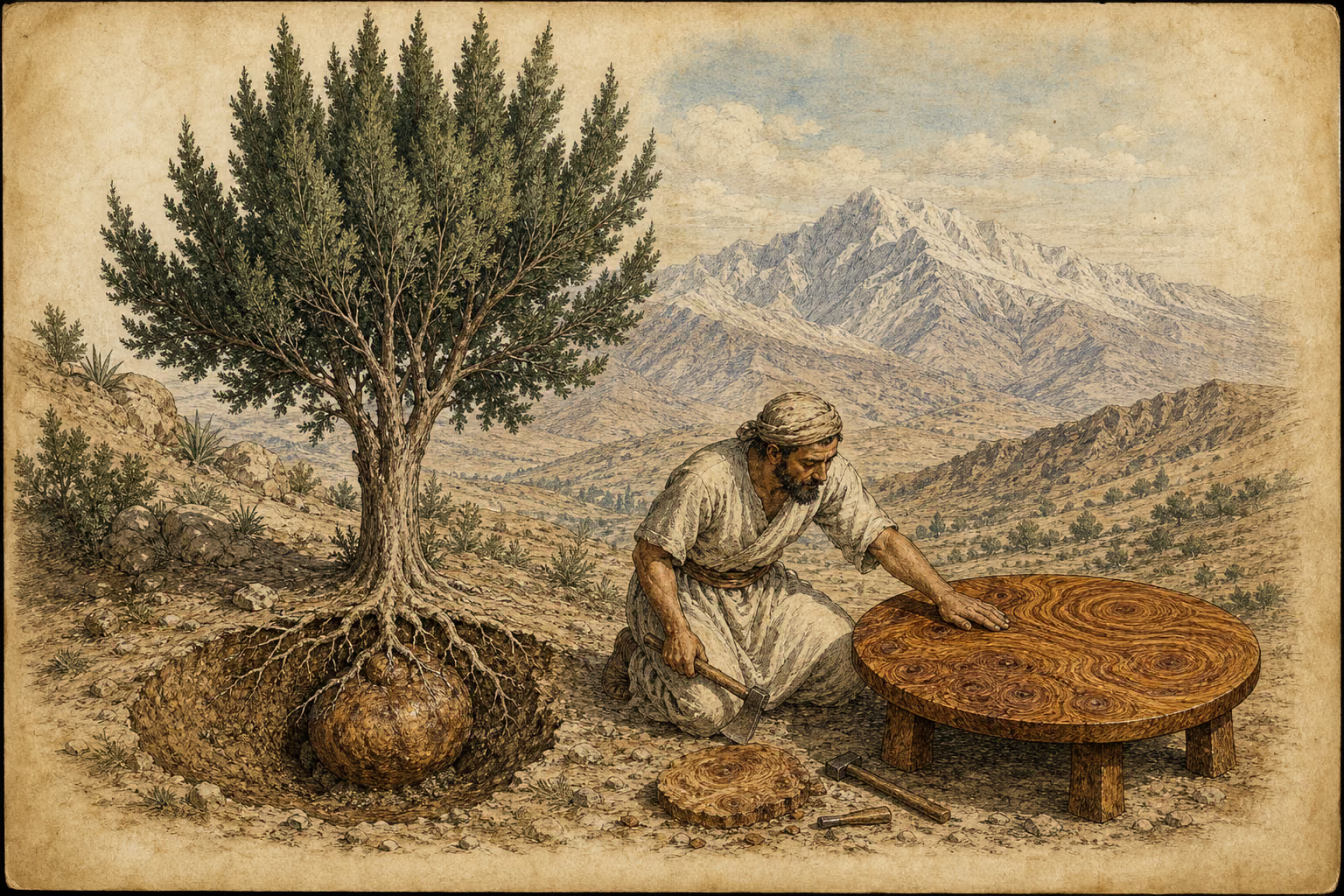
The largest table that has ever yet been known was one that belonged to Ptolemæus, king of Mauretania; it was made of two semicircumferences joined together down the middle, being four feet and a half in diameter, and a quarter of a foot in thickness: the most wonderful fact, however, connected with it, was the surprising skill with which the joining had been concealed, and which rendered it more valuable than if it had been by nature a single piece of wood. The largest table that is made of a single piece of wood, is the one that takes its name from Nomius, a freedman of Tiberius Cæsar. The diameter of it is four feet, short by three quarters of an inch, and it is half a foot in thickness, less the same fraction. While speaking upon this subject, I ought not to omit to mention that the Emperor Tiberius had a table that exceeded four feet in diameter by two inches and a quarter, and was an inch and a half in thickness: this, however, was only covered with a veneer of citrus-wood, while that which belonged to his freedman Nomius was so costly, the whole material of which it was composed being knotted wood.
These knots are properly a disease or excrescence of the root, and those used for this purpose are more particularly esteemed which have lain entirely concealed under ground; they are much more rare than those that grow above ground, and that are to be found on the branches also. Thus, to speak correctly, that which we buy at so vast a price is in reality a defect in the tree: of the size and root of it a notion may be easily formed from the circular sections of its trunk. The tree resembles the wild female cypress in its foliage, smell, and the appearance of the trunk. A spot called Mount Ancorarius, in Nearer Mauretania, used formerly to furnish the most esteemed citrus-wood, but at the present day the supply is quite exhausted.
The principal merit of these tables is to have veins arranged in waving lines, or else forming spirals like so many little whirlpools. In the former arrangement the lines run in an oblong direction, for which reason these are called “tiger” tables; while in the latter the marks are circling and spiral, and hence they are styled “panther” tables. There are some tables also with wavy, undulating marks, and which are more particularly esteemed if these resemble the eyes on a peacock’s tail. Next in esteem to these last, as well as those previously mentioned, is the veined wood, covered, as it were, with dense masses of grain, for which reason these tables have received the name of “apiatæ.” But the colour of the wood is the quality that is held in the highest esteem of all: that of wine mixed with honey being the most prized, the veins being peculiarly refulgent. Next to the colour, it is the size that is prized; at the present day whole trunks are greatly admired, and sometimes several are united in a single table.
The peculiar defects in these kinds of tables are woodiness, such being the name given to the table when the wood is dull, common-looking, indistinct, or else has mere simple marks upon it, resembling the leaves of the plane-tree; also, when it resembles the veins of the holm-oak or the colour of that tree; and, a fault to which it is peculiarly liable from the effect of heat or wind, when it has flaws in it or hair-like lines resembling flaws; when it has a black mark, too, running through it resembling a murena in appearance, various streaks that look like crow scratches, or knots like poppy heads, with a colour all over nearly approaching to black, or blotches of a sickly hue. The barbarous tribes bury this wood in the ground while green, first giving it a coating of wax. When it comes into the workmen’s hands, they put it for seven days beneath a heap of corn, and then take it out for as many more: it is quite surprising how greatly it loses in weight by this process. Shipwrecks have recently taught us also that this wood is dried by the action of sea-water, and that it thereby acquires a hardness and a degree of density which render it proof against corruption: no other method is equally sure to produce these results. These tables are kept best, and shine with the greatest lustre, when rubbed with the dry hand, more particularly just after bathing. As if this wood had been created for the behoof of wine, it receives no injury from it.