LIBER XIV · CAPUT 6
FIFTY KINDS OF GENEROUS WINES
Latine · Mayhoff 1906
Genera autem vini alia aliis gratiora esse quis dubitet aut non ex eodem lacu aliud praestantius altero germanitatem praecedere sive testa sive fortuito eventu? quam ob rem de principatu se quisque iudicem statuet. lulia Augusta LXXXVI annos vitae Pucino vino rettulit acceptos, non alio usa. gignitur in sinu Hadriatici maris non procul Timavo fonte saxoso colle, maritimo adflatu paucas coquente amphoras; nec aliud aptius medicamentis indicatur. hoc esse crediderim quod Graeci celebrantes miris laudibus Praetetianum appellaverint ex Hadriatico sinu. Divus Augustus Setinum praetulit cunctis et fere secuti principes, confessa propter experimenta, non temere cruditatibus noxiis ab ea saliva. nascitur supra Forum Appi. antea Caecubo erat generositas celeberrima in palustribus populetis sinu Amynclano, quod iam intercidit incuria coloni locique angustia, magis tamen fessa Neronis, quam a Baiano lacu Ostiam usque navigabilem incohaverat.
Secunda nobilitas Falerno agro erat et ex eo maxime Faustiniano; cura culturaque id collegerat. exolescit haec quoque copiae potius quam bonitati studentium. Falernus ager a ponte Campano???aeva petentibus Vrbanam coloniam Sullanam nuper Capuae contributam incipit, Faustinianus circiter IIII milia passuum a vico Caedicio, qui vicus a Sinuessa VI M passuum abest. nec ulli nunc vino maior auctoritas. solo vinorurm flamma accenditur. tria eius genera: austerum, dulce, lenue. quidam ita distingunt, summis collibus Caucinum gigni, mediis Faustinianum, imis Falernum. non omittendum autem nulli eorum quae celebrentur iucundum saporem uvae esse.
At tertiam palmam varie venere Albana urbi vicina, praedulcia ac rara in austero, item Surrentina in vineis tantum nascentia, convalescentibus maxime probata propter tenuitatem salubritatemque. Tiberius Caesar dicebat consensisse medicos ut nobilitatem Surrentino darent; alioqui esse generosum acetum; C. Caesar, qui successit illi, nobilem vappam. certant Massica atque a monte Gauro Puteolos Baiasque prospectantia. nam Falerno contermina Statana ad principatum venere non dubie palamque fecere sua quibusque terris tempora esse, suos rerum proventus occasusque. iuncta iis praeponi solebant Calena et quae in vineis arbustisque nascuntur Fundana et alia ex vicinia urbis, Veliterna, Privernatia. nam quod Signiae nascitur, austeritate nimia continendae utile alvo, inter medicamina numeratur.
Quartum curriculum publicis epulis optinuere a Divo Iulio — is enim primus auctoritatem iis dedit, ut epistulis eius apparet — Mamertina circa Messanam in Sicilia genita; ex iis Potulana, ab auctore dicta illo cognomine, proxima Italiae laudantur praecipue. est in eadem Sicilia et Taurom enitanis honos lagonis pro Mamertino plerumque subditis.
Ex reliquis autem a supero maria Praetutia atque Ancone nascentia, et quae a palma una forte enata palmensia appellavere, in mediterraneo vero Caesenatia ac Maecenatiana, in Veroniensi item Raetica, Falernis tantum postlata a Vergilio, mox ab intimo sinu maris Hadriana, ab infero autem Latiniensia, Graviscana, Statoniensia. Etruriae Luna palmam habet, Liguriae Genua, inter Pyrenaeum Alpesque Massilia gemino sapore, quando et condiendis aliis pinguius gignit, quod vocat sucosum. Baeterrarum intra Gallias consistit auctoritas. de reliquis in Narbonensi genitis adseverare non est, quoniam officinam eius rei fecere tinguentes fumo, utinamque non et herbis ac medicaminibus noxiis! quippe etiam aloe mercator saporem coloremque adulterat.
Verum et longinquiona Italiae ab Ausonio mari non carent gloria, Tarentina et ServLtia et Consentiae genita et Tempsae, Calabriae Lucanaque anecedentibus Thurinis. omnium vero eorum maxime inlustrata Messalae Potiti salute Lagarina, non procul Grumento aascentia. Campania nuper excitavit novis nominibus auctoritatem sive cura sive casu ad quartum a Neapoli lapidem Trebellicis, iuxta Capuam Caulinis et in suo agro Trebulanis, alioqui semper inter plebeia et Trifolinis gloriata. nam Pompeianis summum decem annorum incrementum est, nihil senecta conferente. dolore etiam capitum in sextam horam diei sequentis infesta deprehenduntur. quibus exemplis, nisi fallor, manifestum est patriam terramque referre, non uvam, et supervacuam generum consectationem in numerum, cum eadem vitis aliud aliis in locis polleat. Hispaniarum Laeetana copia nobilitantur, elegantia vero Tarraconensia atque Lauronensia et Baliarica ex insulis conferuntur Italiae primis. nec ignoro multa praetermissa plerosque existimaturos, quando suum cuique placet et, quocumque eatur, fabula eadem reperitur, Divi Augusti iudiciorum ac palati peritissimum e libertis censuram vini in epulas eius facientem dixisse hospiti de indigena vino, novum quidem sibi gustum esse eum atque non ex nobilibus, sed Caesarem non aliud poturum, nec negaverim et alia digna esse fama, sed de quibus consensus aevi iudicaverit haec sunt.
English · Bostock & Riley 1855–57
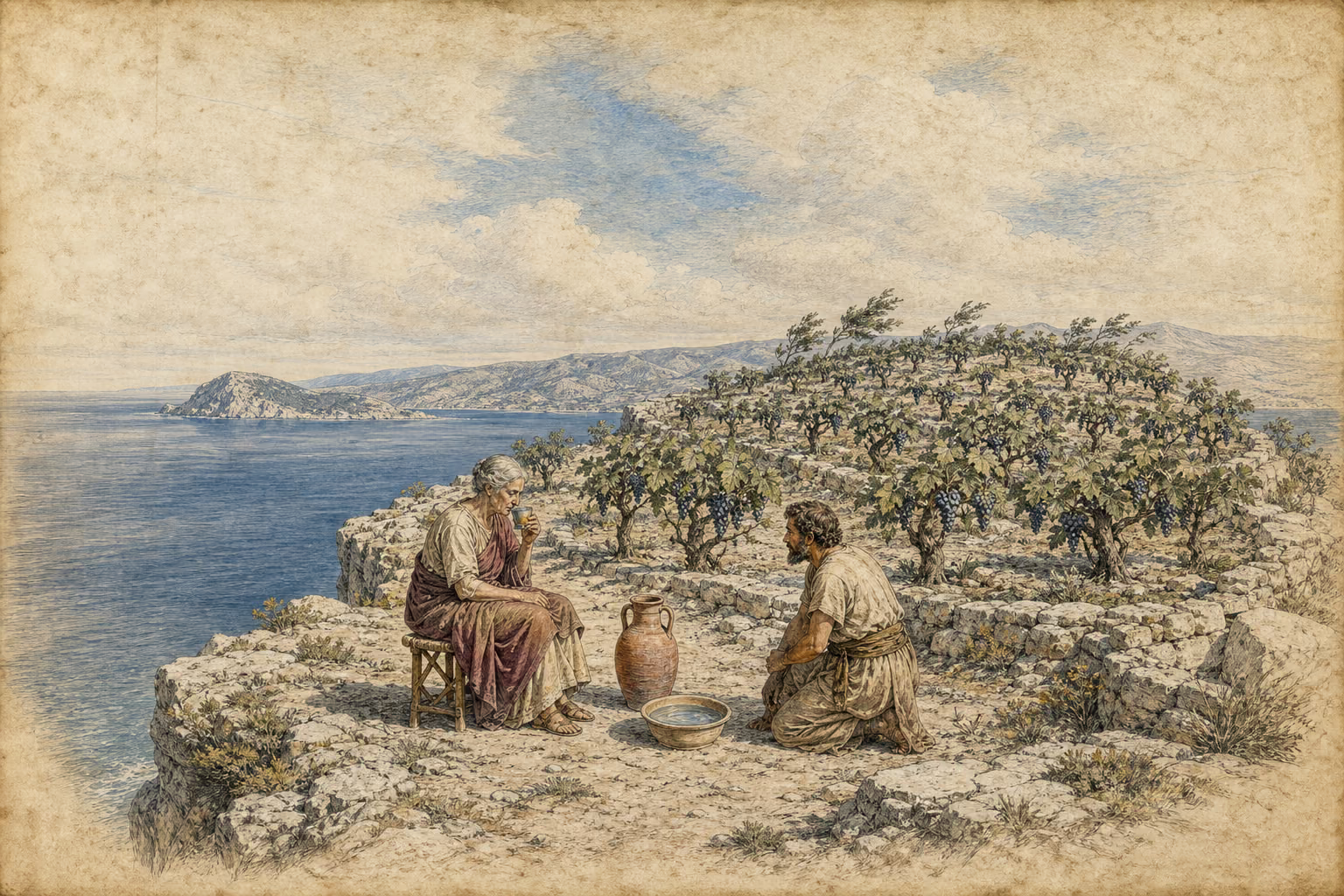
Who can entertain a doubt that some kinds of wine are more agreeable to the palate than others, or that even out of the very same vat there are occasionally produced wines that are by no means of equal goodness, the one being much superior to the other, whether it is that it is owing to the cask, or to some other fortuitous circumstance? Let each person, therefore, constitute himself his own judge as to which kind it is that occupies the pre-eminence. Livia Augusta, who lived to her eighty-second year, attributed her longevity to the wine of Pucinum, as she never drank any other. This wine is grown near a bay of the Adriatic, not far from Mount Timavus, upon a piece of elevated rocky ground, where the sea-breeze ripens a few grapes, the produce of which supplies a few amphoræ: there is not a wine that is deemed superior to this for medicinal purposes. I am strongly of opinion that this is the same wine, the produce of the Adriatic Gulf, upon which the Greeks have bestowed such wonderful encomiums, under the name of Prætetianum.
The late Emperor Augustus preferred the Setinum to all others, and nearly all the emperors that have succeeded him have followed his example, having learnt from actual experience that there is no danger of indigestion and flatulence resulting from the use of this liquor: this wine is grown in the country that lies just above Forum Appii. In former times the Cæcubum enjoyed the reputation of being the most generous of all the wines; it was grown in some marshy swamps, planted with poplars, in the vicinity of the Gulf of Amyclæ. This vineyard has, however, now disappeared, the result of the carelessness of the cultivator, combined with its own limited extent, and the works on the canal which Nero commenced, in order to provide a navigation from Lake Avernus to Ostia.
The second rank belonged to the wine of the Falernian territory, of which the Faustianum was the most choice variety; the result of the care and skill employed upon its cultivation. This, however, has also degenerated very considerably, in consequence of the growers being more solicitous about quantity than quality. The Falernian vineyards begin at the bridge of Campania, on the left-hand as you journey towards the Urbana Colonia of Sylla, which was lately a township of the city of Capua. As to the Faustian vineyards, they extend about four miles from a village near Cædiciæ, the same village being six miles from Sinuessa. There is now no wine known that ranks higher than the Falernian; it is the only one, too, among all the wines that takes fire on the application of flame. There are three varieties of it—the rough, the sweet, and the thin. Some persons make the following distinctions: the Caucinum, they say, grows on the summit of this range of hills, the Faustianum on the middle slopes, and the Falernum at the foot: the fact, too, should not be omitted, that none of the grapes that produce these more famous wines have by any means an agreeable flavour.
To the third rank belonged the various wines of Alba, in the vicinity of the City, remarkable for their sweetness, and sometimes, though rarely, rough as well: the Surrentine wines, also, the growth of only stayed vines, which are especially recommended to invalids for their thinness and their wholesomeness. Tiberius Cæsar used to say that the physicians had conspired thus to dignify the Surrentinum, which was, in fact, only another name for generous vinegar; while Caius Cæsar, who succeeded him, gave it the name of “noble vappa.” Vying in reputation with these are the Massic wines, from the spots which look from Mount Gaurus towards Puteoli and Baiæ. As to the wines of Stata, in the vicinity of Falernum, there is no doubt that they formerly held the very highest rank, a fact which proves very clearly that every district has its own peculiar epochs, just as all other things have their rise and their decadence. The Calenian wines, too, from the same neighbourhood, used to be preferred to those last mentioned, as also the Fundanian, the produce of vines grown on stays, or else attached to shrubs. The wines, too, of Veliternum and Priverna, which were grown in the vicinity of the City, used to be highly esteemed. As to that produced at Signia, it is by far too rough to be used as a wine, but is very useful as an astringent, and is consequently reckoned among the medicines for that purpose.
The fourth rank, at the public banquets, was given by the late Emperor Julius—he was the first, in fact, that brought them into favour, as we find stated in his Letters —to the Mamertine wines, the produce of the country in the vicinity of Messana, in Sicily. The finest of these was the Potulanum, so called from its original cultivator, and grown on the spots that lie nearest to the mainland of Italy. The Tauromenitanum also, a wine of Sicily, enjoys a high repute, and flaggons of it are occasionally passed off for Mamertinum.
Among the other wines, we find mentioned upon the Upper Sea those of Prætutia and Ancona, as also those known as the “Palmensia,” not improbably because the cluster springs from a single shoot. In the interior we find the wines of Cæsena and that known as the Mæcenatian, while in the territory of Verona there are the Rhætian wines, only inferior, in the estimation of Virgil, to the Falernian. Then, too, at the bottom of the Gulf we find the wines of Adria. On the shores of the Lower Sea there are the Latiniensian wines, the Graviscan, and the Statonian: in Etruria, the wines of Luna bear away the palm, and those of Genua in Liguria. Massilia, which lies between the Pyrenees and the Alps, produces two varieties of wine, one of which is richer and thicker than the other, and is used for seasoning other wines, being generally known as “succosum.” The reputation of the wine of Beterræ does not extend beyond the Gallic territories; and as for the others that are produced in Gallia Narbonensis, nothing can be positively stated, for the growers of that country have absolutely established manufactories for the purposes of adulteration, where they give a dark hue to their wines by the agency of smoke; I only wish I could say, too, that they do not employ various herbs and noxious drugs for the same purpose; indeed, these dealers are even known to use aloes for the purpose of heightening the flavour and improving the colour of their wines.
The regions of Italy that are at a greater distance from the Ausonian Sea, are not without their wines of note, such as those of Tarentum, Servitia, and Consentia, and those, again, of Tempsa, Babia, and Lucania, among which the wines of Thurii hold the pre-eminence. But the most celebrated of all of them, owing to the fact that Messala used to drink it, and was indebted to it for his excellent health, was the wine of Lagara, which was grown not far from Grumentum. In Campania, more recently, new growths under new names have gained considerable credit, either owing to careful cultivation, or else to some other fortuitous circumstances: thus, for instance, we find four miles from Neapolis the Trebellian, near Capua the Cauline, wine, and the wine of Trebula grown in the territory so called, though but of a common sort: Campania boasts of all these, as well as of her Trifoline wines. As to the wines of Pompeii, they have arrived at their full perfection in ten years, after which they gain nothing by age: they are found also to be productive of headache, which often lasts so long as the sixth hour of the next day.
These illustrations, if I am not greatly mistaken, will go far to prove that it is the land and the soil that is of primary importance, and not the grape, and that it is quite superfluous to attempt to enumerate all the varieties of every kind, seeing that the same vine, transplanted to several places, is productive of features and characteristics of quite opposite natures. The vineyards of Laletanum in Spain are remarkable for the abundance of wine they produce, while those of Tarraco and of Lauron are esteemed for the choice qualities of their wines: those, too, of the Balearic Isles are often put in comparison with the very choicest growths of Italy.
I am by no means unaware that most of my readers will be of opinion that I have omitted a vast number of wines, seeing that every one has his own peculiar choice; so much so, that wherever we go, we hear the same story told, to the effect that one of the freedmen of the late Emperor Augustus, who was remarkable for his judgment and his refined taste in wines, while employed in tasting for his master’s table, made this observation to the master of the house where the emperor was staying, in reference to some wine the growth of that particular country: “The taste of this wine,” said he, “is new to me, and it is by no means of first-rate quality; the emperor, however, you will see, will drink of no other.” Indeed I have no wish to deny that there may be other wines deserving of a very high reputation, but those which I have already enumerated are the varieties upon the excellence of which the world is at present agreed.