LIBER XV · CAPUT 15
FORTY-ONE VARIETIES OF THE PEAR
Latine · Mayhoff 1906
Eadem causa in piris taxatur superbiae cognomine; parva haec, sed ocissima. e cunctis autem Crustumia gratissima, proxima iis Falerna potu, quoniam tanta vis suci abundat — lactere hoc vocatur —, in iisque alia colore nigro, dona Syriae. reliquorum nomina aliter in aliis atque aliis locis appellantur. sed confessis urbis vocabulis auctores suos nobilitavere Decimiana et ex eo tractum quod Pseudodecimianum vocant, Dolabelliana longissimi pediculi, Pomponiana cognomine mammosa, Liceriana, Seviana et quae ex iis nata sunt Turraniana, longitudine pediculi distantia, Favoniana rubra, paulo superbis maiora, Lateriana, Aniciana postautumnalia, acidulo sapore iucunda. Tiberiana appellantur quae maxime Tiberio principi placuere. colorantur magis sole grandescuntque, alioqui eadem essent quae Liceriana. patriae nomina habent serissima omnium Amerina, Picentina, Numantina, Alexandrina, Numidiana, Graeca et in iis Tarentina, Signina, quae alii a colore testacea appellant, sicut onychina, purpurea, ab odore myrapia, laurea, nardina, tempore hordearia, collo ampullacea, et Coriolana, Bruttia gentilitatis, cucurbitina, acidula suci. incerta nominum causa est barbaricis, Veneriis quae colorata dicunt, regiis quae minimo pediculo sessilia, patriciis, vocimis, viridibus oblongisque. praeterea dixit volema Vergilius a Catone sumpta, qui et sementiva et mustea nominat.
Pars haec vitae iam pridem pervenit ad columen, expertis cuncta hominibus, quippe cum Vergilius insitam nucibus arbutum, malis platanum, cerasis ulmum dicat. nec quicquam amplius excogitari potest; nullum certe pomum novum diu iam invenitur. neque omnia insita misceri fas est, sicut nec spinas inseri, quando fulgura piari non queunt facile, quotque genera insita fuerint, tot fulgura uno ictu fieri pronuntiatur.
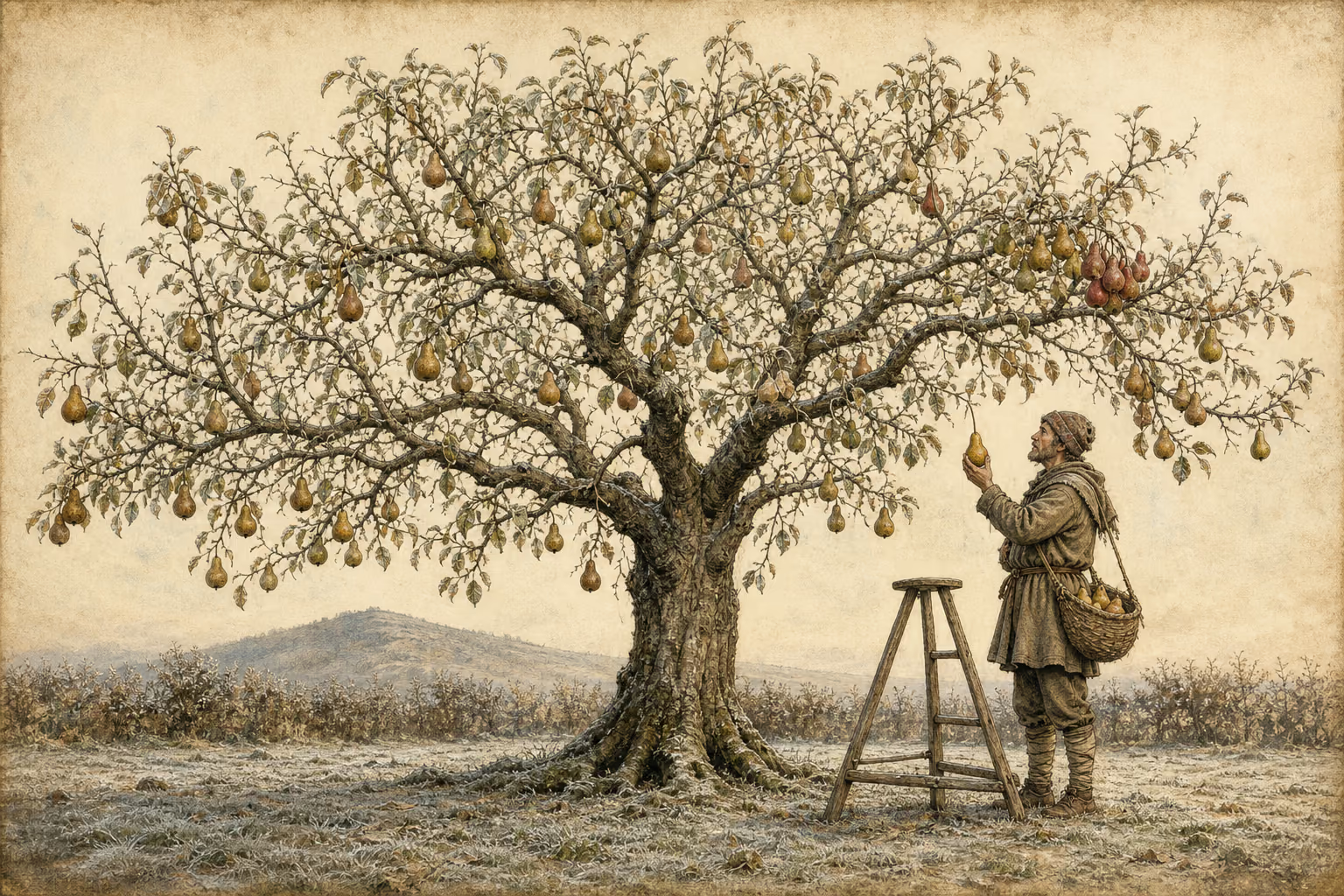
Turbinatior piris figura. in iis serotina ad hiemes usque in matre pendent gelu maturescentia Graeca, ampullacea, laurea, sicut in malis Amerina, Scaudiana. conduntur vero pira ut uvae ac totidem modis, neque aliud in cadis praeterquam pruna. e pomis proprietas piris quae vini, similiterque in aegris medentes cavent. e vino et aqua cocuntur atque pulmentari vicem inplent, quod non alia praeter cotonea ac struthea.
English · Bostock & Riley 1855–57
A similar degree of precocity has caused the appellation of “superbum” to be given to one species of the pear: it is a small fruit, but ripens with remarkable rapidity. All the world are extremely partial to the Crustumian pear; and next to it comes the Falernian, so called from the drink which it affords, so abundant is its juice. This juice is known by the name of “milk” in the variety which, of a black colour, is by some called the pear of Syria. The denominations given to the others vary according to the respective localities of their growth. Among the pears, the names of which have been adopted in our city, the Decimian pear, and the Pseudo-Decimian—an offshoot from it—have conferred considerable renown upon the name of those who introduced them. The same is the case, too, with the variety known as the “Dolabellian,” remarkable for the length of its stalk, the Pomponian, surnamed the mammosum, the Licerian, the Sevian, the Turranian, a variety of the Sevian, but distinguished from it by the greater length of the stalk, the Favonian, a red pear, rather larger than the superbum, together with the Laterian and the Anician, which come at the end of autumn, and are pleasant for the acidity of their flavour. One variety is known as the “Tiberian,” from its having been a particular favourite with the Emperor Tiberius; it is more coloured by the sun, and grows to a larger size, otherwise it would be identical with the Licerian variety.
The following kinds receive their respective names from their native countries: the Amerinian, the latest pear of all, the Picentine, the Numantine, the Alexandrian, the Numidian, the Greek, a variety of which is the Tarentine, and the Signine, by some called “testaceum,” from its colour, like earthenware; a reason which has also given their respective names to the “onychine” and the “purple” kinds. Then, again, we have the “myrapium,” the “laureum,” and the “nardinum,” so called from the odour they emit; the “hordearium,” from the season at which it comes in; and the “ampullaceum,” so called from its long narrow neck. Those, again, that are known as the “Coriolanian” and the “Bruttian,” owe their names to the places of their origin; added to which we have the cucurbitinum, and the “acidulum,” so named from the acidity of its juice. It is quite uncertain for what reason their respective names were given to the varieties known as the “barbaricum” and the “Venerium,” which last is known also as the “coloratum;” the royal pear too, which has a remarkably short stalk, and will stand on its end, as also the patricium, and the voconium, a green oblong kind. In addition to these, Virgil has made mention of a pear called the “volema,” a name which he has borrowed from Cato, who makes mention also of kinds known as the “sementivum” and the “musteum.”
This branch of civilized life has long since been brought to the very highest pitch of perfection, for man has left nothing untried here. Hence it is that we find Virgil speaking of grafting the nut-tree on the arbutus, the apple on the plane, and the cherry on the elm. Indeed, there is nothing further in this department that can possibly be devised, and it is a long time since any new variety of fruit has been discovered. Religious scruples, too, will not allow of indiscriminate grafting; thus, for instance, it is not permitted to graft upon the thorn, for it is not easy, by any mode of expiation, to avoid the disastrous effects of lightning; and we are told that as many as are the kinds of trees that have been engrafted on the thorn, so many are the thunderbolts that will be hurled against that spot in a single flash.
The form of the pear is turbinated; the later kinds remain on the parent tree till winter, when they ripen with the frost; such, for instance, as the Greek variety, the ampullaceum, and the laureum; the same, too, with apples of the Amerinian and the Scandian kinds. Apples and pears are prepared for keeping just like grapes, and in as many different ways; but, with the exception of plums, they are the only fruit that are stored in casks. Apples and pears have certain vinous properties, and like wine these drinks are forbidden to invalids by the physicians. These fruits are sometimes boiled up with wine and water, and so make a preserve that is eaten with bread; a preparation which is never made of any other fruit, with the exception of the quinces, known as the “cotoneum” and the “strutheum.”