LIBER XV · CAPUT 28
THE COLOUR AND SMELL OF JUICES
Latine · Mayhoff 1906
Ergo sucorum vinosi piro, moro, myrto, minime, quod miremur, uvis; pingues olivae, lauro, nuci iuglandi, amygdalis; dulces uvis, ficis, palmis; aquosus prunis. magna differentia et in colore suci: sanguineus moris, cerasis, cornis, uvis nigris; idem albis candidus, lacteus in capite ficis, in corpore non item, spumeus malis, nullus Persicis, cum praesertim duracina suco abundent. sed quis eius ullum dixerit colorem? sua et in odore miracula: malis acutus, Persicis dilutus, dulcibus nullus. nam et vinum tale sine odore, tenue odoratius multoque celerius talia ad usum veniunt quam pinguia. quae odorata, non eadem in gustu tenera, quia non sunt pariter odor et sapor. quam ob rem citreis odor acerrimus, sapor asperrimus, quadamtenus et cotoneis, nullusque odor ficis.
Et hactenus sint species ac genera pomorum: naturas artius colligi par est. alia siliquis distinguntur, ipsis dulcibus semenque conplexis amarum, cum in pluribus semina placeant, in siliqua damnentur; alia bacis, quarum intus lignum et extra caro, ut olivis, cerasis; aliquorum intus bacae, foris lignum, ut iis quae in Aegypto diximus gigni. quae bacis natura, eadem et pomis. aliorum intus corpus et foris lignum, ut nucum; allis foris corpus, intus lignum, ut Persicis et prunis, vitiumque cinctum fructu, cum fructus alibi muniatur vitio. putamine clauduntur nuces, corio castaneae; detrahitur hoc iis, at in mespilis manditur. crusta teguntur glandes, cute uvae, corio et membrana Punica. carne et suco mora constant, cute et suco cerasi. quaedam statim a ligno recedunt, ut nuces et palmae; quaedam adhaerent, ut olivae laurusque. quorundam generi utraque est natura, ut in Persicis; etenim duracinis adhaeret corpus et ligno avelli non quit, cum in ceteris facile separetur. quibusdam nec intus nec extra lignum, ut in palmarum genere. aliquorum lignum ipsum in usu et pomi vice, ut generae nucleis quaedam in Aegypto diximus. quorundam extra geminantur vitia, ut in castaneis et amygdalis nucibusque iuglandibus. quorundam natura trigemina: corpus est, dein lignum rursusque semen in ligno, ut in Persicis. quaedam inter se densa, ut uvae, sorva, quae ramos circumdata ex omni parte uvarum modo degravant; alia rara, ut in Persicis; quaedam alvo continentur, ut granata. dependent alia pediculis, ut pira, alia racemis, ut uvae, palmae, alia et pediculis et racemis, ut hederae, sabuci; alia ramo adhaerent, ut in lauru; quaedam utroque modo, ut olivae. nam et breves pediculi et longi. quaedam vasculis constant, ut Punica et mespila lotosque in Aegypto et Euphrate. iam vero diversa gratia et commendatio: carne palmae placent, crusta Thebaicae, suco uvae et caryotae, callo pira ac mala, corpore mora, cartilagine nuclei, grano quaedam in Aegypto, cute caricae. detrahitur haec ficis virentibus ut putamen, eademque in siccis maxime placet. in papyris et ferulis spinaque alba caulis ipse pomum est, sicut et ficulni caules, in fruticoso genere cum caule capparis; in siliquis vero quod manditur quid nisi lignum est? non omittenda seminis earum proprietate: nam neque corpus nec lignum nec cartilago dici potest neque aliud nomen inveniat.
English · Bostock & Riley 1855–57
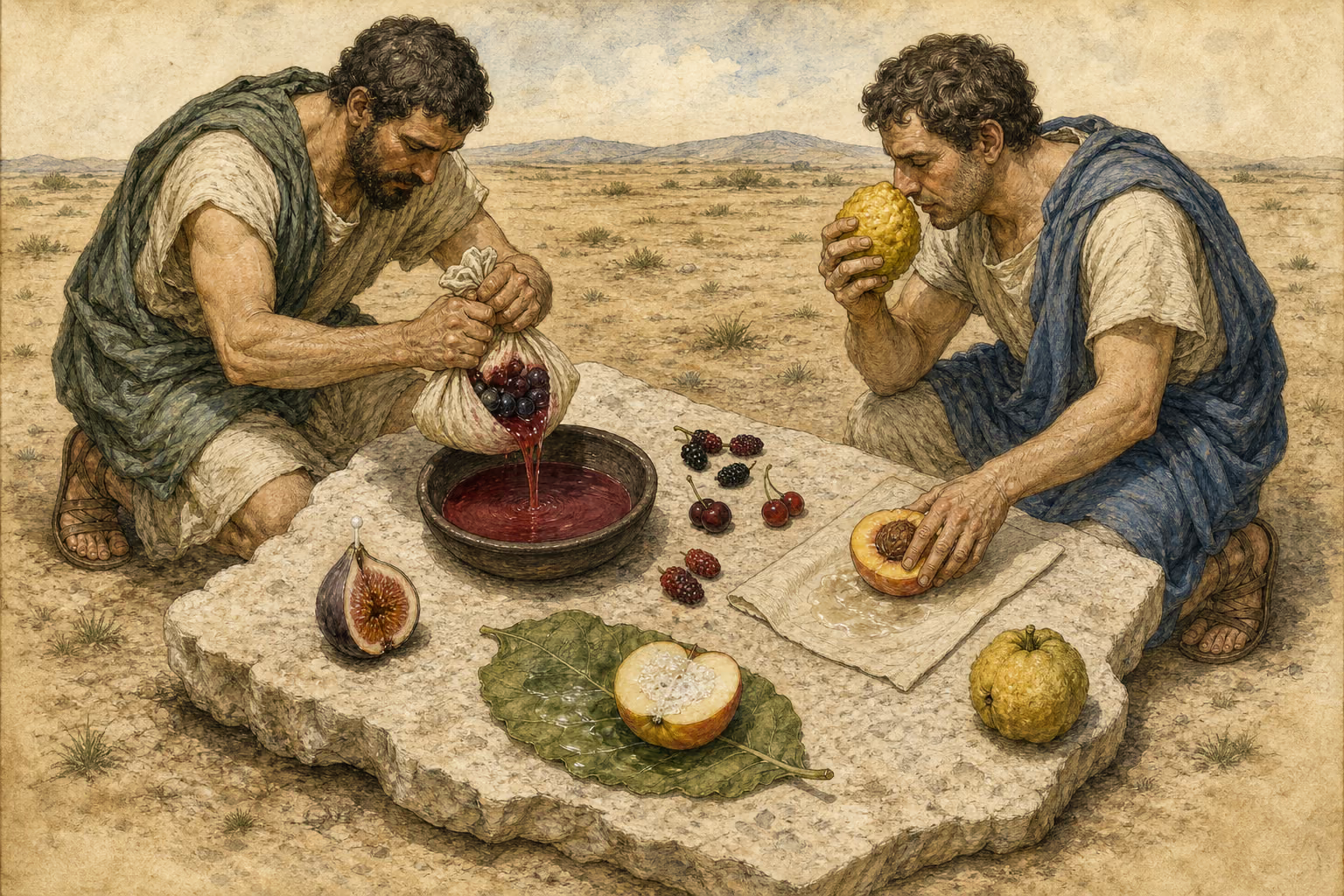
Among the juices, those of a vinous flavour belong to the pear, the mulberry, and the myrtle, and not to the grape, a very singular fact. An unctuous taste is detected in the olive, the laurel, the walnut, and the almond; sweetness exists in the grape, the fig, and the date; while in the plum class we find a watery juice. There is a considerable difference, too, in the colours assumed by the various juices. That of the mulberry, the cherry, the cornel, and the black grape resembles the colour of blood, while in the white grape the juice is white. The humour found in the summit of the fig is of a milky nature, but not so with the juice found in the body of the fruit. In the apple it is the colour of foam, while in the peach it is perfectly colourless, and this is the case, too, with the duracinus, which abounds in juice; for who can say that he has ever detected any colour in it?
Smell, too, presents its own peculiar marvels; in the apple it is pungent, and it is weak in the peach, while in the sweet fruits we perceive none at all: so, too, the sweet wines are inodorous, while the thinner ones have more aroma, and are much sooner fit for use than those of a thicker nature. The odoriferous fruits are not pleasing to the palate in the same degree, seeing that the flavour of them does not come up to their smell: hence it is that in the citron we find the smell so extremely penetrating, and the taste sour in the highest degree. Sometimes the smell is of a more delicate nature, as in the quince, for instance; while the fig has no odour whatever.
Thus much, then, for the various classes and kinds of fruit: it will be as well now to classify their various natures within a more limited scope. Some fruits grow in a pod which is sweet itself, and contains a bitter seed: whereas in most kinds of fruit the seed is agreeable to the palate, those which grow in a pod are condemned. Other fruits are berries, with the stone within and the flesh without, as in the olive and the cherry: others, again, have the berry within and the stone without, the case, as we have already stated, with the berries that grow in Egypt.
Those fruits, known as “pomes” have the same characteristics as the berry fruits; in some of them we find the body of the fruit within and the shell without, as in the nut, for example; others, again, have the meat of the fruit without and the shell within, the peach and the plum, for instance: the refuse part being thus surrounded with the flesh, while in other fruits the flesh is surrounded by the refuse part. Nuts are enclosed in a shell, chesnuts in a skin; in chesnuts the skin is taken off, but in medlars it is eaten with the rest. Acorns are covered with a crust, grapes with a husk, and pomegranates with a skin and an inner membrane. The mulberry is composed of flesh and juice, while the cherry consists of juice and skin. In some fruits the flesh separates easily from the woody part, the walnut and the date, for instance; in others it adheres, as in the case of the olive and the laurel berry: some kinds, again, partake of both natures, the peach, for example; for in the duracinus kind the flesh adheres to the stone, and cannot be torn away from it, while in the other sorts they are easily separated. In some fruits there is no stone or shell either within or without, one variety of the date, for instance. In some kinds, again, the shell is eaten, just the same as the fruit; this we have already mentioned as being the case with a variety of the almond found in Egypt. Some fruits have on the outside a twofold refuse covering, the chesnut, the almond, and the walnut, for example. Some, again, are composed of three separate parts—the body of the fruit, then a woody shell, and inside of that a kernel, as in the peach.
Some fruits grow closely packed together, such as grapes and sorbs: these last, just like so many grapes in a cluster, cling round the branch and bend it downwards with their weight. On the other hand, some fruits grow separately, at a distance from one another; this is the case with the peach. Some fruits are enclosed in a sort of matrix, as with the grains of the pomegranate: some hang down from a stalk, such as the pear, for instance: others hang in clusters, grapes and dates, for example. Others, again, grow upon stalks and bunches united: this we find the case with the berries of the ivy and the elder. Some adhere close to the branches, like the laurel berry, while other varieties lie close to the branch or hang from it, as the case may be: thus we find in the olive some fruit with short stalks, and others with long. Some fruits grow with a little calyx at the top, the pomegranate, for example, the medlar, and the lotus of Egypt and the Euphrates.
Then, too, as to the various parts of fruit, they are held in different degrees of esteem according to their respective recommendations. In the date it is the flesh that is usually liked, in those of Thebais it is the crust; the grape and the caryota date are esteemed for their juice, the pear and the apple for their firmness, the melimelum for its soft meat, the mulberry for its cartilaginous consistency, and nuts for their kernels. Some fruits in Egypt are esteemed for their skin; the carica, for instance. This skin, which in the green fig is thrown away as so much refuse peeling, when the fig is dried is very highly esteemed. In the papyrus, the ferula, and the white thorn the stalk itself constitutes the fruit, and the shoots of the fig-tree are similarly employed.
Among the shrubs, the fruit of the caper is eaten along with the stalk; and in the carob, what is the part that is eaten but so much wood? Nor ought we to omit one peculiarity that exists in the seed of this fruit—it can be called neither flesh, wood, nor cartilage, and yet no other name has been found for it.