LIBER XV · CAPUT 29
THE MYRTLE
Latine · Mayhoff 1906
Sucorum natura praecipuam admirationem in myrto habet, quando ex una omnium olei vinique bina genera fiunt, item myrtidanum, ut diximus. et alius usus bacae fuit apud antiquos ante quam piper reperiretur illam optinens vicem, in quodam etiam genere opsonii nomine inde tracto, quod etiam nunc myrtatum vocatur. eademque origine aprorum sapor commendatur, plerumque ad intinctus additis myrtis.
Arbor ipsa in Europae citeriore caelo, quod a Cerauniis montibus incipit, primum Cerceis in Elpenoris tumulo visa traditur Graecumque ei nomen remanet, quo peregrinam esse apparet. fuit, ubi nunc Roma est, iam cum conderetur; quippe ita traditur, myrtea verbena Romanos Sabinosque, cum propter raptas virgines dimicare voluissent, depositis armis purgatos in eo loco qui nunc signa Veneris Cluacinae habet; cluere enim antiqui purgare dicebant. et in ea quoque arbore suffimenti genus habetur, ideo turn electa, quoniam coniunctioni et huic arbori Venus praeest, haud scio an prima etiam omnium in locis publicis Romae sata, fatidico quidem et memorabili augurio. inter antiquissima namque delubra habetur Quirini, hoc est ipsius Romuli. in eo sacrae fuere myrti duae ante aedem ipsam per longum tempus, altera patricia appellata, altera plebeia. patricia multis annis praevaluit exuberans ac laeta; quamdiu senatus quoque floruit, illa ingens, plebeia retorrida ac squalida. quae postquam evaluit flavescente patricia, a Marsico bello languida auctoritas patrum facta est ac paulatim in sterilitatem emarcuit maiestas. quin et ara vetus fuit Veneri Myrteae, quam nunc Murciam vocant.
Cato tria genera myrti prodidit, nigram, candidam, coniugulam, fortassis a coniugiis, ex illo Cluacinae genere. nunc et alia distinctio sativae aut silvestris et in utraque latifoliae, in silvestri propria oxymyrsinae. sativarum genera topiarii faciunt Tarentinam folio minuto, nostratem patulo, hexasticham densissimo, senis foliorum versibus. haec non est in usu, ramosaatque non alta. coniugalem existimo nunc nostratem dici. myrtus odoratissima Aegypto. Cato docuit vinum fieri e nigra siccata usque in ariditatem in umbra atque ita musto indita. si non siccentur bacae, oleum gigni. postea conpertum et ex alba vinum fieri album, duobus sextariis myrti tusae in vini tribus heminis maceratae expressaeque. folia et per se siccantur in farinam ad ulcerum remedia in corpore humano, leniter mordaci pulvere, ac refrigerandis sudoribus. quin immo oleo quoque, mirum dictu, inest quidam vini sapor simulque pinguis liquor, praecipua vi ad corrigenda vina saccis ante perfusis. retinet quippe faecem nec praeter purum liquorem transire patitur datque se comitem praecipua commendatione liquato. virgae quoque eius, gestatae modo, viatori prosunt in longo itinere pediti; quin et virgei anuli expertes ferri inguinum tumori medentur.
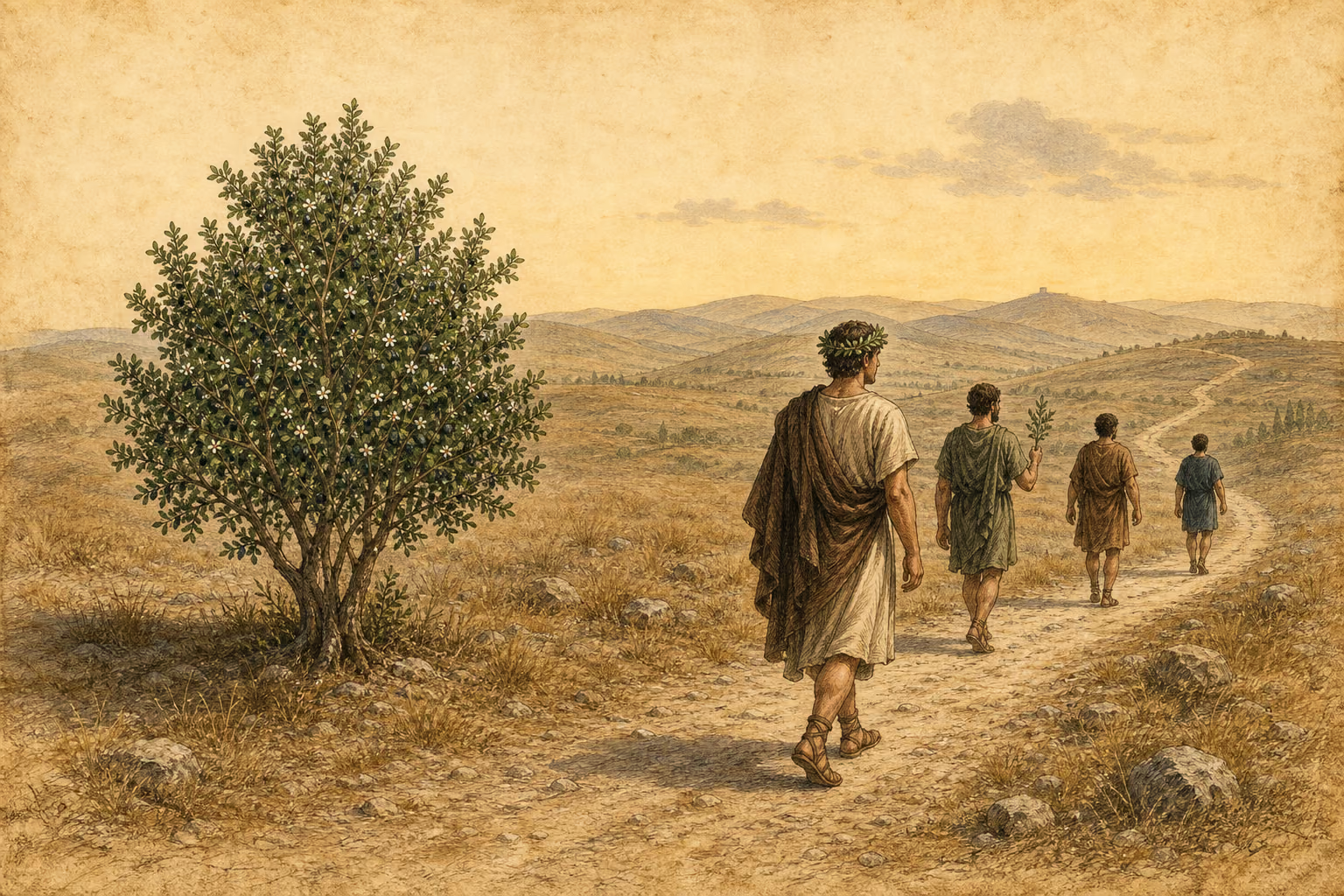
Bellicis quoque se rebus inseruit, triumphansque de Sabinis P. Postumius Tubertus in consulatu, qui primus omnium ovans ingressus urbem est, quoniam rem leniter sine cruore gesserat, myrto Veneris victricis coronatus incessit optabilemque arborem etiam hostibus fecit. haec postea ovantium fuit corona excepto M. Crasso, qui de fugitivis et Spartaco laurea coronatusincessit. Masurius auctor est curru quoque triumphantes myrtea corona usos. L. Piso tradit Papirium Masonem, qui primus in monte Albano triumphavit de Corsis, myrto coronatum ludos Circenses spectare solitum; avus maternus Africani sequentis hic fuit. Marcus Valerius duabus coronis utebatur, laurea et myrtea, qui et hoc voverat.
English · Bostock & Riley 1855–57
The nature of the juices that are found in the myrtle are particularly remarkable, for it is the only one of all the trees, the berries of which produce two kinds of oil as well as of wine, besides myrtidanum, of which we have already spoken. The berry of this was also put to another use in ancient times, for before pepper was known it was employed in place of it as a seasoning; so much so, indeed, that a name has been derived from it for the highly-seasoned dish which to this day is known by the name of “myrtatum.” It is by the aid of these berries, too, that the flavour of the flesh of the wild boar is improved, and they generally form one of the ingredients in the flavouring of our sauces.
This tree was seen for the first time in the regions of Europe, which commence on this side of the Ceraunian mountains, growing at Circeii, near the tomb of Elpenor there: it still retains its Greek name, which clearly proves it to be an exotic. There were myrtles growing on the site now occupied by Rome, at the time of its foundation; for a tradition exists to the effect that the Romans and the Sabines, after they had intended fighting, on account of the virgins who had been ravished by the former, purified themselves, first laying down their arms, with sprigs of myrtle, on the very same spot which is now occupied by the statues of Venus Cluacina; for in the ancient language “cluere” means to purify.
This tree is employed, too, for a species of fumigation; being selected for that purpose, because Venus, who presides over all unions, is the tutelary divinity of the tree. I am not quite sure, too, whether this tree was not the very first that was planted in the public places of Rome, the result of some ominous presage by the augurs of wondrous import. For at the Temple of Quirinus, or, in other words, of Romulus himself, one of the most ancient in Rome, there were formerly two myrtle-trees, which grew for a long period just in front of the temple; one of these was called the Patrician tree, the other the Plebeian. The Patrician myrtle was for many years the superior tree, full of sap and vigour; indeed, so long as the Senate maintained its superiority, so did the tree, being of large growth, while the Plebeian tree presented a meagre, shrivelled appearance. In later times, however, the latter tree gained the superiority, and the Patrician myrtle began to fail just at the period of the Marsic War, when the power of the Senate was so greatly weakened: and little by little did this once majestic tree sink into a state of utter exhaustion and sterility. There was an ancient altar also, consecrated to Venus Myrtea, known at the present day by the name of Murcia.
Cato makes mention of three varieties of the myrtle, the black, white, and the conjugula, perhaps so called from its reference to conjugal unions, and belonging to the same species as that which grew where Cluacina’s statues now stand: at the present day the varieties are differently distinguished into the cultivated and the wild myrtle, each of which includes a kind with a large leaf. The kind known as “oxymyrsine,” belongs only to the wild variety: ornamental gardeners classify several varieties of the cultivated kind; the “Tarentine,” they speak of as a myrtle with a small leaf, the myrtle of this country as having a broad leaf, and the hexasticha as being very thickly covered with leaves, growing in rows of six: it is not, however, made any use of. There are two other kinds, that are branchy and well covered. In my opinion, the conjugula is the same that is now called the Roman myrtle. It is in Egypt that the myrtle is most odoriferous.
Cato has taught us how to make a wine from the black myrtle, by drying it thoroughly in the shade, and then putting it in must: he says, also, that if the berries are not quite dry, it will produce an oil. Since his time a method has been discovered of making a pale wine from the white variety; two sextarii of pounded myrtle are steeped in three semi-sextarii of wine, and the mixture is then subjected to pressure.
The leaves also are dried by themselves till they are capable of being reduced to a powder, which is used for the treatment of sores on the human body: this powder is of a slightly corrosive nature, and is employed also for the purpose of checking the perspiration. A thing that is still more remarkable, this oil is possessed of a certain vinous flavour, being, at the same time, of an unctuous nature, and remarkably efficacious for improving wines. When this is done, the wine strainer is dipped in the oil before it is used, the result of which is that it retains the lees of the wine, and allows nothing but the pure liquor to escape, while at the same time it accompanies the wine and causes a marked improvement in its flavour.
Sprigs of myrtle, if carried by a person when travelling on foot, are found to be very refreshing on a long journey. Rings, too, made of myrtle which has never been touched by iron, are an excellent specific for swellings in the groin.
The myrtle has played its part, also, in the successes of war. Posthumius Tubertus, who gained a victory over the Sabines in his consulship, was the first person who entered the City enjoying the honour of an ovation, for having achieved this success with ease and without bloodshed: upon which occasion he made his entry crowned with the myrtle of Venus Victrix, and thereby rendered her tree an object of regard to our enemies even. Ever since this occasion, the wreath of those who have enjoyed an ovation has been made of myrtle, with the exception of M. Crassus, who, on his victory over the fugitive slaves and Spartacus, made his entry crowned with laurels. Massurius informs us, also, that some generals, on the occasion of a triumph even, have worn a wreath of myrtle in the triumphal car. L. Piso states that Papirius Maso, who was the first to enjoy a triumph for a victory over the Marsi—it was on the Alban Mount —was in the habit of attending at the games of the Circus, wearing a wreath of myrtle: he was the maternal grandfather of the second Scipio Africanus. Marcus Valerius wore two wreaths, one of laurel, the other of myrtle; it was in consequence of a vow which he had made to that effect.