LIBER XV · CAPUT 30
THE LAUREL; THIRTEEN VARIETIES OF IT
Latine · Mayhoff 1906
Laurus triumphis proprie dicatur, vel gratissima domibus, ianitrix Caesarum pontificumque. sola et domos exornat et ante limina excubat. duo eius genera tradidit Cato, Delphicam et Cypriam. Pompeius Len a e u s adiecit quam mustacem appellavit, quoniam mustaceis subiceretur: hanc esse folio maximo flaccidoque et albicante; Delphicam aequali colore viridiorem, maximis bacis atque e viridi rubentibus ac victores Delphis coronare ut triumphantes Romae; Cypriam esse folio brevi, nigro, per margines imbricato crispam. postea accessere genera: tinus — hanc silvestrem laurum aliqui intellegunt, nonnulli sui generis arborem — differt colore; est enim caerula baca. accessit et regia, quae coepit Augusta appellari, amplissima et arbore et folio, bacis gustatu quoque non asperis. aliqui negant eandem esse et suum genus regiae faciunt longioribus foliis latioribusque. iidem in alio genere bacaliam appellant hanc quae vulgatissima est bacarumque fertilissima, sterilem vero earum, quod maxime miror, triumphalem eaque dicunt triumphantes uti, nisi id a Divo Augusto coepit, ut docebimus, ex ea lauru quae ei missa e caelo est, minima altitudine, folio crispo, brevi, inventu rara. accedit in topiario opere Thasia, excrescente in medio folio parvola veluti lacinia folii, et sine ea spadonina, mira opacitatis patientia, itaque quantalibeat sub umbra solum implet. est et chamaedaphne silvestris frutex et Alexandrina, quam aliqui Idaeam, alii hypoglottion, alii danaen, alii carpophyllon, alii hypelaten vocant. ramos spargit a radice dodrantales, coronari i operis, folio acutiore quam myrti ac molliore et candidiore, maiore, semine inter folia rubro, plurima in Ida et circa Heracleam Ponti, nec nisi in montuosis. id quoque quod daphnoides vocatur genus in nominum ambitu est; alii enim Pelasgum, alii eupetalon, alii stephanon Alexandri vocant. et hic frutex est ramosus, crassiore ac molliore quam laurus folio, cuius gustatu accendatur os, bacis e nigro rufis. notatum antiquis, nullum genus laurus in Corsica fuisse, quod nunc satum et ibi provenit.
Ipsa pacifera, ut quam praetendi etiam inter armatos hostes quietis sit indicium. Romanis praecipue laetitiae victoriarumque nuntia additur litteris et militum lanceis pilisque, fasces imperatorum decorat. ex iis in gremio Iovis optimi maximique deponitur, quotiens laetitiam nova victoria adtulit, idque non quia perpetuo viret nec quia pacifera est, praeferenda ei utroque olea, sed quia spectatissima in monte Parnaso ideoque etiam grata Apollini visa, adsuetis eo dona mittere, oracula inde repetere iam et regibus Romanis teste L. Bruto, fortassis etiam in argumentum, quoniam ibi libertatem publicam is meruisset lauriferam tellurem illam osculatus ex responso et quia manu satarum receptarumque in domos fulmine sola non icitur. ob has causas equidem crediderim honorem ei habitum in triumphis potius quam quia suffimentum sit caedis hostium et purgatio, ut tradit Masurius, adeoque in profanis usibus pollui laurum et oleam fas non est, ut ne propitiandis quidem numinibus accendi ex iis altaria araeve debeant. laurus quidem manifesto abdicat ignes crepitu et quadamdetestatione, interaneorum etiam vitia et nervorum ligno torquente. Ti. principem tonante caelo coronari ea solitum ferunt contra fulminum metus.
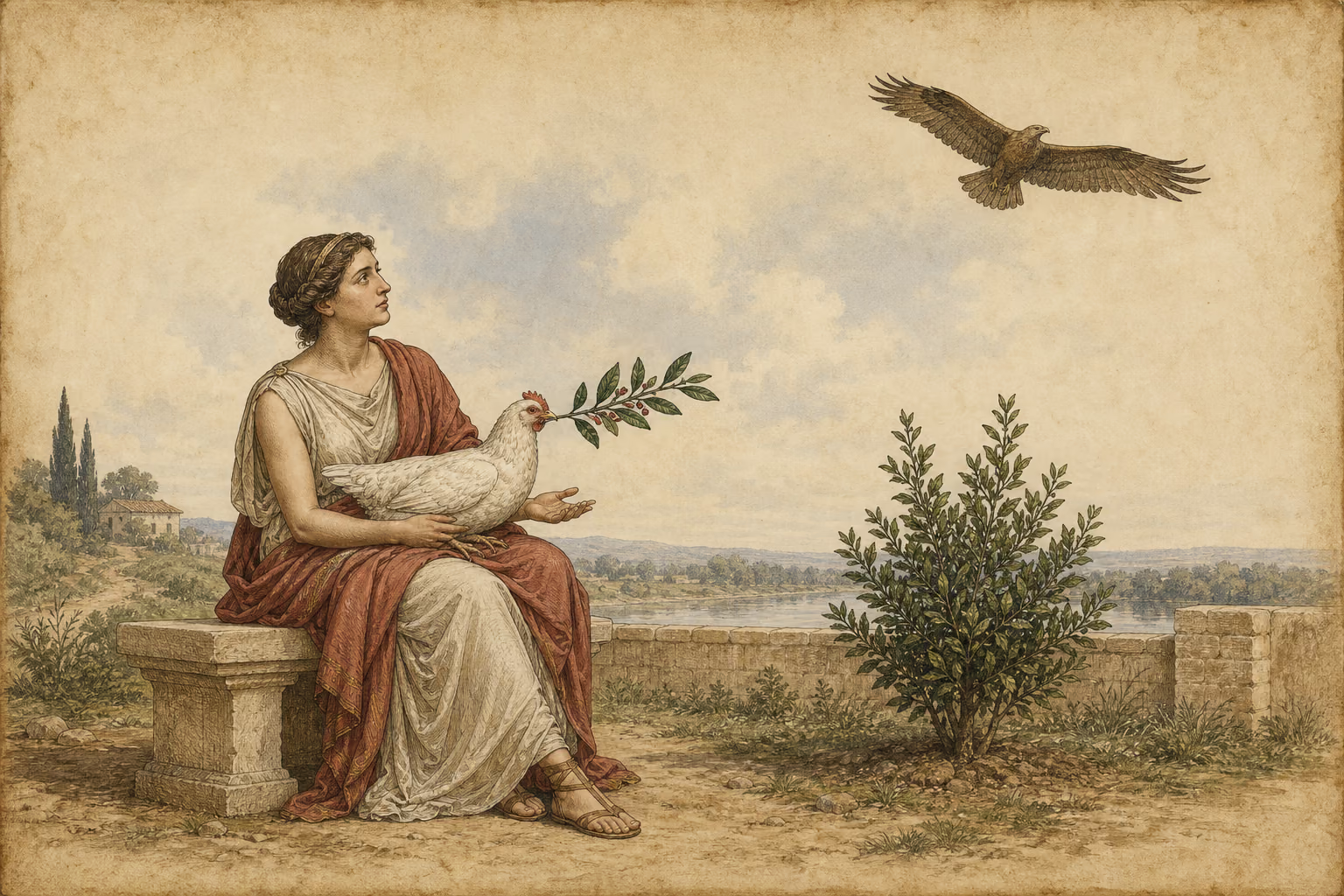
Sunt et circa Divum Augustum eventa eius digna memoratu. namque Liviae Drusillae, quae postea Augusta matrimonii nomen accepit, cum pacta esset illa Caesari, gallinam conspicui candoris sedenti aquila ex alto abiecit in gremium inlaesam, intrepideque miranti accessit miraculum. quoniam teneretin rostro laureum ramum onustum suis bacis, conservari alitem et subolem iussere haruspices ramumque eum seri ac rite custodiri: quod factum est in villa Caesarum fluvio Tiberi inposita iuxta nonum lapidem Flaminiae viae, quae ob id vocatur Ad Gallinas, mireque silva provenit. ex ea triumphans postea Caesar laurum in manu tenuit coronamque capite gessit, ac deinde imperatores Caesares cuncti. traditusque mos est ramos quos tenuerunt serendi, et durant silvae nominibus suis discretae, fortassis ideo mutatis triumphalibus. unius arborum Latina lingua nomen inponitur viris, unius folia distinguntur appellatione; lauream enim vocamus. durat et in urbe inpositum loco, quando Loretum in Aventino vocatur ubi silva laurus fuit. eadem purificationibus adhibetur, testatumque sit obiter et ramo eam seri, quoniam dubitavere Democritus atque Theophrastus.
Nunc dicemus silvestrium naturas.
English · Bostock & Riley 1855–57
The laurel is especially consecrated to triumphs, is remarkably ornamental to houses, and guards the portals of our emperors and our pontiffs: there suspended alone, it graces the palace, and is ever on guard before the threshold. Cato speaks of two varieties of this tree, the Delphic and the Cyprian. Pompeius Lenæus has added another, to which he has given the name of “mustax,” from the circumstance of its being used for putting under the cake known by the name of “mustaceum”. He says that this variety has a very large leaf, flaccid, and of a whitish hue; that the Delphic laurel is of one uniform colour, greener than the other, with berries of very large size, and of a red tint approaching to green. He says, too, that it is with this laurel that the victors at Delphi are crowned, and warriors who enjoy the honours of a triumph at Rome. The Cyprian laurel, he says, has a short leaf, is of a blackish colour, with an imbricated edge, and crisped.
Since his time, however, the varieties have considerably augmented. There is the tinus for instance, by some considered as a species of wild laurel, while others, again, regard it as a tree of a separate class; indeed, it does differ from the laurel as to the colour, the berry being of an azure blue. The royal laurel, too, has since been added, which has of late begun to be known as the “Augustan:” both the tree, as well as the leaf, are of remarkable size, and the berries have not the usual rough taste. Some say, however, that the royal laurel and the Augustan are not the same tree, and make out the former to be a peculiar kind, with a leaf both longer and broader than that of the Augustan. The same authors, also, make a peculiar species of the bacalia the commonest laurel of all, and the one that bears the greatest number of berries. With them, too, the barren laurel is the laurel of the triumphs, and they say that this is the one that is used by warriors when enjoying a triumph—a thing that surprises me very much; unless, indeed, the use of it was first introduced by the late Emperor Augustus, and it is to be considered as the progeny of that laurel, which, as we shall just now have occasion to mention, was sent to him from heaven; it being the smallest of them all, with a crisped short leaf, and very rarely to be met with.
In ornamental gardening we also find the taxa employed, with a small leaf sprouting from the middle of the leaf, and forming a fringe, as it were, hanging from it; the spadonia, too, without this fringe, a tree that thrives remarkably well in the shade: indeed, however dense the shade may be, it will soon cover the spot with its shoots. There is the chamædaphne, also, a shrub that grows wild; the Alexandrian laurel, by some known as the Idean, by others as the “hypoglottion,” by others as the “carpophyllon,” and by others, again, as the “hypelates.” From the root it throws out branches three quarters of a foot in length; it is much used in ornamental gardening, and for making wreaths, and it has a more pointed leaf than that of the myrtle, and superior to it in softness, whiteness, and size: the seed, which lies between the leaves, is red. This last kind grows in great abundance on Mount Ida and in the vicinity of Heraclea in Pontus: it is only found, however, in mountainous districts.
The laurel, too, known as the daphnoides, is a variety that has received many different names: by some it is called the Pelasgian laurel, by others the euthalon, and by others the stephanon Alexandri. This is also a branchy shrub, with a thicker and softer leaf than that of the ordinary laurel: if tasted, it leaves a burning sensation in the mouth and throat: the berries are red, inclining to black. The ancient writers have remarked, that in their time there was no species of laurel in the island of Corsica. Since then, however, it has been planted there, and has thrived well.
This tree is emblematical of peace: when a branch of it is extended, it is to denote a truce between enemies in arms. For the Romans more particularly it is the messenger of joyful tidings, and of victory: it accompanies the despatches of the general, and it decorates the lances and javelins of the soldiers and the fasces which precede their chief. It is of this tree that branches are deposited on the lap of Jupiter All-good and All-great, so often as some new victory has imparted universal gladness. This is done, not because it is always green, nor yet because it is an emblem of peace—for in both of those respects the olive would take the precedence of it—but because it is the most beauteous tree on Mount Parnassus, and was pleasing for its gracefulness to Apollo even; a deity to whom the kings of Rome sent offerings at an early period, as we learn from the case of L. Brutus. Perhaps, too, honour is more particularly paid to this tree because it was there that Brutus earned the glory of asserting his country’s liberties, when, by the direction of the oracle, he kissed that laurel-bearing soil. Another reason, too, may be the fact, that of all the shrubs that are planted and received in our houses, this is the only one that is never struck by lightning. It is for these reasons, in my opinion, that the post of honour has been awarded to the laurel more particularly in triumphs, and not, as Massurius says, because it was used for the purposes of fumigation and purification from the blood of the enemy.
In addition to the above particulars, it is not permitted to defile the laurel and the olive by applying them to profane uses; so much so, indeed, that, not even for the propitiation of the divinities, should a fire be lighted with them at either altar or shrine. Indeed, it is very evident that the laurel protests against such usage by crackling as it does in the fire, thus, in a manner, giving expression to its abhorrence of such treatment. The wood of this tree when eaten is good as a specific for internal maladies and affections of the sinews.
It is said that when it thundered, the Emperor Tiberius was in the habit of putting on a wreath of laurel to allay his apprehensions of disastrous effects from the lightning. There are also some remarkable facts connected with the laurel in the history of the late Emperor Augustus: once while Livia Drusilla, who afterwards on her marriage with the Emperor assumed the name of Augusta, at the time that she was affianced to him, was seated, there fell into her lap a hen of remarkable whiteness, which an eagle let fall from aloft without its receiving the slightest injury: on Livia viewing it without any symptoms of alarm, it was discovered that miracle was added to miracle, and that it held in its beak a branch of laurel covered with berries. The aruspices gave orders that the hen and her progeny should be carefully preserved, and the branch planted and tended with religious care. This was accordingly done at the country-house belonging to the Cæsars, on the Flaminian Way, near the banks of the Tiber, eight miles from the City; from which circumstance that road has since received the title “Ad gallinas.” From the branch there has now arisen, wondrous to relate, quite a grove: and Augustus Cæsar afterwards, when celebrating a triumph, held a branch of it in his hand and wore a wreath of this laurel on his head; since which time all the succeeding emperors have followed his example. Hence, too, has originated the custom of planting the branches which they have held on these occasions, and we thus see groves of laurel still existing which owe their respective names to this circumstance. It was on the above occasion, too, that not improbably a change was effected in the usual laurel of the triumph. The laurel is the only one among the trees that in the Latin language has given an appellation to a man, and it is the only one the leaf of which has a distinct name of its own,—it being known by the name of “laurea.” The name of this tree is still retained by one place in the city of Rome, for we find a spot on the Aventine Mount still known by the name of “Loretum,” where formerly a laurel-grove existed. The laurel is employed in purifications, and we may here mention, incidentally, that it will grow from slips —though Democritus and Theophrastus have expressed their doubts as to that fact.
We shall now proceed to speak of the forest trees.