LIBER XV · CAPUT 3
FIFTEEN VARIETIES OF OLIVES
Latine · Mayhoff 1906
Oliva constat nucleo, oleo, came, amurca. sanies haec est eius amara; fit ex aquis, ideo siccitatibus minima, riguis copiosa. suus quidem olivae sucus oleum est, idque praecipue ex inmaturis intellegitur, sicut in omphacio docuimus. augetur oleum ab arcturi exortu in a. d. XVI kal. Oct., postea nuclei increscunt et caro. tum si etiam copiosi imbres accessere, vitiatur oleum in amurcam. huius color olivam cogit nigrescere, ideoque incipiente nigritia minimum amurcae, ante eam nihil est. error hominum falsus existimantium maturitatis initium quod est vitii proximum, deinde quod oleum crescere olivae came arbitrantur, cum sucus omnis in corpus abeat lignumque intus grandescat. ergo tum maxime rigantur; quod ubi cura multisve imbribus accidit, oleum absumitur nisi consecuta serenitate quae corpus extenuet. omnino enim, ut Theophrasto placet, et olei causa calor est, quare in torcularibus etiam ac cellis multo igni quaeritur. tertia est culpa in parsimonia, quoniam propter inpendium decerpendi expectatur ut decidant olivae. qui medium temperamentum in hoc servant, perticis decutiunt cum iniuria arborum sequentisque anni damno. quippe olivantibus lex antiquissima fuit: oleam ne stringito neve verberato. qui cautissime agunt, harundine levi ictu nec adversos percutiunt ramos. sic quoque alternare fructus cogitur decussis germinibus, nec minus si expectetur ut cadant; haerendo enim ultra suum tempus absumunt venientibus alimentum et detinent locum. argumentum est quod nisi ante favonium collectae novas vires resumunt et difficilius cadunt.
Primae ergo ab autumno colliguntur vitio operae, non naturae, posia cui plurimum carnis, mox orchites cui olei, post radius. has enim ocissime occupatas, quia sunt tenerrimae, amurca cogit decidere. differuntur vero etiam in Martium mensem callosae, contra umorem pugnaces ob idque minimae, Licinia, Cominia, Contia, Sergia, quam Sabini regiam vocant, non ante favonii adflatum nigrescentes, hoc est a. d. VI id. Feb. tunc arbitrantur eas maturescere, et quoniam probatissimum ex iis fiat oleum, accedere etiam ratio pravitati videtur feruntque frigore austeritatem fieri, sicut copiam maturitate, cum sit illa bonitas non temporis, sed generis tarde putrescentiun in amurcam. similis error collectam servandi in tabulatis nec prius quam sudet premendi, cum omni mora oleum decrescat, amurca augeatur. itaque vulgo non amplius senas libras singulis modiis exprimi dicunt. amurcae mensuram nemo agit, quanto ea copiosior reperiatur in eodem genere diebus adiectis. omnino invictus error et publicus tumore olivae crescere oleum existimandi, cum praesertim nec magnitudine copiam olei constare indicio sint quae regiae vocantur, ab aliis maiorinae, ab aliis babbiae, grandissimae alioqui, minimo suco. et in Aegypto carnosissimis olei exiguum, Decapoli vero Syriae perquam parvae, nec cappari maiores, carne tamen commendantur. quam ob causam Italicis transmarinae praeferuntur in cibis, cum oleo vincantur, et in ipsa Italia ceteris Picenae et Sidicinae. sale illae privatim condiuntur et ut reliquae amurca sapave, nec non aliquae oleo suo et sine arcessita commendatione purae innatant, colymbades. franguntur eaedem herbarumque viridium sapore condiuntur. fiunt et praecoques ferventi aqua perfusae quamlibeat inmaturae; mirumque dulcem sucum olivas bibere et alieno sapore infici. purpureae sunt et in iis, ut uvis, in nigrum colorem transeuntibus posiis. sunt et superbae praeter iam dicta genera. sunt et praedulces, per se tantum siccatae uvisque passis dulciores, admodum rarae in Africa et circa Emeritam Lusitaniae. oleum ipsum sale vindicatur a pinguitudinis vitio. cortice oleae conciso odorem accipit. medicatio alias ut vino; palati gratia nulla est nec tam numerosa differentia: tribus ut plurimum bonitatibus distat. odor in tenui argutior, et is tamen etiam in optimo brevis.
English · Bostock & Riley 1855–57
The olive is composed of a stone, oil, flesh, and amurca: the last being a bitter liquid, principally composed of water; hence it is that in seasons of drought it is less plentiful, and more abundant when rains have prevailed. The oil is a juice peculiar to the olive, a fact more particularly stated in reference to its unripe state, as we have already mentioned when speaking of omphacium. This oil continues on the increase up to the rising of Arcturus, or in other words, the sixteenth day before the calends of October; after which the increase is in the stone and the flesh. When drought has been followed by abundant rains, the oil is spoilt, and turns to amurca. It is the colour of this amurca that makes the olive turn black; hence, when the berry is just beginning to turn that colour, there is but little amurca in it, and before that period none at all. It is an error then, on the part of persons, to suppose that that is the commencement of maturity, which is in reality only the near approach of corruption. A second error, too, is the supposition that the oil increases proportionally to the flesh of the berry, it being the fact that the oil is all the time undergoing a change into flesh, and the stone is growing larger and larger within. It is for this reason more particularly, that care is taken to water the tree at this period; the real result of all this care and attention, as well as of the fall of copious rains, being, that the oil in reality is absorbed as the berry increases in size, unless fine dry weather should happen to set in, which naturally tends to contract the volume of the fruit. According to Theophrastus, heat is the sole primary cause of the oleaginous principle; for which reason it is, that in the presses, and in the cellars even, great fires are lighted to improve the quality of the oil.
A third error arises from misplaced economy: to spare the expense of gathering, people are in the habit of waiting till the berry falls from the tree. Others, again, who wish to follow a middle course in this respect, beat the fruit off with poles, and so inflict injury on the tree and ensure loss in the succeeding year; indeed, there was a very ancient regulation in existence relative to the gathering of the olive—“Neither pull nor beat the olive-tree.” Those who would observe a still greater degree of precaution, strike the branches lightly with a reed on one side of them; but even then the tree is reduced to bearing fruit but once in two years, in consequence of the injury done to the buds. Not less injurious, however, are the results of waiting till the berries fall from the tree; for, by remaining on it beyond the proper time, they deprive the crop that is coming on of its due share of nutriment, by occupying its place: a clear proof of which is, that if they are not gathered before the west winds prevail, they are found to have acquired renewed strength, and are all the later before they fall.
The first olive that is gathered after the autumn is that known as the “posia,” the berry of which, owing to a vicious method of cultivation, and not any fault on the part of Nature, has the most flesh upon it. Next to this is the orchites, which contains the greatest quantity of oil, and then, after that, the radius. As these are of a peculiarly delicate nature, the heat very rapidly takes effect upon them, and the amurca they contain causes them to fall. On the other hand, the gathering of the tough, hard-skinned olive is put off so late as the month of March, it being well able to resist the effects of moisture, and, consequently, very small. Those varieties known as the Licinian, the Cominian, the Contian, and the Sergian, by the Sabines called the “royal” olive, do not turn black before the west winds prevail, or, in other words, before the sixth day before the ides of February. At this period it is generally thought that they begin to ripen, and as a most excellent oil is extracted from them, experience would seem to give its support to a theory which, in reality, is altogether wrong. The growers say that in the same degree that cold diminishes the oil, the ripeness of the berry augments it; whereas, in reality, the goodness of the oil is owing, not to the period at which the olives are gathered, but to the natural properties of this peculiar variety, in which the oil is remarkably slow in turning to amurca.
A similar error, too, is committed by those who keep the olives, when gathered, upon a layer of boards, and do not press the fruit till it has thrown out a sweat; it being the fact that every hour lost tends to diminish the oil and increase the amurca: the consequence is, that, according to the ordinary computation, a modius of olives yields no more than six pounds of oil. No one, however, ever takes account of the quantity of amurca to ascertain, in reference to the same kind of berry, to what extent it increases daily in amount. Then, again, it is a very general error among practical persons to suppose that the oil increases proportionably to the increased size of the berry; and more particularly so when it is so clearly proved that such is not the case, with reference to the variety known as the royal olive, by some called majorina, and by others phaulia; this berry being of the very largest size, and yet yielding a minimum of juice. In Egypt, too, the berries, which are remarkably meaty, are found to produce but very little oil; while those of Decapolis, in Syria, are so extremely small, that they are no bigger than a caper; and yet they are highly esteemed for their flesh. It is for this reason that the olives from the parts beyond sea are preferred for table to those of Italy, though, at the same time, they are very inferior to them for making oil.
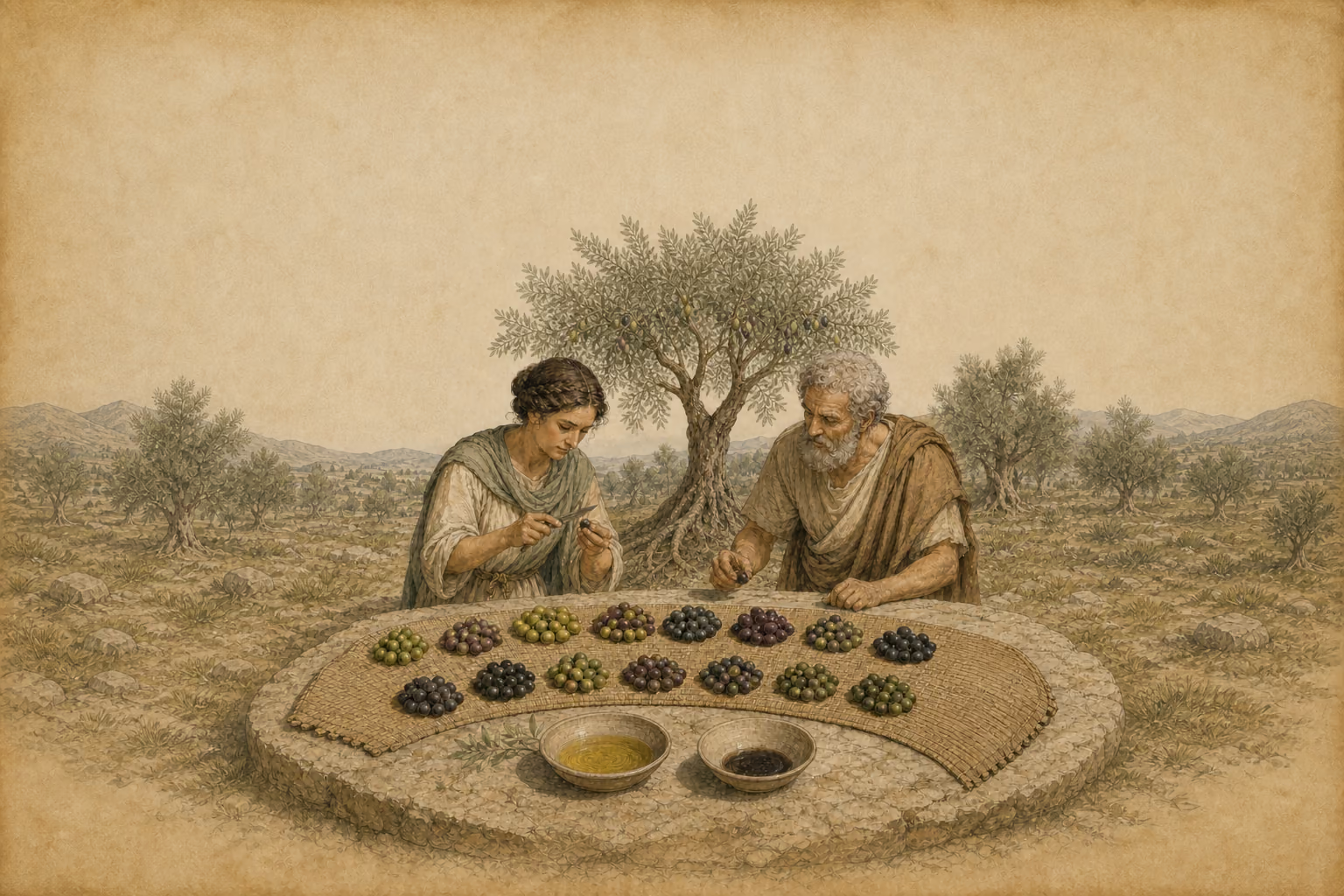
In Italy, those of Picenum and of Sidicina are considered the best for table. These are kept apart from the others and steeped in salt, after which, like other olives, they are put in amurca, or else boiled wine; indeed, some of them are left to float solely in their own oil, without any adventitious mode of preparation, and are then known as colymbades: sometimes the berry is crushed, and then seasoned with green herbs to flavour it. Even in an unripe state the olive is rendered fit for eating by being sprinkled with boiling water; it is quite surprising, too, how readily it will imbibe sweet juices, and retain an adventitious flavour from foreign substances. With this fruit, as with the grape, there are purple varieties, and the posia is of a complexion approaching to black. Besides those already mentioned, there are the superba and a remarkably luscious kind, which dries of itself, and is even sweeter than the raisin: this last variety is extremely rare, and is to be found in Africa and in the vicinity of Emerita in Lusitania.
The oil of the olive is prevented from getting thick and rancid by the admixture of salt. By making an incision in the bark of the tree, an aromatic odour may be imparted to the oil. Any other mode of seasoning, such, for instance, as those used with reference to wine, is not at all gratifying to the palate; nor do we find so many varieties in oil as there are in the produce of the grape, there being, in general, but three different degrees of goodness. In fine oil the odour is more penetrating, but even in the very best it is but short-lived.