LIBER XVI · CAPUT 10
SHINGLES
Latine · Mayhoff 1906
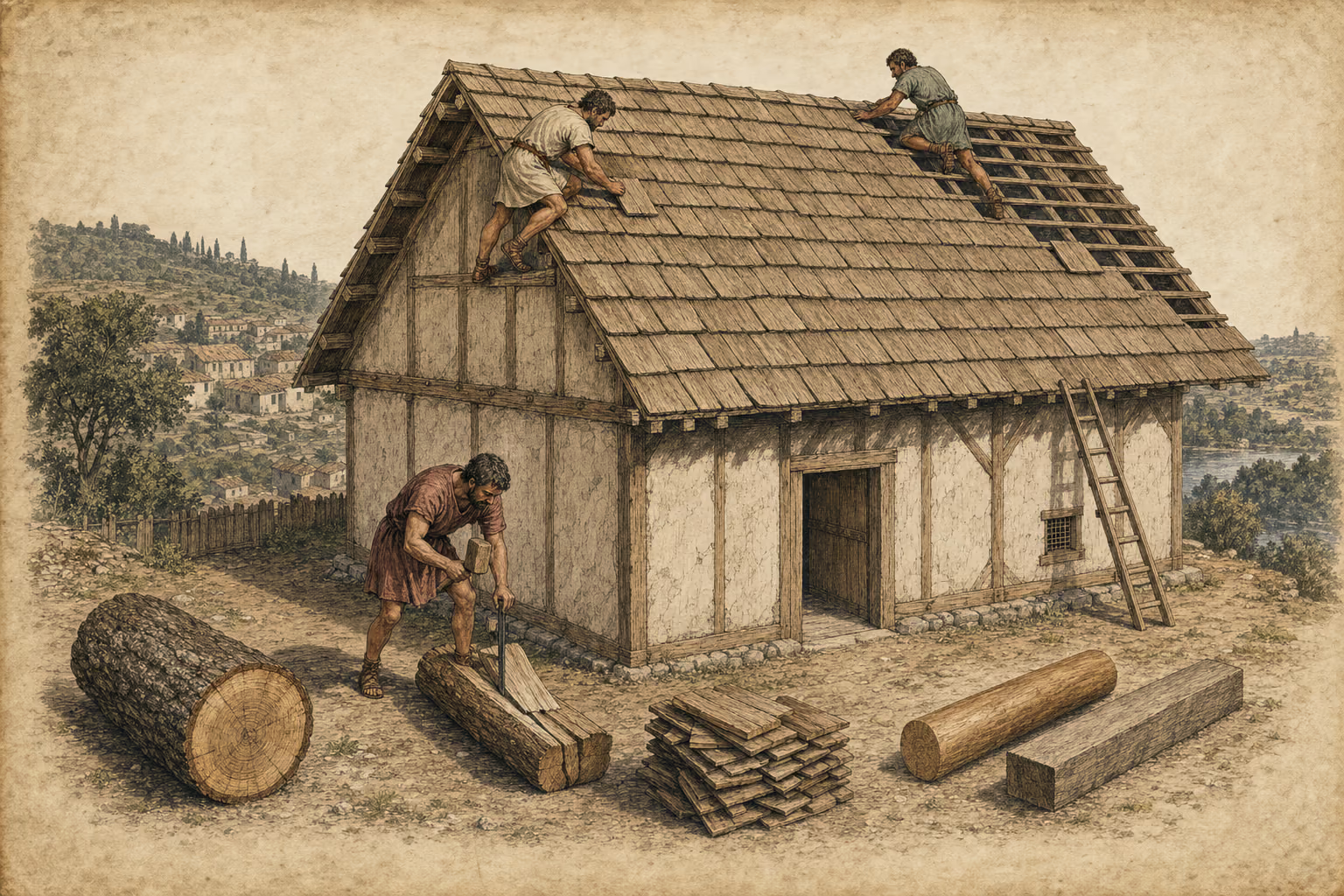
Scandula e robore aptissima, mox e glandiferis aliis fagoque, facillima ex omnibus, quae resinam ferunt, sed minime durans praeterquam e pino. scandula contectam fuisse Romam ad Pyrrhi usque helium annis CCCCLXX Cornelius Nepos auctor est. silvarum certe distinguebatur insignibus, Fagutali love etiam nunc ubi lucus fageus fuit, porta Querquetulana, colle in quem vimina petebantur, totque lucis, quibusdam et geminis. Q. Hortensius dictator, cum plebes secessisset in Ianiculum, legem in aesculeto tulit, ut quod ea iussisset omnes Quirites teneret.
Peregrinae tum videbantur, quoniam non erant suburbanae, pinus atque abies omnesque, quae picem gignunt. de quibus nunc dicemus, simnul ut tota condiendi vina origo cognoscatur, quae ferunt in Asia aut oriente praedictis.
Picem in Europa sex genera cognatarum arborum ferunt. ex his pinus atque pinaster folium habent capillamenti modo praetenue longumque et mucrone aculeatum. pinus fert minimum resinae, interdum et nucibus ipsis, de quibus dictum est, vixque ut adscribatur generi.
Pinaster nihil est aliud quam pinus silvestris minor altitudine et a medio ramosa, sicut pinus in vertice. copiosiorem dat haec resinam quo dicemus modo. gignitur et in planis. easdem arbores alio nomine esse per oram Italiae quas tibulos vocant,plerique arbitrantur, sed graciles succinctioresque et enodes liburnicarum ad usus, paene sine resina.
Picea montes amat atque frigora, feralis arbor et funebri indicio ad fores posita ac rogis virens, iam tamen et in domos recepta tonsili facilitate. haec plurimam fundit interveniente candida gemma, tam simili turis, ut mixta visu discerni non queat; unde fraus Seplasiae. omnibus his generibus folia brevia, sed crassiora duraque ceu cupressis. piceae rami paene statim ab radice modici velut bracchia lateribus inhaerent.
Similiter abieti expetitae navigiis situs in excelso montium, ceu maria fugerit, nec forma alia. materies vero praecipua est trabibus et plurimis vitae operibus. resina in ea vitium, unde fructus piceae, exiguumque sudat aliquando contactu solis. e diverso materies, quae abieti pulcherrima, piceae ad fissiles scandulas cupasque et pauca alia secamenta.
Quinto generi est situs idem, facies eadem. larix vocatur. materies praestantior longe, incorrupta aevis, umori contumax, rubens praeterea et odore acrior. plusculum huic erumpit liquoris melleo colore atque lentore, numquam durescentis.
Sextum genus est taeda proprie dicta, abundantior suco quam reliqua, parcior liquidiorque quam picea, flammis ac lumini sacrorum etiam grata. hae, mares dumtaxat, ferunt et eam, quam Graeci sycen vocant, odoris gravissimi. laricis morbus est ut taeda fiat.
Omnia autem haec genera accensa fuligine inmodica carbonem repente exspuunt cum eruptionis crepitu eiaculanturque longe, excepta larice, quae nec ardet nec carbonem facit nec alio modo ignis vi consumitur quam lapides. omnia ea perpetuo virent nec facile discernuntur in fronde etiam a peritis; tanta natalium mixtura est. sed picea minus alta quam larix; illa crassior leviorque cortice, folio villosior, pinguior et densior, mollius flexo; at piceae rariora siccioraque folia et tenuiora ac magis algentia, totaque horridior et perfusa resina, lignum abieti similius. larix ustis radicibus non repullulat, picea re- pullulat, ut in Lesbo accidit incenso nemore Pyrrhaeo. alia etiamnunc generibus ipsis in sexu differentia. mas brevior et durior, femina procerior, pinguioribus foliis et simplicibus atque non rigentibus. lignum maribus durum et in fabrili opere contortum, feminae mollius, publico discrimine in securibus. hae in quocumque genere deprehendunt marem, quippe respuuntur et fragosius sidunt, aegrius revelluntur. ipsa materies retorrida et nigrior maribus. laricis circa Idam in Troade et alia differentia, montanae maritimaeque. nam in Macedonia et Arcadia circaque Elim permutant nomina, nec constat auctoribus, quod cuique generi adtribuant. nos ista Romano discernimus iudicio. abies e cunctis amplissima est et femina etiam prolixior, materie mollior utiliorque, arbore rotundior, folio pinnato densa, ut imbres non tramittat, atque hilarior in totum. e ramis generum horum panicularum modo nucamenta squamatim compacta dependent praeterquam larici. haec abietis masculae primori parte nucleos habent, non item feminae. piceae vero totis paniculis, minoribus gracilioribusque, minimos ac nigros, propter quod Graeci phthiropoeon eam appellant. in eadem nucamenta maribus compressiora sunt ac minus resina roscida.
Similis his etiamnunc aspectu est, ne quid praetereatur, taxus minime virens gracilisque et tristis ac dira, nullo suco, ex omnibus sola bacifera. mas noxio fructu; letale quippe bacis in Hispania praecipue venenum inest, vasa etiam viatoria ex ea vinis in Gallia facta mortifera fuisse compertum est. hanc Sextius milacem a Graecis vocari dicit et esse in Arcadia tam praesentis veneni, ut qui obdormiant sub ea cibumve capiant moriantur. sunt qui et taxica hine appellata dicant venena— quae nunc toxica dicimus—, quibus sagittae tinguantur. repertum innoxiam fieri, si in ipsam arborem clavus aereus adigatur.
English · Bostock & Riley 1855–57
The best shingles are those made of the wood of the robur; the next best being those furnished by the other glandiferous trees and the beech. Those most easily made are cut from the wood of the resinous trees, but they do not last, with the exception of those made of pine. Cornelius Nepos informs us, that Rome was roofed solely with shingles down to the time of the war with Pyrrhus, a period of four hundred and seventy years. It is well known that it was remarkable for the fine forests in its vicinity. Even at the present day, the name of Jupiter Fagutalus points out in what locality there stood a grove of beeches; the Querquetulan Gate shows where the quercus once stood, and the Viminal Hill is the spot where the “vimen” was sought in ancient times. In many other parts, too, there were groves to be found, and sometimes as many as two. Q. Hortensius, the Dictator, on the secession of the plebeians to the Janiculum, passed a law in the Æsculetum, that what the plebeians had enacted should be binding upon every Roman citizen.
In those days they regarded as exotics, because they did not exist in the vicinity of the City, the pine and the fir, as well as all the other varieties that produce pitch; of which we shall now proceed to speak, in order that the method of seasoning wine, from the very first, may be fully known. Whereas there are several among the trees already mentioned in Asia or the East, that produce pitch, in Europe there are but six varieties of kindred trees that supply it. In this number there are the pine and the pinaster, which have long thin leaves like hair, and pointed at the end. The pine yields the least resin of them all: in the pine nut, indeed, of which we have previously spoken, it is sometimes to be found, but hardly in sufficient quantities to warrant us in reckoning the pine among the resinous trees.
The pinaster is nothing else but a wild pine: it rises to a surprising height, and throws out branches from the middle, just as the pine does from the top. This tree yields a more copious supply of resin than the pine: the mode in which this is done we shall set forth on a future occasion. It grows also in flat countries. Many people think that this is the same tree that grows along the shores of Italy, and is known as the “tibulus;” but this last is slender, and more compact than the pine; it is likewise free from knots, and hence is used in the construction of light gallies; they are both almost entirely destitute of resin.
The pitch-tree loves the mountain heights and cold localities. This is a funereal tree, and, as an emblem of death, is placed before the door of the deceased, and is left to grow in the vicinity of the funeral pile. Still, however, it is now some time since it was admitted into our gardens, in consequence of the facility with which it is clipped into various shapes. It gives out considerable quantities of resin, which is intermingled with white granulations like pearls, and so similar in appearance to frankincense, that when mixed, it is impossible to distinguish them; hence the adulterations we find practised in the Seplasia. All this class of trees have a short bristly leaf, thick and hard, like that of the cypress. The branches of the pitch-tree are of moderate size, and extend from almost the very root of the tree, adhering to the sides like so many arms: the same is the case with the fir, the wood of which is held in great esteem for ship-building.
This tree grows upon the summits of lofty mountains, as though, in fact, it had an antipathy to the sea, and it does not at all differ from the pitch-tree in appearance: the wood is also very highly esteemed for the construction of rafters, and many other appliances of life. A flow of resin, which in the pitch-tree constitutes its great merit, is looked upon as a defect in the fir, though it will generally exude in some small quantity on exposure of the wood, to the action of the sun. On the other hand, the wood which in the fir-tree is remarkably fine, in the pitch-tree is only used for making shingles, vats, and a few other articles of joiners’ work.
The fifth kind of resinous tree has the same localities, and is very similar in appearance; it is known as the larch. The wood of this tree is far more valuable, being unimpaired by time, and proof against all decay; it is of a reddish colour, and of an acrid smell. Resin flows from this wood in still greater quantities; it is of the colour of honey, more viscous than the other varieties, and never turns hard.
A sixth variety is the torch-tree, properly so called, which gives out more resin than any of the others, with the exception of the pitch-tree; but its resin is more liquid than that of this last. The wood, too, of this tree is more particularly employed for kindling fires and giving torch-light in religious ceremonials. Of this tree it is the male only that bears what is known to the Greeks by the name of “syce,” remarkable for its extremely powerful odour. When the larch is changed into the torch-tree, it is a proof that it is in a diseased state.
The wood of all these trees, when set fire to, gives out immoderate volumes of sooty smoke, and sputters every now and then with a sudden crackling noise, while it sends out red-hot charcoal to a considerable distance—with the sole exception of that of the larch, which will neither burn nor char, nor, in fact, suffer any more from the action of fire than a stone. All these trees are evergreens, and are not easily distinguished by the foliage, even by those who are best acquainted with them, so nearly related are they to one another. The pitch-tree, however, is not so high as the larch; which, again, is stouter, and has a smoother bark, with a more velvety leaf, more unctuous to the touch, thicker, and more soft and flexible. The pitch-tree, again, has a leaf more sparsely scattered and drier; it is thinner also, and of a colder nature, rougher all over in appearance, and covered with a resinous deposit: the wood of this tree is most like that of the fir. The larch, when the roots are once burnt, will not throw out fresh shoots, which the pitch-tree will do, as was found to be the case in the island of Lesbos, after the Pyrrhæan grove had been burnt there.
In the same species too, the variety of sex is found to constitute a considerable difference: the male is the shorter tree, and has a harder wood; while the female is taller, and bears a leaf more unctuous to the feel, smooth and free from all rigidity. The wood of the male tree is hard and awry, and consequently not so well suited for carpenters’ work; while that of the female is softer, as may be very easily perceived on the application of the axe, a test, in fact, which, in every variety, immediately shows us which trees are males; the axe in such case meeting with a greater resistance, falling with a louder noise, and being withdrawn from the wood with considerably greater difficulty: the wood of the male tree is more parched too, and the root is of a blacker hue. In the vicinity of Mount Ida, in Troas, the circumstance whether the tree grows in the mountain districts or on the sea-shore, makes another considerable difference. In Macedonia and Arcadia, and in the neighbourhood of Elis, the names of the several varieties have been totally altered, and it has not been agreed by authors which name ought to be given to each: we have, therefore, contented ourselves with employing the Roman denominations solely.
The fir is the largest of them all, the female being the taller of the two; the wood, too, is softer and more easily worked. This tree is of a rounder form than the others, and its leaves are closely packed and feathered, so as not to admit of the passage of rain; the appearance, too, of the tree is altogether more cheerful. From the branches of these different varieties, with the sole exception of the larch, there hang numbers of scaly nuts of compact shape, like so many catkins. The nuts found upon the male fir have a kernel in the fore-part, which is not the case with those on the female tree. In the pitch-tree, again, these kernels, which are very small and black, occupy the whole of the catkin, which is smaller and more slender than in the other varieties; hence it is that the Greeks call this tree by the name of phthirophoron. In this tree, too, the nuts on the male are more compressed, and less moist with resin.
Not to omit any one of them, the yew is similar to these other trees in general appearance. It is of a colour, however, but slightly approaching to green, and of a slender form; of sombre and ominous aspect, and quite destitute of juice: it is the only one, too, among them all, that bears a berry. In the male tree the fruit is injurious; indeed, in Spain more particularly, the berries contain a deadly poison. It is an ascertained fact that travellers’ vessels, made in Gaul of this wood, for the purpose of holding wine, have caused the death of those who used them. Sextius says, that in Greece this tree is known by the name of “smilax,” and that in Arcadia it is possessed of so active a poison, that those who sleep beneath it, or even take food there, are sure to meet their death from it. There are authors, also, who assert that the poisons which we call at the present day “toxica,” and in which arrows are dipped, were formerly called taxica, from this tree. It has been discovered, also, that these poisonous qualities are quite neutralized by driving a copper nail into the wood of the tree.