LIBER XVI · CAPUT 16
BRUSCUM: MOLLUSCUM; THE STAPHYLODENDRON
Latine · Mayhoff 1906
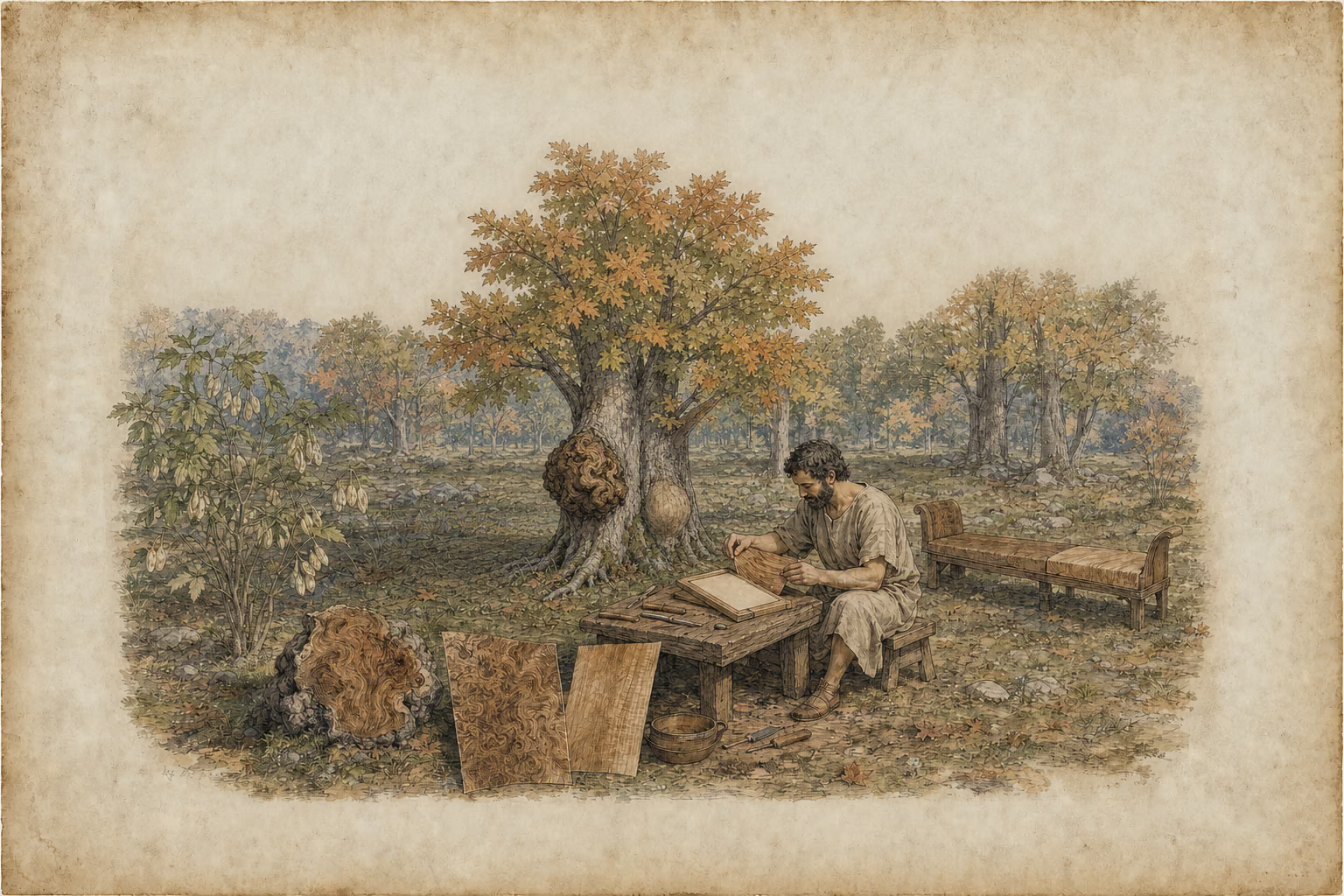
Pulcherrimum vero est bruscum, multoque excellentius etiamnum molluscum. tuber utrumque arboris eius, bruscum intortius crispum, molluscum simplicius sparsum et, si magnitudinem mensarum caperet, haud dubie praeferretur citro; nunc intra pugillares lectorumque solidos aut lamnas raro usu spectatur. e brusco fiunt et mensae nigrescentes. reperitur et in alno tuber, tanto deterius, quantum ab acere alnus ipsa distat. aceris mares prius florent. etiamnum in siccis natae praeferuntur aquaticis, sicut et fraxini. est trans Alpes arbor simillima aceri albo materie, quae vocatur staphylodendron. fert siliquas et in iis nucleos sapore nucis abellanae.
In primis vero materies honorata buxo est raro crispanti nec nisi radice, de ceteo..... levisque est materiae, set lentore quodam et duritie ac pallore commendabilis, ipsa vero arbor et topiario opere. tria eius genera: Gallicum, quod in metas emittitur amplitudinemque proceriorem. oleastrum, in omni usu damnatum, gravem praefert odorem. tertium genus nostratis vocant, e silvestri, ut credo, mitigatum satu, diffusius et densitate parietum, virens semper ac tonsile. buxus Pyrenaeis ac Cytoriis montibus plurima et Berecyntio tractu, crassissima in Corsica, flore non spernendo, quae causa amaritudinis mellis. semen cunctis animantibus invisum. nec in Olympo Macedoniae gracilior, sed brevis. amat frigida, aprica. in igni quoque duritia quae ferro, nec flamma nec carbone utili.
English · Bostock & Riley 1855–57
But the most beautiful feature of all in the maple is what is known as bruscum, and, even more particularly so, the molluscum. These are both of them tuberosities of this tree, the bruscum presenting veins more violently contorted, while those of the molluscum are disposed in a more simple and uniform manner: indeed, if this last were of sufficiently large size to admit of tables being made of it, there is no doubt that it would be preferred to the wood of the citrus even. At the present day, however, we find it but little used except for the leaves of tablets, or as a veneer for couches. Tuberosities are also found on the alder, but as much inferior to those already mentioned, as the alder itself is to the maple. In the maple the male tree is the first to blossom. The trees that frequent dry spots are preferred to those that grow in watery localities, which is the case also with the ash.
There is found in the countries beyond the Alps a tree, the wood of which is very similar to that of the white maple, and which is known as the staphylodendron. This tree bears a pod in which there is found a kernel, which has the flavour of the hazel-nut.
One of the most highly esteemed of all the woods is the box, but it is seldom veined, and then only the wood of the root. In other respects, it is a wood, so to say, of quiet and unpretending appearance, but highly esteemed for a certain degree of hardness and its pallid hue: the tree, too, is very extensively employed in ornamental gardening. There are three varieties of it: the Gallic box, which is trained to shoot upwards in a pyramidal form, and attains a very considerable height; the oleaster, which is condemned as being utterly worthless, and emits a disagreeable odour; and a third, known as the “Italian” box, a wild variety, in my opinion, which has been improved by cultivation. This last spreads more than the others, and forms a thick hedge: it is an evergreen, and is easily clipped.
The box-tree abounds on the Pyrenean range, the mountains of Cytorus, and the country about Berecynthus. The trunk grows to the largest size in the island of Corsica, and its blossom is by no means despicable; it is this that causes the honey there to be bitter. The seed of the box is held in aversion by all animals. That which grows upon Mount Olympus in Macedonia is not more slender than the other kinds, but the tree is of a more stunted growth. It loves spots exposed to the cold winds and the sun: in fire, too, it manifests all the hardness of iron; it gives out no flame, and is of no use whatever for the manufacture of charcoal.