LIBER XVI · CAPUT 8
CACHRYS
Latine · Mayhoff 1906
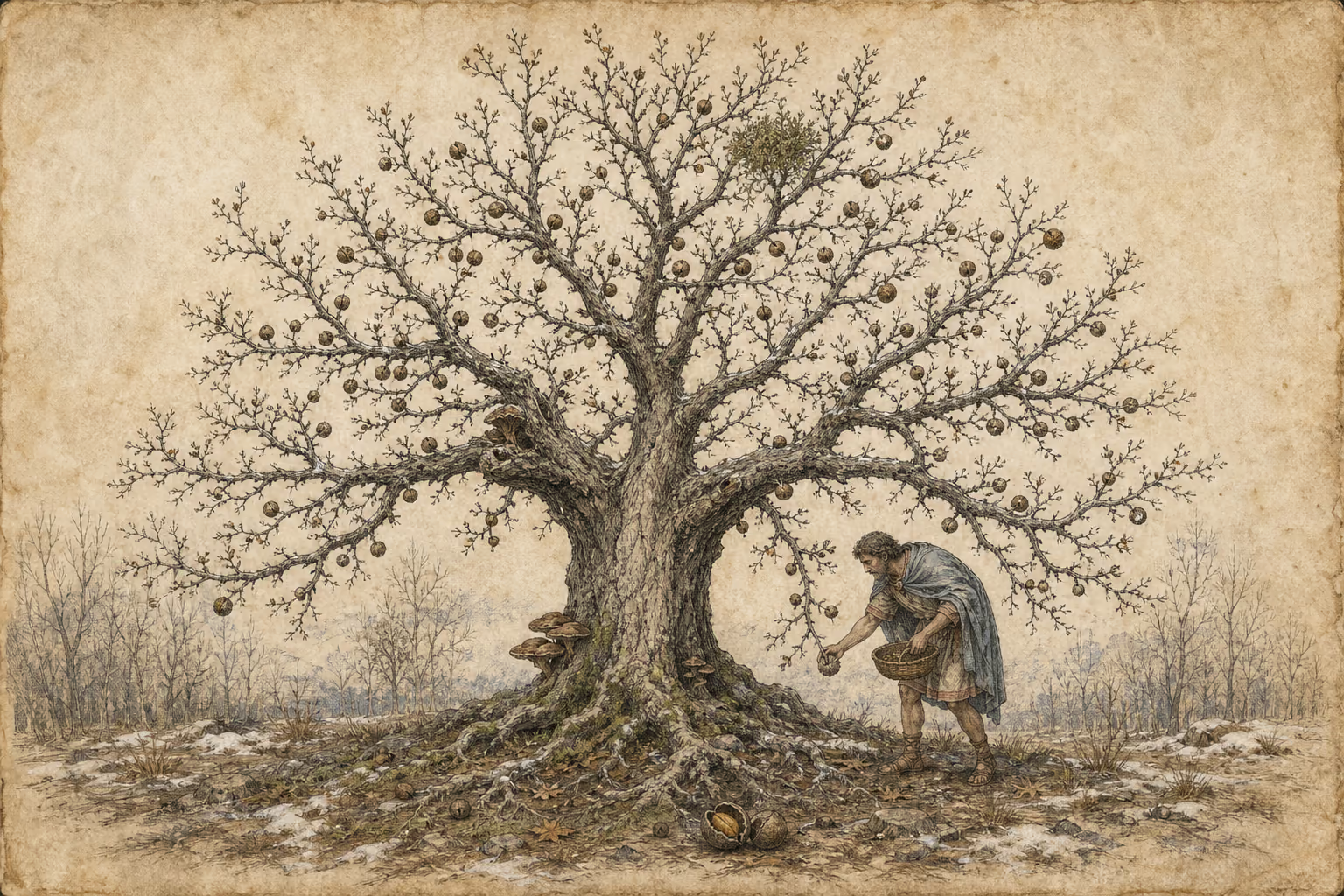
Ferunt, robora et cachrym; ita vocatur pilula in medicina urendi vim habens. gignitur et in abiete, larice, picea, tilia, nuce, platano, postquam folia cecidere, hieme durans. continet nucleum pineis similem. is crescit hieme, aperitur vere. pilula tota cadit, cum folia coepere crescere. tam multifera sunt, tot res praeter glandem pariunt robora, sed et boletos suillosque—gulae novissima inritamenta—, qui circa radices gignuntur, quercus probatissimos, robur autem et cupressus et pinus noxios. robora ferunt et viscum et mella, ut auctor est Hesiodus, constatque rores melleos e caelo, ut diximus, cadentes non aliis magis insidere frondibus. crematoque robore cinerem nitrosum esse certum est.
Omnes tamen has eius dotes ilex solo provocat cocco. granum hoc primoque ceu scabies fruticis, parvae aquifoliae ilicis. cusculium vocant. pensionem alteram tributi pauperibus Hispaniae donat. usum eius ac rationem in conchylii mentione tradidimus. gignitur et in Galatia, Africa, Pisidia, Cilicia, pessimum in Sardinia.
Galliarum glandiferae maxime arbores agaricum ferunt. est autem fungus candidus, odoratus, antidotis efficax, in summis arboribus nascens, nocte relucens. signum hoc eius, quo in tenebris decerpitur. e glandiferis sola quae vocatur aegilops fert pannos arentes, muscoso villo canos, non in cortice modo, verum et e ramis dependentes cubitali magnitudine, odoratos, uti diximus inter unguenta. suberi minima arbor, glans pessima, rara, cortex tantum in fructu, praecrassus ac renascens atque etiam in denos pedes undique explanatus. usus eius ancoralibus maxime navium piscantiumque tragulis et cadorum obturamentis, praeterea in hiberno feminarum calceatu. quamobrem non infacete Graeci corticis arborem appellant. sunt et qui feminam ilicem vocent atque, ubi non nascitur ilex, pro ea subere utantur in carpentariis praecipue fabricis, ut circa Elim et Lacedaemonem. nec in Italia tota nascitur aut in Gallia omnino.
English · Bostock & Riley 1855–57
The robur bears cachrys, too; such being the name given to a small round ball that is employed in medicine for its caustic properties. It grows on the fir likewise, the larch, the pitch-tree, the linden, the nut-tree, and the plane, and remains on the tree throughout the winter, after the leaves have fallen. It contains a kernel very similar to that of the pine-nut, and increases in size during the winter. In spring the ball opens throughout, and it finally drops when the leaves are beginning to grow.
Such is the multiplicity of the products borne by the robur in addition to its acorns; and not only these, but mushrooms as well, of better or worse quality, the most recent stimulants that have been discovered for the appetite; these last are found growing about its roots. Those of the quercus are the most highly esteemed, while those of the robur, the cypress, and the pine are injurious. The robur produces mistletoe also, and, if we may believe Hesiod, honey as well: indeed, it is a well-known fact, that a honey-like dew falling from heaven, as we have already mentioned, deposits itself upon the leaves of this tree in preference to those of any other. It is also well known that the wood of this tree, when burnt, produces a nitrous ash.
The holm oak, however, by its scarlet berry alone challenges competition with all these manifold productions. This grain appears at first sight to be a roughness on the surface of the tree, as it were, a small kind of the aquifolia variety of holm oak, known as the cusculium. To the poor in Spain it furnishes the means of paying one half of their tribute. We have already, when speaking of the purple of the murex, mentioned the best methods adopted for using it. It is produced also in Galatia, Africa, Pisidia, and Cilicia: the most inferior kind is that of Sardinia.
It is in the Gallic provinces more particularly that the glandiferous trees produce agaric; such being the name given to a white fungus which has a strong odour, and is very useful as an antidote. It grows upon the top of the tree, and gives out a brilliant light at night: this, indeed, is the sign by which its presence is known, and by the aid of this light it may be gathered during the night. The ægilops is the only one among the glandiferous trees that bears a kind of dry cloth, covered with a white mossy shag, and this, not only attached to the bark, but hanging down from the branches as well, a cubit even in length: this substance has a strong odour, as we have already stated, when speaking of the perfumes.
The cork is but a very small tree, and its acorn is of the very worst quality, and rarely to be found as well: the bark is its only useful product, being remarkably thick, and if removed it will grow again. When straitened out, it has been known to form planks as much as ten feet square. This substance is employed more particularly attached as a buoy to the ropes of ships’ anchors and the drag-nets of fishermen. It is employed also for the bungs of casks and as a material for the winter shoes of females; for which reason the Greeks not inappropriately call them “the bark of a tree.”
There are some writers who speak of it as the female of the holm oak; and in the countries where the holm does not grow, they substitute for it the wood of the cork-tree, more particularly in cartwrights’ work, in the vicinity of Elis and Lacedæmon for instance. The cork-tree does not grow throughout the whole of Italy, and in no part whatever of Gaul.