LIBER XVI · CAPUT 7
OTHER PRODUCTIONS ON THESE TREES BESIDES THE ACORN
Latine · Mayhoff 1906
nascitur autem galla sole de geminis exeunte erumpens noctu semper universa. crescit uno die candidior et, si aestu excepta est, arescit protinus neque ad iustum incrementum pervenit, hoc est ut nucleum fabae magnitudine habeat. nigra diutius viret crescitque, ut interdum mali compleat magnitudinem. optima Commagena, deterrima ex robore. signum eius quod cavernae tralucent.
Robur praeter fructum plurima et alia gignit. namque fert et gallae utrumque genus et quaedam veluti mora, ni distarent arida duritie, plerumque et tauri caput imitantia, quibus fructus inest nucleis olivae similis. nascuntur in eo et pilulae nucibus non absimiles, intus habentes floccos molles, lucernarum luminibus aptos. nam et sine oleo flagrant, sicuti galla nigra. fert et aliam inutilem pilulam cum capillo, verno tamen tempore melliginis suci. gignunt et alae ramorum eius pilulas corpore, non pediculo adhaerentes, candicantes umbilicis, cetera nigra varietate dispersa; media cocci colorem habent, apertis atra inanitas est. aliquando et pumices gignit nec non et e foliis convolutas pilulas et in foliorum venis aquosos nucleos candicantes ac tralucidos, quamdiu molles sint, in quibus et culices nascuntur. maturescunt in modum....
English · Bostock & Riley 1855–57
The gall-nut begins to grow just as the sun is leaving the sign of Gemini, and always bursts forth in its entirety in a single night. The white variety grows, too, in a single day, but if the heat happens to overtake it, it shrinks immediately, and never arrives at its proper size, which is about that of a bean. The black gall-nut will remain green for a longer period, and sometimes attains the size of an apple even. The best kind is that which comes from Commagene, and the most inferior are those produced by the robur: it may easily be tested by means of certain holes in it which admit of the passage of the light.
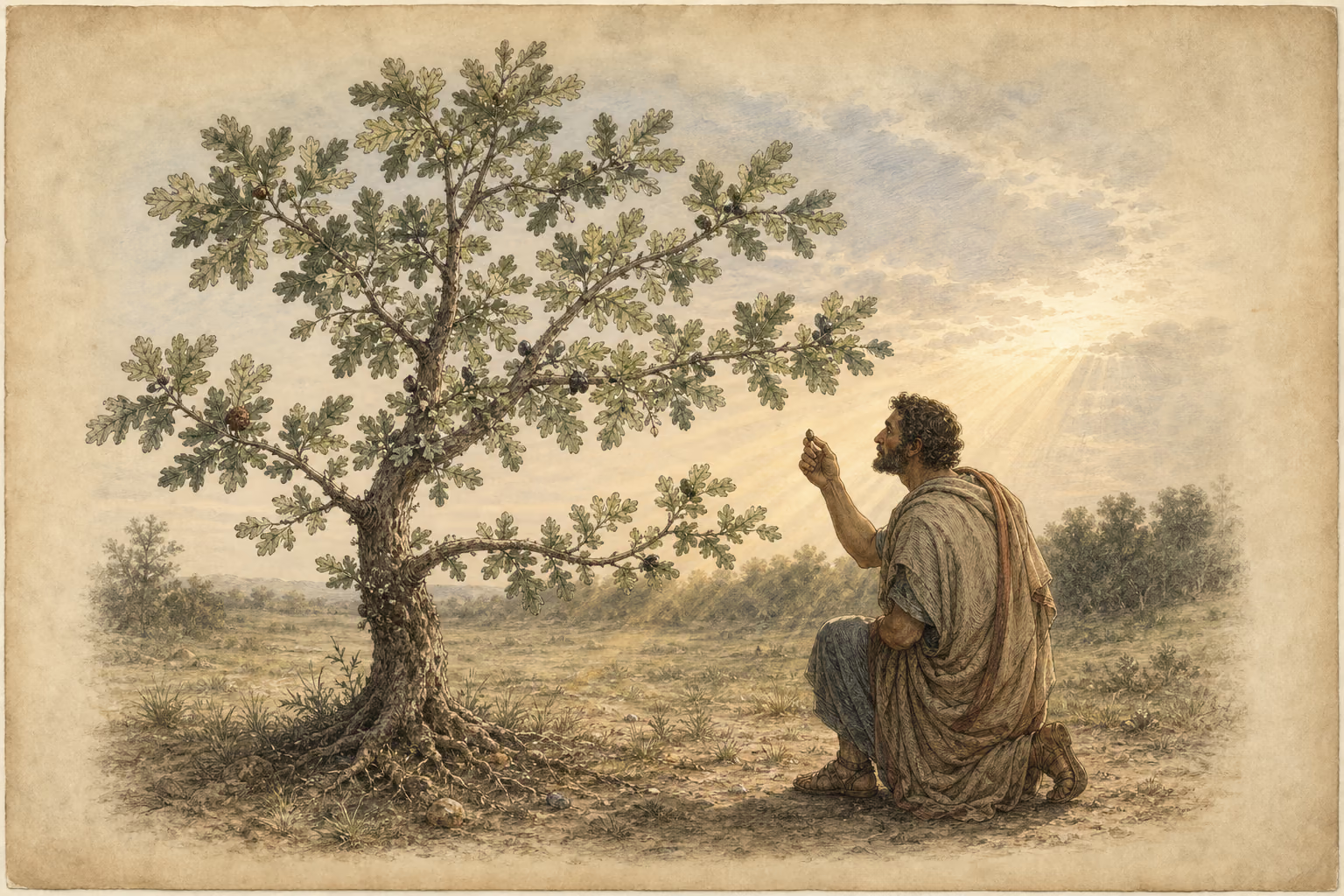
The robur, in addition to its fruit, has a great number of other productions: it bears the two varieties of the gall-nut, and a production which closely resembles the mulberry, except that it differs from it in being dry and hard: for the most part it bears a resemblance to a bull’s head, and in the inside there is a fruit very similar to the stone of the olive. Little balls also are found growing on the robur, not unlike nuts in appearance, and containing within them a kind of soft wool, which is used for burning in lamps; for it will keep burning without oil, which is the case also with the black gall-nut. It bears another kind, too, of little ball, covered with hair, but used for no purpose: in spring, however, this contains a juice like honey. In the hollows formed by the union of the trunk and branches of this tree there are found also small round balls, which adhere bodily to the bark, and not by means of a stalk: at the point of junction they are white, but the rest of the body is spotted all over with black: inside they are of a scarlet colour, but on opening them they are found to be empty, and are of a bitter taste.
Sometimes, too, the robur bears a kind of pumice, as well as little balls, which are formed of the leaves rolled up; upon the veins of the leaves, too, there are watery pustules, of a whitish hue, and transparent while they are soft; in these a kind of gnat is produced, and they come to maturity just in the same way that the ordinary gall-nut does.