LIBER XVI · CAPUT 6
THE BEECH
Latine · Mayhoff 1906
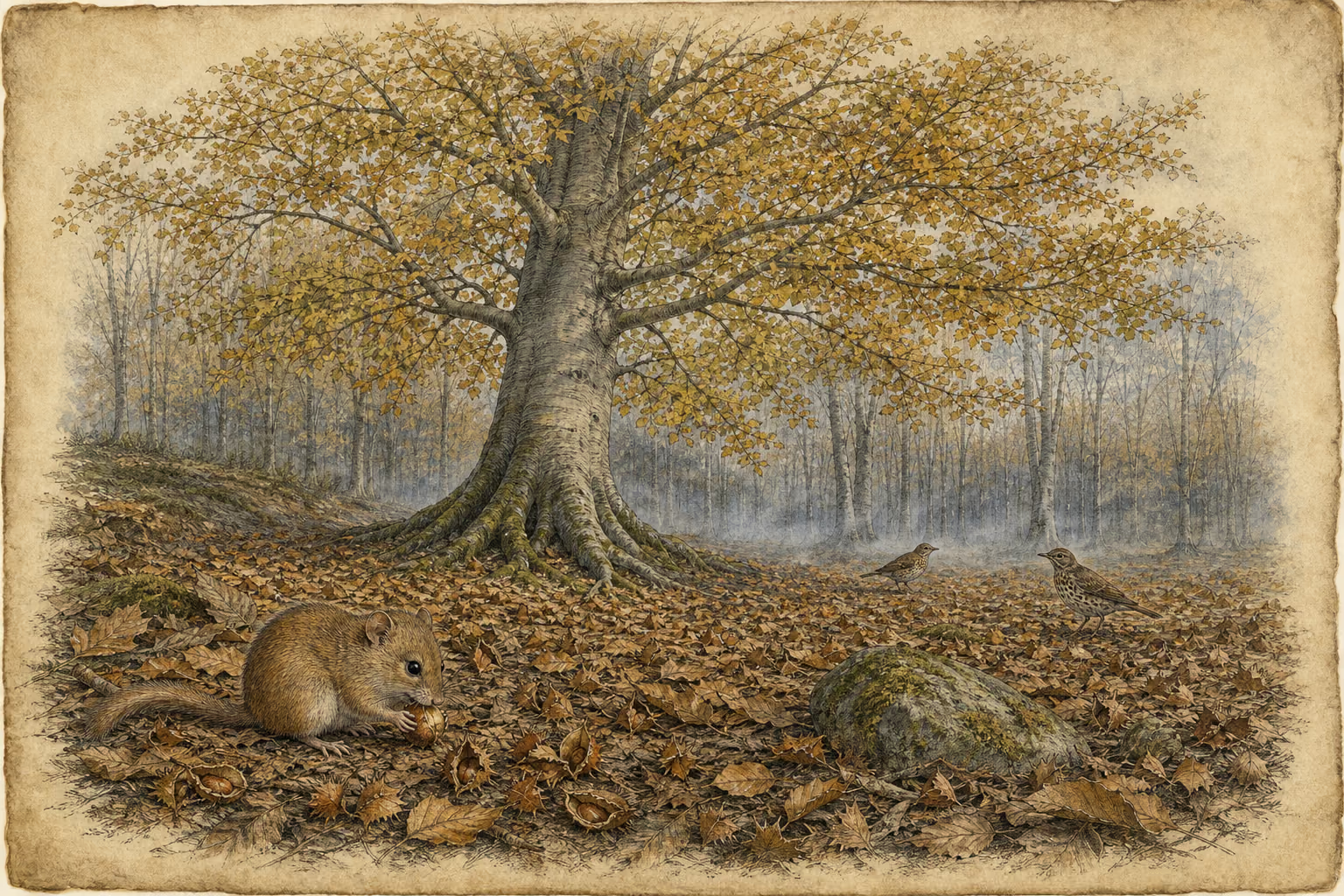
Fagi glans nucleis similis triangula cute includitur. folium tenue atque e levissimis, populo simile, celerrime flavescens et media parte plerumque gignens superne parvolam bacam viridem, cacumine aculeatam. fagum muribus gratissimum est, et ideo animalis eius una proventus, glires quoque saginat, expetitur et turdis. arborum fertilitas omnium fere alternat, sed maxime fagi.
Glandem, quae proprie intellegitur, ferunt robur, quercus, aesculus, cerrus, ilex, suber. continent hispido calyce per genera plus minusve complectente. folia praeter ilicemn gravia, carnosa, procera, sinuosa lateribus, nec, cum cadunt, flavescentia, ut fagi, pro differentia generum breviora vel longiora.
Ilicis duo genera. ex his in Italia folio non multum ab oleis distant milaces a quibusdam Graecis dictae; in provinciis aquifoliae sunt ilices. glans utriusque brevior et gracilior, quam Homerus aculon appellat eoque nomine a glande distinguit. masculas ilices negant ferre.
Glans optima in quercu atque grandissima, mox aesculo. nam robori parva, cerro tristis, horrida, echinato calyce ceu castaneae. sed et in querna alia dulcior, molliorque feminae, mari spissior. maxime autem probantur latifoliae ex argumento dictae. distant inter se magnitudine et cutis tenuitate, item quod aliis subest tunica robigine scabra, aliis protinus candidum corpus. probatur et ea, cuius in balano utrimque ex longitudine extrema lapidescit duritia, melior cui in cortice quam cui in corpore, utrumque non nisi mari. praeterea aliis ovata, aliis rotunda, aliis acutior figura, sicut et colos nigrior candidiorve, qui praefertur. amaritudo in extremitatibus, mediae dulces. quin et pediculi brevitas proceritasque differentiam habet. in ipsis vero arboribus quae maximam fert hemeris vocatur, brevior et in orbem comosa alasque ramorum crebro cavata. fortius lignum quercus habet et incorruptius, ramosa et ipsa, procerior tamen et crassior caudice, excelsissima autem aegilops, incultis arnica.
Ab hac proxima latifoliae proceritas, sed minus utilis aedificiis atque carboni: dolata vitiis obnoxia est, quamobrem solida utuntur; carbo in aerariorum tantum officinis compendio, quoniam desinente flatu protinus emoriens saepius recoquitur, cetero plurimus scintillis. idem e novellis melior. acervi consertis taleis recentibus luto caminantur, accensa strue contis pungitur durescens calyx atque ita sudorem emittit.
Pessima et carboni et materiae haliphloeos dicta, cui crassissimus cortex atque caudex et plerumque cavus fungosusque. nec alia putrescit ex hoc genere, etiam cum vivit. quin et fulmine saepissime icitur, quamvis altitudine non excellat. ideo ligno eius nec ad sacrificia uti fas habetur. eidem rara glans et, cum tulit, amara, quam praeter sues nullum attingat animal, ac ne hae quidem, si aliud pabulum habeant. hoc quoque inter reliqua neglectae religionis est, quod emortuo carbone sacrificatur.
Glans fagea suem hilarem facit, carnem cocibilem ac levem et utilem stomacho; iligna suem angustam, nitidam, strigosam; ponderosam querna, diffusam, gravissima et ipsa glandium atque dulcissima. proximam huic cerream tradit Nigidius, nec ex alia solidiorem carnem, sed duram. iligna temptari sues, nisi paulatim detur. hanc novissimam cadere. fungosam carnem fieri aesculo, robore, subere.
Quae glandem ferunt, omnes et gallam alternisque annis glandem, sed gallam hemeris optimam et coriis perficiendis aptissimam, similem huic latifolia, sed leviorem multoque minus probatam. fert et nigram—duo enim genera sunt—; haec tinguendis lanis utilior.
English · Bostock & Riley 1855–57
The acorn of the beech is similar in appearance to a kernel, enclosed in a shell of triangular shape. The leaf is thin and one of the very lightest, is similar in appearance to that of the poplar, and turns yellow with remarkable rapidity. From the middle of the leaf, and upon the upper side of it, there mostly shoots a little green berry, with a pointed top. The beech is particularly agreeable to rats and mice; and hence it is, that where this tree abounds, those creatures are sure to be plentiful also. The leaves are also very fattening for dormice, and good for thrushes too. Almost all trees bear an average crop but once in two years; this is the case with the beech more particularly.
The other trees that bear acorns, properly so called, are the robur, the æsculus, the cerrus, the holm-oak, and the cork-tree: it is contained in a rivelled calyx, which embraces more or less of it, according to the several varieties. The leaves of these trees, those of the holm-oak excepted, are weighty, pulpy, long, and jagged at the edges, and they do not turn yellow before they fall, as with the beech: they are also longer or shorter, as the case may be.
There are two kinds of holm-oak: one of them, which belongs to Italy, has a leaf not very unlike that of the olive; some of the Greeks give it the name of “milax,” and in our provinces it is known as the aquifolia. The acorn of these two kinds is shorter and more slender than in the others: Homer calls it “acylos,” and by that name distinguishes it from the ordinary acorn: it is generally said that the male tree of the holm-oak bears no fruit.
The best acorn, and the very largest, is that which grows upon the quercus, and the next to it is the fruit of the æsculus: that of the robur, again, is diminutive, and the fruit of the cerrus has a meagre, wretched look, being enclosed in a calyx covered with prickles, like the outer coat of the chesnut. With reference to the acorn of the quercus, that which grows upon the female tree is sweeter and more tender, while that of the male is more solid and compact. The acorn, however, of the latifolia is the most esteemed, an oak so called from the remarkable broadness of its leaves. The acorns differ also among themselves in size, and the comparative fineness of the outer shell; as also in the circumstance that some have beneath the shell a rough coat of a rusty colour, while in others a white flesh immediately presents itself. Those, too, are more particularly esteemed, the two extremities of the nut of which, taken lengthwise, are as hard as a stone: and it is considered preferable that this peculiarity should present itself rather in the shell than in the flesh: in either case, however, it only exists in the fruit of the male tree. In some kinds, again, the acorn is oval, in others round; while in others it is of a more pointed form. The colour, too, varies considerably, according as it is blacker or whiter; this last being held in the highest esteem. The extremities of the acorn are bitter, but the flesh in the middle of it is sweet; another difference, too, consists in the comparative length or shortness of the stalk.
As for the trees themselves, the one that bears the acorn of largest size is known as the “hemeris;” a small tree with a thick bushy foliage all around it, and often hollowed at the place where the branch is joined to the trunk. The quercus has a stronger wood, and less susceptible of decay: this also is a very branchy tree, but is much taller than the last, while the trunk is considerably thicker. The ægilops, however, is the highest of them all, and is much attached to wild, uncultivated spots. Next to this in height is the latifolia, but its wood is far from being so useful either for building purposes or for charcoal. When rough-hewn it is very apt to spoil, hence it is that it is generally used in an unhewn state. As charcoal, it is considered only economical in smelting copper; for the moment the workman ceases to blow, the fire dies out, and hence it requires to be repeatedly rekindled; while at the same time it gives out great quantities of sparks. The best charcoal is that obtained from the wood of young trees. Square billets of wood, newly cut, are piled compactly together with clay, and built up in the form of a chimney; the pile is then set fire to, and incisions are made in the coat of clay as it gradually hardens, by the aid of long poles, for the purpose of letting the moisture of the wood evaporate.
The worst kind of all, however, both for timber and for making charcoal, is the oak known as the “haliphlœos,” the bark of which is remarkably thick, and the trunk of considerable size, but mostly hollow and spongy: it is the only one of this species that rots while the tree is still alive. In addition to this, it is very frequently struck by lightning, although it is not so remarkably lofty in height: for this reason it is not considered lawful to employ its wood for the purposes of sacrifice. It is but rarely that it bears any acorns, and when it does they are bitter: no animal will touch them, with the sole exception of swine, and not even they, if they can get any other food. An additional reason also for its exclusion from all religious ceremonials, is the circumstance that the fire is very apt to go out in the middle of the sacrifice when the wood of it is used for fuel.
The acorn of the beech, when given to swine, makes them brisk and lively, and renders the flesh tender for cooking, and light and easy of digestion; while, on the other hand, that of the holm oak has the effect of making them thin, pallid, meagre, and lumpish. The acorn of the quercus is of a broad shape, and is the heaviest as well as the sweetest of them all. According to Nigidius, the acorn of the cerrus occupies the next rank to this, and, indeed, there is no acorn that renders the flesh of swine more firm, though at the same time it is apt to impart a certain degree of hardness. The same author assures us also, that the acorn of the holm oak is a trying diet for swine, unless it is given in very small quantities at a time. He says, too, that this acorn is the last to fall, and that the flesh of swine, if fed upon the acorns of the æsculus, the robur, or the cork-tree, will be of a spongy nature.
All the glandiferous trees produce the gall-nut as well: they only bear acorns, however, in alternate years. The gall-nut of the hemeris is considered the choicest of all, and the best adapted for the preparation of leather: that of the latifolia closely resembles it, but is somewhat lighter, and not by any means so highly approved. This last tree produces the black gall-nut also—for there are two varieties of it—this last being deemed preferable for dyeing wool.