LIBER XVII · CAPUT 17
PLANTS WHICH GROW FROM A BRANCH
Latine · Mayhoff 1906
Non est omittenda raritas unius exempli. Corellius eques Romanus Ateste genitus insevit castaneam suomet ipsam surculo in Neapolitano agro. sic facta est castanea, quae ab eo nomen accepit inter laudatas. postea Tereus eiusdem libertus Corellianam iterum insevit. haec est inter eas differentia: illa copiosior, haec Tereiana melior.
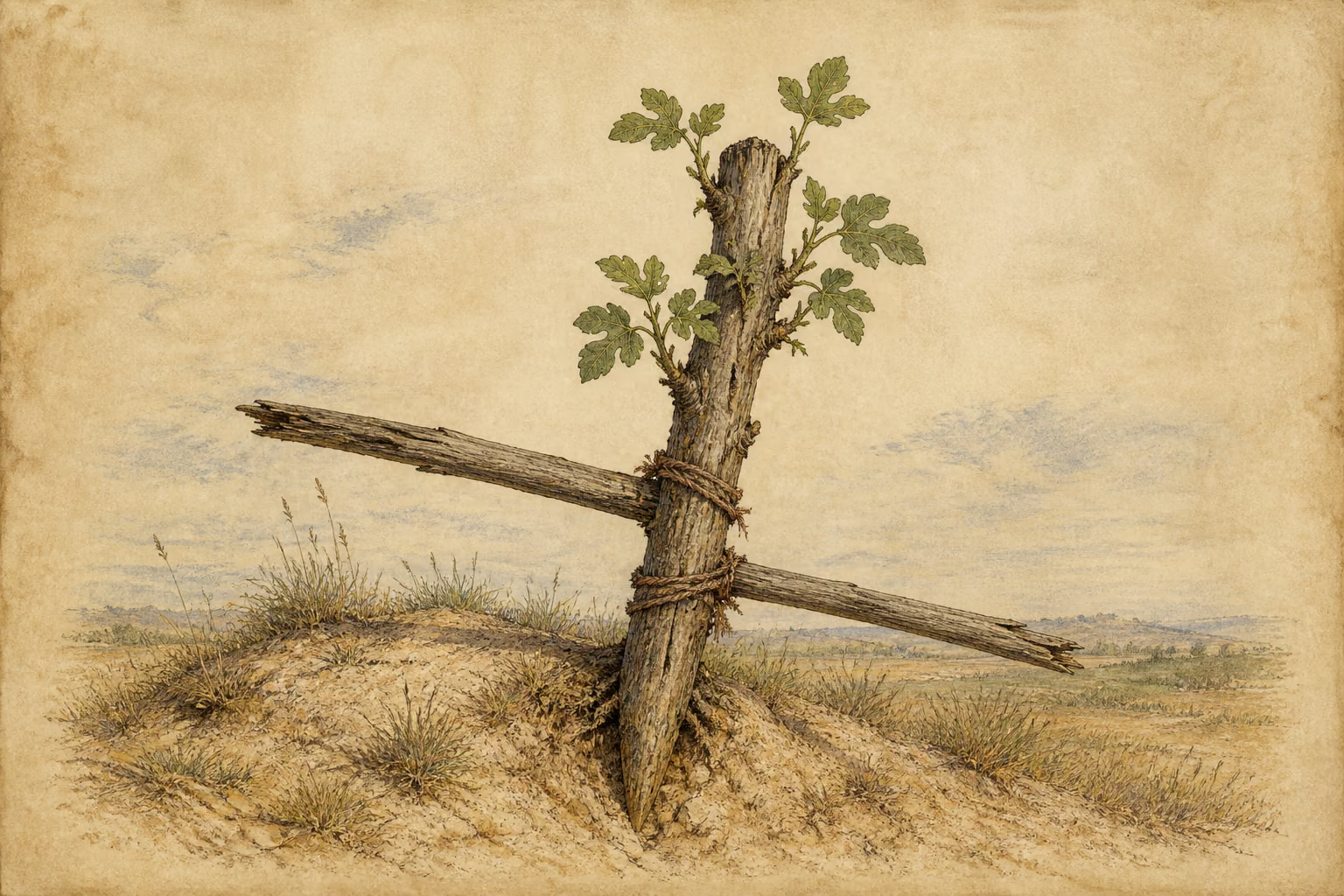
Reliqua genera casus ingenio suo excogitavit ac defractos serere ramos docuit, cum pali defixi radices cepissent. multa sic seruntur inprimisque ficus omnibus aliis modis nascens praeterquam talea, optime quidem, si vastiore ramo pali modo exacuto adigatur alte, exiguo super terram relicto capite eoque ipso harena cooperto. ramo seruntur et punica, palis laxato prius meatu, item myrtus, omnium horum longitudine III pedum, crassitudine minus bracchiali, cortice diligenter servato, trunco exacuto.
Myrtus et taleis seritur, morus talea tantum, quoniam in ulmo eam inseri religio fulgurum prohibet. quapropter de talearum satu nunc dicendum est. servandum in eo ante omnia, ut taleae ex feracibus fiant arboribus, ne curvae neve scabrae aut bifurcae, ne tenuiores quam ut manum impleant, ne minores pedalibus, ut inlibato cortice atque ut sectura inferior ponatur semper et quod fuerit ab radice, adcumuleturque germinatio terra, done robur planta capiat.
English · Bostock & Riley 1855–57
We must not here omit one very singular circumstance. Corellius, a member of the Equestrian order at Rome, and a native of Ateste, grafted a chesnut, in the territory of Neapolis, with a slip taken from the same tree, and from this was produced the chesnut which is so highly esteemed, and from him has derived its name. At a later period again, Etereius, his freedman, grafted the Corellian chesnut afresh. There is this difference between the two; the Corellian is more prolific, but the Etereian is of superior quality.
It is accident that has the credit of devising the other methods of reproduction, and has taught us how to break off a branch of a tree and plant it in the earth, from seeing stakes, when driven in the earth, take root, and grow. It is in this way that many of the trees are reproduced, and the fig more particularly; which may be propagated also by all the methods previously stated, with the exception, indeed, of that by cuttings. The best plan, however, is to take a pretty large branch, and, after sharpening it like a stake, to drive it to a considerable depth in the earth, taking care to leave only a small portion above ground, and then to cover it over with sand. The pomegranate, too, may be planted in a similar manner, the hole being first widened with a stake; the same, too, with the myrtle. For all trees of this nature a branch is required three feet in length, and not quite the thickness of the arm, care being taken to keep the bark on, and to sharpen the branch to a point at the lower end.
The myrtle, too, may be propagated from cuttings, and the mulberry is grown no other way, the religious observances relative to lightning forbidding it to be grafted on the elm; hence it would appear that the present is a fitting opportunity for speaking of reproduction from cuttings. Care should be taken more particularly to select the slips from fruitful trees, and it should be seen that they are neither bent, scabbed, nor bifurcated. The cuttings, too, should be thick enough to fill the hand, and not less than a foot in length: the bark, too, should be uninjured, and the end which is cut and lies nearest the root should always be the one inserted in the earth. While the work of germination is going on, the slip should be kept well moulded up, until such time as it has fully taken root.