LIBER XVII · CAPUT 18
THE CULTIVATION OF THE OLIVE
Latine · Mayhoff 1906
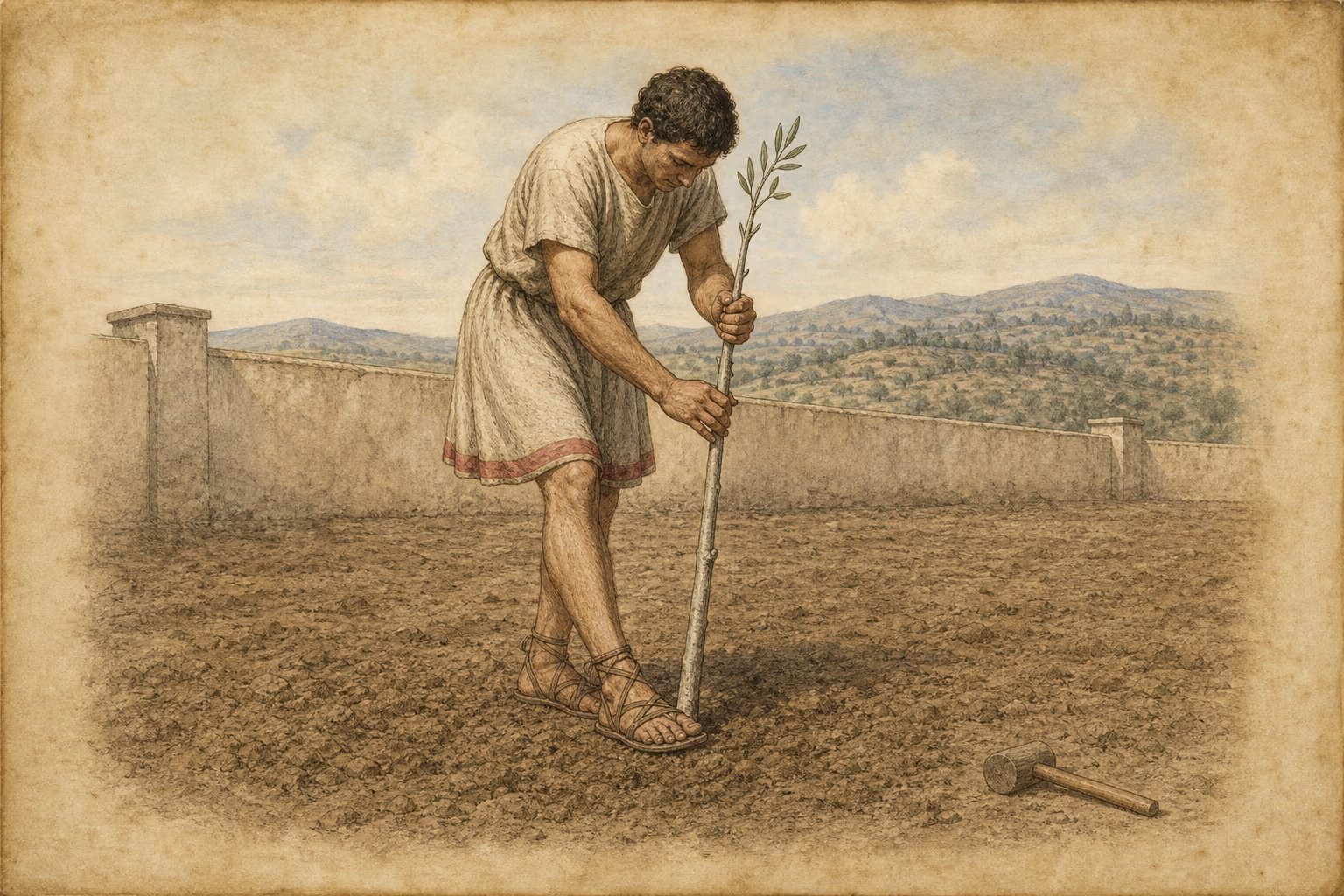
Quae custodienda in olearum cura Cato iudicaverit, ipsius verbis optime praecipiemus: Taleas oleagineas, quas in scrobe saturus eris, tripedaneas facito, diligenterque tractato, ne liber laboret, cum dolabis aut secabis. quas in seminario saturus eris, pedales facito. eas sic inserito: locus bipalio subactus sit beneque gluttus. cum taleam demittes, pede taleam opprimito. si parum descendet, malleo aut mateola adigito, cavetoque, ne librum scindas, cum adiges. palo prius locum ne feceris, quo taleam demittas; ita melius vivet. taleae ubi trimae sunt, tum denique maturae sunt, ubi liber se vertet. si in scrobibus aut in sulcis seres, ternas taleas ponito easque divaricato. supra terrain ne plus quattuor digitos traverses emineant, vel oculos serito.—Diligenter eximere oleam oportet et radices quam plurimas cum terra ferre, ubi radices bene operueris, calcare bene, ne quid noceat. si quis quaeret, quod tempus oleae serendae sit, agro sicco per sementem, agro laeto per ver. <1> Olivetum diebus xv ante aequinoctium vernum incipito putare. ex eo die dies XL recte putabis. id hoc modo putato: qua locus recte ferax erit, quae arida erunt et si quid ventus interfregerit, inde ea omnia eximito. qua locus ferax non erit, id plus concidito aratoque bene enodatoque stirpisque leves facito.—Circum oleas autumnitate ablaqueato et stercus addito.—Qui oletum saepissime et altissime miscebit, is tenuissimas radices exarabit. si male arabit, radices susum abibunt, crassiores fient et eo in radices vires oleae abibunt.
<2> Quae genera olearum et in quo genere terrae iuberet seri quoque spectare oliveta, diximus in ratione olei. Mago in colle et siccis et argilla inter autumnum et brumam seri iussit, in crasso aut umido aut subriguo solo a messe ad brumam. quod praecepisse eum Africae intellegitur. Italia quidem nunc vere maxime serit. sed si et autumno libeat, post aequinoctium XL diebus ad vergiliarum occasum III soli dies sunt, quibus seri noceat. Africae peculiare, quod in oleastro eas inserit quadam aeternitate, cum senescant, proxima adoptione virga emissa atque ita alia arbore ex eadem iuvenescente iterumque et quotiens opus sit, ut aevis eadem oliveta constent. inseritur autem oleaster calamo et inoculatione.
<3> Olea, ubi quercus effossa est, male ponitur, quoniam vermes, qui raucae vocantur, in radice quercus nascuntur et transeunt. non infumare taleas aut siccare prius, quam serantur, utilius conpertum. vetus olivetum ab aequinoctio verno intra vergiliarum exortum interradi alternis annis melius inventum, item museum radi, circumfodi autem omnibus annis a solstitio II cubitorum scrobe pedali altitudine, stercorari tertio anno.
<4> Mago idem amygdalas ab occasu arcturi ad brumain seri iubet, pira non eodem tempore omnia, quoniam neque floreant eodem, oblonga aut rotunda ab occasu vergiliarum ad brumam, reliqua genera media hieme ab occasu sagittae, subsolanum aut septentrionis spectantia, laurum ab occasu aquilae ad occasum sagittae. conexa enim de tempore serendi inserendique ratio est. vere et autumno id magna ex parte fieri decrevere. est et alia hora circa canis ortus, paucioribus nota, quoniam non omnibus locis pariter utilis intellegitur, sed haud omittenda nobis non tractus alicuius rationem, verum naturae totius indagantibus. in Cyrenaica regione sub etesiarum flatu conserunt, nec non et in Graecia, oleam maxime in Laconia. Coos insula et vites tune serit, ceteri apud Graecos inoculare et inserere non dubitant, sed arbores non serunt. plurimumque in eo locorum natura pollet; namque in Aegypto omni serunt mense et ubicumque imbres aestivi sunt, ut in India et Aethiopia, necessario post haec autumno seruntur arbores. <5> ergo tria tempora eadem germinationis, ver et canis arcturique ortus. neque enim animalium tantum est ad coitus aviditas, sed multo maior est terrae ac satorum omnium libido, qua tempestive uti plurimum interest conceptus, peculiare utique in insitis, cum sit mutua cupiditas utrimque coeundi. qui ver probant, ab aequinoctio statim admittunt, praedicantes germina parturire, ideo faciles corticum esse conplexus. qui praeferunt autumnum, ab arcturi ortu, quoniam statim radicem quandam capiant et ad ver parata veniant atque non protinus germinatio auferat vires. quaedam tamen statutum tempus anni habent ubique, ut cerasi et amygdalae circa brumam serendi vel inserendi. de pluribus locorum situs optime iudicabit. frigida enim et aquosa verno conseri oportet, sicca et calida autumno. <6> communis quidem Italiae ratio tempora ad hunc modum distribuit: moro ab idibus Februariis in aequinoctium, piro autumnum, ita ut brumam XV ne minus diebus antecedant, malis aestivis et cotoneis, item sorbis, prunis, post mediam hiemem in idus Februarias, siliquae Graecae et persicis ante brumam per autumnum, nucibus iuglandi et pineae et abellanae et Graecae atque castaneae a kal. Martiis ad idus easdem, salici et genistae circa Martias kal. hanc in siccis semine, illam in umidis virga seri diximus.
English · Bostock & Riley 1855–57
Cato has treated so well of the precautions that are necessary in cultivating the olive, that we cannot do better than employ his own words on the subject. “Let the slips of olive,” says he, “which you are about to plant in the hole, be three feet long, and be very careful in your treatment of them, so as not to injure the bark when you are smoothing or cutting them. Those that you are going to plant in the nursery, should be a foot in length; and you should plant them the following way: let the spot be turned up with the mattock, and the soil be well loosened. When you put the cutting in the ground, press it down with the foot only. If there is any difficulty in making it descend, drive it down with a mallet or the handle of the dibble, but be careful not to break the bark in doing so. Take care, too, not to make a hole first with the dibble, for the slip will have the better chance of surviving the other way. When the slip is three years old, due care must be taken to observe the direction in which each side of the bark is situate. If you are planting in holes or furrows, you must put in the cuttings by threes, but be careful to keep them separate. Above ground, however, they should not be more than four fingers distant from one another, and each of them must have a bud or eye above ground. In taking up the olive for transplanting, you must use the greatest caution, and see that there is as much earth left about the roots as possible. When you have covered the roots well up, tread down the earth with the foot, so that nothing may injure the plant.”
If the enquiry is made what is the proper season for planting the olive, my answer will be, “where the soil is dry, at seed-time; where it is rich, in spring.” The following is the advice given by Cato on the subject: “Begin pruning your olive-yard fifteen days before the vernal equinox; from that period for forty days will be a good time for doing so. In pruning, adopt the following rules: when the ground is extremely productive, remove all the dry branches or such as may have been broken by the wind; where it is not so prolific, you must cut away still more, then tie them well up, and remove all tangled branches, so as to lighten the roots. In autumn clear away the roots of the olive, and then manure them. The man who labours most assiduously and most earnestly will remove the very smallest fibres that are attached to the roots. If, however, he hoes negligently, the roots will soon appear again above ground, and become thicker than ever; the consequence of which will be, that the vigour of the tree will be expended in the roots.”
We have already stated, when speaking on the subject of oil, what are the different varieties of the olive, in what kind of soil it ought to be planted, and what is the proper aspect for the olive-yard. Mago recommends that the olive should be planted on declivities and in dry spots, in an argillaceous soil, and between autumn and the winter equinox. If, on the other hand, the soil is thick, humid, or somewhat damp even, it ought to be planted between harvest and the winter solstice; advice, however, it should be remembered, applicable to Africa more particularly. At the present day, it is mostly the custom in Italy to plant the olive in spring, but if it is thought desirable to do so in the autumn as well, there are only four days in the forty between the equinox and the setting of the Vergiliæ that are unfavourable for planting it. It is a practice peculiar to Africa, to engraft the olive on the wild olive only, a tree which is made to be everlasting, as it were; for when it becomes old the best of the suckers are carefully trained for adoption by grafting, and in this way in another tree it grows young again; an operation which may be repeated continuously as often as needed; so much so, indeed, that the same olive-yard will last for ages. The wild olive also is propagated both by insertion and inoculation.
It is not advisable to plant the olive in a site where the quercus has been lately rooted up; for the earth-worms, known as “raucæ,” which breed in the root of the quercus, are apt to get into that of the olive. It has been found, from practical experience, that it is not advisable to bury the cuttings in the ground nor yet to dry them before they are planted out. Experience has also taught us that it is the best plan to clean an old olive-yard every other year, between the vernal equinox and the rising of the Vergiliæ, and to lay moss about the roots; to dig holes also round the trees every year, just after the summer solstice, two cubits wide by a foot in depth, and to manure them every third year.
Mago, too, recommends that the almond should be planted between the setting of Arcturus and the winter solstice. All the varieties, however, of the pear, he says, should not be planted at the same time, as they do not all blossom together. Those with oblong or round fruit should be planted between the setting of the Vergiliæ and the winter solstice, and the other kinds in the middle of the winter, after the setting of the constellation of the Arrow, on a site that looks towards the east or north. The laurel should be planted between the setting of the Eagle and that of the Arrow; for we find that the proper time for planting is equally connected with the aspect of the heavenly bodies. For the most part it has been recommended that this should be done in spring and autumn; but there is another appropriate period also, though known to but few, about the rising of the Dog-star, namely; it is not, however, equally advantageous in all localities. Still, I ought not to omit making mention of it, as I am not setting forth the peculiar advantages of any one country in particular, but am enquiring into the operations of Nature taken as a whole.
In the region of Cyrenaica, the planting is generally done while the Etesian winds prevail, and the same is the case in Greece, and with the olive more particularly in Laconia. At this period, also, the vine is planted in the island of Cos; and in the rest of Greece they do not neglect to inoculate and graft, though they do not plant, their trees just then. The natural qualities, too, of the respective localities, exercise a very considerable influence in this respect; for in Egypt they plant in any month, as also in all other countries where summer rains do not prevail, India and Æthiopia, for instance. When trees are not planted in the spring they must be planted in autumn, as a matter of course.
There are three stated periods, then, for germination; spring, the rising of the Dog-star, and that of Arcturus. And, indeed, it is not the animated beings only that are ardent for the propagation of their species, for this desire is manifested in even a greater degree by the earth and all its vegetable productions; to employ this tendency at the proper moment is the most advantageous method of ensuring an abundant increase. These moments, too, are of peculiar importance in relation to the process of grafting, as it is then that the two productions manifest a mutual desire of uniting. Those who prefer the spring for grafting commence operations immediately after the vernal equinox, reckoning on the fact that then the buds are just coming out, a thing that greatly facilitates the union of the barks. On the other hand, those who prefer the autumn graft immediately after the rising of Arcturus, because then the graft at once takes root in some degree, and becomes seasoned for spring, so as not to exhaust its strength all at once in the process of germination. However, there are certain fixed periods of the year, in all cases, for certain trees; thus, the cherry, for instance, and the almond, are either planted or grafted about the winter solstice. For many trees the nature of the locality will be the best guide; thus, where the soil is cold and moist it is best to plant in spring, and where it is dry and hot, in autumn.
Taking Italy in general, the proper periods for these operations may be thus distributed:—The mulberry is planted at any time between the ides of February and the vernal equinox; the pear, in the autumn, but not beyond the fifteenth day before the winter solstice; the summer apples, the quince, the sorb, and the plum, between mid-winter and the ides of February; the Greek carob and the peach, at any time in autumn before the winter solstice; the various nuts, such as the walnut, pine, filbert, almond, and chesnut, between the calends of March and the ides of that month; the willow and the broom about the calends of March. The broom is grown from seed, and in a dry soil, the willow from plants, in a damp locality, as already stated on former occasions.