LIBER XVII · CAPUT 2
THE INFLUENCE OF WEATHER UPON THE TREES: WHAT IS THE PROPER SITUATION FOR THE VINE
Latine · Mayhoff 1906
Aquilone maxime gaudent, densiores ab adflatu eius laetioresque et materie firmiores. qua in re plerique falluntur, cum in vineis pedamenta non sint a vento eo opponenda et id tantum a septentrione servandum. quin immo tempestiva frigora plurimum arborum firmitati conferunt, et sic optime germinant, alioqui, si blandiantur austri, defetiscentes, ac magis etiam in flore. nam si, cum defloruere, protinus sequantur imbres, in totum poma depereunt, adeo ut amygdalae et piri, etiam si omnino nubilum fuit austrinusve flatus, amittant fetus. circa vergilias quidem pluvere inimicissimum viti et oleae, quoniam tum coitus est earum. hoc est illud quadriduum oleis decretorium, hic articulus austrinus nubili spurci, quod diximus. fruges quoque peius maturescunt austrinis diebus, sed celerius. illa sunt noxia frigora, quae septentrionibus aut praeposteris fiunt horis. hiemem quidem aquiloniam esse omnibus satis utilissimum. imbres vero tum expetendi evidens causa est, quoniam arbores fetu exinanitas et foliorum quoque amissione languidas naturale est avide esurire, cibus autem earum imber. quare tepidam esse hiemem, ut absumpto partu arborum sequatur protinus conceptus, id est germinatio, ac deinde alia florescendi exinanitio, inutilissimum experimentis creditur. quin immo si plures ita continuentur anni, etiam ipsae moriuntur arbores, quando nemini dubia poena est in fame laborantium. ergo qui dixit hiemes serenas optandas, non pro arboribus vota fecit; nec per solstitia imbres vitibus conducunt; hiberno quidem pulvere laetiores fieri messes luxuriantis ingenii fertilitate dictum est. alioqui vota arborum frugumque communia sunt nives diutinas sedere. causa non solum quia animam terrae evanescentem exhalatione includunt et conprimunt retroque agunt in vires frugum atque radices, verum quod et liquorem sensim praebent, purum praeterea levissimumque, quando nix aquarum caelestium spuma est. ergo umor ex his non universus ingurgitans diluensque, sed quomodo sititur destillans velut ex ubere, alit omnia, quia non inundat. tellus quoque illo modo fermentescit, et sui plena, a lactescentibus satis non effeta, cum tempus aperit, tepidis adridet horis. ita maxime frumenta pinguescunt, praeterquam ubi calidus semper aër est, ut in Aegypto. continuatio enim et ipsa consuetudo idem quod modus aliubi efficit, plurimumque prodest ubicumque non esse quod noceat. in maiore parte orbis, cum praecoces excurrere germinationes evocatae indulgentia caeli, secutis frigoribus exuruntur. qua de causa serotinae hiemes noxiae, silvestribus quoque, quae magis etiam dolent urguente umbra sua nec adiuvante medicina, quando vestire teneras intorto stramento in silvestribus non est. ergo tempestivae aquae hibernis primum imbribus, dein germinationem antecedentibus; tertium tempus est, cum educant poma, nec protinus, sed iam valido fetu. quae fructus suos diutius continent longioresque desiderant cibos, his et serotinae aquae utiles, ut viti, oleae, punicis. hae tam en pluviae generis cuiusque arboribus diverso modo desiderantur, aliis alio tempore maturantibus. quapropter eisdem imbribus aliqua laedi videas, aliqua iuvari, etiam in eodem genere, sicut in piris alio die hiberna quaerunt pluvias, alio vero praecocia, ut pariter quidem omnia desiderent hibernum tempus, set ante germinationem. quae aquilonem austro utiliorem facit ratio, eadem mediterranea maritimis praefert—sunt enim plerumque frigidiora — et montuosa planis et nocturnes imbres diurnis. magis fruuntur aquis sata non statim auferente eas sole.
Conexa et situs vinearum arbustorumque ratio est, quas in horas debeant spectare. Vergilius ad occasus seri damnavit, aliqui sic maluere quam in exortus. a pluribus meridiem probari adverto, nec arbitror perpetuum quicquam in hoc praecipi posse. ad soli naturam, ad loci ingenium, ad caeli cuiusque mores dirigenda sollertia est. in Africa meridiem vineas spectare et viti inutile et colono insalubre est, quoniam ipsa meridianae subiacet plagae, quapropter ibi, qui in occasum aut septentriones conseret, optime miscebit solum caelo. cum Vergilius occasus improbet, nec de septentrione relinqui dubitatio videtur. atqui in cisalpina Italia magna ex parte vineis ita positis compertum est nullas esse fertiliores. multum rationis optinent et venti. in Narbonensi provincia atque Liguria et parte Etruriae contra circium serere imperitia existimatur, eundemque oblicum accipere providentia. is namque aestates ibi temperat, sed tanta plerumque violentia, ut auferat tecta.
English · Bostock & Riley 1855–57
Trees are fond of a site more particularly that faces the north-east; the breezes rendering their foliage more thick and exuberant, and imparting additional solidity to the wood. This is a point, however, upon which most people are very greatly deceived; thus in vineyards, for instance, the props ought not to be placed in such a position as to shelter the stems from the wind in that quarter, it being only against the northern blasts that this precaution should be taken. Nay, even more than this—if the cold weather only comes on in due season, it contributes very materially to the strengthening of the trees, and promotes the process of germination; while, on the other hand, if at that period the southern breezes should caress them, they will grow weak and languid, and more particularly so, if the blossom is just coming on. If rainy weather, too, should happen to follow close upon blossoming, the total destruction of the fruit is the necessary result: indeed, if the weather should be only cloudy, or south winds happen to prevail, it is quite sufficient to ensure the loss of the fruit in the almond and the pear. Rains, if prevalent about the rising of the Vergiliæ, are most injurious to the vine and the olive, as it is at that season that germination is commencing with them; indeed, this is a most critical four days for the olive, being the period at which the south wind, as we have already stated, brings on its dark and lowering clouds. The cereals, too, ripen more unfavourably when south winds prevail, though at the same time it proceeds with greater rapidity. All cold, too, is injurious to vegetation, which comes with the northern winds, or out of the proper season. It is most advantageous to all plants for north-east winds to prevail throughout the winter.
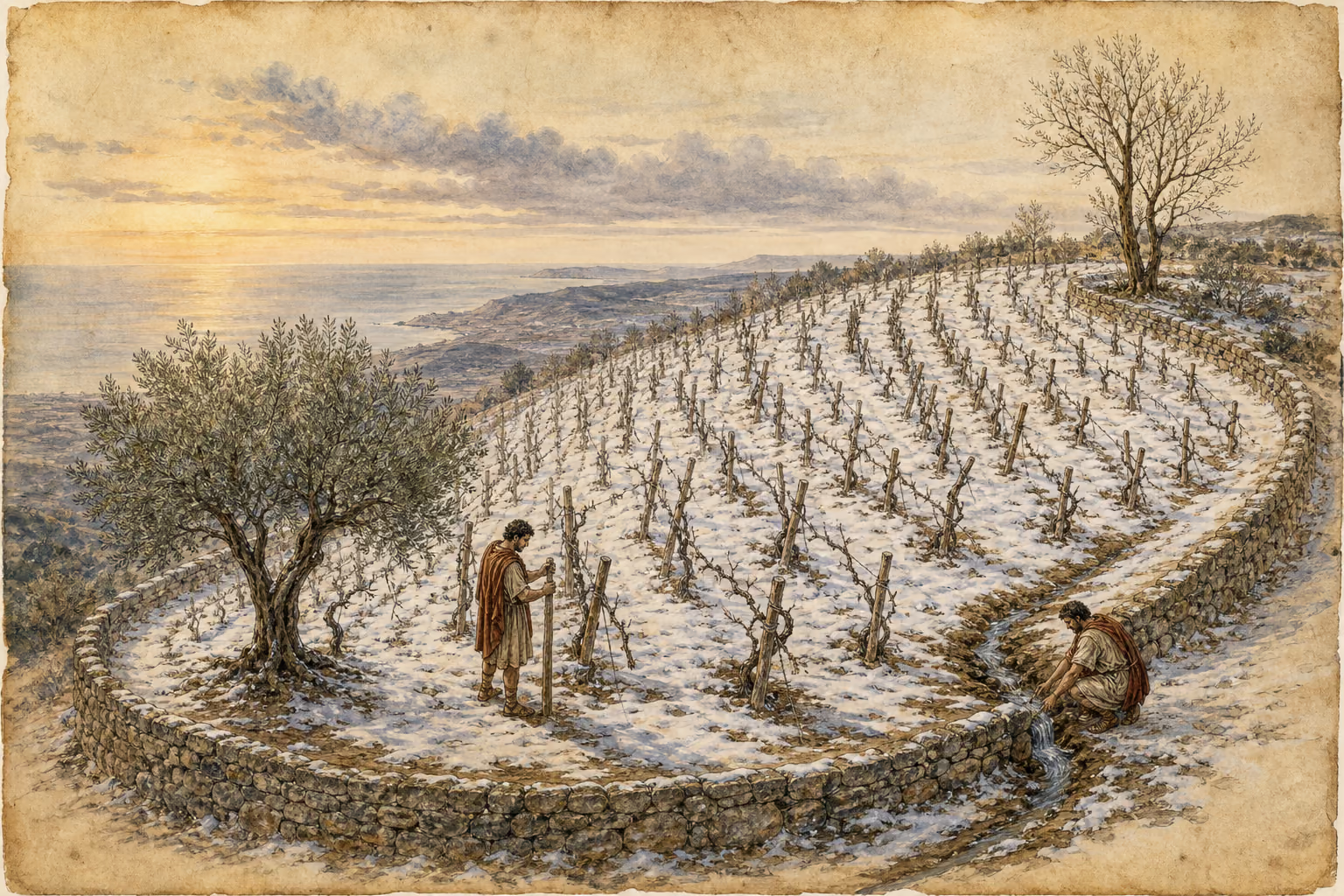
In this season, too, showers are very necessary, and the reason is self-evident—the trees, being exhausted by the fruit they have borne, and weakened by the loss of their leaves, are, of course, famished and hungry; and it is the showers that constitute their aliment. Experience has led us to believe that there is nothing more detrimental than a warm winter; for it allows the trees, the moment they have parted with their fruits, to conceive again, or, in other words, to germinate, and then exhaust themselves by blossoming afresh. And what is even worse than this, should there be several years of such weather in succession, even the trees themselves will die; for there can be little doubt that the effort must of necessity be injurious, when they put forth their strength, and are at the same time deprived of their natural sustenance. The poet then, who has said that serene winters are to be desired, certainly did not express those wishes in favour of the trees. And no more does rain, if prevalent at the summer-solstice, conduce to the benefit of the vine: while, at the same time, to say that a dusty winter produces a luxuriant harvest, is certainly the mistake of a too fertile imagination. It is a thing greatly to be wished, too, both in behalf of the trees as well as the cereals, that the snows should lie for a considerable time upon the ground; the reason being that they check the escape of the spirit of the earth by evaporation, and tend to throw it back again upon the roots of the plants, adding greatly to their strength thereby; and not only this, but they afford a gradual supply of moisture as well, that is both pure and of remarkable lightness, from the fact that snow is only the foam of the waters of heaven. Hence it is that the moisture of snow does not drench and engulph everything all at once, but gradually trickles downwards, in proportion to the thirst of the plant, nurturing it as though from the breast, instead of producing an inundation. The earth, too, ferments under this influence, and becomes filled with her own emanations: not exhausted by the seeds in her bosom, swollen as they are with milk, she smiles in the warm and balmy hours, when the time comes for opening it. It is in this way, more particularly, that corn fattens apace, except, indeed, in those climates in which the atmosphere is always warm, Egypt for example; for there the continuance of the same temperature and the force of habit are productive of the same effects as the modifications of temperature in other countries.
At the same time it is equally necessary in every climate that there should be no noxious influence in existence. Thus, for instance, in the greater part of the world, that precocious germination which has been encouraged by the indulgent temperature of the weather, is sure to be nipped by the intense colds that ensue. Hence it is that late winters are so injurious, and such they prove to the trees of the forest even; indeed, these last are more particularly exposed to the ill effects of a late winter, oppressed as they are by the density of their foliage, and human agency being unable to succour them; for it would be quite impossible to cover the more tender forest trees with wisps of straw. Rains, then, are favourable to vegetation—first of all, during the winter season, and next, just previously to germination; the third period for them being that of the formation of the fruit, though not immediately, and only, in fact, when the produce of the tree shows itself strong and healthy.
Those trees which are the slowest in bringing their fruits to maturity, and require a more prolonged supply of nutriment, receive benefit also from late rains, such as the vine, the olive, and the pomegranate, for instance. These rains, however, are required at different seasons by the different trees, some of them coming to maturity at one period and some at another; hence it is that we see the very same rain productive of injury to some trees and beneficial to others, even when they are of the very same species, as in the pear for instance: for the winter pear stands in need of rain at one period, and the early pear at another, though at the same time they, all of them, require it in an equal degree. Winter precedes the period of germination, and it is this fact that makes the north-east wind more beneficial than the south, and renders the parts that lie in the interior preferable to those near the coast,—the former being generally the coldest,—mountainous districts better than level ones, and rain at night better than showers in the day. Vegetation, too, receives a greater degree of benefit from the water when the sun does not immediately soak it up.
Connected, too, with this subject is the question of the best situation for planting vines, and the trees which support them. Virgil condemns a western aspect, while there are some persons, again, who prefer it to an easterly one: I find, however, that most authors approve of the south, though I do not think that any abstract precepts can be given in relation to the point. The most careful attention on the part of the cultivator ought to be paid to the nature of the soil, the character of the locality, and the respective influences of climate. The method of giving to the vine a southern aspect, as practised in Africa and * * * * is injurious to the tree, as well as unhealthy for the cultivator, from the very circumstance that the country itself lies under a southern meridian: hence it is, that he who selects for his plants there a western or a northerly aspect, will combine on the most advantageous terms the benefits of soil with those of climate. When Virgil condemns a western aspect, there can be no doubt that he includes in his censure a northern aspect as well: and yet, in Cisalpine Italy, where most of the vineyards have an aspect to the north, it has been found by experience that there are none that are more prolific.
The winds are also a very important consideration. In the provinces of Gallia Narbonensis, and in Liguria and part of Etruria, it is considered a proof of great want of skill to plant the vine on a site that lies in the teeth of the wind Circius, while, on the other hand, it is a mark of prudence to catch its breezes in an oblique direction; it is this wind, in fact, that modifies the heat in those countries, though at the same time it is usually so violent, as to sweep away the roofs of the houses.