LIBER XVII · CAPUT 1
TREES WHICH HAVE BEEN SOLD AT ENORMOUS PRICES
Latine · Mayhoff 1906
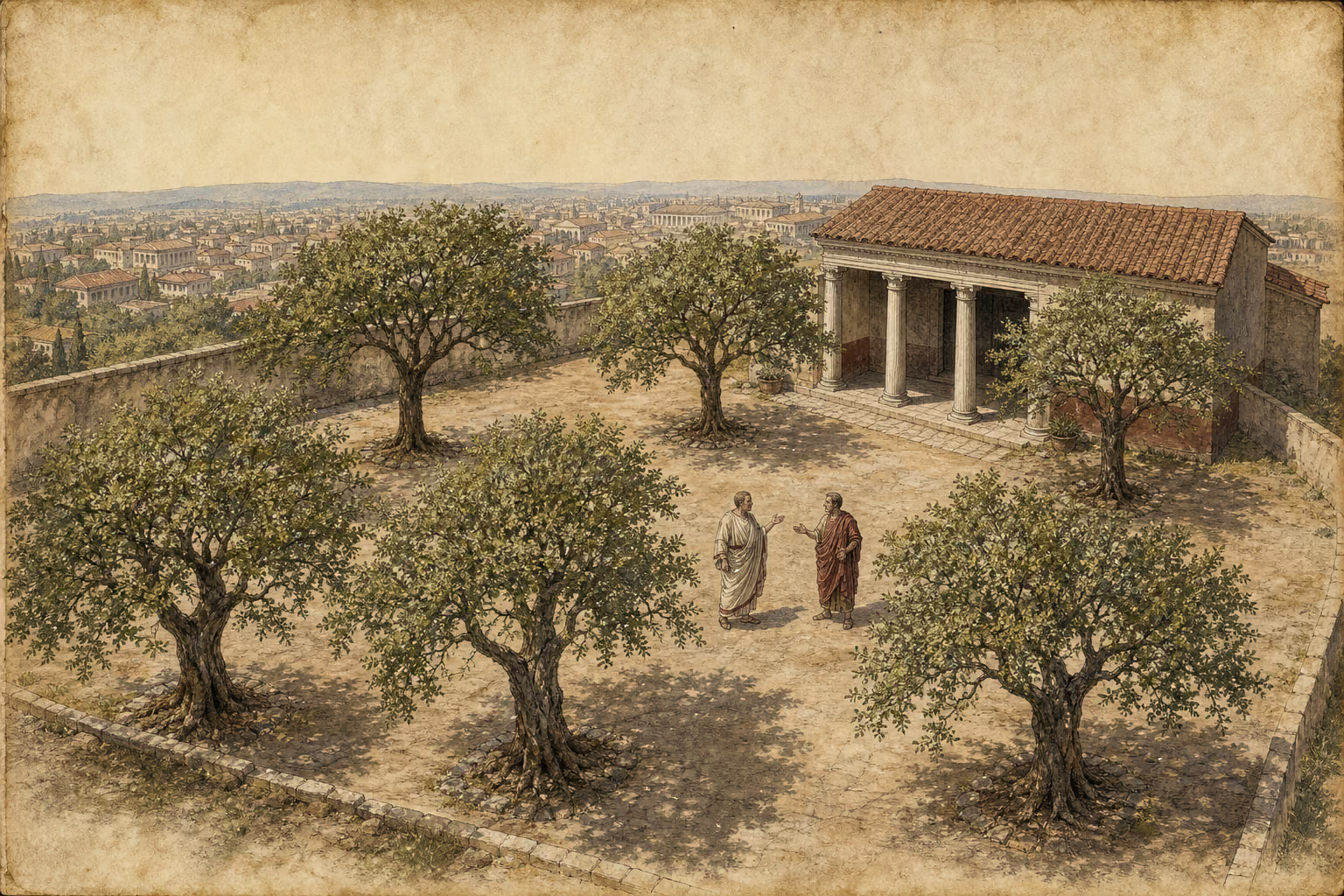
Natura arborum terra marique sponte sua provenientium dicta est; restat earum, quae arte et humanis ingeniis fiunt verius quam nascuntur. sed prius mirari succurrit, quae retulimus paenuria pro indiviso possessa feris, depugnante cum his homine circa caducos fructus, circa pendentes vero et cum alitibus, in tanta deliciarum pretia venisse, clarissimo, ut equidem arbitror, exemplo L. Crassi atque Cn. Domiti Ahenobarbi. Crassus orator fuit in primis nominis Romani. domus ei magnifica, sed aliquanto praestantior in eodem Palatio Q. Catuli, qui Cimbros cum C. Mario fudit, multo vero pulcherrima consensu omnium aetate ea in colle Viminali C. Aquili, equitis Romani clarioris illa etiam quam iuris civilis scientia, cum tamen obiecta Crasso sua est. nobilissimarum gentium ambo censuram post consulatus simul gessere anno conditae urbis DCLXII frequentem iurgiis propter dissimilitudinem morum. tum Cn. Domitius, ut erat vehemens natura, praeterea accensus odio, quod ex aemulatione avidissimum est, graviter increpuit tanti censorem habitare, |LX| HSpro domo eius identidem promittens, et Crassus, ut praesens ingenio semper, ut faceto lepore sollers, addicere se respondit exceptis sex arboribus. ac ne uno quidem denario, si adimerentur, emptam volente Domitio, Crassus: Utrumne igitur ego sum, inquit, quaeso, Domiti, exemplo gravis et ipsa mea censura notandus, qui domo, quae mihi hereditate obvenit, comiter habitem, an tu, qui sex arbores |LX| aestimes? haec fuere lotoe patula ramorum opacitate lascivae, Caecina Largo e proceribus crebro iuventa nostra eas in domo sua ostentante, duraveruntque —quoniam et de longissimo aevo arborum diximus— ad Neronis principis incendia cultu virides iuvenesque, ii princeps ille adcelerasset etiam arborum mortem. ac ne quis vilem de cetero Crassi domum nihilque in ea iurganti Domitio fuisse licendum praeter arbores iudicet, iam columnas VI Hymetti marmoris, aedilitatis gratia ad scenam ornandam advectas, in atrio eius domus statuerat, cum in publico nondum essent ullae marmoreae. tam recens est opulentia, tantoque tunc plus honoris arbores domibus adferebant, ut sine illis ne inimicitiarum quidem pretium servaverit Domitius.
Fuere ab his et cognomina antiquis: Frondicio militi illi, qui praeclara facinora Volturnum transnatans fronde inposita adversus Hannibalem edidit, Stolonum Liciniae genti. ita appellatur in ipsis arboribus fruticatio inutilis, unde et pampinatio inventa primo Stoloni dedit nomen. fuit et arborum cura legibus priscis, cautumque est XII tabulis ut, qui iniuria cecidisset alienas, lueret in singulas aeris xxv. quid existimamus? venturasne eas credidisse ad supra dictam aestimationem illos, qui vel frugiferas tanti taxaverant? nec minus miraculum in porno est multarum circa suburbana fructu annuo addicto binis milibus nummum, maiore singularum reditu quam erat apud antiquos praediorum. ob hoc insita et arborum quoque adulteria excogitata sunt, ut nec poma pauperibus nascerentur. nunc ergo dicemus, quonam maxime modo tantum ex his vectigal contingat, veram colendi rationem absolutamque prodituri, et ideo non volgata tractabimus nec quae constare animo advertimus, sed incerta atque dubia, in quibus maxime fallitur vita. nam diligentiam supervacuis adfectare non nostrum est. ante omnia autem [in universum et] quae ad cuncta arborum genera pertinent in commune de caelo terraque dicemus.
English · Bostock & Riley 1855–57
We have described the trees which grow spontaneously on land and in the sea, and it now remains for us to speak of those which owe their formation, properly speaking, rather than birth, to art and the inventive genius of man. Here, however, I cannot but express my surprise, that after the state of penury in which man lived, as already described, in primitive times, holding the trees of the forest in common with the wild beasts, and disputing with them the possession of the fruits that fell, and with the fowls of the air that of the fruits as they hung on the tree, luxury has now attached to them prices so enormous.
The most famous instance, in my opinion, of this excess, was that displayed by L. Crassus and Cneius Domitius Ahenobarbus. Crassus was one of the most celebrated of the Roman orators; his house was remarkable for its magnificence, though in some measure surpassed even by that of Q. Catulus, also upon the Palatine Hill; the same Catulus, who, in conjunction with C. Marius, defeated the Cimbri. But by far the finest house of all that period, it was universally acknowledged, was that of C. Aquilius, a Roman of Equestrian rank, situate upon the Viminal Hill; a house, indeed, that conferred a greater degree of celebrity upon him than even his acquaintance with the civil law. This, however, did not prevent Crassus being reproached with the magnificence of his. Crassus and Domitius, members, both of them, of the most illustrious families, after holding the consulship, were appointed jointly to the censorship, in the year from the building of the City 662, a period of office that was fruitful in strife, the natural result of their dissimilarity of character. On one occasion, Cneius Domitius, naturally a man of hasty temper, and inflamed besides by a hatred that rivalry only tends to stimulate, gravely rebuked Crassus for living, and he a Censor too, in a style of such magnificence, and in a house for which, as he said, he himself would be ready to pay down ten millions of sesterces. Crassus, a man who united to singular presence of mind great readiness of wit, made answer that, deducting six trees only, he would accept the offer; upon which Domitius replied, that upon those terms he would not give so much as a single denarius for the purchase. “Well then, Domitius,” was the rejoinder of Crassus, “which of the two is it that sets a bad example, and deserves the reproof of the censorship; I, who live like a plain man in a house that has come to me by inheritance, or you, who estimate six trees at a value of ten millions of sesterces?” These trees were of the lotus kind, and by the exuberance of their branches afforded a most delightful shade. Cæcina Largus, one of the grandees of Rome, and the owner of the house, used often to point them out to me in my younger days; and, as I have already made mention of the remarkable longevity of trees, I would here add, that they were in existence down to the period when the Emperor Nero set fire to the City, one hundred and eighty years after the time of Crassus; being still green and with all the freshness of youth upon them, had not that prince thought fit to hasten the death of the very trees even.
Let no one, however, imagine that the house of Crassus was of no value in other respects, or that, from the rebuke of Domitius, there was nothing about it worthy of remark with the exception of these trees. There were to be seen erected in the atrium four columns of marble from Mount Hymettus, which in his ædileship he had ordered to be brought over for the decoration of the stage; and this at a time, too, when no public buildings even as yet possessed any pillars made of that material. Of such recent date is the luxury and opulence which we now enjoy, and so much greater was the value which in those days trees were supposed to confer upon a property! A pretty good proof of which, was the fact that Domitius even, with all his enmity, would not keep to the offer he had made, if the trees were not to be included in the bargain.
The trees have furnished surnames also to the ancients, such, for instance, as that of Fronditius to the warrior who swam across the Volturnus with a wreath of leaves on his head, and distinguished himself by his famous exploits in the war against Hannibal; and that of Stolo to the Licinian family, such being the name given by us to the useless suckers that shoot from trees; the best method of clearing away these shoots was discovered by the first Stolo, and hence his name. The ancient laws also took the trees under their protection; and by the Twelve Tables it was enacted, that he who should wrongfully cut down trees belonging to another person, should pay twenty-five asses for each. Is it possible then to imagine that they, who estimated the fruit-trees at so low a rate as this, could ever have supposed that so exorbitant a value would be put upon the lotus as that which I have just mentioned? And no less marvellous, too, are the changes that have taken place in the value of fruit; for at the present day we find the fruit alone of many of the trees in the suburbs valued at no less a sum than two thousand sesterces; the profits derived from a single tree thus being more than those of a whole estate in former times. It was from motives of gain that the grafting of trees and the propagation thereby of a spurious offspring was first devised, so that the growth of the fruits even might be a thing interdicted to the poor. We shall, therefore, now proceed to state in what way it is that such vast revenues are derived from these trees, and with that object shall set forth the true and most approved methods of cultivation; not taking any notice of the more common methods, or those which we find generally adopted, but considering only those points of doubt and uncertainty, in relation to which practical men are most apt to find themselves at a loss: while, at the same time, to affect any scrupulous exactness in cases where there is no necessity for it, will be no part of our purpose. In the first place, however, we will consider in a general point of view, those influences of soil as well as weather which are exercised upon all the trees in common.