LIBER XVI · CAPUT 44
THE AGE OF TREES. A TREE THAT WAS PLANTED BY THE FIRST SCIPIO AFRICANUS. A TREE AT ROME FIVE HUNDRED YEARS OLD
Latine · Mayhoff 1906
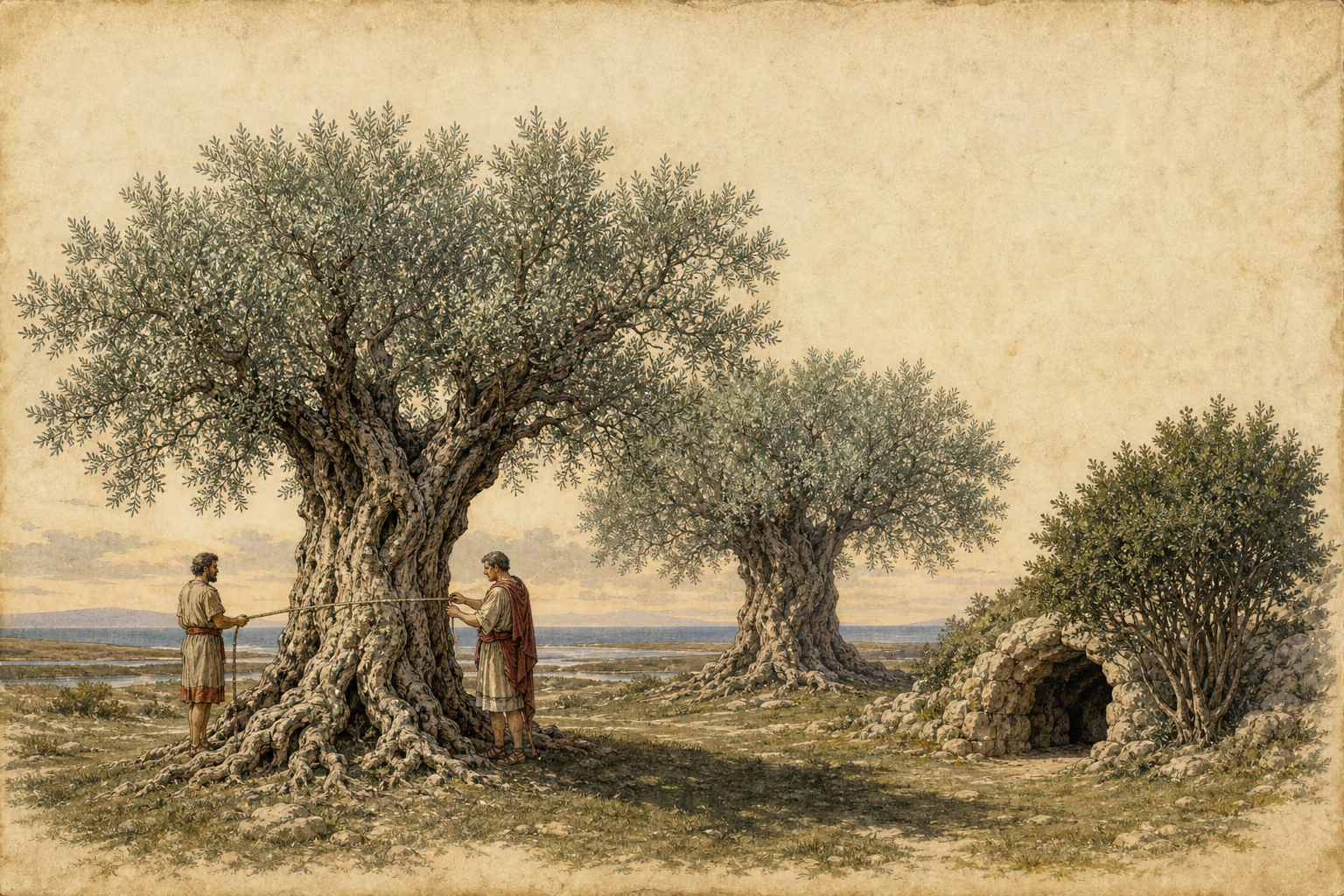
Vita arborum quarundam inmensa credi potest, si quis profunda mundi et saltus inaccessos cogitet. verum ex iis, quas memoria hominum custodit, durant in Liternino Africani prioris manu satae olea, item myrtus eodem loco conspicuae magnitudinis—subest specus, in quo manes eius custodire draco traditur—, Romae vero lotos in Lucinae area, anno, qui fuit sine magistratibus, CCCLXXIX urbis aede condita. incertum, ipsa quanto vetustior; esse quidem vetustiorem non est dubium, cum ab eo luco Lucina nominetur. haec nunc D circiter annum habet. antiquior, sed incerta eius aetas, quae capillata dicitur, quoniam Vestalium virginum capillus ad eam defertur.
Verum altera lotos in Volcanali, quod Romulus constituit ex victoria de decumis, aequaeva urbi intellegitur, ut auctor est Masurius. radices eius in forum usque Caesaris per stationes municipiorum penetrant. fuit cum ea cupressus aequalis, circa suprema Neronis principis prolapsa atque neglecta.
Vetustior autem urbe in Vaticano ilex, in qua titulus aereis litteris Etruscis religione arborem iam turn dignam fuisse significant. Tiburtes quoque originem multo ante urbem Romam habent. apud eos extant ilices tres etiam Tiburno coinditore eorum vetustiores, apud quas inauguratus traditur. fuisse autem eum tradunt filium Amphiarai, qui apud Thebas obierit una aetate ante Iliacum bellum.
Sunt auctores et Delphicam platanum Agamemnonis manu satam et alteram in Caphya Arcadiae loco. sunt hodie ex adverse Iliensium urbis iuxta Hellespontum in Protesilai sepulchre arbores, quae omnibus ex eo aevis, cum in tantum adcrevere, ut Ilium aspiciant, inarescunt rursusque adolescunt. iuxta urbem autem quercus in Ili tumulo tunc satae dicuntur, cum coepit Ilium vocari.
Argis olea etiamnum durare dicitur, ad quam in tauram mutatam Argus alligaverit. in Ponto citra Heracleam arae sunt Iovis στρατίου cognomine, ibi quercus duae ab Hercule satae. in eodem tractu portus Amyci est, Bebryce rege interfecto clarus. eius tumulus a supremo die lauro tegitur, quam insanam vocant, quoniam, si quid ex ea decerptum inferatur navibus, iurgia fiunt, donec abiciatur. regionem Aulocrenen diximus, per quam Apamea in Phrygiam itur. ibi platanus ostenditur, ex qua pependerit Marsuas victus ab Apolline, quae iam tum magnitudine electa est. nec non palma Deli ab eiusdem dei aetate conspicitur, Olympiae oleaster, ex quo primus Hercules coronatus est, et nunc custoditur religio. Athenis quoque olea durare traditur in certamine edita a Minerva.
Ex diverso brevissima vita est punicis, fico, malis, et ex his praecocibus brevior quam serotinis, dulcibus quam acidis, et dulciori in punicis, item in vitibus, praecipueque fertilioribus. Graecinus auctor est sexagenis annis durasse vites. videntur et aquaticae celerius interire. senescunt quidem velociter, sed e radicibus repullulant laurus et mali et punicae. firmissimae ergo ad vivendum oleae, ut quas durare annis cc inter auctores conveniat.
Est in suburbano Tusculani agri colle, qui Corne appellatur, lucus antiqua religione Dianae sacratus a Latio, velut arte tonsili coma fagei nemoris. in hoc arborem eximiam aetate nostra amavit Passienus Crispus bis cos., orator, Agrippinae matrimonio et Nerone privigno clarior postea, osculari conplectique eam solitus, non modo cubare sub ea vinumque illi adfundere. vicina luco est ilex, et ipsa nobilis XXXIV pedum ambitu caudicis, decem arbores emittens singulas magnitudinis visendae silvamque sola faciens.
Hedera necari arbores certum est. similem quidam et in visco, tametsi tardiorem, iniuriam earum arbitrantur. namque et hoc praeter fructus adgnascitur, non in novissimis mirabile. quaedam enim in terra gigni non possunt et in arboribus nascuntur. namque cum suam sedem non habeant, in aliena vivunt, sicut viscum et in Syria herba quae vocatur cadytas, non tantum arboribus, sed ipsis etiam spinis circumvolvens sese, item circa Tempe Thessalica quae polypodion vocatur et quae dolichos ac serpyllum. oleastro quoque deputato quod gignatur, vocant phaunos; quod vero in spina fullonia, hippopha eston, cauliculis inanibus, foliis parvis, radice alba, cuius sucus ad detractiones in comitiali morbo utilissimus habetur.
Visci tria genera. namque in abiete, larice stelin dicit Euboea nasci, hyphear Arcadia, viscum autem in quercu, robore, ilice, piro silvestri, terebintho, nec non et aliis arboribus adgnasci plerique. copiosissimum in quercu quod hyphear vocant. in omni arbore, excepta ilice et quercu, differentiam facit.. odor virusque, et folium non iucundi odoris, utroque visci amaro et lento. hyphear ad saginanda pecora utilius. vitia modo purgat primo, dein pinguefacit quae suffecere purgationi; quibus sit aliqua tabes intus, negant durare. ea medendi ratio aestatis quadragenis diebus. adiciunt discrimen: visco in iis, quae folia amittant, et ipsi decidere, contra inhaerere nato in aeterna fronde. omnino autem satum nullo modo nascitur nec nisi per alvum avium redditum, maxime palumbis ac turdi. haec est natura, ut nisi maturatum in ventre avium non proveniat. altitudo eius non excedit cubitalem, semper frutectosi ac viridis. mas fertilis, femina sterilis, nisi quod et fertilis aliquando non fert.
Viscum fit ex acinis, qui colliguntur messium tempore inmaturi. nam si accessere imbres, amplitudine quidem augentur, visco vero marcescunt. siccantur deinde et aridi tunduntur ac conditi in aqua putrescunt duodenis fere diebus, unumque hoc rerum putrescendo gratiam invenit. inde in profluente, rursus malleo tusi, amissis corticibus interiore came lentescunt. hoc est viscum pinnis avium tactu ligandis oleo subactum, cum libeat insidias moliri.
Non est omittenda in hac re et Galliarum admiratio. nihil habent Druidae—ita suos appellant magos -visco et arbore, in qua gignatur, si modo sit robur, sacratius. iam per se roborum eligunt lucos nec ulla sacra sine earum fronde conficiunt, ut inde appellati quoque interpretatione Graeca possint Druidae videri. enimvero quidquid adgnascatur illis e caelo missum putant signumque esse electae ab ipso deo arboris. est autem id rarum admodum inventu et repertum magna religione petitur et ante omnia sexta luna, quae principia mensum annorumque his facit et saeculi post tricesimum annum, quia iam virium abunde habeat nec sit sui dimidia. omnia sanantem appellant suo vocabulo. sacrificio epulisque rite sub arbore conparatis duos admovent candidi coloris tauros, quorum cornua tum primum vinciantur. sacerdos candida veste cultus arborem scandit, falce aurea demetit, candido id excipitur sago. tum deinde victimas immolant precantes, suum donum deus prosperum faciat iis quibus dederit. fecunditatem eo poto dari cuicumque animalium sterili arbitrantur, contra venena esse omnia remedio. tanta gentium in rebus frivolis plerumque religio est.
English · Bostock & Riley 1855–57
The life of some trees might really be looked upon as of infinite duration, if we only think of the dense wilds and inaccessible forests in some parts of the world. In relation, however, to those, the date of which is still within the memory of man, there are some olive-trees still in existence at Liternum, which were planted by the hand of the first Scipio Africanus, as also a myrtle there of extraordinary size; beneath them there is a grotto, in which, it is said, a dragon keeps watch over that hero’s shade. There is a lotus tree in the open space before the Temple of Lucina at Rome, which was built in the year of the City 379, a year in which the republic had no magistrates. How much older the tree is than the temple, is a matter of doubt; but that it is older is quite certain, for it was from that same grove that the goddess Lucina derived her name; the tree in question is now about four hundred and fifty years old. The lotus tree, which is known as the Capillata, is still older than this, though it is uncertain what is its age; it received that name from the circumstance of the Vestal Virgins suspending locks of their hair from it.
There is another lotus in the Vulcanal, which Romulus erected with the tenth part of the spoil taken from the enemy: according to Massurius, it is generally considered to be as old as the City. The roots of this tree penetrate as far as the Forum of Cæsar, right across the meeting-places of the municipalities. There was a cypress of equal age growing with it till towards the latter part of Nero’s reign, when it fell to the ground, and no attempts were made to raise it again.
Still older than the City is the holm-oak that stands on the Vaticanian Hill: there is an inscription in bronze upon it, written in Etruscan characters, which states that even in those days it was an object of religious veneration. The foundation of the town of Tibur, too, dates many years before that of the City of Rome: there are three holm-oaks there, said to be more ancient than Tiburnus even, who was the founder of that place; the tradition is that in their vicinity he was inaugurated. Tradition states also that he was a son of Amphiaraüs, who died before Thebes, one generation before the period of the Trojan war.
There are some authors, too, who state that a plane-tree at Delphi was planted by the hand of Agamemnon, as also another at Caphyæ, a sacred grove in Arcadia. At the present day, facing the city of Ilium, and close to the Hellespont, there are trees growing over the tomb of Protesilaüs there, which, in all ages since that period, as soon as they have grown of sufficient height to behold Ilium, have withered away, and then begun to flourish again. Near the city, at the tomb of Ilus, there are some oaks which are said to have been planted there when the place was first known by the name of Ilium.
At Argos an olive-tree is said to be still in existence, to which Argus fastened Io, after she had been changed into a cow. In the vicinity of Heraclea in Pontus, there are certain altars called after Jupiter surnamed Stratios; two oaks there were planted by Hercules. In the same country, too, is the port of Amycus, rendered famous by the circumstance that King Bebryx was slain there. Since the day of his death his tomb has been covered by a laurel, which has obtained the name of the “frantic laurel,” from the fact that if a portion of it is plucked and taken on board ship, discord and quarrelling are the inevitable result, until it has been thrown overboard. We have already made mention of Aulocrene, a district through which you pass in going from Apamia into Phrygia: at this place they show a plane upon which Marsyas was hanged, after he had been conquered by Apollo, it having been chosen even in those days for its remarkable height. At Delos, also, there is a palm to be seen which dates from the birth of that divinity, and at Olympia there is a wild olive, from which Hercules received his first wreath: at the present day it is preserved with the most scrupulous veneration. At Athens, too, the olive produced by Minerva, is said still to exist.
On the other hand, the pomegranate, the fig, and the apple are remarkably short-lived; the precocious trees being still more so than the later ripeners, and those with sweet fruit than those with sour: among the pomegranates, too, that variety which bears the sweetest fruit lives the shortest time. The same is the case, too, with the vine, and more particularly the more fruitful varieties. Græcinus informs us that vines have lasted so long as sixty years. It appears, also, that the aquatic trees die the soonest. The laurel, the apple, and the pomegranate age rapidly, it is true, but then they throw out fresh shoots at the root. The olive must be looked upon, then, as being one of the most long-lived, for it is generally agreed among authors that it will last two hundred years.
In the territory about the suburbs of Tusculum, upon a hill known by the name of Corne, there is a grove which has been consecrated to Diana by the people of Latium from time immemorial; it is formed of beeches, the foliage of which has all the appearance of being trimmed by art. Passienus Crispus, the orator, who in our time was twice consul, and afterwards became still more famous as having Nero for his step-son, on marrying his mother Agrippina, was passionately attached to a fine tree that grew in this grove, and would often kiss and embrace it: not only would he lie down, too, beneath it, but he would also moisten its roots with wine. In the vicinity of this grove there is a holm-oak, likewise of very considerable celebrity, the trunk of which is no less than thirty-four feet in circumference; giving birth to ten other trees of remarkable size, it forms of itself a whole forest.
It is a well-known fact that trees are killed by ivy. The mistletoe also has a similar influence, although it is generally thought that its injurious effects are not so soon perceptible: and, indeed, this plant, apart from the fruit that it bears, is looked upon as by no means the least remarkable. There are certain vegetable productions which cannot be propagated in the ground, and which grow nowhere but on trees; having no domicile of their own, they live upon others; such, for instance, is the case with the mistletoe, and a herb that grows in Syria, and is known as the “cadytas.” This last entwines around not only trees, but brambles even; in the neighbourhood of Tempe, too, in Thessaly, there is found a plant which is called “polypodion;” the dolichos is found also, and wild thyme. After the wild olive has been pruned there springs up a plant that is known as “phaulias;” while one that grows upon the fuller’s thistle is called the “hippophæston;” it has a thin, hollow stem, a small leaf, and a white root, the juice of which is considered extremely beneficial as a purgative in epilepsy.
There are three varieties of the mistletoe. That which grows upon the fir and the larch has the name of stelis in Eubœa; and there is the hyphear of Arcadia. It grows also upon the quercus, the robur, the holm-oak, the wild plum, and the terebinth, but upon no other tree. It is most plentiful of all upon the quercus, and is then known as “adasphear.” In all the trees, with the exception of the holm-oak and the quercus, there is a considerable difference in its smell and pungency, and the leaf of one kind has a disagreeable odour; both varieties, however, are sticky and bitter. The hyphear is the best for fattening cattle with; it begins, however, by purging off all defects, after which it fattens all such animals as have been able to withstand the purging. It is generally said, however, that those animals which have any radical malady in the intestines cannot withstand its drastic effects. This method of treatment is generally adopted in the summer for a period of forty days.
Besides the above, there is yet another difference in the mistletoe; that which grows upon the trees which lose their leaves, loses its leaves as well; while, on the other hand, that which grows upon evergreens always retains its leaves. In whatever way the seed may have been sown, it will never come to anything, unless it has been first swallowed and then voided by birds, the wood-pigeon more particularly, and the thrush: such being the nature of the plant, that it will not come to anything unless the seed is first ripened in the crop of the bird. It never exceeds a single cubit in height, and is always green and branchy. The male plant is fruitful, the female barren; sometimes, indeed, the male even bears no berry.
Birdlime is made of the berries of the mistletoe, which are gathered at harvest, and while in an unripe state; for if the rainy season comes on, though they increase in size, the viscous juice is apt to lose its virtues. They are then dried, and when brought to a state of perfect aridity, are first pounded, and then put in water, in which they are left to rot for twelve days; this being, in fact, the only thing that finds improvement in decay. After this, they are again beaten in running water with a mallet, and after losing the outer coat there is only the viscous inner pulp remaining. This substance is birdlime; and after it has been thinned by the addition of walnut oil, it is found particularly useful for catching birds, it being quite sufficient if they only touch it with the wings.
Upon this occasion we must not omit to mention the admiration that is lavished upon this plant by the Gauls. The Druids—for that is the name they give to their magicians —held nothing more sacred than the mistletoe and the tree that bears it, supposing always that tree to be the robur. Of itself the robur is selected by them to form whole groves, and they perform none of their religious rites without employing branches of it; so much so, that it is very probable that the priests themselves may have received their name from the Greek name for that tree. In fact, it is the notion with them that everything that grows on it has been sent immediately from heaven, and that the mistletoe upon it is a proof that the tree has been selected by God himself as an object of his especial favour.
The mistletoe, however, is but rarely found upon the robur; and when found, is gathered with rites replete with religious awe. This is done more particularly on the fifth day of the moon, the day which is the beginning of their months and years, as also of their ages, which, with them, are but thirty years. This day they select because the moon, though not yet in the middle of her course, has already considerable power and influence; and they call her by a name which signifies, in their language, the all-healing. Having made all due preparation for the sacrifice and a banquet beneath the trees, they bring thither two white bulls, the horns of which are bound then for the first time. Clad in a white robe the priest ascends the tree, and cuts the mistletoe with a golden sickle, which is received by others in a white cloak. They then immolate the victims, offering up their prayers that God will render this gift of his propitious to those to whom he has so granted it. It is the belief with them that the mistletoe, taken in drink, will impart fecundity to all animals that are barren, and that it is an antidote for all poisons. Such are the religious feelings which we find entertained towards trifling objects among nearly all nations.