LIBER XVII · CAPUT 4
WHAT SOILS ARE TO BE CONSIDERED THE BEST
Latine · Mayhoff 1906
aquilonis situm ventorumque reliquorum diximus secundo volumine dicemusque proximo plura caelestia. interim manifestum videtur salubritatis argumentum, quoniam in meridiem etiam spectantium semper ante decidunt folia. similis et in maritimis causa. quibusdam locis adflatus maris noxii, in plurimis iidem alunt. quibusdam satis e longinquo aspicere maria iucundum, propius admoveri salis halitum inutile. similis et fluminum stagnorumque ratio. nebulis adurunt aut aestuantia refrigerant. opacitate atque etiam rigore gaudent quae diximus. quare experimentis optime creditur.
A caelo proximum est terrae dixisse rationem, haud faciliore tractatu, quippe non eadem arboribus convenit et frugibus plerumque, nec pulla, qualem habet Campania, ubique optima vitibus, aut quae tenues exhalat nebulas, nec rubrica multis laudata. cretam in Albensium Pompeianorum agro et argillam cunctis ad vineas generibus anteponunt, quamquam praepingues, quod excipitur in eo genere. invicem sabulum album in Ticiniensi multisque in locis nigrum itemque rubrum, etiam pingui terrae permixtum, infecundum est. argumenta quoque iudicantium saepe fallunt. non utique laetum solum est, in quo procerae arbores nitent, praeterquam illis arboribus. quid enim abiete procerius? at quae vixisse possit alia in loco eodem? nec luxuriosa pabula pinguis soli semper indicium habent. nam quid laudatius Germaniae pabulis? at statim subest harena tenuissimo caespitum corio. nec semper aquosa est terra, cui proceritas herbarum, non, Hercules, magis quam pinguis, adhaerens digitis, quod in argillis arguitur. scrobes quidem regesta in eos nulla conplet, ut densa atque rara ad hunc modum deprehendi possit, ferroque omnis rubiginem obducit. nec gravis aut levior iusto deprehenditur pondere. quod enim pondus terrae iustum intellegi potest? neque fluminibus adgesta semper laudabilis, quando senescant sata quaedam aqua. sed neque illa, quae laudatur, diu praeterquam salici utilis sentitur. inter argumenta stipulae crassitudo est, tanta alioqui in Leborino Campaniae nobili campo, ut ligni vice utantur. sed id solum ubicumque arduum opere, difficili cultu, bonis suis acrius paene, quam vitiis posset, adfligit agricolam. et carbunculus, quae terra ita vocatur, emendari intenta cura videtur. nam tofus naturae friabilis expetitur quoque ab auctoribus. Vergilius et quae felicem ferat non inprobat vitibus. salsaeque terrae multa melius creduntur, tutioraa vitiis innascentium animalium. nec colles opere nudantur, si quis perite fodiat, nec campi omnes minus solis atque perflatus, quam opus sit, accipiunt, et quasdam pruinis ac nebulis pasci diximus vites. omnium rerum sunt quaedam in alto secreta et suo cuique corde pervidenda. quid quod mutantur saepe iudicata quoque et diu comperta? in Thessalia circa Larisam emisso lacu frigidior facta ea regio est, oleaeque desierunt, quae prius fuerant, item vites aduri, quod non antea,.... Aenos sensit admoto Hebro, et circa Philippos cultura siccata regio mutavit caeli habitum. at in Syracusano agro advena cultor elapidato solo perdidit fruges luto, done regessit lapides. in Syria levem tenui sulco inprimunt vomerem, quia subest saxum exurens aestate semina. iam in quibusdam locis similes aestus inmodici et frigorum effectus. est fertilis Thracia frugum rigore, aestibus Africa et Aegyptus. in Chalcia Rhodiorum insula locus quidam est in tantum fecundus, ut suo tempore satum demetant hordeum sublatumque protinus serant et cum aliis frugibus metant. glareosum oleis solum aptissimum in Venafrano, pinguissimum in Baetica. Pucina vina in saxo cocuntur, Caecubae vites in Pomtinis paludibus madent. tanta est argumentorum ac soli varietas ac differentia. Caesar Vopiscus, cum causam apud censores ageret, campos Rosiae dixit Italiae sumen esse, in quibus perticas pridie relictas gramen operiret, sed non nisi ad pabulum probantur. non tamen indociles natura nos esse voluit, et vitia confessa fecit etiam ubi bona certa non fecerat. quamobrem primum crimina dicemus.
English · Bostock & Riley 1855–57
We have already spoken, in the Second Book, of the points of the north-east and other winds, and shall have occasion in the succeeding one to make mention of several more of the heavenly phænomena. In the mean time, however, we may observe that it would appear to be a manifest proof of the salubrity of a north-east site, that the leaves are always the first to fall in the trees that have an aspect towards the south. A similar reason exists, too, in the maritime districts; in certain localities the sea breezes are detrimental, though in most they are nutritious. For some plants, again, it is pleasant to behold the sea at a distance, while at the same time they will gain nothing by approaching closer to its saline exhalations. The same, too, is the influence exercised by rivers and lakes; they will either scorch the vegetation by the fogs they emit, or else modify by their coolness the excess of heat. We have already mentioned the plants that thrive in the shade, and in the cold even; but in all these matters experience will be found the best of guides.
Next after the influences of the heavens, we have to treat of those of the earth, a task that is in no way more easy than the previous one. It is but rarely that the same soil is found suited to trees as well as corn: indeed, the black earth which prevails in Campania is not everywhere found suited to the vine, nor yet that which emits light exhalations, or the red soil that has been so highly praised by many. The cretaceous earth that is found in the territory of Alba Pompeia, and an argillaceous soil, are preferred to all others for the vine, although, too, they are remarkably rich, a quality that is generally looked upon as not suited to that plant. On the other hand, again, the white sand of the district of Ticinum, the black sand of many other places, and the red sand as well, even though mixed with a rich earth, will prove unproductive.
The very signs, also, from which we form our judgment are often very deceptive; a soil that is adorned with tall and graceful trees is not always a favourable one, except, of course, for those trees. What tree, in fact, is there that is taller than the fir? and yet what other plant could possibly exist in the same spot? Nor ought we always to look upon verdant pastures as so many proofs of richness of soil; for what is there that enjoys a greater renown than the pastures of Germany? and yet they consist of nothing but a very thin layer of turf, with sand immediately beneath. Nor yet is the soil which produces herbage of large growth always to be looked upon as humid; no, by Hercules! no more than a soil is to be looked upon as unctuous and rich, which adheres to the fingers—a thing that is proved in the case of the argillaceous earths. The earth when thrown back into the hole from which it has just been dug will never fill it, so that it is quite impossible by that method to form any opinion as to its density or thinness. It is the fact, too, that every soil, without exception, will cover iron with rust. Nor yet can we determine the heaviness or lightness of soils in relation to any fixed and ascertained weight: for what are we to understand as the standard weight of earth? A soil, too, that is formed from the alluvion of rivers is not always to be recommended, for there are some crops that decay all the sooner in a watery soil; indeed, those soils even of this description which are highly esteemed, are never found to be long good for any kind of vegetation but the willow.
Among other proofs of the goodness of soil, is the comparative thickness of the stem in corn. In Laborium, a famous champaign country of Campania, the stalk is of such remarkable thickness, that it may be used even to supply the place of wood: and yet this very soil, from the difficulty that is everywhere experienced in cultivating it, and the labour required in working it, may be almost said to give the husbandman more trouble by its good qualities than it could possibly have done by reason of any defects. The soil, too, that is generally known as charcoal earth, appears susceptible of being improved by being planted with a poor meagre vine: and tufa, which is naturally rough and friable, we find recommended by some authors. Virgil, too, does not condemn for the vine a soil which produces fern: while a salted earth is thought to be much better entrusted with the growth of vegetation than any other, from the fact of its being comparatively safe from noxious insects breeding there. Declivities, too, are far from unproductive, if a person only knows how to dig them properly; and it is not all champaign spots that are less accessible to the sun and wind than is necessary for their benefit. We have already alluded to the fact, that there are certain vines which find nutriment in hoar frosts and fogs.
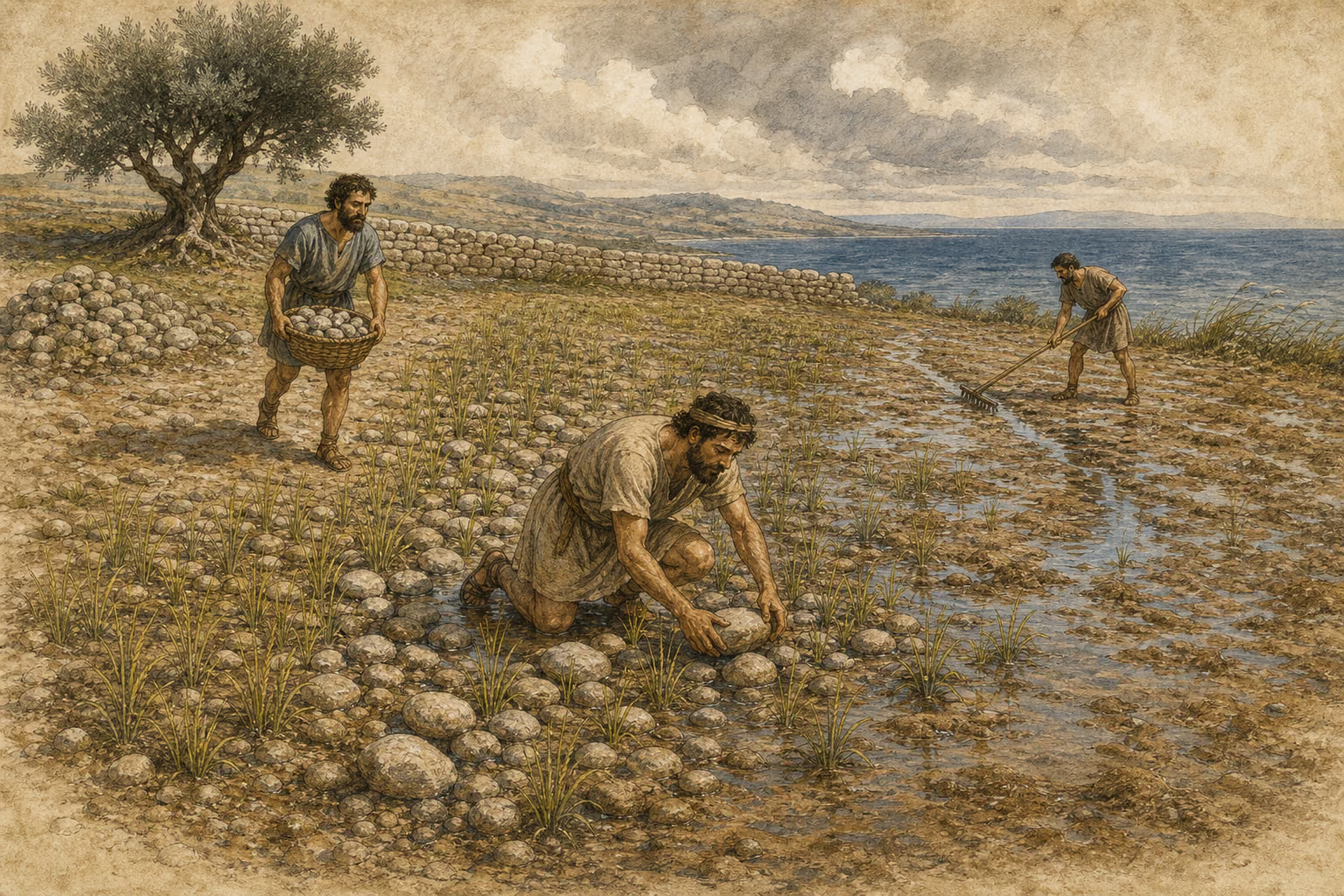
In every subject there are certain deep and recondite secrets, which it is left to the intelligence of each to penetrate. Do we not, for instance, find it the fact, that soils which have long offered opportunities for a sound judgment being formed on their qualities have become totally altered? In the vicinity of Larissa, in Thessaly, a lake was drained; and the consequence was, that the district became much colder, and the olive-trees which had formerly borne fruit now ceased to bear. When a channel was cut for the Hebrus, near the town of Ænos, the place was sensible of its nearer approach, in finding its vines frost-bitten, a thing that had never happened before; in the vicinity, too, of Philippi, the country having been drained for cultivation, the nature of the climate became entirely altered. In the territory of Syracuse, a husbandman, who was a stranger to the place, cleared the soil of all the stones, and the consequence was, that he lost his crops from the accumulation of mud; so that at last he was obliged to carry the stones back again. In Syria again, the plough-share which they use is narrow, and the furrows are but very superficial, there being a rock beneath the soil that in summer scorches up the seeds.
Then, too, the effects of excessive cold and heat in various places are similar; thus, for instance, Thrace is fruitful in corn, by reason of the cold, while Africa and Egypt are so in consequence of the heat that prevails there. At Chalcia, an island belonging to the Rhodians, there is a certain place which is so remarkably fertile, that after reaping the barley that has been sown at the ordinary time, and gathering it in, they immediately sow a fresh crop, and reap it at the same time as the other corn. A gravelly soil is found best suited for the olive in the district of Venafrum, while one of extreme richness is required for it in Bætica. The wines of Pucinum are ripened upon a rock, and the vines of Cæcubum are moistened by the waters of the Pomptine marshes; so great are the differences that have been detected by human experience in the various soils. Cæsar Vopiscus, when pleading a cause before the Censors, said that the fields of Rosia are the very marrow of Italy, and that a stake, left in the ground there one day, would be found covered by the grass the next: the soil, however, is only esteemed there for the purposes of pasturage. Still, however, Nature has willed that we should not remain uninstructed, and has made full admission as to existing defects in soil, even in cases where she has failed to give us equal information as to its good qualities: we shall begin, therefore, by speaking of the defects that are found in various soils.