LIBER XVII · CAPUT 5
WHAT SOILS ARE TO BE CONSIDERED THE BEST
Latine · Mayhoff 1906
Terram amaram [probaverim] demonstrant eius atrae degeneresque herbae, frigidam autem retorride nata, item uliginosam tristia, rubricam oculi argillamque, operi difficillimas quaeque rastros aut vomeres ingentibus glaebis onerent, quamquam non quod operi, hoc et fructui adversum; item e contrario cineraceam et sabulum album. nam sterilis denso callo facile deprehenditur vel uno ictu cuspidis. Cato breviter atque ex suo more vitia determinat: Terram cariosam cave, neve plaustro neve pecore inpellas. quid putamus hac appellatione ab eo tantopere reformidari, ut paene vestigiis quoque interdicat? redigamus ad ligni cariem, et inveniemus illa, quae in tantum abominatur, vitia aridae, fistulosae, scabrae, canescentis, exesae, pumicosae. plus dixit una significatione quam possit ulla copia sermonis enarrari. est enim interpretatione vitiorum quaedam non aetate (quae nulla in ea intellegi potest), sed natura sua anus terra, et ideo infecunda ad omnia atque inbecilla. idem agrum optimum iudicat ab radice montium planitie in meridiem excurrente, qui est totius Italiae situs, terram vero teneram, quae vocetur pulla. erit igitur haec optima et operi et satis. intellegere modo libeat dictam mira significatione teneram, et quidquid optari debet, in eo vocabulo invenietur. illa temperatae ubertatis, illa mollis facilisque culturae, nec madida nec sitiens. illa post vomerem nitescens, qualem fons ingeniorum Homerus in armis a deo caelatam dixit addiditque miraculum nigrescentis, quamvis fieret ex auro. illa quam recentem exquirunt inprobae alites vomerem comitantes corvique aratoris vestigia ipsa rodentes. reddatur hoc in loco luxuriae quoque sententia et aliqua in propositum certe. Cicero, lux doctrinarum altera, Meliora, inquit, unguenta sunt quae terram, quam quae crocum sapiunt. hoc enim maluit dixisse quam redolent. ita est profecto, illa erit optima quae unguenta sapiet. quod si admonendi sumus, qualis sit terrae odor ille qui quaeritur, contingit saepe etiam quiescente ea sub occasum solis, in quo loco arcus caelestes deiecere capita sua, et cum a siccitate continua immaduit imbre. tune emittit ilium suum halitum divinum ex sole conceptum, cui conparari suavitas nulla possit. is esse e commota debebit repertusque neminem fallet, ac de terra odor optime iudicabit. talis fere est in novalibus caesa vetere silva, quae consensu laudatur. et in frugibus quidem ferendis eadem terra utilior intellegitur, quotiens intermissa cultura quievit, quod in vineis non fit, eoque est diligentius eligenda, ne vera existat opinio eorum, qui iam Italiae terram existimavere lassam. operis quidem facilitas in aliis generibus constat et caelo, nec potest arari post imbres aliqua, ubertatis vitio lentescens. contra in Byzacio Africae illum centena quinquagena fruge fertilem campum nullis, cum siccum est, arabilem tauris, post imbres vili asello et a parte altera iugi anu vomerem trahente vidimus scindi. terram enim terra emendandi, ut aliqui praecipiunt, super tenuem pingui iniecta aut gracili bibulaque super umidam ac praepinguem, dementi s operae est. quid potest sperare qui colit talem?
English · Bostock & Riley 1855–57
If it is the wish of a person to test whether a soil is bitter, or whether it is thin and meagre, the fact may be easily ascertained from the presence of black and undergrown herbs. If, again, the herbage shoots up dry and stunted, it shows that the soil is cold, and if sad and languid, that it is moist and slimy. The eye, too, is able to judge whether it is a red earth or whether it is argillaceous, both of them extremely difficult to work, and apt to load the harrow or ploughshare with enormous clods; though at the same time it should be borne in mind that the soil which entails the greatest amount of labour is not always productive of the smallest amount of profit. So, too, on the other hand, the eye can distinguish a soil that is mixed with ashes or with white sand, while earth that is sterile and dense may be easily detected by its peculiar hardness, at even a single stroke of the mattock.
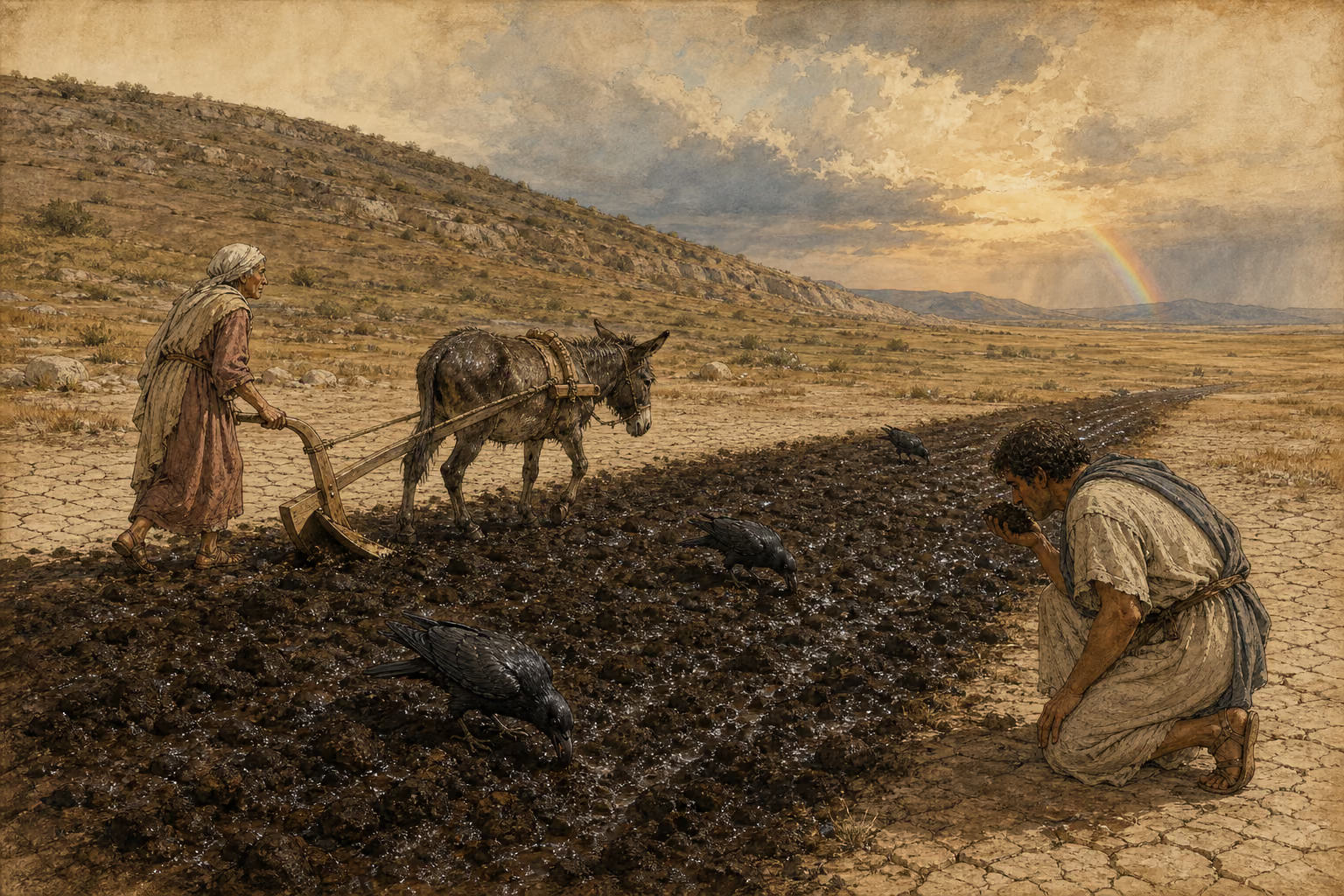
Cato, briefly and in his peculiar manner, characterizes the defects that exist in the various soils. “Take care,” he says, “where the earth is rotten not to shake it either with carts or by driving cattle over it.” Now what are we to suppose that this term “rotten” means, as applied to a soil, about which he is so vastly apprehensive as to almost forbid our setting foot upon it? Let us only form a comparison by thinking what it is that constitutes rottenness in wood, and we shall find that the faults which are held by him in such aversion are the being arid, full of holes, rough, white, mouldy, worm-eaten, in fact, just like pumice-stone; and thus has Cato said more in a single word than we could have possibly found means to express in a description, however long. Indeed, if we could find means of expressing the various defects that exist in soils, we should find that there are some of them that are old, not with age (for age cannot be concerned in relation to the earth), but of their own nature, and are hence unfruitful and powerless for every purpose from the first. The same writer, too, considers that as the very best of soils, which, situate at the foot of a declivity, runs out into a champaign country, taking a southward direction; such, in fact, being the aspect of the whole of Italy: he says also, that the earth generally known as black earth is of a tender nature, and is consequently the most easily worked and the best for cereals. If we only appreciate with due care the signification of this word “tender,” we shall find that it expresses its intended meaning remarkably well, and that in this word is comprised every quality that is desirable for the purposes of cultivation. In a tender soil we shall find fertility combined with moderation, a softness and a pliancy easily adapted to cultivation, and an equal absence of humidity and of dryness. Earth of this nature will shine again after the plough-share has passed through it, just as Homer, that great fountain-head of all genius, has described it sculptured by the Divinity upon the arms [of Achilles], adding, too, a thing that is truly marvellous, that it was of a blackish hue, though gold was the material in which it was wrought. This, too, is that kind of earth, which, when newly turned up, attracts the ravenous birds that follow the plough-share, the ravens even going so far as to peck at the heels of the ploughman.
We may in this place appropriately make mention of an opinion that has been pronounced by an Italian writer also with reference to a matter of luxury. Cicero, that other luminary of literature, has made the following remark: “Those unguents which have a taste of earth are better,” says he, “than those which smack of saffron;” it seeming to him more to the purpose to express himself by the word “taste” than “smell.” And such is the fact, no doubt; that soil is the best which has the flavour of a perfume. If the question should be put to us, what is this odour of the earth that is held in such estimation, our answer is, that it is the same that is often to be recognized at the moment of sunset, without the necessity even of turning up the ground, at the spots where the extremities of the rainbow have been observed to meet the earth; as also when, after long-continued drought, the rain has soaked the ground. Then it is that the earth exhales this divine odour, that is so peculiarly its own, and to which, imparted to it by the sun, there is no perfume, however sweet, that can possibly be compared. It is this odour that the earth, when turned up, ought to emit, and which, when once found, can never deceive a person; and this will be found the best criterion for judging of the quality of the soil. Such, too, is the odour that is usually perceived on land newly cleared, when an ancient forest has been just cut down; its excellence is a thing that is universally admitted.
For the culture of the cereals, too, the same land is generally looked upon as the more improved the oftener it has been allowed to rest from cultivation, a thing that is not the case with vineyards; for which reason all the greater care is required in the selection of their site, if we would not have the opinions of those to appear well founded who entertain the notion that the soil of Italy is already worn out. In other kinds of soil the work of cultivation depends entirely upon the weather; as, for instance, in those which cannot be ploughed just after rain, because the natural exuberance of the earth renders it viscous and cloggy. On the other hand, in Byzacium, a district of Africa, and a champaign country of such singular fertility as to render grain one hundred and fifty fold, the soil is such, that in time of drought, not even bulls are able to plough it; while, on another occasion, just after a shower of rain, one poor ass, with an old woman to guide it, is quite sufficient, as ourselves we have witnessed, to do the ploughing. But as to amending one soil by the agency of another, as some persons recommend, by throwing rich earth over one that is poor and thin, or by laying a soaking light soil over one that is humid and unctuous, it is a labour of perfect madness. What can a man possibly hope for who cultivates such a soil as this?