LIBER XVIII · CAPUT 24
HOW TO ASCERTAIN THE QUALITY OF SEED
Latine · Mayhoff 1906
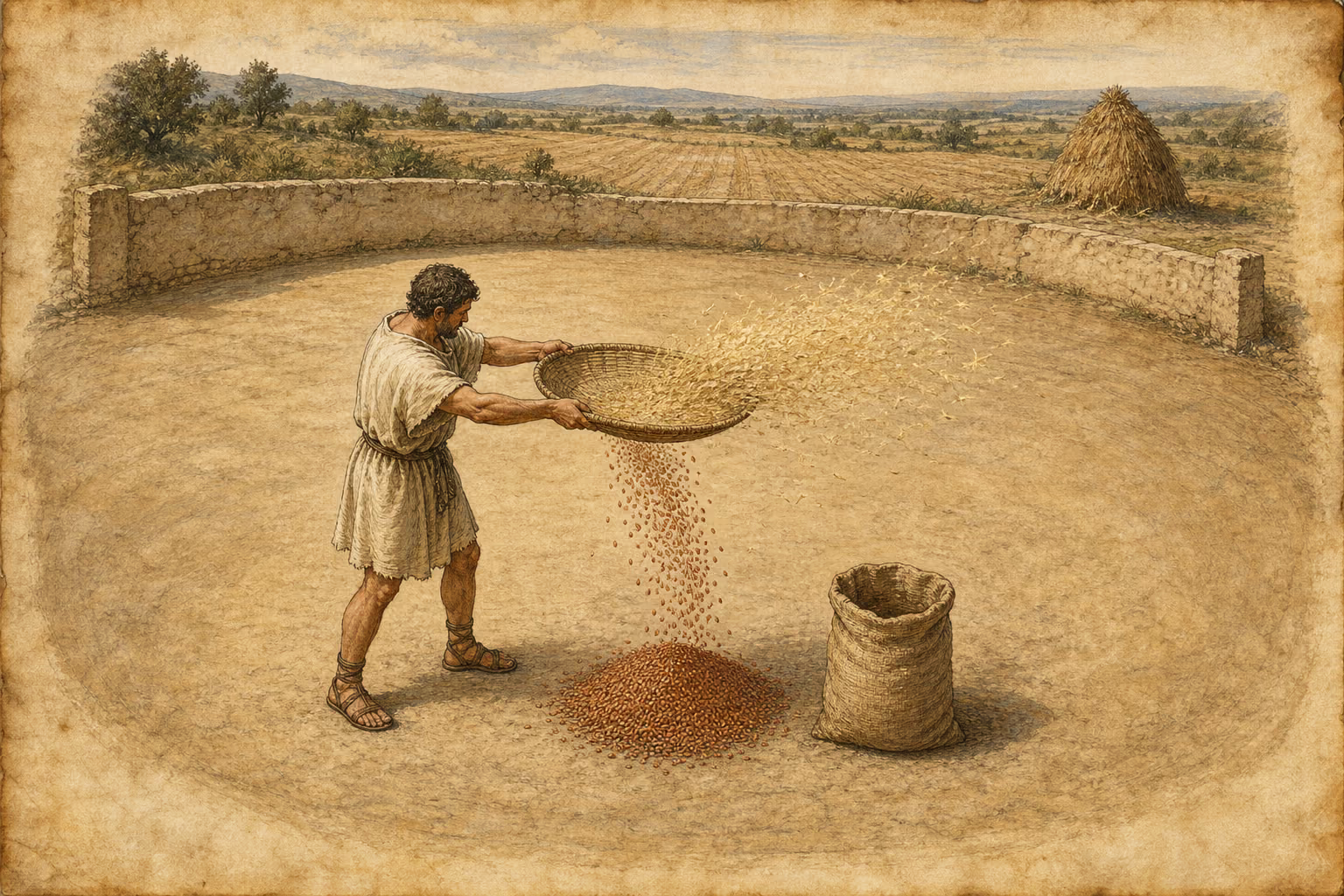
Semen optimum anniculum, bimum deterius, trimum pessimum, ultra sterile; etenim omnium definita generatio est. quod in ima area subsedit, ad semen reservandum est; id enim optimum, quoniam gravissimum, neque alio modo utilius discernitur. quae spica intervalla ta semina habebit, abicietur. optimum granum, quod rubet et dentibus fractum eundem habet colorem; deterius, cui plus intus albi est. certum terras alias plus seminis recipere, alias minus, religiosumque inde et primum colonis augurium, cum avidius accipiat: esurire creditur et comesse semen. sationem locis umidis celerius fieri ratio est, ne semen imbre putrescat; siccis serius, ut pluviae sequantur nec diu iacens atque non concipiens evanescat; itemque festinata satione densum spargi semen, quia tarde concipiat, serotina rarum, quia densitate nimia necetur. artis quoque cuiusdam est aequaliter spargere. manus utique congruere debet cum gradu semperque cum dextro pede. fit quoque quorundam occulta ratione, quod sors genialis atque fecunda est. non transferendum est ex frigidis locis semen in calida, neque ex praecocibus inserotina nihilque in contrarium, ut praecepere quidam falsa diligentia.
Serere in iugera temperato solo iustum est tritici ant siliginis modios V, farris aut seminis, quod frumenti genus ita appellamus, X, hordei VI, fabae quinta amplius quam tritici, viciae VII, ciceris et cicerculae et pisi III, lupini X, lentis III—sed hanc cum fimo arido seri volunt —, ervi VI, siliciae VI, passiolorum IIII, pabuli XX, milii, panici sextarios IIII, pingui solo plus, gracili minus. est et alia distinctio: in denso aut cretoso aut uliginoso tritici aut siliginis modios VI, in soluta terra et sicca et laeta IIII. macie enim solum, nisi rarum culmum habeat, spicam minutam facit et inanem; pinguia arva ex uno semine fruticem numerosum fundunt densamque segetem ex raro semine emittunt. ergo inter quattuor et sex modios, pro natura soli quinta minus seri plusve praecipiunt; item in consito aut clivoso, ut in macro. hoc pertinet oraculum illud magno opere custodiendum: Segetem ne defrudes. adiecit his Attius in Praxidica, ut sereretur, cum luna esset in ariete, geminis, leone, libra, aquario, Zoroastres sole scorpionis duodecim partes transgresso, cum luna esset in tauro.
Sequitur huc dilata et maxima indigens cura de tempore fruges serendi quaestio magnaque ex parte ration i siderum conexa; quamobrem sententias omnium in primis ad id pertinentes exponemus. Hesiodus, qui princeps hominum de agricultura praecepit, unum tempus serendi tradidit a vergiliarum occasu. scribebat enim in Boeotia Helladis, ubi ita seri diximus. inter diligentissimos convenit, ut in alitum quadripedumque genitura, esse quosdam ad conceptum impetus et terrae. hoc Graeci ita definiunt, cum sit calida et umida. Vergilius triticum et far a vergiliarum occasu seri iubet, hordeum inter aequinoctium autumni et brumam, viciam vero et passiolos et lentem boote occidente. quo fit, ut horum siderum aliorumque exortus et occasus digerendi sint in suos dies. sunt qui et ante vergiliarum occasum seri iubeant, dumtaxat in arida terra calidisque provinciis; custodiri enim semen, corrumpente umore, et a proximo imbre uno die erumpere; alii statim ab occasu vergiliarum—sequi imbres a septimo fere die —; aliqui in frigidis ab aequinoctio autumni, in calidis serius, ne ante hiemem luxurient. inter omnes autem convenit circa brumam serendum non esse, magno argumento, quoniam hiberna semina, cum ante brumam sata sint, septimo die erumpant; si post brumam, vix quadragesimo. sunt qui properent atque ita pronuntient, festinatam sementem saepe decipere, serotinam semper. e contrario alii vel vere potius serendum quam malo autumno atque, ubi fuerit necesse, inter favonium et vernum aequinoctium. quidam omissa caelesti subtilitate temporibus definiunt: vere linum et avenam et papaver atque, uti nunc etiam Transpadani servant, usque in quinquatrus, fabam, siliginem Novembri mense, far Septembri extremo usque in idus Octobres, alii post hunc diem in kal. Novembres. ita his nulla naturae cura est, illis nimia, et ideo caeca subtilitas, cum res geratur inter rusticos litterarumque expertes, non modo siderum. et confitendum est caelo maxime constare ea, quippe Vergilio iubente praedisci ventos ante omnia ac siderum mores neque aliter quam navigantibus servari. spes ardua, inmensa, misceri posse caelestem divinitatem inperitiae rusticae, sed temptandaiam grandi vitae emolumento. prius tamen sideralis difficultas, quam sensere etiam periti, subicienda contemplationi est, quo deinde laetior mens discedat a caelo et facta sentiat, quae futura praenosci non possint.
English · Bostock & Riley 1855–57
The best seed of all is that which is of the last year’s growth. That which is two years old is inferior, and three the worst of all—beyond that, it is unproductive. The same definite rule which applies to one kind of seed is applicable to them all: the seed which falls to the bottom on the threshing-floor, should be reserved for sowing, for being the most weighty it is the best in quality: there is no better method, in fact, of ascertaining its quality. The grains of those ears which have intervals between the seed should be rejected. The best grain is that which has a reddish hue, and which, when broken between the teeth, presents the same colour; that which has more white within is of inferior quality. It is a well-known fact that some lands require more seed than others, from which circumstance first arose a superstition that exists among the peasantry; it is their belief that when the ground demands the seed with greater avidity than usual, it is famished, and devours the grain. It is consistent with reason to put in the seed where the soil is humid sooner than elsewhere, to prevent the grain from rotting in the rain: on dry spots it should be sown later, and just before the fall of a shower, so that it may not have to lie long without germinating and so come to nothing. When the seed is put in early it should be sown thick, as it is a considerable time before it germinates; but when it is put in later, it should be sown thinly, to prevent it from being suffocated. There is a certain degree of skill, too, required in scattering the seed evenly; to ensure this, the hand must keep time with the step, moving always with the right foot. There are certain persons, also, who have a secret method of their own, having been born with a happy hand which imparts fruitfulness to the grain. Care should be taken not to sow seed in a warm locality which has been grown in a cold one, nor should the produce of an early soil be sown in a late one. Those who give advice to the contrary have quite misapplied their pains.
In a soil of middling quality, the proper proportion of seed is five modii of wheat or winter-wheat to the jugerum, ten of spelt or of seed-wheat—that being the name which we have mentioned as being given to one kind of wheat—six of barley, one-fifth more of beans than of wheat, twelve of vetches, three of chick-pease, chicheling vetches, and pease, ten of lupines, three of lentils—(these last, however, it is said, must be sown with dry manure)—six of fitches, six of fenugreek, four of kidney-beans, twenty of hay grass, and four sextarii of millet and panic. Where the soil is rich, the proportion must be greater, where it is thin, less.
There is another distinction, too, to be made; where the soil is dense, cretaceous, or moist, there should be six modii of wheat or winter-wheat to the jugerum, but where the land is loose, dry, and prolific, four will be enough. A meagre soil, too, if the crop is not very thinly sown, will produce a diminutive, empty ear. Rich lands give a number of stalks to each grain, and yield a thick crop from only a light sowing. The result, then, is, that from four to six modii must be sown, according to the nature of the soil; though there are some who make it a rule that five modii is the proper proportion for sowing, neither more nor less, whether it is a densely-planted locality, a declivity, or a thin, meagre soil. To this subject bears reference an oracular precept which never can be too carefully observed —“Don’t rob the harvest.” Attius, in his Praxidicus, has added that the proper time for sowing is, when the moon is in Aries, Gemini, Leo, Libra, and Aquarius. Zoroaster says it should be done when the sun has passed twelve degrees of Scorpio, and the moon is in Taurus.
We now come to a subject which has been hitherto deferred by us, and which requires our most careful attention—the proper times for sowing. This is a question that depends in a very great degree upon the stars; and I shall therefore make it my first care to set forth all the opinions that have been written in reference to the subject. Hesiod, the first writer who has given any precepts upon agriculture, speaks of one period only for sowing—the setting of the Vergiliæ: but then he wrote in Bœotia, a country of Hellas, where, as we have already stated, they are still in the habit of sowing at that period.
It is generally agreed by the most correct writers, that with the earth, as with the birds and quadrupeds, there are certain impulses for reproduction; and the epoch for this is fixed by the Greeks at the time when the earth is warm and moist. Virgil says that wheat and spelt should be sown at the setting of the Vergiliæ, barley between the autumnal equinox and the winter solstice, and vetches, kidney-beans, and lentils at the setting of Boötes: it is of great importance, therefore, to ascertain the exact days of the rising and setting of these constellations, as well as of the others. There are some, again, who recommend the sowing to be done before the setting of the Vergiliæ, but only in a dry soil, and in those provinces where the weather is hot; for the seed, they say, if put in the ground will keep, there being no moisture to spoil it, and within a single day after the next fall of rain, will make its appearance above ground. Others, again, are of opinion that sowing should begin about seven days after the setting of the Vergiliæ, a period which is mostly followed by rain. Some think that cold soils should be sown immediately after the autumnal equinox, and a warm soil later, so that the blade may not put forth too luxuriantly before winter.
It is universally agreed, however, that the sowing should not be done about the period of the winter solstice; for this very good reason—the winter seeds, if put in before the winter solstice, will make their appearance above ground on the seventh day, whereas, if they are sown just after it, they will hardly appear by the fortieth. There are some, however, who begin very early, and have a saying to justify their doing so, to the effect that if seed sown too early often disappoints, seed put in too late always does so. On the other hand, again, there are some who maintain that it is better to sow in spring than in a bad autumn; and they say that if they find themselves obliged to sow in spring, they would choose the period that intervenes between the prevalence of the west winds and the vernal equinox. Some persons, however, take no notice of the celestial phenomena, and only regulate their movements by the months. In spring they put in flax, the oat, and the poppy, up to the feast of the Quinquatria, as we find done at the present day by the people of Italy beyond the Padus. There, too, they sow beans and winter-wheat in the month of November, and spelt at the end of September, up to the ides of October: others, however, sow this last after the ides of October, as late as the calends of November.
The persons who do this take no notice, consequently, of the phenomena of Nature, while others, again, lay too much stress upon them, and hence, by these refined subtleties and distinctions, only add to their blindness; for here are ignorant rustics, not only dealing with a branch of learning, but that branch astronomy! It must still, however, be admitted that the observation of the heavens plays a very important part in the operations of agriculture; and Virgil, we find, gives it as his advice, that before any thing else, we should learn the theory of the winds, and the revolutions of the stars; for, as he says, the agriculturist, no less than the mariner, should regulate his movements thereby. It is an arduous attempt, and almost beyond all hope of success, to make an endeavour to introduce the divine science of the heavens to the uninformed mind of the rustic; still, however, with a view to such vast practical results as must be derived from this kind of knowledge, I shall make the attempt. There are some astronomical difficulties, however, which have been experienced by the learned even, that ought to be first submitted for consideration, in order that the mind may feel some encouragement on abandoning the study of the heavens, and may be acquainted with facts at least, even though it is still unable to see into futurity.