LIBER XVIII · CAPUT 25
ARRANGEMENT OF THE STARS ACCORDING TO THE TERRESTRIAL DAYS AND NIGHTS
Latine · Mayhoff 1906
Primum omnium dierum ipsorum annis solisque motus prope inexplicabilis ratio est, ad CCCLXV adiciente anno intercalario diei noctisque quadrantes. ita fit, ut tradi non possint certa siderum tempora. accedit confessa rerum obscuritas, nunc praecurrente nec paucis diebus tempestatum significatu, quod προχειμάζειν Graeci vocant, nunc postveniente, quodἐπιχειμάζειν, et plerumque aliascelerius, alias tardius caeli effectu ad terram deciduo: vulgo serenitate reddita confectum sidus audimus. praeterea cum omnia haec statis sideribus caeloque adfixis constent, interveniunt motus stellarum, grandinum, imbrium, et ipsi non levi effectu, ut docuimus, turbantque conceptae spei ordinem. idque, ne nobis tantum putemus accidere, et reliqua fallit animalia sagaciora circa hoc, ut quo vita eorum constet, aestivasque alites praeposteri aut praeproperi rigores necant, hibernas aestus. ideo Vergilius errantium quoque siderum rationem ediscendam praecipit, admonens observandum frigidae Saturni stellae transitum. sunt qui certissimum veris indicium arbitrentur ob infirmitatem animalis papiliones. sed eo ipso anno, cum commentaremur haec, notatum est, proventum eorum ter repetito frigore extinctum advenasque volucres a. d. VI. kal. Febr. spem veris adtulisse mox saevissima hieme conflictatas. res anceps primum omnium a caelo peti legem, deinde eam argumentis esse quaerendam. super omnia est mundi convexitatis terrarumque globi differentia, eodem sidere alio tempore aliis aperiente se gentibus, quo fit, ut causa eius non isdem diebus ubique valeat. addidere difficultatem et auctores diversis in locis observando, mox etiam in isdem diversa prodendo. tres autem fuere sectae, Chaldaea, Aegyptia, Graeca. his addidit quartam apud nos Caesar dictator annos ad solis cursum redigens singulos Sosigene perito scientiae eius adhibito; et ea ipsa ratio postea conperto errore correcta est ita, ut duodecim annis continuis non intercalaretur, quia coeperat ad sidera annus morari, qui prius antecedebat. et Sosigenes ipse trinis commentationibus—quamquam diligentior ceteris, non cessavit tamen addubitare ipse semet corrigendo—et auctores prodidere ea, quos praetexuimus volumini huic, raro ullius sententia cum alio congruente. minus hoc in reliquis mirum, quos diversi excusaverint tractus. eorum, qui in eadem regione dissedere, unam discordiam ponemus exempli gratia: occasum matutinum vergiliarum Hesiodus—nam huius quoque nomine exstat astrologia—tradidit fieri, cum aequinoctium autumni conficeretur, Thales xxv die ab aequinoctio, Anaximander XXXI, Euctemon XLIIIII Eudoxus XLVIII. nos sequimur observationem Caesaris maxime; haec erit Italiae ratio. dicemus autem et aliorum placita, quoniam non unius terrae, sed totius naturae interpretes sumus, non auctoribus positis—id enim verbosum est —, sed regionibus. legentes tantum meminerint brevitatis gratia, cum Attica nominata fuerit, simul intellegere Cycladas insulas; cum Macedonia, Magnesiam, Threciam; cum Aegyptus, Phoenicen, Cyprum, Ciliciam; cum Boeotia, Locridem, Phocidem et finitimos semper tractus; cum Hellespontus, Chersonesum et continentia usque Atho montem; cum Ionia, Asiam et insulas Asiae; cum Peloponnesus, Achaiam et ad vesperam iacentes terras. Chaldaei Assyriam et Babyloniam demonstrabunt. Africam, Hispanias, Gallias sileri non erit mirum; nemo enim observavit in iis, qui proderet siderum exortus. non tamen difficili ratione dinoscentur in illis quoque terris digestione circulorum, quam in sexto volumine fecimus, qua cognatio caeli non gentium modo, verum urbium quoque singularum intellegitur. ergo ex iis terris, quas nominavimus, sumpta convexitate circuli pertinentis ad quas quisque quaeret terras, iidem erunt siderum exortus per omnium circulorum pares umbras. indicandum et illud, tempestates ipsas cardines suos habere quadrinis annis, et easdem non magna diflerentia reverti ratione solis, octonis vero augeri easdem, centesima revolvente se luna.
Omnis autem ratio observata est tribus modis, exortu siderum occasuque et ipsorum temporum cardinibus. exortus occasusque binis modis intelleguntur. aut enim adventu solis occultantur stellae et conspici desinunt aut eiusdem abscessu proferunt se, ut emersum hoc melius quam exortum consuetudo dixisset et illud occultationem potius quam occasum.alio modo, quo die incipiunt apparere vel desinunt oriente sole aut occidente, matutini vespertinive cognominati, prout alteruter eorum mane vel crepusculo contingit. dodrantes horarum, cum minimum, intervalla ea desiderant ante solis ortum vel post occasum, ut aspici possint. praeterea bis quaedam exoriuntur et occidunt, omnisque sermo de iis est stellis, quas adhaerere caelo diximus.
Cardines temporum quadripertita anni distinctione constant per incrementa lucis. augetur haec a bruma et aequatur noctibus verno aequinoctio diebus xc horis tribus, dein superat noctes ad solstitium diebus XCIIII horis XII;..... usque ad aequinoctium autumni, et tum aequata diei proceditnox ex eo ad brumam diebus LXXXVIII boris tribus—horae nunc in omni accessione aequinoctiales, non cuiuscumque diei, significantur —, omnesque eae differentiae fiunt in octavis partibus signorum, bruma capricorni a. d. VII kal. Ian. fere, aequinoctium vernum arietis, solstitium cancri, alterumque aequinoctium librae, qui et ipsi dies raro non aliquos tempestatum significatus habent. rursus hi cardines singulis etiamnum articulis temporum dividuntur, per media omnes dierum spatia, quoniam inter solstitium et aequinoctium autumni fidiculae occasus autumnum inchoat die XLVI, ab aequinoctio eo ad brumam vergiliarum matutinus occasus hiemem die XLIIII, inter brumam et aequinoctium die XLV flatus favoni vernum tempus, ab aequinoctio verno initium aestatis die XLVIII vergiliarum exortus matutinus. nos incipiemus a sementibus frumenti, hoc est vergiliarum occasu matutino. nec deinde parvorum siderum mentione concidenda ratio est et difficultas rerum augenda, cum sidus vehemens Orionis isdem diebus longo decedat spatio.
Sementibus tempora plerique praesumunt et ab XI die autumnalis aequinoctii fruges serunt, novem a coronae exortu continuis diebus certo prope imbrium promisso, Xenophon non antequam deus signum dederit. hoc Cicero noster imbre fieri interpretatus est, cum sit vera ratio non prius serendi quam folia coeperint decidere. hoc ipso vergiliarum occasu fieri putant aliqui a. d. III idus Novembris, ut diximus, servantque id sidus etiam vestis institores, et est in caelo notatu facillimum. ergo ex occasu eius de hieme augurantur quibus est cura insidiandi, negotiatores avari. ita nubilo occasu pluviosam hiemem denuntiat, statimque augent lacernarum pretia; sereno asperam,et reliquarum vestium accendunt. sed ille indocilis caeli agricola hoc signum habeat inter suos vepres humumque suam aspiciens: cum folia viderit decidua. sic iudicetur anni temperies, alibi tardius, alibi maturius. ita enim sentitur, ut caeli locique adficit natura, idque in hac ratione praecellit, quod eadem et in mundo publica est et unicuique loco peculiaris. miretur hoc qui non meminerit ipso brumali die puleium in carnariis florere. adeo nihil occultum esse natura voluit. et serendi igitur hoc dedit signum. haec est vera interpretatio argumenta naturae secum adferens, quippe sic terram peti suadet promittitque quandam stercoris vicem et contra rigores terram satusque operiri a se nuntiat ac monet festinare.
Varro in fabae utique satu hanc observationem custodiri praecepit. alii plena luna serendam, lentim vero a vicesima quinta ad tricesimam, viciam quoque iisdem lunae diebus. ita demum sine limacibus fore. quidam pabuli causa sic iubent seri, seminis autem vere.
Est et alia manifestior ratio mirabiliore naturae providentia, in qua Ciceronis sententiam ipsius verbis subsignabimus:
Iam vero semper viridis semperque gravata
Lentiscus triplici solita est grandescere fetu
Ter fruges fundens tria tempora monstrat arandi.
Ex his unum hoc erit idem et lino ac papaveri serendo. Cato de papavere ita tradit: Virgas et sarmenta, quae tibi usioni supererunt, in segete comburito. ubi eas combusseris, ibi papaver serito. silvestre in miro usu est melle decoctum ad faucium remedia, visque somnifera etiam sativo. et hactenus de hiberna semente.
English · Bostock & Riley 1855–57
In the first place, it is almost an utter impossibility to calculate with a fair degree of accuracy the days of the year and the movements of the sun. To the three hundred and sixty-five days there are still to be added the intercalary days, the result of the additional quarters of a day and night: hence it is, that it is found impossible to ascertain with exactness the proper periods for the appearance of the stars. To this we must add, too, a certain degree of uncertainty connected with these matters, that is universally admitted; thus, for instance, bad and wintry weather will often precede, by several days, the proper period for the advent of that season, a state of things known to the Greeks as προχειμάζειν; while at another time, it will last longer than usual, a state of circumstances known as ἐπιχειμάζειν. The effects, too, of the changes that take place in the seasons will sometimes be felt later, and at other times earlier, upon their reaching the face of the earth; and we not unfrequently hear the remark made, upon the return of fine weather, that the action of such and such a constellation is now completed. And then, again, as all these phænomena depend upon certain stars, arranged and regulated in the vault of heaven, we find intervening, in accordance with the movements; of certain stars, hailstorms and showers, themselves productive of no slight results, as we have already observed, and apt to interfere with the anticipated regular recurrence of the seasons. Nor are we to suppose that these disappointments fall upon the human race only, for other animated beings, as well as ourselves, are deceived in regard to them, although endowed with even a greater degree of sagacity upon these points than we are, from the fact of their very existence depending so materially upon them. Hence it is, that we sometimes see the summer birds killed by too late or too early cold, and the winter birds by heat coming out of the usual season. It is for this reason, that Virgil has recommended us to study the courses of the planets, and has particularly warned us to watch the passage of the cold star Saturn.
There are some who look upon the appearance of the butterfly as the surest sign of spring, because of the extreme delicacy of that insect. In this present year, however, in which I am penning these lines, it has been remarked that the flights of butterflies have been killed three several times, by as many returns of the cold; while the foreign birds, which brought us by the sixth of the calends of February every indication of an early spring, after that had to struggle against a winter of the greatest severity. In treating of these matters, we have to meet a twofold difficulty: first of all, we have to ascertain whether or not the celestial phænomena are regulated by certain laws, and then we have to seek how to reconcile those laws with apparent facts. We must, however, be more particularly careful to take into account the convexity of the earth, and the differences of situation in the localities upon the face of the globe; for hence it is, that the same constellation shows itself to different nations at different times, the result being, that its influence is by no means perceptible everywhere at the same moment. This difficulty has been considerably enhanced, too, by various authors, who, after making their observations in different localities, and indeed, in some instances, in the same locality, have yet given us varying or contradictory results.
There have been three great schools of astronomy, the Chaldæan, the Ægyptian, and the Grecian. To these has been added a fourth school, which was established by the Dictator Cæsar among ourselves, and to which was entrusted the duty of regulating the year in conformity with the sun’s revolution, under the auspices of Sosigenes, an astronomer of considerable learning and skill. His theory, too, upon the discovery of certain errors, has since been corrected, no intercalations having been made for twelve successive years, upon its being found that the year which before had anticipated the constellations, was now beginning to fall behind them. Even Sosigenes himself, too, though more correct than his predecessors, has not hesitated to show, by his continual corrections in the three several treatises which he composed, that he still entertained great doubts on the subject. The writers, too, whose names are inserted at the beginning of this work, have sufficiently revealed the fact of these discrepancies, the opinions of one being rarely found to agree with those of another. This, however, is less surprising in the case of those whose plea is the difference of the localities in which they wrote. But with reference to those who, though living in the same country, have still arrived at different results, we shall here mention one remarkable instance of discrepancy. Hesiod—for under his name, also, we have a treatise extant on the Science of the Stars —has stated that the morning setting of the Vergiliæ takes place at the moment of the autumnal equinox; whereas Thales, we find, makes it the twenty-fifth day after the equinox, Anaximander the twenty-ninth, and Euctemon the forty-eighth.
As for ourselves, we shall follow the calculations made by Julius Cæsar, which bear reference more particularly to Italy; though at the same time, we shall set forth the dicta of various other writers, bearing in mind that we are treating not of an individual country, but of Nature considered in her totality. In doing this, however, we shall name, not the writers themselves, for that would be too lengthy a task, but the countries in reference to which they speak. The reader must bear in mind, then, that for the sake of saving space, under the head of Attica, we include the islands of the Cyclades as well; under that of Macedonia, Magnesia and Thracia; under that of Egypt, Phœnice, Cyprus, and Cilicia; under that of Bœotia, Locris, Phocis, and the adjoining countries; under that of Hellespont, Chersonesus, and the contiguous parts as far as Mount Athos; under that of Ionia, Asia and the islands of Asia; under that of Peloponnesus, Achaia, and the regions lying to the west of it. Chaldæa, when mentioned, will signify Assyria and Babylonia, as well.
My silence as to Africa, Spain, and the provinces of Gaul, will occasion no surprise, from the fact that no one has published any observations made upon the stars in those countries. Still, however, there will be no difficulty in calculating them, even for these regions as well, on reference being made to the parallels which have been set forth in the Sixth Book. By adopting this course, an accurate acquaintance may be made with the astronomical relations, not only of individual nations, but of cities even as well. By taking the circular parallels which we have there appended to the several portions of the earth respectively, and applying them to the countries in question, that are similarly situate, it will be found that the rising of the heavenly bodies will be the same for all parts within those parallels, where the shadows projected are of equal length. It is also deserving of remark, that the seasons have their periodical recurrences, without any marked difference, every four years, in consequence of the influence of the sun, and that the characteristics of the seasons are developed in excess every eighth year, at the revolution of every hundredth moon.
The whole of this system is based upon the observation of three branches of the heavenly phænomena, the rising of the constellations, their setting, and the regular recurrence of the seasons. These risings and settings may be observed in two different ways:—The stars are either concealed, and cease to be seen at the rising of the sun, or else present themselves to our view at his setting—this last being more generally known by the name of “emersion” than of “rising,” while their disappearance is rather an “occultation” than a “setting.”—Considered, again, in another point of view, when upon certain days they begin to appear or disappear, at the setting or the rising of the sun, as the case may be, these are called their morning or their evening settings or risings, according as each of these phænomena takes place at day-break or twilight. It requires an interval of three quarters of an hour at least before the rising of the sun or after his setting, for the stars to be visible to us. In addition to this, there are certain stars which rise and set twice. All that we here state bears reference, it must be remembered, to the fixed stars only.
The year is divided into four periods or seasons, the recurrence of which is indicated by the increase or diminution of the daylight. Immediately after the winter solstice the days begin to increase, and by the time of the vernal equinox, or in other words, in ninety days and three hours, the day is equal in length to the night. After this, for ninety-four days and twelve hours, the days continue to increase, and the nights to diminish in proportion, up to the summer solstice; and from that point the days, though gradually decreasing, are still in excess of the nights for ninety-two days, twelve hours, until the autumnal equinox. At this period the days are of equal length with the nights, and after it they continue to decrease inversely to the nights until the winter solstice, a period of eighty-eight days and three hours. In all these calculations, it must be remembered, equinoctial hours are spoken of, and not those measured arbitrarily in reference to the length of any one day in particular. All these seasons, too, commence at the eighth degree of the signs of the Zodiac. The winter solstice begins at the eighth degree of Capricorn, the eighth day before the calends of January, in general; the vernal equinox at the eighth degree of Aries; the summer solstice, at the eighth degree of Cancer; and the autumnal equinox at the eighth degree of Libra: and it is rarely that these days do not respectively give some indication of a change in the weather.
These four seasons again, are subdivided, each of them, into two equal parts. Thus, for instance, between the summer solstice and the autumnal equinox, the setting of the Lyre, on the forty-sixth day, indicates the beginning of autumn; between the autumnal equinox and the winter solstice, the morning setting of the Vergiliæ, on the forty-fourth day, denotes the beginning of winter; between the winter solstice and the vernal equinox, the prevalence of the west winds on the forty-fifth day, denotes the commencement of spring; and between the vernal equinox and the summer solstice, the morning rising of the Vergiliæ, on the forty-eighth day, announces the commencement of summer. We shall here make seed-time, or in other words, the morning setting of the Vergiliæ, our starting-point; and shall not interrupt the thread of our explanation by making any mention of the minor constellations, as such a course would only augment the difficulties that already exist. It is much about this period that the stormy constellation of Orion departs, after traversing a large portion of the heavens.
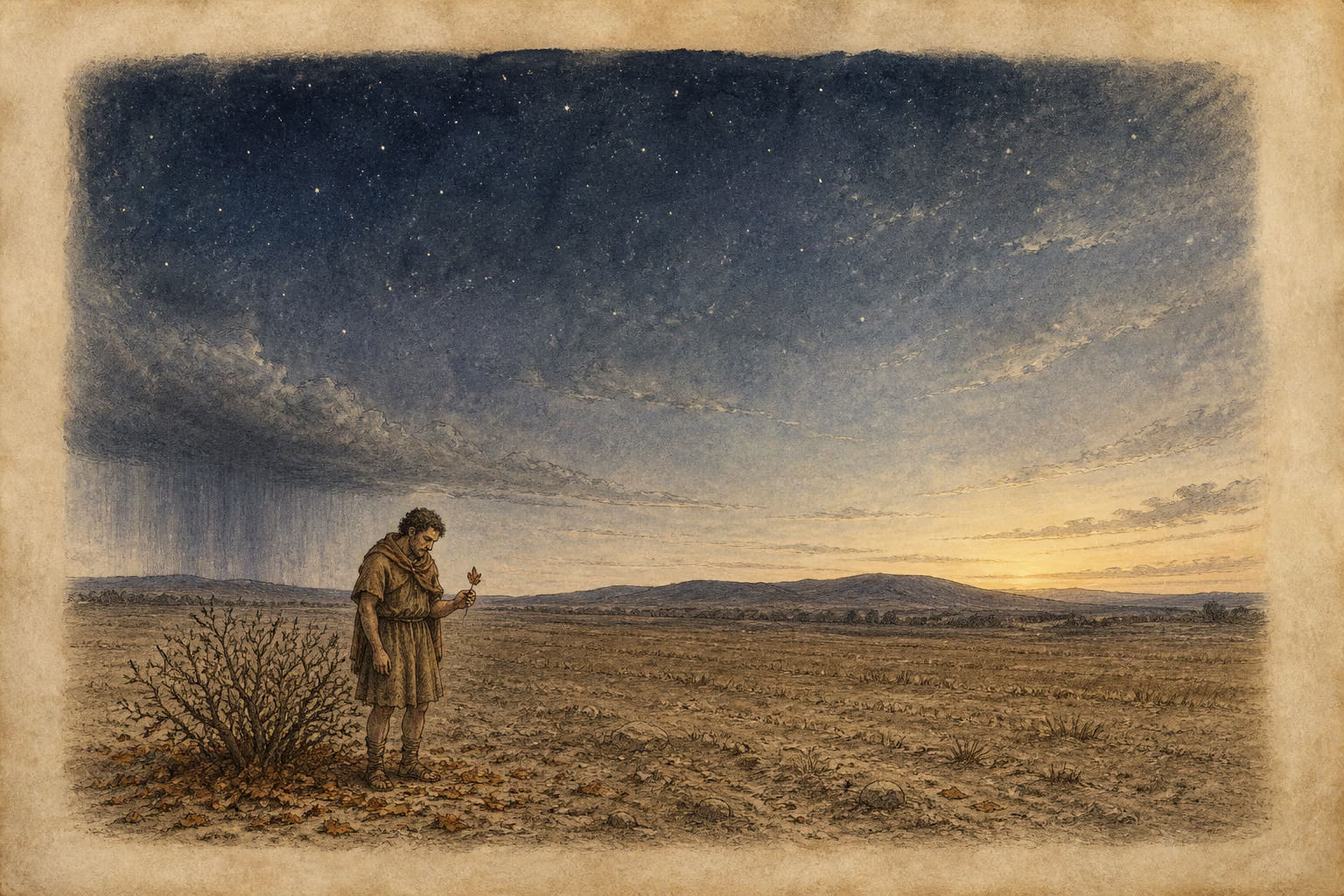
Most persons anticipate the proper time for sowing, and begin to put in the corn immediately after the eleventh day of the autumnal equinox, at the rising of the Crown, when we may reckon, almost to a certainty, upon several days of rainy weather in succession. Xenophon is of opinion, that sowing should not be commenced until the Deity has given us the signal for it, a term by which Cicero understands the rains that prevail in November. The true method to be adopted, however, is not to sow until the leaves begin to fall. Some persons are of opinion that this takes place at the setting of the Vergiliæ, or the third day before the ides of November, as already stated, and they carefully observe it, for it is a constellation very easily remarked in the heavens, and warns us to resume our winter clothes. Hence it is, that immediately on its setting, the approach of winter is expected, and care is taken by those who are on their guard against the exorbitant charges of the shop-keepers, to provide themselves with an appropriate dress. If the Vergiliæ set with cloudy weather, it forebodes a rainy winter, and the prices of cloaks immediately rise; but if, on the other hand, the weather is clear at that period, a sharp winter is to be expected, and then the price of garments of other descriptions is sure to go up. But as to the husbandman, unacquainted as he is with the phænomena of the heavens, his brambles are to him in place of constellations, and if he looks at the ground he sees it covered with their leaves. This fall of the leaves, earlier in one place and later in another, is a sure criterion of the temperature of the weather; for there is a great affinity between the effects produced by the weather in this respect, and the nature of the soil and climate. There is this peculiar advantage, too, in the careful observation of these effects, that they are sure to be perceptible throughout the whole earth, while at the same time they have certain features which are peculiar to each individual locality.—A person may perhaps be surprised at this, who does not bear in mind that the herb pennyroyal, which is hung up in our larders, always blossoms on the day of the winter solstice; so firmly resolved is Nature that nothing shall remain concealed from us, and in that spirit has given us the fall of the leaf as the signal for sowing.
Such is the true method of interpreting all these phænomena, granted to us by Nature as a manifestation of her will. It is in this way that she warns us to prepare the ground, makes us a promise of a manure, as it were, in the fall of the leaves, announces to us that the earth and the productions thereof are thus protected by her against the cold, and warns us to hasten the operations of agriculture.
Varro has given no other sign but this for our guidance in sowing the bean. Some persons are of opinion that it should be sown at full moon, the lentil between the twenty-fifth and thirtieth day of the moon, and the vetch on the same days of the moon; and they assure us that if this is done they will be exempt from the attacks of slugs. Some say, however, that if wanted for fodder, they may be sown at these periods, but if for seed, in the spring. There is another sign, more evident still, supplied us by the marvellous foresight of Nature, with reference to which we will give the words employed by Cicero himself:
“The lentisk, ever green and ever bent Beneath its fruits, affords a threefold crop: Thrice teeming, thrice it warns us when to plough.”
One of the periods here alluded to, is the same that is now under consideration, being the appropriate time also for sowing flax and the poppy. With reference to this last, Cato gives the following advice: “Burn, upon land where corn has been grown, the twigs and branches which are of no use to you, and when that is done, sow the poppy there.” The wild poppy, which is of an utility that is quite marvellous, is boiled in honey as a remedy for diseases in the throat, while the cultivated kind is a powerful narcotic. Thus much in reference to winter sowing.