LIBER XVIII · CAPUT 26
WORK TO BE DONE IN THE COUNTRY IN EACH MONTH RESPECTIVELY
Latine · Mayhoff 1906
Verum ut pariter omnis culturae quoddam breviarium peragatur, eodem tempore conveniet arbores stercorare, adcumulare item vineas—sufficit in iugerum opera—et, ubi patietur loci ratio, arbusta ac vineas putare, solum seminariis bipalio praeparare, incilia aperire, aquam de agro pellere, torcular lavare et recondere. a kal. Novemb. gallinis ova supponere nolito, donec bruma conficiatur. in eum diem ternadena subicito aestate tota, hieme pauciora, non tamen infra novena. Democritus talem futuram hiemem arbitratur, qualis fuerit brumae dies et circa eum terni; item solstitio aestatem. circa brumam plerisque bis septeni halcyonum feturae ventorum quiete molliunt caelum. sed et in his et in aliis omnibus ex eventu significationum intellegi sidera debebunt, non ad dies utique praefinitos expectari tempestatum vadimonia.
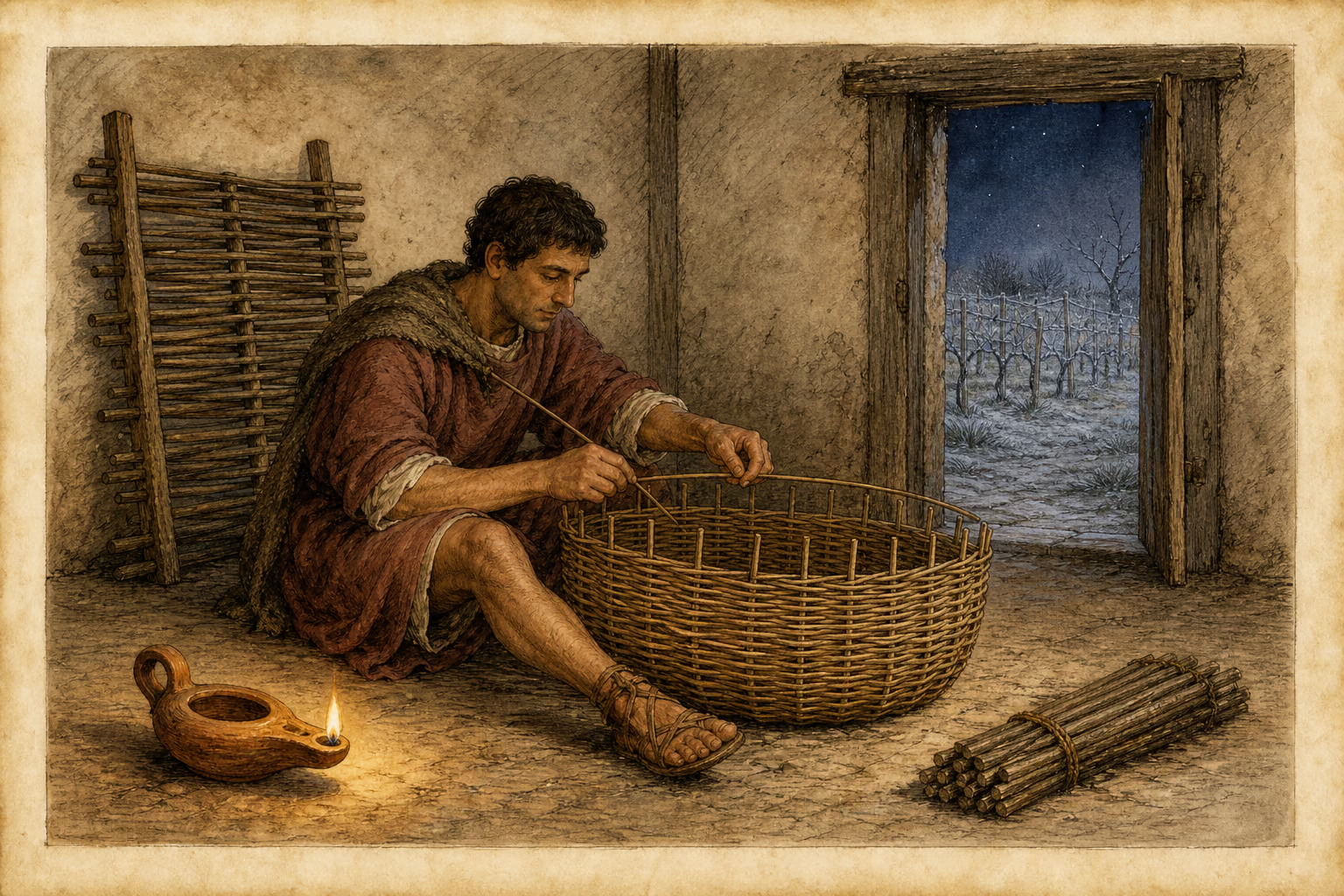
Per brumam vitem ne colito. vina tum defaecari vel etiam diffundi Hyginus suadet a confecta ea septimo die, utique si septima luna conpetat; cerasa circa brumam seri. bubus glandem tum adspergi convenit in iuga singula modios. largior valetudinem infestat, et quocumque tempore detur, si minus xxx diebus continuis data sit, narrant verna scabie poenitere. materiae caedendae tempus hoc dedimus. reliqua opera nocturna maxime vigilia constent, cum sint noctes tanto ampliores, qualos, crates, fiscinas texere, faces incidere, ridicas praeparare interdiu XXX, palos LX et in lucubratione vespertina ridicas v, palos x, totidem antelucana.
A bruma in favonium Caesari nobilia sidera significant, III kal. Ian. matutino canis occidens, quo die Atticae et finitimis regionibus aquila vesperi occidere traditur. pridie nonas Ian. Caesari delphinus matutino exoritur et postero die fidicula, quo Aegypto sagitta vesperi occidit. item ad VI idus Ian. eiusdem delphini vespertino occasu continui dies hiemant Italiae, et cum sol in aquarium sentiatur transire, quod fere XVI kal. Feb. evenit. VIII kal. stella regia appellata Tuberoni in pectore leonis occidit matutina, et pridie nonas Feb. fidicula vespera. huius temporis novissimis diebus, ubicumque patietur caeli ratio, terram ad rosaria et vineae satum vertere bipalio oportet—iugero operae LXX sufficiunt —, fossas purgare aut novas facere, antelucanis ferramenta acuere, manubria aptare, dolia quassa sarcire, ovium tegimenta concinnare ipsarumque lanas scabendo purgare.
<1> A favonio in aequinoctium vernum Caesari significat, XIII kal. Mart. triduum varie, et VIII kal. hirundinis visu et postero die arcturi exortu vespertino, item III non. Mart.—Caesar cancri exortu id fieri observavit, maior pars auctorum vindemitoris emersu—VIII idus aquilonii piscis exortu et postero die Orionis. in Attica miluum apparere servatur. Caesar et idus Mart. ferales sibi notavit scorpionis occasu, xv kal. vero April. Italiae miluum ostendi, XII kal. equum occidere matutino.
<2> Hoc intervallum temporis vegetissimum agricolis maximeque operosum est, in quo praecipue falluntur. neque enim eo die vocantur ad munia, quo favonius flare debeat, sed quo coeperit. hoc acri intentione servandum est; hoc illo mense signum dies habet observatione minime fallaci aut dubia, si quis adtendat. unde autem spiret is ventus quaque parte veniat, diximus secundo volumine et dicemus mox paulo operosius. interim ab eo die, quisquis ille fuerit, quo flare coeperit—non utique VI id. Feb., sed sive ante, quando praevernat, sive postea, quando hiemat post diem hunc —, innumera rusticos cura distringat et prima quaeque peragantur, quae differri nequeunt. trimestria serantur, vites putentur qua diximus ratione, oleae curentur, poma serantur inseranturque, vineae pastinentur, seminaria digerantur, instaurentur alia, harundines, salices, genistae serantur caedanturque, serantur vero ulmi, populi, platani, uti dictum est.tum et segetes convenit purgare, sarire hibernas fruges maximeque far. lex certa in eo, cum quattuor fibrarum esse coeperit, faba vero non antequam trium foliorum, tune quoque levi sarculo purgare verius quam fodere, florentem utique xv primis diebus non attingere. hordeum nisi sicco ne sarito. putationem aequinoctio peractam habeto. vineae iugerum quaternae operae putant, alligant in arbusto singulae operae arbores xv. eodem hoc tempore hortorum rosariorumque cura est, quae separatim proximis voluminibus dicetur, eodem et topiarii. tum optime scrobes fiunt. terra in futurum proscinditur Vergilio maxime auctore, ut glaebas sol coquat. utilior sententia, quae non nisi temperatum solum medio vere arari iubet, quoniam in pingui statim sulcos occup ent herbae, gracili insecuti aestus exsiccent omnemque sucum venturis seminibus auferant. talia autumno melius arari certum est.
<3> Cato verna opera sic definit: scrobes fieri, seminaria.... propagari, in locis crassis et umidis ulmos, ficos, poma, oleas seri, prata stercorari luna sitiente; quae rigua non erunt, a flatu favoni defendi et purgari, herbas malas radicitus erui, ficos interputari, seminaria fieri et vetera sarciri: haec antequam vineam fodere incipias. idemque: piro florente arare incipito macra harenosaque. postea uti quaeque gravissima et aquosissima, ita postremo arato. ergo haec aratio has habebit notas: lentisci primum fructum ostendentis ac piri florentis. erit et tertia in bulborum satu scillae, item in coronamentorum narcissi, namque et hac ter florent primoque flore primam arationem ostendunt, medio secundam, tertio novissimam, quando inter sese alia aliis notas praebent. ac non in novissimis cavetur, ne fabis florentibus attingatur hedera; id enim noxium et exitiale ei est tempus. quaedam vero et suas habent uotas, sicuti ficus. cum folia pauca in cacumine acetabuli modo germinent, tunc maxime serendas ficus.
<1> Aequinoctium vernum a. d. VII kal. April. peragi videtur. ab eo ad vergiliarum exortum matutinum Caesari significant kal. April. III non. April. in Attica vergiliae vesperi occultantur, eaedem postridie in Boeotia, Caesari autem et Chaldaeis nonis, Aegypto Orion et gladius eius incipiunt abscondi. Caesari VI idus significatur imber librae occasu. XIIII kal. Mai. Aegypto suculae occidunt vesperi, sidus vehemens et terra marique turbidum. XVI Atticae, xv Caesari continuo quatriduo significat, Assyriae autem XII kal. hoc est vulgo appellatum sidus Parilicium, quoniam XI kal. Mai. urbis Romae natalis, quo fere serenitas redditur, claritatem observationi dedit, nimborum argumento hyadas appellantibus Graecis [eas stellas] quod nostri a similitudine cognominis Graeci, propter sues inpositum arbitrantes, inperitia appellavere suculas. Caesari et VIII kal. notatur dies. VII kal. Aegypto haedi exoriuntur, VI Boeotiae et Atticae canis vesperi occultatur, fidicula mane oritur. v kal. Assyriae Orion totus absconditur, IIII autem canis. VI non. Mai. Caesari suculae matutino exoriuntur et VII id. capella pluvialis, Aegypto autem eodemr die canis vesperi occultatur. sic fere in VI id. Mai., qui est vergiliarum exortus, decurrunt sidera.
<2> In hoc temporis intervallo xv diebus primis agricolae rapienda sunt quibus peragendis ante aequinoctium non suffecerit, dum sciat inde natam exprobrationem foedam putantium vites per imitationem cantus alitis temporariae, quam cuculum vocant. dedecus enim habetur obprobriumque meritum, falcem ab illa volucre in vite deprehendi, et ob id petulantiae sales, etiam cum primo vere, laudantur, auspicio tamen detestabiles videntur. adeo minima quaeque in agro naturalibus trahuntur argumentis.
Extremo autem hoc tempore panici miliique satio est. iustum haec seri maturato hordeo. atque etiam in eodem arvo signum illius maturitati et horum sationi commune lucentes vespere per arva cicindelae—ita appellant rustici stellantes volatus, Graeci vero lampyridas— incredibili benignitate naturae.
English · Bostock & Riley 1855–57
And now, in order to complete what we may call in some measure an abridgment of the operations of agriculture, it is as well to add that it will be a good plan at the same period to manure the roots of trees, and to mould up the vines—a single hand being sufficient for one jugerum. Where, too, the nature of the locality will allow it, the vines, and the trees upon which they are trained, should be lopped, and the soil turned up with the mattock for seed plots; trenches, too, should be opened out, and the water drained from off the fields, and the presses should be well washed and put away. Never put eggs beneath the hen between the calends of November and the winter solstice: during all the summer and up to the calends of November, you may put thirteen under the hen; but the number must be smaller in winter, not less than nine, however. Democritus is of opinion, that the winter will turn out of the same character as the weather on the day of the winter solstice and the three succeeding days; the same too with the summer and the weather at the summer solstice. About the winter solstice, for about twice seven days mostly, while the halcyon is sitting, the winds are lulled, and the weather serene; but in this case, as in all others, the influence of the stars must only be judged of by the result, and we must not expect the changes of the weather, as if out upon their recognizances, to make their appearance exactly on certain predetermined days.
Be careful never to touch the vine at the winter solstice. Hyginus recommends us to strain and even rack-off wine at the seventh day after the winter solstice, provided the moon is seven days old. About this period, also, the cherry-tree, he says, should be planted. Acorns, too, should now be put in soak for the oxen, a modius for each pair. If given in larger quantities, this food will prove injurious to their health; and whenever it is given, if they are fed with it for less than thirty days in succession, an attack of scab in the spring, it is said, will be sure to make you repent.
This, too, is the period that we have already assigned for cutting timber—other kinds of work, again, may be found for the hours of the night, which are then so greatly prolonged. There are baskets, hurdles, and panniers to be woven, and wood to be cut for torches: squared stays for the vine may be prepared, too, thirty in the day time, and if rounded, as many as sixty. In the long hours of the evening, too, some five squared stays, or ten rounded ones may be got ready, and the same number while the day is breaking.
Between the winter solstice and the period when the west winds begin to prevail, the following, according to Cæsar, are the more important signs afforded by the constellations: the Dog sets in the morning, upon the third day before the calends of January; a day on the evening of which the Eagle sets to the people of Attica and the adjoining countries. On the day before the nones of January, according to Cæsar’s computation, the Dolphin rises in the morning, and on the next day, the Lyre, upon the evening of which the Arrow sets to the people of Egypt. Upon the sixth day before the ides of January, the Dolphin sets in the evening, and Italy has many days of continuous cold; the same is the case also when the sun enters Aquarius, about the sixteenth day before the calends of February. On the eighth before the calends of February, the star which Tubero calls the Royal Star sets in the morning in the breast of Leo, and in the evening of the day before the nones of February, the Lyre sets.
During the latter days of this period, whenever the nature of the weather will allow of it, the ground should be turned up with a double mattock, for planting the rose and the vine—sixty men to a jugerum. Ditches, too, should be cleaned out, or new ones made; and the time of day-break may be usefully employed in sharpening iron tools, fitting on handles, repairing such dolia as may have been broken, and rubbing up and cleaning their staves.
Between the prevalence of the west winds and the vernal equinox, the fourteenth day before the calends of March, according to Cæsar, announces three days of changeable weather; the same is the case, too, with the eighth before the calends of March, at the first appearance of the swallow, Arcturus rising on the evening of the next day. Cæsar has observed, that the same takes place on the third before the nones of March, at the rising of Cancer; and most authorities say the same with reference to the emersion of the Vintager. On the eighth before the ides of March, the northern limb of Pisces rises, and on the next day Orion, at which period also, in Attica, the Kite is first seen. Cæsar has noted, too, the setting of Scorpio on the ides of March, a day that was so fatal to him; and on the fifteenth before the calends of April, the Kite appears in Italy. On the twelfth before the calends of April, the Horse sets in the morning.
This interval of time is a period of extreme activity for the agriculturist, and affords him a great number of occupations, in reference to which, however, he is extremely liable to be deceived. He is summoned to the commencement of these labours, not upon the day on which the west winds ought to begin, but upon the day on which they really do begin, to blow. This moment then must be looked for with the most careful attention, as it is a signal which the Deity has vouchsafed us in this month, attended with no doubts or equivocations, if only looked for with scrupulous care. We have already stated in the Second Book, the quarter in which this wind blows, and the exact point from which it comes, and before long we shall have occasion to speak of it again still more in detail.
In the mean time, however, setting out from the day, whatever it may happen to be, on which the west winds begin to prevail (for it is not always on the seventh before the ides of February that they do begin), whether, in fact, they begin to blow before the usual time, as is the case with an early spring, or whether after, which generally happens when the winter is prolonged—there are subjects innumerable to engage the attention of the agriculturist, and those, of course, should be the first attended to, which will admit of no delay. Three month wheat must now be sown, the vine pruned in the way we have already described, the olive carefully attended to, fruit-trees put in and grafted, vineyards cleaned and hoed, seedlings laid out, and replaced in the nursery by others, the reed, the willow, and the broom planted and lopped, and the elm, the poplar, and the plane planted in manner already mentioned. At this period, also, the crops of corn ought to be weeded, and the winter kinds, spelt more particularly, well hoed. In doing this, there is a certain rule to be observed, the proper moment being when four blades have made their appearance, and with the bean this should never be done until three leaves have appeared above ground; even then, however, it is a better plan to clean them only with a slight hoeing, in preference to digging up the ground—but in no case should they ever be touched the first fifteen days of their blossom. Barley must never be hoed except when it is quite dry: take care, too, to have all the pruning done by the vernal equinox. Four men will be sufficient for pruning a jugerum of vineyard, and each hand will be able to train fifteen vines to their trees.
At this period, too, attention should be paid to the gardens and rose-beds, subjects which will be separately treated of in succeeding Books; due care should be given to ornamental gardening as well. It is now, too, the very best time for making ditches. The ground should now be opened for future purposes, as we find recommended by Virgil in particular, in order that the sun may thoroughly warm the clods. It is a piece of even more sound advice, which recommends us to plough no lands in the middle of spring but those of middling quality; for if this is done with a rich soil, weeds will be sure to spring up in the furrows immediately; and if, on the other hand, it is a thin, meagre land, as soon as the heat comes on, it will be dried up, and so lose all the moisture which should be reserved to nourish the seed when sown. It is a much better plan, beyond a doubt, to plough such soils as these in autumn.
Cato lays down the following rules for the operations of spring. “Ditches,” he says, “should be dug in the seed-plots, vines should be grafted, and the elm, the fig, the olive, and other fruit-trees planted in dense and humid soils. Such meadows as are not irrigated, must be manured in a dry moon, protected from the western blasts, and carefully cleaned: noxious weeds must be rooted up, fig-trees cleared, new seed-plots made, and the old ones dressed: all this should be done before you begin to hoe the vineyard. When the pear is in blossom, too, you should begin to plough, where it is a meagre gravelly soil. When you have done all this, you may plough the more heavy, watery soils, doing this the last of all.”
The proper time for ploughing, then, is denoted by these two signs, the earliest fruit of the lentisk making its appearance, and the blossoming of the pear. There is a third sign however, as well, the flowering of the squill among the bulbous, and of the narcissus among the garland, plants. For both the squill and the narcissus, as well as the lentisk, flower three times, denoting by their first flowering the first period for ploughing, by the second flowering the second, and by the third flowering the last; in this way it is that one thing affords hints for another. There is one precaution, too, that is by no means the least important among them all, not to let ivy touch the bean while in blossom; for at this period the ivy is noxious to it, and most baneful in its effects. Some plants, again afford certain signs which bear reference more particularly to themselves, the fig for instance; when a few leaves only are found shooting from the summit, like a cup in shape, then it is more particularly that the fig-tree should be planted.
The vernal equinox appears to end on the eighth day before the calends of April. Between the equinox and the morning rising of the Vergiliæ, the calends of April announce, according to Cæsar, [stormy weather]. Upon the third before the nones of April, the Vergiliæ set in the evening in Attica, and the day after in Bœotia, but according to Cæsar and the Chaldæans, upon the nones. In Egypt, at this time, Orion and his Sword begin to set. According to Cæsar, the setting of Libra on the sixth before the ides of April announces rain. On the fourteenth before the calends of May, the Suculæ set to the people of Egypt in the evening, a stormy constellation, and significant of tempests both by land and sea. This constellation sets on the sixteenth in Attica, and on the fifteenth, according to Cæsar, announcing four days of bad weather in succession: in Assyria it sets upon the twelfth before the calends of May. This constellation has ordinarily the name of Parilicium, from the circumstance that the eleventh before the calends of May is observed as the natal day of the City of Rome; upon this day, too, fine weather generally returns, and gives us a clear sky for our observations. The Greeks call the Suculæ by the name of “Hyades,” in consequence of the rain and clouds which they bring with them; while our people, misled by the resemblance of the Greek name to another word of theirs, meaning a “pig,” have imagined that the constellation receives its name from that word, and have consequently given it, in their ignorance, the name of “Suculæ,” or the “Little Pigs.”
In the calculations made by Cæsar, the eighth before the calends of May is a day remarked, and on the seventh before the calends, the constellation of the Kids rises in Egypt. On the sixth before the calends, the Dog sets in the evening in Bœotia and Attica, and the Lyre rises in the morning. On the fifth before the calends of May, Orion has wholly set to the people of Assyria, and on the fourth before the calends the Dog. On the sixth before the nones of May, the Suculæ rise in the morning, according to the calculation of Cæsar, and on the eighth before the ides, the She-goat, which announces rain. In Egypt the Dog sets in the evening of the same day. Such are pretty nearly the movements of the constellations up to the sixth before the ides of May, the period of the rising of the Vergiliæ.
In this interval of time, during the first fifteen days, the agriculturist must make haste and do all the work for which he has not been able to find time before the vernal equinox; and he should bear in mind that those who are late in pruning their vines are exposed to jibes and taunts, in imitation of the note of the bird of passage known to us as the cuckoo. For it is looked upon as a disgrace, and one that subjects him to well-merited censure, for that bird, upon its arrival, to find him only then pruning his vines. Hence it is, too, that we find those cutting jokes, of which our peasantry are the object, at the beginning of spring. Still, however, all such jokes are to be looked upon as most abominable, from the ill omens they convey.
In this way, then, we see that, in agricultural operations, the most trifling things are construed as so many hints supplied us by Nature. The latter part of this period is the proper time for sowing panic and millet; the precise moment, however, is just after the barley has ripened. In the case of the very same land, too, there is one sign that points in common both to the ripening of the barley and the sowing of panic and millet—the appearance of the glow-worm, shining in the fields at night. “Cicindelæ” is the name given by the country people to these flying stars, while the Greeks call them “lampyrides,”—another manifestation of the incredible bounteousness of Nature.