LIBER XVIII · CAPUT 3
THE JUGERUM OF LAND
Latine · Mayhoff 1906
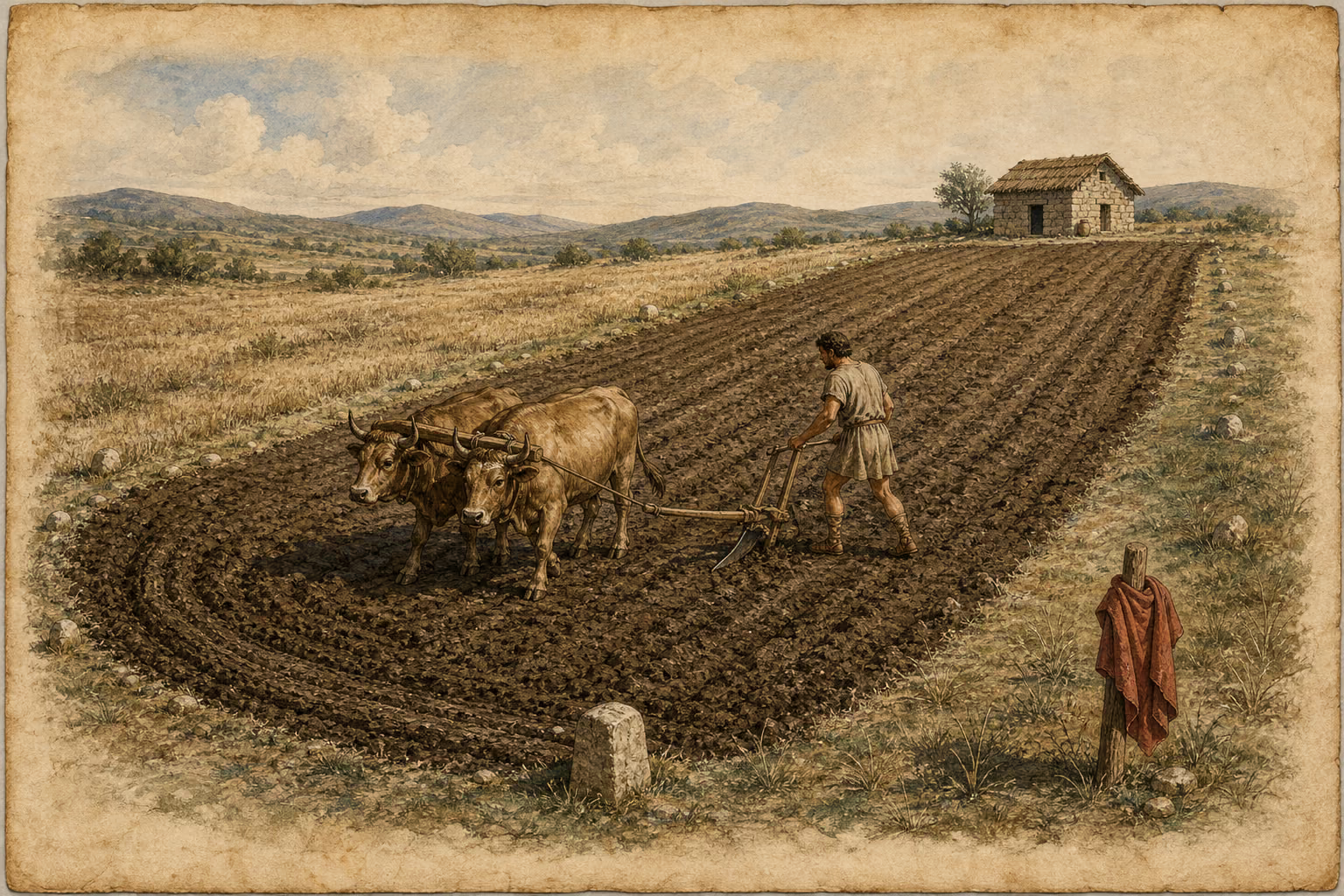
Iugum vocabatur, quod uno iugo boum in die exarari posset; actus, in quo boves agerentur cum aratro uno impetu iusto. hic erat CXX pedum duplicatusque in longitudinem iugerum faciebat. dona amplissima imperatorum ac fortium civium quantum quis uno die plurimum circumaravisset, item quartarii farris aut heminae, conferente populo. cognomina etiam prima inde: Pilumni, qui pilum pistrinis invenerat, Pisonis a pisendo, iam Fabiorum, Lentulorum, Ciceronum, ut quisque aliquod optime genus sereret. Iuniorum e familia Bubulcum nominarunt, qui bubus optime utebatur. quin et in sacris nihil religiosius confarreationis vinculo erat, novaeque nuptae farreum praeferebant. agrum male colere censorium probrum iudicabatur, atque, ut refert Cato, cum virum bonum laudantes bonum agricolam bonumque colonum dixissent, amplissime laudasse existimabantur. hinc et locupletes dicebant loci, hoc est agri, plenos. pecunia ipsa a pecore appellabatur. etiam nunc in tabulis censoriis pascua dicuntur omnia, ex quibus populus reditus habet, quia diu hoc solum vectigal fuerat. multatio quoque non nisi ovium boumque inpendio dicebatur, non omittenda priscarum legum benivolentia: cautum quippe est, ne bovem prius quam ovem nominaret, qui indiceret multam. ludos boum causa celebrantes Bubetios vocabant. Servius rex ovium boumque effigie primum aes signavit. frugem quidem aratro quaesitam furtim noctu pavisse ac secuisse puberi XII tabulis capital erat, suspensumque Cereri necari iubebant gravius quam in homicidio convictum, inpubem praetoris arbitratu verberari noxiamve duplionemve decerni. iam distinctio honosque civitatis ipsius non aliunde erat. rusticae tribus laudatissimae eorum, qui rura haberent, urbanae vero, in quas transferri ignominia esset, desidiae probro. itaque quattuor solae erant, a partibus urbis, in quis habitabant, Suburana, Palatina, Collina, Esquilina. nundinis urbem revisitabant et ideo comitia nundinis habere non licebat, ne plebes rustica avocaretur. quies somnusque in stramentis erat. gloriam denique ipsam a farris honore adoriam appellabant. equidem ipsa etiam verba priscae significationis admiror; ita enim est in commentariis pontificum: Augurio canario agendo dies constituantur, priusquam frumenta vaginis exeant nec antequam in vaginas perveniant.
Ergo his moribus non modo sufficiebant fruges Nulla provinciarum pascente Italiam, verum etiam annonae vilitas incredibilis erat. Manius Marcius aedilis plebis primum frumentum populo in modios assibus datavit. L. Minucius Augurinus, qui Spurium Maelium coarguerat, farris pretium in trinis nundinis ad assem redegit undecimus plebei tribunus, qua de causa statua ei extra portam Trigeminam a populo stipe conlata statuta est. Seius in aedilitate assibus populo frumentum praestitit, quam ob causam et ei statuae in Capitolio ac Palatio dicatae sunt, ipse supremo die populi umeris portatus in rogum est. quo vero anno Mater deum advecta Romam est, maiorem ea aestate messem quam antecedentibus annis decem factam esse tradunt. M. Varro auctor est, cum L. Metellus in triumpho plurimos duxit elephantos, assibus singulis farris modios fuisse, item vini congios ficique siccae pondo XXX, olei pondo X, carnis pondo XII. nec e latifundiis singulorum contingebat arcentium vicinos, quippe etiam lege Stolonis Licini incluso modo quingentorum iugerum, et ipso sua lege damnato, cum substituta filii persona amplius possideret. luxuriantis iam rei p. fuit ista mensura. Mani quidem Curi post triumphos inmensumque terrarum adiectum imperio nota contio est: perniciosum intellegi civem, cui septem iugera non essent satis. haec autem mensura plebei post exactos reges adsignata est. quaenam ergo tantae ubertatis causa erat? ipsorum tunc manibus imperatorum colebantur agri, ut fas est credere, gaudente terra vomere laureato et triumphali aratore, sive illi eadem cura semina tractabant, qua bella, eademque diligentia arva disponebant, qua castra, sive honestis manibus omnia laetius proveniunt, quoniam et curiosius fiunt. serentem invenerunt dati honores Serranum, unde ei et cognomen. aranti quattuor sua iugera in Vaticano, quae prata Quintia appellantur, Cincinnato viator attulit dictaturam et quidem, ut traditur, nudo, plenoque nuntius morarum: Vela corpus, inquit, ut perferam senatus populique Romani mandata. tales tum etiam viatores erant, quod ipsum nomen inditum est subinde ex agris senatum ducesque arcessentibus. at nunc eadem illa vincti pedes, damnatae manus inscriptique vultus exercent, non tam surda tellure, quae parens appellatur colique dicitur et ipso honore his absumpto, ut non invita ea et indignante credatur id fieri. et nos miramur ergastulorum non eadem emolumenta esse, quae fuerint imperatorum!
Igitur de cultura agri praecipere principale fuit etiam apud exteros, siquidem et reges fecere, Hiero, Philometor, Attalus, Archelaus, et duces, Xenophon et Poenus etiam Mago, cui quidem tantum honorem senatus noster habuit Carthagine capta, ut, cum regulis Africae bibliothecas donaret, unius eius duodetriginta volumina censeret in Latinam linguam transferenda, cum iam M. Cato praecepta condidisset, peritisque Punicae dandum negotium, in quo praecessit omnes vir clarissimae familiae D. Silanus. sapientiae vero auctores et carminibus excellentes quique alii illustres viri conposuissent, quos sequeremur, praetexuimus hoc in volumine, non in grege nominando M. Varrone, qui LXXXI vitae annum agens de ea re prodendum putavit.
English · Bostock & Riley 1855–57
That portion of land used to be known as a “jugerum,” which was capable of being ploughed by a single “jugum,” or yoke of oxen, in one day; an “actus” being as much as the oxen could plough at a single spell, fairly estimated, without stopping. This last was one hundred and twenty feet in length; and two in length made a jugerum. The most considerable recompense that could be bestowed upon generals and valiant citizens, was the utmost extent of land around which a person could trace a furrow with the plough in a single day. The whole population, too, used to contribute a quarter of a sextarius of spelt, or else half a one, per head.
From agriculture the earliest surnames were derived. Thus, for instance, the name of Pilumnus was given to him who invented the “pilum,” or pestle of the bake-house, for pounding corn; that of Piso was derived from “piso,” to grind corn; and those of Fabius, Lentulus, and Cicero, from the several varieties of leguminous plants in the cultivation of which respectively these individuals excelled. One individual of the family of the Junii received the name of “Bubulcus,” from the skill he displayed in breeding oxen. Among the sacred ceremonials, too, there was nothing that was held more holy than the marriage by confarreation, and the woman just married used to present a cake made of spelt. Careless cultivation of the land was in those times an offence that came under the cognizance of the censors; and, as we learn from Cato, when it was said that such and such a man was a good agriculturist or a good husbandman, it was looked upon as the very highest compliment that could be paid him. A man came to be called “locuples,” or “rich,” from being “loci plenus,” or “full of earth.” Money, too, received its name of “pecunia,” from “pecus,” “cattle.” At the present day, even, in the registers of the censors, we find set down under the head of “pascua,” or “pasture lands,” everything from which the public revenues are derived, from the fact that for a long period of time pasture lands were the only sources of the public revenue. Fines, too, were only imposed in the shape of paying so many sheep or so many oxen; and the benevolent spirit of the ancient laws deserves remark, which most considerately enjoined that the magistrate, when he indicted a penalty, should never impose a fine of an ox before having first condemned the same party to the payment of a sheep.
Those who celebrated the public games in honour of the ox received the name of Bubetii. King Servius was the first who impressed upon our copper coin the figures of sheep and oxen. To depasture cattle secretly by night upon the unripe crops on plough lands, or to cut them in that state, was made by the Twelve Tables a capital offence in the case of an adult; and it was enacted that the person guilty of it should be hanged, in order to make due reparation to the goddess Ceres, a punishment more severe, even, than that inflicted for murder. If, on the other hand, the offender was not an adult, he was beaten at the discretion of the prætor; a penalty double the amount of the damage was also exacted.
The various ranks, too, and distinctions in the state had no other origin than the pursuits of agriculture. The rural tribes held the foremost rank, and were composed of those who possessed lands; while those of the city, a place to which it was looked upon as ignominious to be transferred, had the discredit thrown upon them of being an indolent race. Hence it was that these last were only four in number, and received their names from the several parts of the City which they respectively inhabited; being the Suburran, the Palatine, Colline, and Exquiline tribes. Every ninth day the rural tribes used to visit the city for the purpose of marketing, and it was for this reason that it was made illegal to hold the comitia upon the Nundinæ; the object being that the country people might not be called away thereby from the transaction of their business. In those days repose and sleep were enjoyed upon straw. Even to glory itself, in compliment to corn, the name was given of “adorea.”
For my own part, I greatly admire the modes of expression employed in our ancient language: thus, for instance, we read in the Commentaries of the Priesthood to the following effect:—“For deriving an augury from the sacrifice of a bitch, a day should be set apart before the ear of corn appears from out of the sheath, and then again before it enters the sheath.”
The consequence was, that when the Roman manners were such as these, the corn that Italy produced was sufficient for its wants, and it had to be indebted to no province for its food; and not only this, but the price of provisions was incredibly cheap. Manius Marcius, the ædile of the people, was the first who gave corn to the people at the price of one as for the modius. L. Minutius Augurinus, the same who detected, when eleventh tribune of the people, the projects of Spurius Mælius, reduced the price of corn on three market days, to one as per modius; for which reason a statue was erected in honour of him, by public subscription, without the Trigeminian Gate. T. Seius distributed corn to the people, in his ædileship, at one as per modius, in remembrance of which statues were erected in honour of him also in the Capitol and the Palatium: on the day of his funeral he was borne to the pile on the shoulders of the Roman people. In the year, too, in which the Mother of the Gods was brought to Rome, the harvest of that summer, it is said, was more abundant than it had been for ten years before. M. Varro informs us, that in the year in which L. Metellus exhibited so many elephants in his triumphal procession, a modius of spelt was sold for one as, which was the standard price also of a congius of wine, thirty pounds’ weight of dried figs, ten pounds of olive oil, and twelve pounds of flesh meat. Nor did this cheapness originate in the wide-spread domains of individuals encroaching continually upon their neighbours, for by a law proposed by Licinius Stolo, the landed property of each individual was limited to five hundred jugera; and he himself was convicted under his own law of being the owner of more than that amount, having as a disguise prevailed upon his son to lend him his name. Such were the prices of commodities at a time when the fortunes of the republic were rapidly on the increase. The words, too, that were uttered by Manius Curius after his triumphs and the addition of an immense extent of territory to the Roman sway, are well known: “The man must be looked upon,” said he, “as a dangerous citizen, for whom seven jugera of land are not enough;” such being the amount of land that had been allotted to the people after the expulsion of the kings.
What, then, was the cause of a fertility so remarkable as this? The fact, we have every reason to believe, that in those days the lands were tilled by the hands of generals even, the soil exulting beneath a plough-share crowned with wreaths of laurel, and guided by a husbandman graced with triumphs: whether it is that they tended the seed with the same care that they had displayed in the conduct of wars, and manifested the same diligent attention in the management of their fields that they had done in the arrangement of the camp, or whether it is that under the hands of honest men everything prospers all the better, from being attended to with a scrupulous exactness. The honours awarded to Serranus found him engaged in sowing his fields, a circumstance to which he owes his surname. Cincinnatus was ploughing his four jugera of land upon the Vaticanian Hill—the same that are still known as the “Quintian Meadows,” when the messenger brought him the dictatorship—finding him, the tradition says, stripped to the work, and his very face begrimed with dust. “Put on your clothes,” said he, “that I may deliver to you the mandates of the senate and people of Rome.” In those days these messengers bore the name of “viator,” or “wayfarer,” from the circumstance that their usual employment was to fetch the senators and generals from their fields.
But at the present day these same lands are tilled by slaves whose legs are in chains, by the hands of malefactors and men with a branded face! And yet the Earth is not deaf to our adjurations, when we address her by the name of “parent,” and say that she receives our homage in being tilled by hands such as these; as though, forsooth, we ought not to believe that she is reluctant and indignant at being tended in such a manner as this! Indeed, ought we to feel any surprise were the recompense she gives us when worked by chastised slaves, not the same that she used to bestow upon the labours of warriors?
Hence it was that to give precepts upon agriculture became one of the principal occupations among men of the highest rank, and that in foreign nations even. For among those who have written on this subject we find the names of kings even, Hiero, for instance, Attalus Philometor, and Archelaüs, as well as of generals, Xenophon, for example, and Mago the Carthaginian. Indeed, to this last writer did the Roman senate award such high honours, that, after the capture of Carthage, when it bestowed the libraries of that city upon the petty kings of Africa, it gave orders, in his case only, that his thirty-two Books should be translated into the Latin language, and this, although M. Cato had already compiled his Book of Precepts; it took every care also to entrust the execution of this task to men who were well versed in the Carthaginian tongue, among whom was pre-eminent D. Silanus, a member of one of the most illustrious families of Rome. I have already indicated, at the commencement of this work, the numerous learned authors and writers in verse, together with other illustrious men, whose authority it is my intention to follow; but among the number I may here more particularly distinguish M. Varro, who, at the advanced age of eighty-eight years, thought it his duty to publish a treatise upon this subject.