LIBER XVIII · CAPUT 6
THE PROPER ARRANGEMENTS FOR A FARM-HOUSE
Latine · Mayhoff 1906
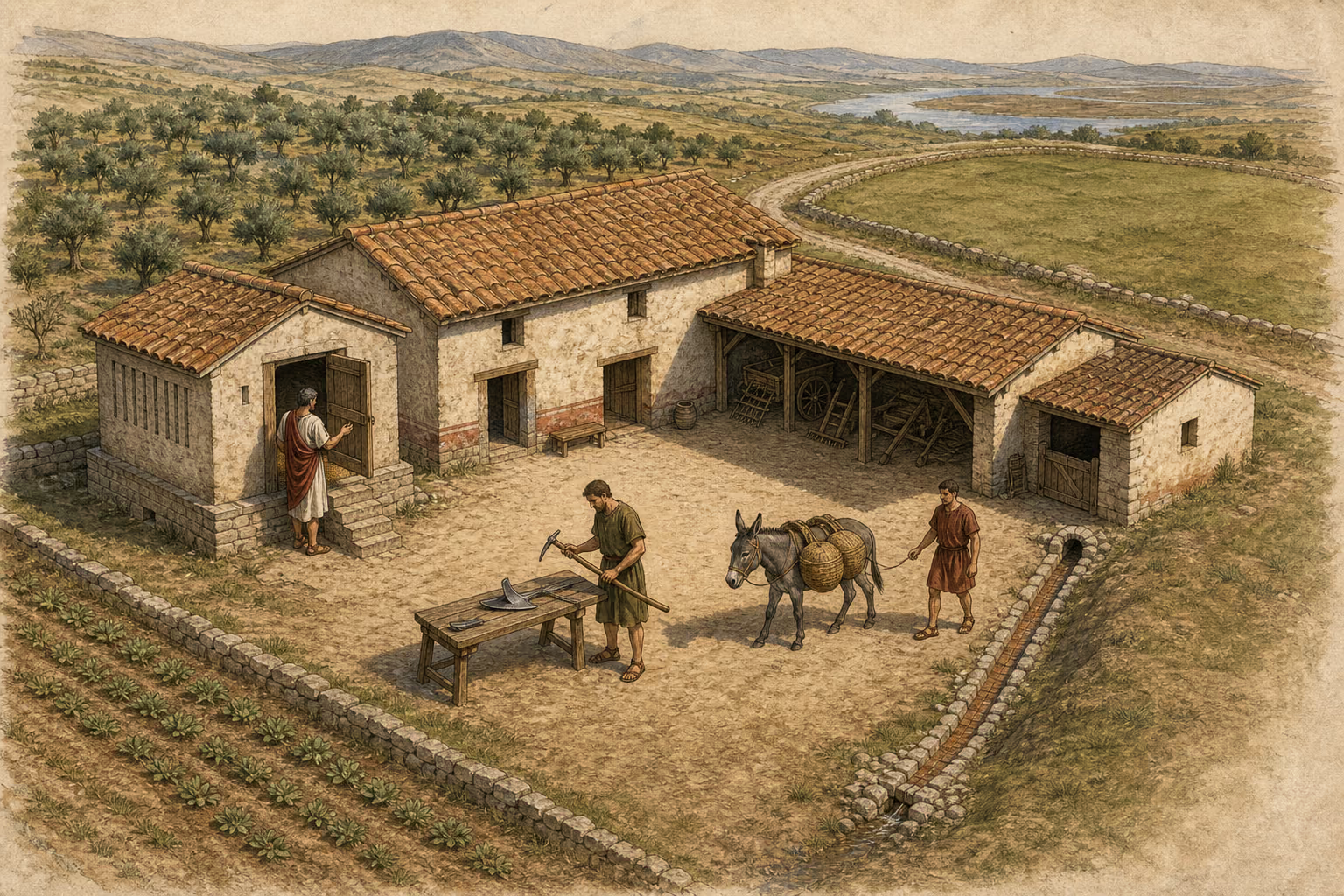
<1> Modus hic probatur, ut neque fundus villam quaerat neque villa fundum, non, ut fecere iuxta diversisin eadem aetate exemplis L. Lucullus et Q. Scaevola, cum villa Scaevolae fructus non caperet, villam Luculli ager, quo in genere censoria castigatio erat minus arare quam verrere. nec hoc sine arte quadam est. novissimus villam in Misenensi posuit C. Marius VII cos., sed peritia castra metandi sic, ut conparatos ei ceteros etiam Sulla Felix caecos fuisse diceret. <2> convenit neque iuxta paludes ponendam esse neque adverso amne, quamquam Homerus omnino e flumine semper antelucanas auras insalubres verissime tradidit. spectare in aestuosis locis septentriones debet, meridiem in frigidis, in temperatis exortum aequinoctialem.
Agri ipsius bonitas quibus argumentis iudicanda sit, quamquam de terrae genere optimo disserentes abunde dixisse possumus videri, etiamnum tamen traditas notas subsignabimus Catonis maxime verbis: ebulum vel prunus silvestris vel rubus, bulbus minutus, trifolium, herba pratensis, quercus, silvestris pirus malusque frumentarii soli notae, item nigra terra et cinerei coloris. omnis creta coquet, nisi permacra, sabulumque, nisi id etiam pertenue est, et multo campestribus magis quam clivosis respondent eadem.
<3> Modum agri in primis servandum antiqui putavere, quippe ita censebant, satius esse minus serere et melius arare; qua in sententia et Vergilium fuisse video. verumque confitentibus latifundia perdidere Italiam, iam vero et provincias—sex domini semissem africae possidebant, cum interfecit eos Nero princeps—, non fraudando magnitudine hac quoque sua Cn. Pompeio, qui numquam agrum mercatus est conterminum. agro empto domum vendendam inclementer atque non ex utilitate publici status Mago censuit, hoc exordio praecepta pandere ingressus, ut tamen appareat adsiduitatem desideratam ab eo.
<4> Dehinc peritia vilicorum in cura habenda est, multaque de his Cato praecepit. nobis satis sit dixisse, quam proximum domino corde esse debere et tamen sibimet ipsi non videri. coli rura ab ergastulis pessumum est, ut quidquid agitur a desperantibus. temerarium Videatur unam vocem antiquorum posuisse, et fortassis incredibile, ni penitus aestimetur, nihil minus expedire, quam agrum optime colere. L. Tarius Rufus infima natalium humilitate consulatum militari industria meritus, antiquae alias parsimoniae, circiter |M???| HS liberalitate divi Augusti congestum usque ad detractationem heredis exhausit agros in Piceno coemendo colendoque in gloriam. internicionem ergo famemque censemus? immo, Hercules, modum iudicem rerum omnium utilissimum. bene colere necessarium est, optime damnosum, praeterquam subole sua colono aut pascendis alioqui colente. domino aliquas messes colligere non expedit, si conputetur inpendium operae, nec temere olivam, nec quasdam terras diligenter colere, sicut in Sicilia tradunt, itaque decipi advenas.
<1> Quonam igitur modo utilissime colentur agri? ex oraculo scilicet: malis bonis. Sed defendi aequum est abavos, qui praeceptis suis prospexere vitae. namque cum dicerent malis, intellegere voluere vilissimos, summumque providentiae illorum fuit, ut quam minimum esset inpendii. praecipiebant enim ista, qui triumphales denas argenti libras in supellectile crimini dabant, qui mortuo vilico relinquere victorias et reverti in rura sua postulabant, quorum heredia colenda suscipiebat res p., exercitusque ducebant senatu illis vilicante. inde illa reliqua oracule: nequam agricolam esse quisquis emeret quod praestare ei fundus posset; malum patrem familias quisquis interdiu faceret, quod noctu posset, nisi in tempestate caeli; peiorem qui profestis diebus ageret, quod feriatis deberet; pessimum qui sereno die sub tecto potius operaretur quam in agro. <2> Nequeo mihi temperare, quo minus unum exemplum antiquitatis adferam, ex quo intellegi possit, apud populum etiam de culturis agendi morem fuisse qualiterque defendi soliti sint illi viri. C. Furius Cresimus e servitute liberatus, cum in parvo admodum agello largiores multo fructus perciperet, quam ex amplissimis vicinitas, in invidia erat magna, ceu fruges alienas perliceret veneficiis. quamobrem ab spurio albino curuliaedile die dicta metuens damnationem, cum in suffragium tribus oporteret ire, instrumentum rusticum omne in forum attulit et adduxit familiam suam validam atque, ut ait piso, bene curatam ac vestitam, ferramenta egregie facta, graves ligones, vomeres ponderosos, boves saturos. postea dixit: Veneficia mea, Quirites, haec Sunt, nec possum vobis ostendere aut in forum adducere lucubrationes meas vigiliasque et sudores. omnium sententiis absolutus itaque est. profecto opera, non inpensa, cultura constat, et ideo maiores fertilissimum in agro oculum domini esse dixerunt.
<3> Reliqua praecepta reddentur suis locis, quae propria generum singulorum erunt. interim communia, quae succurrunt, non omittemus, et in primis catonis humanissimum utilissimumque: id agendum, ut diligant vicini. causas reddit ille, nos existimamus nulli esse dubias.—Inter prima idem cavet, ne familiae male sit.— Nihil sero faciendum in agricultura omnes censent, iterumQue suo quaeque tempore facienda, et tertio praecepto praetermissa frustra revocari.—De terra cariosa execratio Catonis abunde indicata est, quamquam praedicere noncessantis.—Quidquid per asellum fieri potest, vilissime constat.—Filex biennio moritur, si frondem agere non patiaris. id efficacissime contingit germinantis ramis baCulo decussis; sucus enim ex ipsa defluens necat radices. aiunt et circa solstitium avolsas non renasci nec harundine sectas aut exaratas vomeri harundine inposita. similiter et harundinem exarari filice vomeri inposita praecipiunt.—Iuncosus ager verti pala debet aut in saxoso bidentibus. frutecta igni optime tolluntur. umidiorem agrum fossis concidi atque siccari utilissimum est, fossas autem cretosis locis apertas relinqui, in solutiore terra saepibus firmari vel proclivibus ac supinis lateribus procumbere; quasdam obcaecari et in alias dirigi maiores patentioresque et, si sit occasio, silice vel glarea sterni, ora autem earum binis utrimque lapidibus statuminari et alio superintegi. silvae extirpandae rationem Democritus prodidit, lupini flore in suco cicutae uno die macerato sparsisque radicibus.
English · Bostock & Riley 1855–57
The proper plan to be pursued is this: the farm-house must not be unsuitable for the farm, nor the farm for the house; and we must be on our guard against following the examples of L. Lucullus and Q. Scævola, who, though living in the same age, fell into the two opposite extremes; for whereas the farm-house of Scævola was not large enough for the produce of his farm, the farm of Lucullus was not sufficiently large for the house he built upon it; an error which gave occasion to the reproof of the censors, that on his farm there was less of ground for ploughing than of floor for sweeping. The proper arrangements for a farm-house are not to be made without a certain degree of skill. C. Marius, who was seven times consul, was the last person who had one built at Misenum; but he erected it with such a degree of that artistic skill which he had displayed in castrametation, that Sylla Felix even made the remark, that in comparison with Marius, all the others had been no better than blind.
It is generally agreed, that a farm-house ought neither to be built near a marsh, nor with a river in front of it; for, as Homer has remarked, with the greatest correctness, unwholesome vapours are always exhaled from rivers before the rising of the sun. In hot localities, a farm-house should have a northern aspect, but where it is cold, it should look towards the south; where, on the other hand, the site is temperate, the house should look due east. Although, when speaking of the best kinds of soil, I may seem to have sufficiently discussed the characteristics by which it may be known, I shall take the present opportunity of adding a few more indications, employing the words of Cato more particularly for the purpose. “The dwarf-elder,” says he, “the wild plum, the bramble the small bulb, trefoil, meadow grass, the quercus, and the wild pear and wild apple, are all of them indicative of a corn land. The same is the case, too, where the land is black, or of an ashy colour. All chalky soils are scorching, unless they are very thin; the same, too, with sand, unless it is remarkably fine. These remarks, however, are more applicable to champaign localities than declivities.”
The ancients were of opinion, that before everything, moderation should be observed in the extent of a farm; for it was a favourite maxim of theirs, that we ought to sow the less, and plough the more: such too, I find, was the opinion entertained by Virgil, and indeed, if we must confess the truth, it is the wide-spread domains that have been the ruin of Italy, and soon will be that of the provinces as well. Six proprietors were in possession of one half of Africa, at the period when the Emperor Nero had them put to death. With that greatness of mind which was so peculiarly his own, and of which he ought not to lose the credit, Cneius Pompeius would never purchase the lands that belonged to a neighbour. Mago has stated it as his opinion, that a person, on buying a farm, ought at once to sell his town house; an opinion, however, which savours of too great rigidity, and is by no means conformable to the public good. It is with these words, indeed, that he begins his precepts; a good proof, at all events, that he looks upon the personal inspection of the owner as of primary importance.
The next point which requires our care is to employ a farm-steward of experience, and upon this, too, Cato has given many useful precepts. Still, however, it must suffice for me to say that the steward ought to be a man nearly as clever as his master, though without appearing to know it. It is the very worst plan of all, to have land tilled by slaves let loose from the houses of correction, as, indeed, is the case with all work entrusted to men who live without hope. I may possibly appear guilty of some degree of rashness in making mention of a maxim of the ancients, which will very probably be looked upon as quite incredible—“That nothing is so disadvantageous as to cultivate land in the highest style of perfection.” L. Tarius Rufus, a man who, born in the very lowest ranks of life, by his military talents finally attained the consulship, and who in other respects adhered to the old-fashioned notions of thriftiness, made away with about one hundred millions of sesterces, which, by the liberality of the late Emperor Augustus, he had contrived to amass, in buying up lands in Picenum, and cultivating them in the highest style, his object being to gain a name thereby; the consequence of which was, that his heir renounced the inheritance. Are we of opinion, then, that ruin and starvation must be the necessary consequence of such a course as this? Yes, by Hercules! and the very best plan of all is to let moderation guide our judgment in all things. To cultivate land well is absolutely necessary, but to cultivate it in the very highest style is mere extravagance, unless, indeed, the work is done by the hands of a man’s own family, his tenants, or those whom he is obliged to keep at any rate. But besides this, even when the owner tills the land itself, there are some crops which it is really not worth the while to gather, if we only take into account the manual labour expended upon them. The olive, too, should never be too highly cultivated, nor must certain soils, it is said, be too carefully tilled, those of Sicily, for instance; hence it is, that new comers there so often find themselves deceived.
In what way, then, can land be most profitably cultivated? Why, in the words of our agricultural oracles, “by making good out of bad.” But here it is only right that we should say a word in justification of our forefathers, who in their precepts on this subject had nothing else in view but the benefit of mankind: for when they use the term “bad” here, they only mean to say that which costs the smallest amount of money. The principal object with them was in all cases to cut down expenses to the lowest possible sum; and it was in this spirit that they made the enactments which pronounced it criminal for a person who had enjoyed a triumph, to be in possession, among his other furniture, of ten pounds’ weight of silver plate: which permitted a man, upon the death of his farm-steward, to abandon all his victories, and return to the cultivation of his lands—such being the men the culture of whose farms the state used to take upon itself; and thus, while they led our armies, did the senate act as their steward.
It was in the same spirit, too, that those oracles of ours have given utterance to these other precepts, to the effect that he is a bad agriculturist who has to buy what his farm might have supplied him with; that the man is a bad manager who does in the day-time what he might have done in the night, except, indeed, when the state of the weather does not allow it; that he is a worse manager still, who does on a work-day what he might have done on a feast-day; but that he is the very worst of all, who works under cover in fine weather, instead of labouring in the fields.
I cannot refrain from taking the present opportunity of quoting one illustration afforded us by ancient times, from which it will be found that it was the usage in those days to bring before the people even questions connected with the various methods employed in agriculture, and will be seen in what way men were accustomed to speak out in their own defence. C. Furius Chresimus, a freedman, having found himself able, from a very small piece of land, to raise far more abundant harvests than his neighbours could from the largest farms, became the object of very considerable jealousy among them, and was accordingly accused of enticing away the crops of others by the practice of sorcery. Upon this, a day was named by Spurius Calvinus, the curule ædile, for his appearance. Apprehensive of being condemned, when the question came to be put to the vote among the tribes, he had all his implements of husbandry brought into the Forum, together with his farm servants, robust, well-conditioned, and well-clad people, Piso says. The iron tools were of first-rate quality, the mattocks were stout and strong, the plough-shares ponderous and substantial, and the oxen sleek and in prime condition. When all this had been done, “Here, Roman citizens,” said he, “are my implements of magic; but it is impossible for me to exhibit to your view, or to bring into this Forum, those midnight toils of mine, those early watchings, those sweats, and those fatigues.” Upon this, by the unanimous voice of the people, he was immediately acquitted. Agriculture, in fact, depends upon the expenditure of labour and exertion; and hence it is that the ancients were in the habit of saying, that it is the eye of the master that does more towards fertilizing a field than anything else.
We shall give the rest of these precepts in their appropriate places, according as we find them adapted to each variety of cultivation; but in the meantime we must not omit some of a general nature, which here recur to our recollection, and more particularly that maxim of Cato, as profitable as it is humane: “Always act in such a way as to secure the love of your neighbours.” He then proceeds to state his reasons for giving this advice, but it appears to me that no one surely can entertain the slightest doubt upon the subject. One of the very first recommendations that he gives is to take every care that the farm servants are kept in good condition. It is a maxim universally agreed upon in agriculture, that nothing must be done too late; and again, that everything must be done at its proper season; while there is a third precept, which reminds us that opportunities lost can never be regained. The malediction uttered by Cato against rotten ground has been treated of at some length already; but there is another precept which he is never tired of repeating, “Whatever can be done by the help of the ass, will cost the least money.”
Fern will be sure to die at the end of a couple of years, if you prevent it from putting forth leaves; the most efficient method of ensuring this is to beat the branches with a stick while they are in bud; for then the juices that drop from it will kill the roots. It is said, too, that fern will not spring up again if it is pulled up by the roots about the turn of the summer solstice, or if the stalks are cut with the edge of a reed, or if it is turned up with a plough-share with a reed placed upon it. In the same way, too, we are told that reeds may be effectually ploughed up, if care is taken to place a stalk of fern upon the share. A field infested with rushes should be turned up with the spade, or, if the locality is stony, with a two-pronged mattock: overgrown shrubs are best removed by fire. Where ground is too moist, it is an advantageous plan to cut trenches in it and so drain it; where the soil is cretaceous, these trenches should he left open; and where it is loose, they should be strengthened with a hedge to prevent them from falling in. When these drains are made on a declivity, they should have a layer of gutter tiles at the bottom, or else house tiles with the face upwards: in some cases, too, they should be covered with earth, and made to run into others of a larger size and wider; the bottom, also, should, if possible, have a coating of stones or of gravel. The openings, too, should be strengthened with two stones placed on either side, and another laid upon the top. Democritus has described a method of rooting up a forest, by first macerating the flower of the lupine for one day in the juice of hemlock, and then watering the roots of the trees with it.