LIBER XVIII · CAPUT 7
THE DIFFERENT KINDS OF GRAIN
Latine · Mayhoff 1906
Et quoniam praeparatus est ager, nunc indiCabitur natura frugum. Sunt autem duo prima earum genera: frumenta, ut triticum, hordeum, et legumina, ut faba, cicer. differentia notior, quam ut indicari deceat.
<1> Frumenti ipsius totidem genera per tempora satu divisa: hiberna, quae circa vergiliarum occasum sata terra per hiemem nutriuntur, ut triticum, hordeum; aestiva, quae aestate ante vergiliarum exortum seruntur, ut milium, panicun, sesama, horminum, irio, Italiae dumtaxat ritu. alioquin in graecia et in Asia omnia a vergiliarum occasu seruntur, quaedam autem utroque tempore in Italia, ex his quaedam et tertio veris. aliqui verna milium, panicum, lentem, cicer, alicam appellant, sementiva autem triticum, hordeum, fabam, rapam. et in tritici genere pars aliqua pabuli est quadripedum causa sati, ut farrago, et in leguminibus, ut vicia; ad communem quadripedum hominumque usum lupinum.
<2> Legumina omnia singulas habent radices praeter fabam, easque surculosas, quia non in multa dividuntur, altissimas autem cicer. frumenta multis radicantur fibris ine ramis. erumpit a primo satu hordeum die septimo, legumen quarto vel, cum tardissime, septimo, faba a xv Ad XX, legumina in Aegypto tertio die. Ex hordeo alterum caput grani in radicem exit, alterum in herbam, quae et prior floret. radicem crassior pars grani fundit, tenuior florem, ceteris seminibus eadem pars et radicem et florem.
<3> Frumenta hieme in herba sunt, verno tempore fastigantur in stipulam quae sunt hiberni generis, at milium et panicum in culmum geniculatum et concavum, sesama vero in ferulaceum. omnium satorum fructus aut spicis continetur, ut tritici, hordei, muniturque vallo aristarum contra aves et parvas quadripedes, aut includitur Siliquis, ut leguminum, aut vasculis, ut sesamae ac papaveris. milium et panicum tantum pro indiviso et parvis avibus expositum est; indefensum quippe membranis continetur.
Panicum a paniculis dictum, cacumine languide nutante, paulatim extenuato culmo paene in surculum, praedensis acervatur granis, cum longissima, pedali phoba. milio comae granum complexae fimbriato capillo curvantur. sunt et panico genera mammosa, e pano parvis racemata panculis, et cacumine gemino; quin et colore distinguntur candido, nigro, rufo, etiam purpureo. panis multifariam et e milio fit, e panico rarus; sed nullum ponderosius frumentum est aut quod coquendo magis crescat. LX pondo panis e modio reducunt modiumque pultis ex tribus sextariis madidis. milium intra hos X annos ex india in Italiam invectum est nigrum colore, amplum grano, harundineum culmo. adolescit ad pedes altitudine vii, praegrandibus comis—iubas vocant—, omnium frugum fertilissimum. Ex uno grano sextarii terni gignuntur. Seri debet in umidis.
<4> Frumenta quaedam in tertio genu spicam incipiunt concipere, quaedam in quarto, sed etiamnum occultam. genicula autem sunt tritico quaterna, farri sena, hordeo octona. Sed non ante supra dictum geniculorum numerum conceptus est spicae, qui ut spem sui fecit, iiii aut V tardissime diebus florere incipiunt totidemque aut paulo pluribus deflorescunt, hordea vero, cum tardissime, diebus VII. Varro quater novenis diebus fruges absolvi tradit et mense nono meti.
<5> Fabae in folia exeunt ac deinde caulem emittunt nullis distinctum internodiis. Reliqua legumina surculosa sunt. Ex his ramosa cicer, ervum, lens. Quorundam caules sparguntur in terram, si non habeant adminiculum; at pisa scandunt, si habuere, aut deteriora fiunt. Leguminum unicaulis faba sola, unus et lupino, sed...., ceteris ramosis praetenui surculo, omnibus vero fistulosis. folium quaedam ab radice emittunt, quaedam a cacumine, ut frumentum et hordeum. Utrumque et quidquid in stipula est in cacumine unum folium habet—sed hordeo scabra sunt, ceteris levia—, multifolia contra faba, cicer, pisum. Frumentis folium harundinaceum, fabae rotunda et magnae leguminum parti, longiora erviliae et piso, phasiolis venosa, sesamae et irioni sanguinea. cadunt folia lupino tantum et papaveri. Legumina diutius florent, et ex his ervum ac cicer, sed diutissime faba, XL diebus, non autem singuli scapi tamdiu, quoniam alio desinente alius incipit, nec tota seges, sicut frumenti, pariter. Siliquantur vero omnia diversis diebus et ab ima primum parte, paulatim flore subeunte.
<6> frumenta cum defloruere, crassescunt maturanturque, cum plurimum, diebus XL, item faba, paucissimis cicer. Id enim a sementi diebus XL perficitur. Milium et panicum et sesama et omnia aestiva xl diebus maturantur a flore, magna terrae caelique differentia. in aegypto enim hordeum sexto a satu mense, frumenta septumo metuntur, in hellade VII hordeum, in peloponneso octavo, et frumenta etiamnum tardius. grana in stipula crinito textu spicantur. In faba leguminibusque alternis lateribus siliquantur. fortiora contra hiemes frumenta, legumina in cibo.
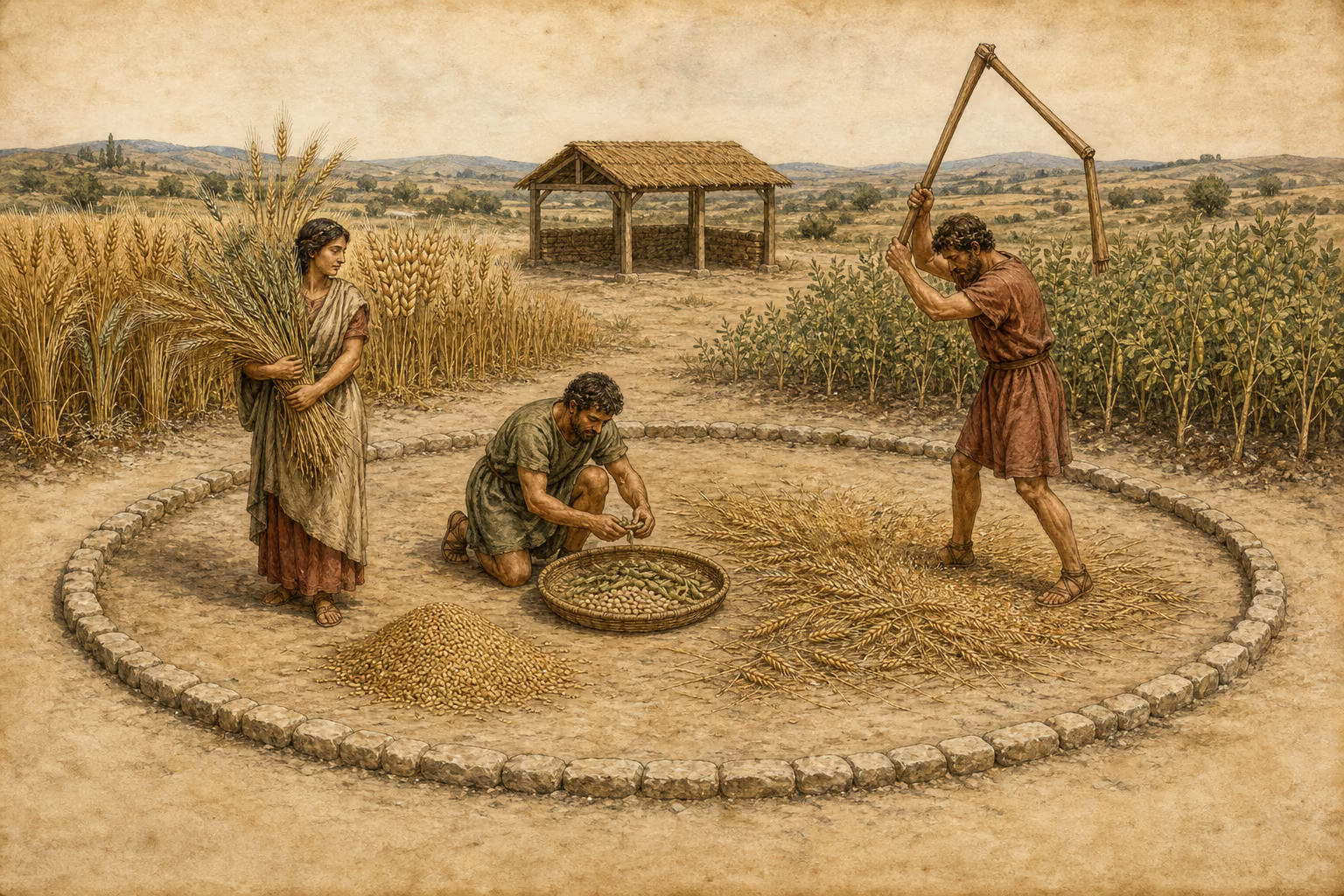
<7> Tunicae frumento plures. hordeum maxime nudum et arinca, set praecipue avena. calamus altior frumento quam hordeo, arista mordacior hordeo. in area exteruntur triticum et siligo et hordeum. Sic et seruntur pura, qualiter moluntur, quia tosta non sunt. e diverso far, milium, panicum purgari nisi tosta non possunt. Itaque haec cum suis folliculis seruntur cruda. et far in vaginulis suis servant ad satus atque non torrent.
Levissimum ex his hordeum raro excedit XV libras et faba XXII. Ponderosius far magisque etiamnum triticum. far in aegypto ex olyra conficitur. tertium genus spicae hoc ibi est. Galliae quoque suum genus farris dedere, quod illic bracem vocant, apud nos scandalam, nitidissimi grani. Est et alia differentia, quod fere quaternis libris plus reddit panis quam far aliud. Populum romanum farre tantum e frumento CCC annis usum verrius tradit.
<1> Tritici genera plura, quae fecere gentes. Italico nullum equidem comparaverim candore ac pondere, quo maxime decernitur. montanis modo comparetur ltaliae agris externum, in quo principatum tenuit Boeotia, dein Sicilia, mox Africa. tertium pondus erat Thracio, Syrio, deinde et aegyptio, athletarum [cum] decreto, quorum capacitas iumentis similis quem diximus ordinem fecerat. Graecia et Ponticum laudavit, quod in italiam non pervenit. ex omni autem genere grani praetulit dracontian et strangian et Selinusium argumento crassissimi calami. itaque pingui solo haec genera adsignabat. levissimum et maxime inane speudian, tenuissimi calami, in umidis seri iubebat, quoniam multo egeret alimento. haec fuere sententiae Alexandro Magno regnante, cum clarissima fuit Graecia atque in toto orbe terrarum potentissima, ita tamen ut ante mortem eius annis fere CXLV Sophocles poeta in fabula Triptolemo frumentum Italicum ante cuncta laudaverit, ad verbum tralata sententia: et fortunatam Italiam frumento serere candido. quae laus peculiaris hodieque Italico est; quo magis admiror posteros Graecornm nullam mentionem huius fecisse frumenti.
<2> Nunc ex his generibus, quae Romam invehuntur, levissimum est Gallicum atque Chersonneso advectum, quippe non excedunt modii vicenas libras, si quis granum ipsum ponderet. Sardum adicit selibram, Alexandrinum et trientem—hoc et Siculi pondus—, Baeticum totam libram addit, Africum et dodrantem. in transpadana Italia scio vicenas quinas libras farris modios pendere, circa Clusium et senas. lex certa naturae, ut in quocumque genere pani militari tertia portio ad grani pondus accedat, sicut optumum frumentum esse, quod in subactum congium aquae capiat. quibusdam generibus per se pondus, sicut Baliarico: modio tritici panis p???. XXXV reddit; quibusdam binis mixtis, ut Cyprio et Alexandrino XX prope libras non excedentibus. Cyprium fuscum est panemque nigrum facit, itaque miscetur Alexandrinum candidum, redeuntque XXV pondo. Thebaicum libram adicit. marina aqua subigi, quod plerique in maritimis locis faciunt occasione lucrandi salis, inutilissimum. non alia de causa opportuniora morbis corpora existunt. Galliae et Hispa niae frumento in potum resoluto quibus diximus generibus spuma ita concreta pro fermento utuntur, qua de causa levior illis quam ceteris panis. <3> Est differentia et calami, crassior quippe melioris est generis. plurimis tunicis Thracium triticum vestitur ob nimia frigora illi plagae exquisitum. eadem causa et trimenstre invenit detinentibus terras nivibus, quod tertio fere a satu mense, cum et in reliquo orbe, metitur. totis hoc Alpibus notum, et hiemalibus provinciis nullum hoc frumento laetius, unicalamum praeterea nec usquam capax, seriturque non nisi tenui terra. est et bimestre circa ThraciaeAenum, quod XL die, e quo satum est, maturescit, mirumque nulli frumento plus esse ponderis et furfuribus carere. utitur eo et Sicilia et Achaia, montuosis utraque partibus, Euboea quoque circa Carystum. in tantum fallitur Columella, qui ne trimestris quidem proprium genus existimaverit esse, cum sit antiquissimum. Graeci setanion vocant. tradunt in Bactris grana tantae magnitudinis fieri, ut singula spicas nostras aequent.
primum ex omnibus frumentis seritur hordeum. dabimus et dies serendo cuique generi natura singulorum exposita. hordeum Indis sativum et silvestre, ex quo panis apud eos praecipuus et alica. maxume quidem oryza gaudent, ex qua tisanam conficiunt, quam reliqui mortales ex hordeo. oryzae folia carnosa, porro similia, sed latiora, altitudo cubitalis, flos purpureus, radix gemmeae rotunditatis.
Antiquissimum in cibis hordeum, sicut Atheniensium ritu Menandro auctore apparet et gladiatorum cognomine, qui hordearii vocabantur. polentam quoque Graeci non aliunde praeferunt. pluribus fit haec modis. Graeci perfusum aqua hordeum siccant nocte una ac postero die frigunt, dein molis frangunt. sunt qui vehementius tostum rursus exigua aqua adspergant et siccent, priusquam molant. alii vero virentibus spicis decussum hordeum recens purgant madidumque in pila tundunt atque in corbibus eluunt ac siccatum sole rursus tundunt et purgatum molunt. quocumque autem genere praeparato vicenis hordei libris ternas seminis lini et coriandri selibram salisque acetabulum, torrentes omnia ante, miscent in mola. qui diutius volunt servare, cum polline ac furfuribus suis condunt novis fictilibus. Italia sine perfusione tostum in subtilem farinam molit, isdem additis atque etiam milio.
Panem ex hordeo antiquis usitatum vita damnavit, quadripedumque fere cibus est, cum tisanae inde usus validissimus saluberrimusque tanto opere probetur. unum laudibus eius volumen dicavit Hippocrates e clarissimis medicinae scientia. tisanae bonitas praecipua Uticensi. in Aegypto vero est quae fiat ex hordeo, cui sunt bini anguli. in Baetica et Africa genus, ex quo fiat, hordei glabrum appellat Turranius. idem olyran et oryzan eandem esse existimat. tisanae conficiendae volgata ratio est.
Simili modo e tritici semine tragum fit, in Campania dumtaxat et Aegypto, amylum vero ex omni tritico ac siligine, sed optimum e trimestri. inventio eius Chio insulae debetur; et hodie laudatissimum inde. est appellatum ab eo quod sine mola fiat. proximum trimestri quod e minime ponderoso tritico. madescit dulci aqua in ligneis vasis, ita ut integatur quinquies in die mutata; melius, si et noctu, ita ut misceatur pariter. emollitum priusquam acescat, linteo aut sportis saccatum tegulae infunditur inlitae fermento, atque ita in sole densatur. post Chium maxime laudatur Creticum, mox Aegyptium—probatur autem levore et levitate atque ut recens sit—, iam et Catoni dictum apud nos.
Hordei farina et ad medendum utuntur, mirumque in usu iumentorum ignibus durato ac postea molito offisque humana manu demissis in alvum maiores vires torosque corporis fieri. spicae quaedam binos ordines habent, quaedam plures usque ad senos. grano ipsi aliquo t differentiae: longius leviusque aut brevius ac rotundius, candidius nigriusve, cui purpura est opimo ad polentam. contra tempestates candido maxima infirmitas. hordeum frugum omnium mollissimum est. seri non volt nisi in sicca et soluta terra ac nisi laeta. palea ex optimis, stramento vero nullum conparatur. hordeum ex omni frumento minime calamitosum, quia ante tollitur quam triticum occupet rubigo—itaque sapientes agricolae triticum cibariis tantum serunt, hordeum sacculo seri dicunt—, propterea celerrime redit, fertilissimumque quod in Hispaniae Carthagine Aprili mense collectum est. hoc seritur eodem mense in Celtiberia, eodemque anno bis nascitur. rapitur omne a prima statim maturitate festinantius quam cetera. fragili enim stipula et tenuissima palea granum continetur. meliorem etiam polentam fieri tradunt, si non excocta maturitate tollatur.
English · Bostock & Riley 1855–57
As the field is now prepared, we shall proceed to speak of the nature of the various kinds of grain; we must premise, however, that there are two principal classes of grain, the cereals, comprising wheat and barley, and the legumina, such as the bean and the chick-pea, for instance. The difference between these two classes is too well known to require any further description.
The cereals are divided again into the same number of varieties, according to the time of the year at which they are sown. The winter grains are those which are put in the ground about the setting of the Vergiliæ, and there receive their nutriment throughout the winter, for instance, wheat, spelt, and barley. The summer grains are those which are sown in summer, before the rising of the Vergiliæ, such as millet, panic, sesame, horminum, and irio, in accordance, however, with the usage of Italy only; for in Greece and Asia all the grains are sown just after the setting of the Vergiliæ. There are some, again, that are sown at either season in Italy, and others at a third period, or, in other words, in the spring. Some authors give the name of spring-grain to millet, panic, lentils, chick-peas, and alica, while they call wheat, barley, beans, turnips, and rape, sementive or early sowing seeds. Certain species of wheat are only sown to make fodder for cattle, and are known by the name of “farrago,” or mixed grain; the same, too, with the leguminous plants, the vetch, for instance. The lupine, however, is grown in common as food for both cattle and men.
All the leguminous plants, with the exception of the bean, have a single root, hard and tough, like wood, and destitute of numerous ramifications; the chick-pea has the deepest root of all. Corn has numerous fibrous roots, but no ramifications. Barley makes its appearance above ground the seventh day after sowing; the leguminous plants on the fourth, or at the very latest, the seventh; the bean from the fifteenth day to the twentieth: though in Egypt the leguminous plants appear as early as the third day after they are sown. In barley, one extremity of the grain throws out the root, and the other the blade; this last flowers, too, before the other grain. In the cereals in general it is the thicker end of the seed that throws out the root, the thinner end the blossom; while in the other seeds both root and blossom issue from the same part.
During the winter, corn is in the blade; but in the spring winter corn throws out a tall stem. As for millet and panic, they grow with a jointed and grooved stalk, while sesame has a stem resembling that of fennel-giant. The fruit of all these seeds is either contained in an ear, as in wheat and barley, for instance, and protected from the attacks of birds and small animals by a prickly beard bristling like so many palisades; or else it is enclosed in pods, as in the leguminous plants, or in capsules, as in sesame and the poppy. Millet and panic can only be said to belong to the grower and the small birds in common, as they have nothing but a thin membrane to cover them, without the slightest protection. Panic receives that name from the panicule or down that is to be seen upon it; the head of it droops languidly, and the stalk tapers gradually in thickness, being of almost the toughness and consistency of wood: the head is loaded with grain closely packed, there being a tuft upon the top, nearly a foot in length. In millet the husks which embrace the grain bend downward with a wavy tuft upon the edge. There are several varieties of panic, the mammose, for instance, the ears of which are in clusters with small edgings of down, the head of the plant being double; it is distinguished also according to the colour, the white, for instance, the black, the red, and the purple even. Several kinds of bread are made from millet, but very little from panic: there is no grain known that weighs heavier than millet, and which swells more in baking. A modius of millet will yield sixty pounds’ weight of bread; and three sextarii steeped in water will make one modius of fermenty. A kind of millet has been introduced from India into Italy within the last ten years, of a swarthy colour, large grain, and a stalk like that of the reed. This stalk springs up to the height of seven feet, and has tufts of a remarkable size, known by the name of “phobæ.” This is the most prolific of all the cereals, for from a single grain no less than three sextarii are produced: it requires, however, to be sown in a humid soil.
Some kinds of corn begin to form the ear at the third joint, and others at the fourth, though at its first formation the ear remains still concealed. Wheat, however, has four articulations, spelt six, and barley eight. In the case of these last, the ear does not begin to form before the number of joints, as above mentioned, is complete. Within four or five days, at the very latest, after the ear has given signs of forming, the plant begins to flower, and in the course of as many days or a little more, sheds its blossom: barley blossoms at the end of seven days at the very latest. Varro says that the grains are perfectly formed at the end of four times nine days from their flowering, and are ready for cutting at the ninth month.
The bean, again, first appears in leaf, and then throws out a stalk, which has no articulations upon it. The other leguminous plants have a tough, ligneous stalk, and some of them throw out branches, the chick-pea, the fitch, and the lentil, for instance. In some of the leguminous plants, the pea, for example, the stem creeps along the ground, if care is not taken to support it by sticks: if this precaution is omitted, the quality is deteriorated. The bean and the lupine are the only ones among the leguminous plants that have a single stem: in all the others the stem throws out branches, being of a ligneous nature, very thin, and in all cases hollow. Some of these plants throw out the leaves from the root, others at the top. Wheat, barley, and the vetch, all the plants, in fact, which produce straw, have a single leaf only at the summit: in barley, however, this leaf is rough, while in the others it is smooth. * * * In the bean, again, the chick-pea, and the pea, the leaves are numerous and divided. In corn the leaf is similar to that of the reed, while in the bean it is round, as also in a great proportion of the leguminous plants. In the ervilia and the pea the leaf is long, in the kidney-bean veined, and in sesame and irio the colour of blood. The lupine and the poppy are the only ones among these plants that lose their leaves.
The leguminous plants remain a longer time in flower, the fitch and the chick-pea more particularly; but the bean is in blossom the longest of them all, for the flower remains on it forty days; not, indeed, that each stalk retains its blossom for all that length of time, but, as the flower goes off in one, it comes on in another. In the bean, too, the crop is not ripe all at once, as is the case with corn; for the pods make their appearance at different times, at the lowest parts first, the blossom mounting upwards by degrees.
When the blossom is off in corn, the stalk gradually thickens, and it ripens within forty days at the most. The same is the case, too, with the bean, but the chick-pea takes a much shorter time to ripen; indeed, it is fit for gathering within forty days from the time that it is sown. Millet, panic, sesame, and all the summer grains are ripe within forty days after blossoming, with considerable variations, of course, in reference to soil and weather. Thus, in Egypt, we find barley cut at the end of six months, and wheat at the end of seven, from the time of sowing. In Hellas, again, barley is cut in the seventh month, and in Peloponnesus in the eighth; the wheat being got in at a still later period.
Those grains which grow on a stalk of straw are enclosed in an envelope protected by a prickly beard; while in the bean and the leguminous plants in general they are enclosed in pods upon branches which shoot alternately from either side. The cereals are the best able to withstand the winter, but the leguminous plants afford the most substantial food. In wheat, the grain has several coats, but in barley, more particularly, it is naked and exposed; the same, too, with arinca, but most of all, the oat. The stem is taller in wheat than it is in barley, but the ear is more bearded in the last. Wheat, barley, and winter-wheat are threshed out; they are cleaned, too, for sowing just as they are prepared for the mill, there being no necessity for parching them. Spelt, on the other hand, millet, and panic, cannot be cleaned without parching them; hence it is that they are always sown raw and with the chaff on. Spelt is preserved in the husk, too, for sowing, and, of course, is not in such case parched by the action of fire.
Of all these grains barley is the lightest, its weight rarely exceeding fifteen pounds to the modius, while that of the bean is twenty-two. Spelt is much heavier than barley, and wheat heavier than spelt. In Egypt they make a meal of olyra, a third variety of corn that grows there. The Gauls have also a kind of spelt peculiar to that country: they give it the name of “brace,” while to us it is known as “sandala:” it has a grain of remarkable whiteness. Another difference, again, is the fact that it yields nearly four pounds more of bread to the modius than any other kind of spelt. Verrius states that for three hundred years the Romans made use of no other meal than that of corn.
There are numerous kinds of wheat which have received their names from the countries where they were first produced. For my part, however, I can compare no kind of wheat to that of Italy either for whiteness or weight, qualities for which it is more particularly distinguished: indeed it is only with the produce of the more mountainous parts of Italy that the foreign wheats can be put in comparison. Among these the wheat of Bœotia occupies the first rank, that of Sicily the second, and that of Africa the third. The wheats of Thrace, Syria, and, more recently, of Egypt, used to hold the third rank for weight, these facts having been ascertained through the medium of the athletes; whose powers of consumption, equal to those of beasts of burden, have established the gradations in weight, as already stated. Greece, too, held the Pontic wheat in high esteem; but this has not reached Italy as yet. Of all the varieties of grain, however, the Greeks gave the preference to the kinds called dracontion, strangia, and Selinusium, the chief characteristic of which is a stem of remarkable thickness: it was this, in the opinion of the Greeks, that marked them as the peculiar growth of a rich soil. On the other hand, they recommended for sowing in humid soils an extremely light and diminutive species of grain, with a remarkably thin stalk, known to them as speudias, and standing in need of an abundance of nutriment. Such, at all events, were the opinions generally entertained in the reign of Alexander the Great, at a time when Greece was at the height of her glory, and the most powerful country in the world. Still, however, nearly one hundred and forty-four years before the death of that prince we find the poet Sophocles, in his Tragedy of “Triptolemus,” praising the corn of Italy before all others. The passage, translated word for word, is to the following effect:—
“And favour’d Italy grows white with hoary wheat.”
And it is this whiteness that is still one of the peculiar merits of the Italian wheat; a circumstance which makes me the more surprised to find that none of the Greek writers of a later period have made any reference to it.
Of the various kinds of wheat which are imported at the present day into Rome, the lightest in weight are those which come from Gaul and Chersonnesus; for, upon weighing them, it will be found that they do not yield more than twenty pounds to the modius. The grain of Sardinia weighs half a pound more, and that of Alexandria one-third of a pound more than that of Sardinia; the Sicilian wheat is the same in weight as the Alexandrian. The Bœotian wheat, again, weighs a whole pound more than these last, and that of Africa a pound and three quarters. In Italy beyond the Padus, the spelt, to my knowledge, weighs twenty-five pounds to the modius, and, in the vicinity of Clusium, six-and-twenty. We find it a rule, universally established by Nature, that in every kind of commissariat bread that is made, the bread exceeds the weight of the grain by one-third; and in the same way it is generally considered that that is the best kind of wheat, which, in kneading, will absorb one congius of water. There are some kinds of wheat which give, when used by themselves, an additional weight equal to this: the Balearic wheat, for instance, which to a modius of grain yields thirty-five pounds weight of bread. Others, again, will only give this additional weight by being mixed with other kinds, the Cyprian wheat and the Alexandrian, for example; which, if used by themselves, will yield no more than twenty pounds to the modius. The wheat of Cyprus is swarthy, and produces a dark bread; for which reason it is generally mixed with the white wheat of Alexandria; the mixture yielding twenty-five pounds of bread to the modius of grain. The wheat of Thebais, in Egypt, when made into bread, yields twenty-six pounds to the modius. To knead the meal with sea-water, as is mostly done in the maritime districts, for the purpose of saving the salt, is extremely pernicious; there is nothing, in fact, that will more readily predispose the human body to disease. In Gaul and Spain, where they make a drink by steeping corn in the way that has been already described—they employ the foam which thickens upon the surface as a leaven: hence it is that the bread in those countries is lighter than that made elsewhere.
There are some differences, also, in the stem of wheat; for the better the kind the thicker it is. In Thrace, the stem of the wheat is covered with several coats, which are rendered absolutely necessary by the excessive cold of those regions. It is the cold, also, that led to the discovery there of the three-month wheat, the ground being covered with snow most of the year. At the end mostly of three months after it has been sown, this wheat is ready for cutting, both in Thrace and in other parts of the world as well. This variety is well known, too, throughout all the Alpine range, and in the northern provinces there is no kind of wheat that is more prolific; it has a single stem only, is by no means of large size in any part of it, and is never sown but in a thin, light soil. There is a two-month wheat also found in the vicinity of Ænos, in Thrace, which ripens the fortieth day after sowing; and yet it is a surprising fact, that there is no kind of wheat that weighs heavier than this, while at the same time it produces no bran. Both Sicily and Achaia grow it, in the mountainous districts of those countries; as also Eubœa, in the vicinity of Carystus. So greatly, then, is Columella in error, in supposing that there is no distinct variety of three-month wheat even; the fact being that these varieties have been known from the very earliest times. The Greeks give to these wheats the name of “setanion.” It is said that in Bactria the grains of wheat are of such an enormous size, that a single one is as large as our ears of corn.
Of all the cereals the first that is sown is barley. We shall state the appropriate time for sowing each kind when we come to treat of the nature of each individually. In India, there is both a cultivated and a wild barley, from which they make excellent bread, as well as alica. But the most favourite food of all there is rice, from which they prepare a ptisan similar to that made from barley in other parts of the world. The leaves of rice are fleshy, very like those of the leek, but broader; the stem is a cubit in height, the blossom purple, and the root globular, like a pearl in shape.
Barley is one of the most ancient aliments of man, a fact that is proved by a custom of the Athenians, mentioned by Menander, as also by the name of “hordearii,” that used to be given to gladiators. The Greeks, too, prefer barley to anything else for making polenta. This food is made in various ways: in Greece, the barley is first steeped in water, and then left a night to dry. The next day they parch it, and then grind it in the mill. Some persons parch it more highly, and then sprinkle it again with a little water; after which they dry it for grinding. Others shake the grain from out of the ear while green, and, after cleaning and soaking it in water, pound it in a mortar. They then wash the paste in baskets, and leave it to dry in the sun; after which they pound it again, clean it, and grind it in the mill. But whatever the mode of preparation adopted, the proportions are always twenty pounds of barley to three pounds of linseed, half a pound of coriander, and fifteen drachmæ of salt: the ingredients are first parched, and then ground in the mill.
Those who want it for keeping, store it in new earthen vessels, with fine flour and bran. In Italy, the barley is parched without being steeped in water, and then ground to a fine meal, with the addition of the ingredients already mentioned, and some millet as well. Barley bread, which was extensively used by the ancients, has now fallen into universal disrepute, and is mostly used as a food for cattle only.
With barley, too, the food called ptisan is made, a most substantial and salutary aliment, and one that is held in very high esteem. Hippocrates, one of the most famous writers on medical science, has devoted a whole volume to the praises of this aliment. The ptisan of the highest quality is that which is made at Utica; that of Egypt is prepared from a kind of barley, the grain of which grows with two points. In Bætica and Africa, the kind of barley from which this food is made is that which Turranius calls the “smooth” barley: the same author expresses an opinion, too, that olyra and rice are the same. The method of preparing ptisan is universally known.
In a similar manner, too, tragum is prepared from seed wheat, but only in Campania and Egypt.
Amylum is prepared from every kind of wheat, and from winter-wheat as well; but the best of all is that made from three-month wheat. The invention of it we owe to the island of Chios, and still, at the present day, the most esteemed kind comes from there; it derives its name from its being made without the help of the mill. Next to the amylum made with three-month wheat, is that which is prepared from the lighter kinds of wheat. In making it, the grain is soaked in fresh water, placed in wooden vessels; care being taken to keep it covered with the liquid, which is changed no less than five times in the course of the day. If it can be changed at night as well, it is all the better for it, the object being to let it imbibe the water gradually and equally. When it is quite soft, but before it turns sour, it is passed through linen cloth, or else wicker-work, after which it is poured out upon a tile covered with leaven, and left to harden in the sun. Next to the amylum of Chios, that of Crete is the most esteemed, and next to that the Ægyptian. The tests of its goodness are its being light and smooth: it should be used, too, while it is fresh. Cato, among our writers, has made mention of it.
Barley-meal, too, is employed for medicinal purposes; and it is a curious fact, that for beasts of burden they make a paste of it, which is first hardened by the action of fire, and then ground. It is then made up into balls, which are introduced with the hand into the paunch, the result of which is, that the vigour and muscular strength of the animal is considerably increased. In some kinds of barley, the ears have two rows of grains, and in others more; in some cases, as many as six. The grain itself, too, presents certain differences, being long and thin, or else short or round, white, black, or, in some instances, of a purple colour. This last kind is employed for making polenta: the white is ill adapted for standing the severity of the weather. Barley is the softest of all the grains: it can only be sown in a dry, loose soil, but fertile withal. The chaff of barley ranks among the very best; indeed, for litter there is none that can be compared with it. Of all grain, barley is the least exposed to accidents, as it is gathered before the time that mildew begins to attack wheat; for which reason it is that the provident agriculturist sows only as much wheat as may be required for food. The saying is, that “barley is sown in a money-bag,” because it so soon returns a profit. The most prolific kind of all is that which is got in at Carthage, in Spain, in the month of April. It is in the same month that it is sown in Celtiberia, and yet it yields two harvests in the same year. All kinds of barley are cut sooner than other grain, and immediately after they are ripe; for the straw is extremely brittle, and the grain is enclosed in a husk of remarkable thinness. It is said, too, that a better polenta is made from it, if it is gathered before it is perfectly ripe.