LIBER XIX · CAPUT 1
HOW FLAX IS SOWN: TWENTY-SEVEN PRINCIPAL VARIETIES OF IT
Latine · Mayhoff 1906
Siderum quoque tempestatumque ratio vel imperitis facili atque indubitato modo demonstrata est, vereque intellegentibus non minus conferunt rura deprehendendo caelo quam sideralis scientia agro colendo. proximam multi hortorum curam fecere; nobis non protinus transire ad ista tempestivum videtur, miramurque aliquos scientiae gratiam eruditionisve gloriam ex his petentes tam multa praeterisse, nulla mentione habita tot rerum sponte curave provenientium, praesertim cum plerisque earum pretio usuque vitae maior etiam quam frugibus perhibeatur auctoritas. atque, ut a confessis ordiamur utilitatibus quaeque non solum terras omnes, verum etiam maria replevere, seritur ac dici neque inter fruges neque inter hortensia potest linum, sed in qua non occurrit vitae parte? quodve miraculum maius, herbam esse quae admoveat Aegyptum Italiae in tantum, ut Galerius a freto Siciliae Alexandriam septimo die pervenerit, Balbillus sexto, ambo praefecti, aestate vero post xv annos Valerius Marianus ex praetoriis senatoribus a Puteolis nono die lenissumo flatu? herbam esse quae Gadis ab Herculis columnis septimo die Ostiam adferat et citeriorem Hispaniam quarto, provinciam Narbonensem tertio, Africam altero, quod etiam mollissimo flatu contigit C. Flavio legato Vibi Crispi procos.? audax vita, scelerum plena! aliquid seri, ut ventos procellasque capiat, et parum esse fluctibus solis vehi, iam vero nec vela satis esse maiora navigiis, sed, quamvis amplitudini antemnarum singulae arbores sufficiant, super eas tamen addi velorum alia vela, praeterque in proris et alia in puppibus pandi, ac tot modis provocari mortem, denique tam parvo semine nasci quod orbem terrarum ultro citro portet, tam gracili avena, tam non alte a tellure tolli, neque id viribus suis necti, sed fractum tunsumque et in mollitiem lanae coactum iniuria, ac summa audacia pervehi mare! nulla exsecratio sufficit contra inventorem (dictum suo loco nobis), cui satis non fuit hominem in terra mori, nisi periret et insepultus. ac nos priore libro imbres et flatus cavendos frugum causa victusque praemonebamus: ecce seritur hominis manu, metitur eiusdem hominis ingenio, quod ventos in mari optet. propterea, ut sciamus favisse Poenas, nihil gignitur facilius; ut sentiamus nolente seri natura, urit agrum deteriorelnque etiam terrain facit.
<1> Seritur sabulosis maxime unoque sulco, nec magis festinat aliud. vere satum aestate vellitur, et hanc quoque terrae iniuriam facit. ignoscat tamen aliquis Aegypto serenti, ut Arabiae Indiaeque merces inportet. itane et Galliae censentur hoc reditu? montesque mari oppositos esse non est satis et a latere oceani obstare ipsum, quod vocant inane? Cadurci, Caleti, Ruteni, Bituriges ultimique hominum existimati Morini, immo vero Galliae universae vela texunt, iam quidem et transrhenani hostes, nec pulchriorem aliam vestem eorum feminae novere. qua admonitione succurrit quod M. Varro tradit, in Serranorum familia gentilicium esse feminas lintea veste non uti. in Germania autem defossae atque sub terra id opus agunt. similiter etiam in Italiae regione Aliana inter Padum Ticinumque amnes, ubi a Saetabi tertia in Europa lino palma; secundam enim in vicino Alianis capessunt Retovina et in Aemilia via Faventina. candore Alianis semper crudis Faventina praeferuntur; Retovinis tenuitas summa densitasque, candor qui Faventinis, sed lanugo nulla, quod apud alios gratiam, apud alios offensionem habet. nervositas filo aequalior paene quam araneis tinnitusque, cum dente libeat experiri. ideo duplex quam ceteris pretium. <2> Et ab his Hispania citerior habet splendorem lini praecipuum torrentis, in quo politur, natura, qui adluit Tarraconem. et tenuitas mira ibi primum carbasis repertis. non dudum ex eadem Hispania Zoelicum venit in Italiam plagis utilissimum; civitas ea Gall aeciae et oceano propinqua. est sua gloria et Cumano in Campania ad piscium et alitum capturas. eadem et plagis materia—neque enim minores cunctis animalibus insidias quam nobismet ipsis lino tendimus —, sed Cumanae plagae concidunt apro saetas et vel ferri aciem vincunt, vidimusque iam tantae tenuitatis, ut anulum hominis cum epidromis transirent uno portante multitudinem, qua saltus cingerentur. nec id maxime mirum, singula earum stamina centeno quinquageno filo constare, sicut paulo ante Iulio Lupo, qui in praefectura Aegypti obiit. mirentur hoc ignorantes in Aegypti quondam regis, quem Amasim vocant, thorace in Rhodiorum insula Lindi in templo Minervae CCCLXV filis singula fila constare, quod se expertum nuperrime prodidit Mucianus ter cos. parvasque iam reliquias eius superesse hac experientium iniuria. Italia et Paelignis etiamnum linis honorem habet, sed fullonum tantum in usu. nullum est candidius lanaeve similius, sicut in culcitis praecipuam gloriam Cadurci obtinent. Galliarum hoc et tomenta pariter inventum. Italiae quidem mos etiam nunc durat in appellatione stramenti.
<3> Aegyptio lino minimum firmitatis, plurimum lucri. quattuor ibi genera: Taniticum, Pelusiacum, Buticum, Tentyriticum regionum nominibus, in quibus nascuntur. superior pars Aegypti in Arabiam vergens gignit fruticem, quem aliqui gossypion vocant, plures xylon et ideo lina inde facta xylina. parvus est similemque barbatae nucis fructum defert, cuius ex interiore bombyce lanugo netur. nec ulla sunt cum candore molliora pexiorave. vestes inde sacerdotibus Aegypti gratissimae. quartum genus et othoninum appellant. fit e palustri velut harundine, dumtaxat panicula eius. Asia e genista facit lina ad retia praecipue in piscando durantia, frutice madefacto x diebus, Aethiopes Indique e malis, Arabes e curcurbitis in arboribus, ut diximus, genitis.
Apud nos maturitas eius duobus argumentis intellegitur, intumescente semine aut colore flavescente. tum evolsum et in fasciculos manuales colligatum siccatur in sole pendens conversis superne radicibus uno die, mox v aliis contrariis in se fascium cacuminibus, ut semen in medium cadat. inter medicamina huic vis, et in quodam rustico ac praedulci Italiae transpadanae cibo, sed iam pridem sacrorum tantum, gratia. deinde post messem triticiam virgae ipsae merguntur in aquam solibus tepefactam, pondere aliquo depressae; nulli enim levitas maior. maceratas indicio est membrana laxatior, iterumque inversae, ut prius, sole siccantur, mox arefactae in saxo tunduntur stuppario malleo. quod proximum cortici fuit, stuppa appellatur, deterioris lini, lucernarum fere luminibus aptior; et ipsa tamen pectitur ferreis aculeis, donec omnis membrana decorticetur, *corticesque decussi clibanis et furnis praebent usum*. medullae numerosior distinctio candore, mollitia. linumque nere et viris decorum. est* ars depectendi digerendique: iustum e quinquagenis fascium libris quinas denas carminari. iterum deinde in filo politur, inlisum crebro silici ex aqua, textumque rursus tunditur clavis, semper iniuria melius.
Inventum iam est etiam quod ignibus non absumeretur. vivum id vocant, ardentesque in focis conviviorum ex eo vidimus mappas sordibus exustis splendescentes igni magis quam possent aquis. regum inde funebres tunicae corporis favillam ab reliquo separant cinere. nascitur in desertis adustisque sole Indiae, ubi non cadunt imbres, inter diras serpentes, adsuescitque vivere ardendo, rarum inventu, difficile textu propter brevitatem. rufus de cetero colos splendescit igni. cum inventum est, aequat pretia excellentium margaritarum. vocatur autem a Graecis ἀσβέστινον ex argumento naturae. Anaxilaus auctor est linteo eo circumdatam arborem surdis ictibus et qui non exaudiantur caedi. ergo huic lino principatus in toto orbe. proximus byssino, mulierum maxime deliciis circa Elim in Achaia genito; quaternis denariis scripula eius permutata quondam ut auri reperio. linteorum lanugo, e velis navium maritimarum maxime, in magno usu medicinae est, et cinis spodii vim habet. est et inter papavera genus quoddam, quo candorem lintea praecipuum trahunt.
Temptatum est tingui linum quoque, ut vestium insaniam acciperet, in Alexandri Magni primum classibus Indo amne navigantis, cum duces eius ac praefecti certamine quodam variassent insignia navium, stupueruntque litora flatu versicoloria pellente vela. purpureo ad Actium cum M. Antonio Cleopatra venit eodemque fugit. hoc fuit imperatoriae navis insigne.
Postea in theatris tantum umbram fecere, quod primus omnium invenit Q. Catulus, cum Capitolium dedicaret. carbasina deinde vela primus in theatro duxisse traditur Lentulus Spinther Apollinaribus ludis. mox Caesar dictator totum forum Romanum intexit viamque sacram ab domo sua et clivum usque in Capitolium, quod munere ipso gladiatorio mirabilius visum tradunt. deinde et sine ludis Marcellus Octavia Augusti sorore genitus in aedilitate sua, avunculi XI consulatu, a kal. Aug. velis forum inumbravit, ut salubrius litigantes consisterent, quantum mutatia moribus Catonis censorii, qui sternendum quoque forum muricibus censuerat! vela nuper et colore caeli, stellata, per rudentes iere etiam in amphitheatris principis Neronis. rubent in cavis aedium et muscum ab sole defendunt. cetero mansit candori pertinax gratia. honor ei iam et Troiano bello. cur enim non et proeliis intersit ut naufragiis? thoracibus lineis paucos tamen pugnasse testis est Homerus. hinc fuisse et navium armamenta apud eundem interpretantur eruditiores, quoniam, cum σπαρτὰ dixit, significaverit sata.
English · Bostock & Riley 1855–57
We have now imparted a knowledge of the constellations and of the seasons, in a method unattended with difficulty for the most ignorant even, and free from every doubt; indeed, to those who understand these matters aright, the face of the earth contributes in no less a degree to a due appreciation of the celestial phænomena, than does the science of astronomy to our improvement in the arts of agriculture.
Many writers have made it their next care to treat of horticulture; but, for my own part, it does not appear to me altogether advisable to pass on immediately to that subject, and, indeed, I am rather surprised to find that some among the learned, who have either sought the pleasures of knowledge in these pursuits, or have grounded their celebrity upon them, have omitted so many particulars in reference thereto; for no mention do we find in their writings of numerous vegetable productions, both wild as well as cultivated, many of which are found, in ordinary life, to be of higher value and of more extended use to man than the cereals even.
To commence, then, with a production which is of an utility that is universally recognized, and is employed not only upon dry land but upon the seas as well, we will turn our attention to flax, a plant which is reproduced from seed, but which can neither be classed among the cereals nor yet among the garden plants. What department is there to be found of active life in which flax is not employed? and in what production of the earth are there greater marvels revealed to us than in this? To think that here is a plant which brings Egypt in close proximity to Italy!—so much so, in fact, that Galerius and Balbillus, both of them prefects of Egypt, made the passage to Alexandria from the Straits of Sicily, the one in six days, the other in five! It was only this very last summer, that Valerius Marianus, a senator of prætorian rank, reached Alexandria from Puteoli in eight days, and that, too, with a very moderate breeze all the time! To think that here is a plant which brings Gades, situate near the Pillars of Hercules, within six days of Ostia, Nearer Spain within three, the province of Gallia Narbonensis within two, and Africa within one!—this last passage having been made by C. Flavius, when legatus of Vibius Crispus, the proconsul, and that, too, with but little or no wind to favour his passage!
What audacity in man! What criminal perverseness! thus to sow a thing in the ground for the purpose of catching the winds and the tempests, it being not enough for him, forsooth, to be borne upon the waves alone! Nay, still more than this, sails even that are bigger than the very ships themselves will not suffice for him, and although it takes a whole tree to make a mast to carry the cross-yards, above those cross-yards sails upon sails must still be added, with others swelling at the prow and at the stern as well—so many devices, in fact, to challenge death! Only to think, in fine, that that which moves to and fro, as it were, the various countries of the earth, should spring from a seed so minute, and make its appearance in a stem so fine, so little elevated above the surface of the earth! And then, besides, it is not in all its native strength that it is employed for the purposes of a tissue; no, it must first be rent asunder, and then tawed and beaten, till it is reduced to the softness of wool; indeed, it is only by such violence done to its nature, and prompted by the extreme audacity of man, and * * * that it is rendered subservient to his purposes. The inventor of this art has been already mentioned by us on a more appropriate occasion; not satisfied that his fellow-men should perish upon land, but anxious that they should meet their end with no sepulchral rites to await them, there are no execrations to be found that can equal his demerits!
It is only in the preceding Book that I was warning the agriculturist, as he values the grain that is to form our daily sustenance, to be on his guard against the storm and the tempest; and yet, here we have man sowing with his own hand, man racking his invention how best to gather, an object the only aspirations of which upon the deep are the winds of heaven! And then, too, as if to let us understand all the better how highly favoured is this instrument of our punishment, there is no vegetable production that grows with greater facility; and, to prove to us that it is in despite of Nature herself that it exists, it has the property of scorching the ground where it is grown, and of deteriorating the quality of the very soil itself.
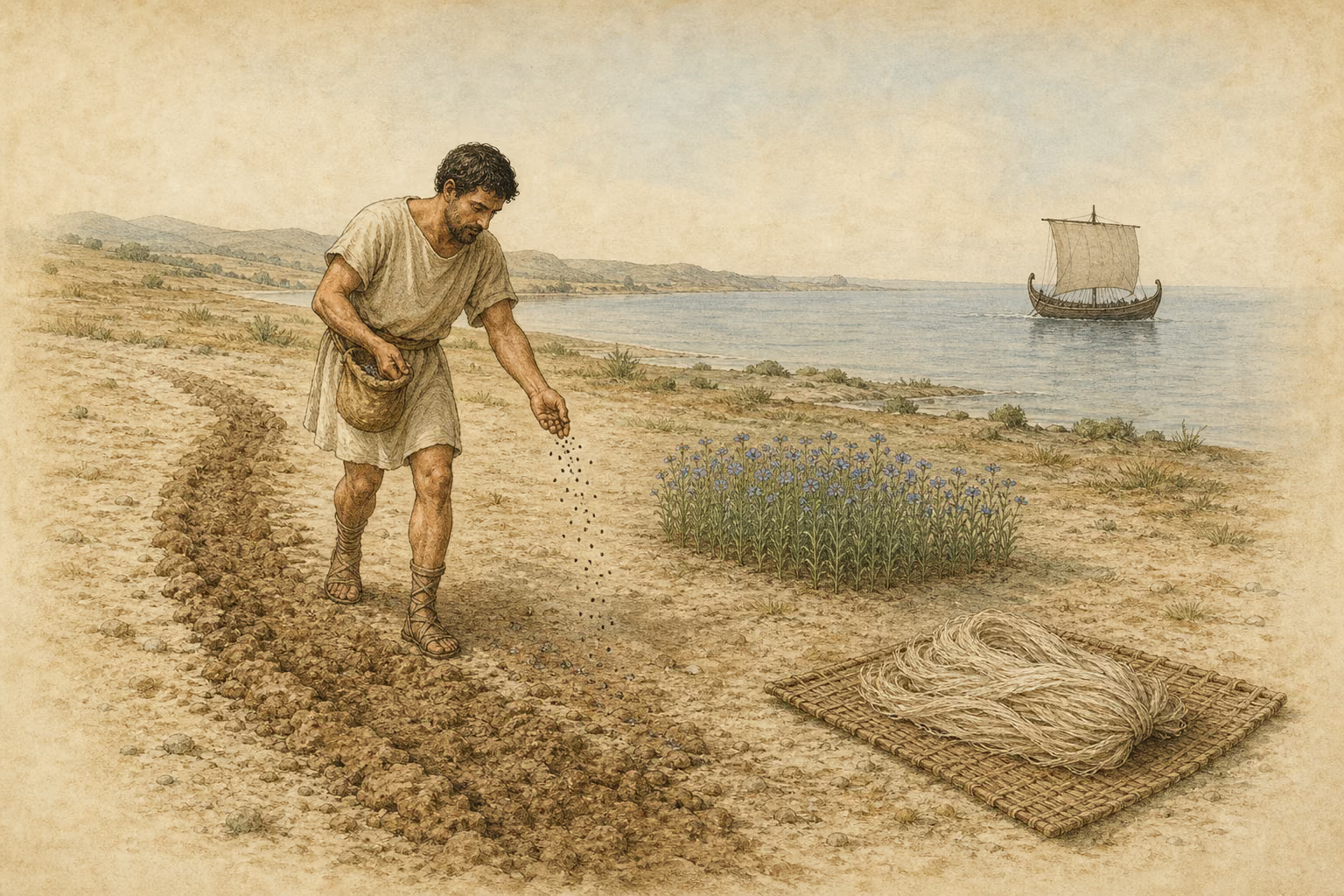
Flax is mostly sown in sandy soils, and after a single ploughing only. There is no plant that grows more rapidly than this; sown in spring, it is pulled up in summer, and is, for this reason as well, productive of considerable injury to the soil. There may be some, however, who would forgive Egypt for growing it, as it is by its aid that she imports the merchandize of Arabia and India; but why should the Gallic provinces base any of their reputation upon this product? Is it not enough, forsooth, for them to be separated by mountains from the sea, and to have, upon the side on which they are bounded by the Ocean, that void and empty space, as it is called? The Cadurci, the Caleti, the Ruteni, the Bituriges, and the Morini, those remotest of all mankind, as it is supposed, the whole of the Gallic provinces, in fact, are in the habit of weaving sail-cloth; and at the present day our enemies even, who dwell beyond the Rhenus, have learned to do the same; indeed, there is no tissue that is more beautiful in the eyes of their females than linen. I am here reminded of the fact, that we find it stated by M. Varro, that it is a custom peculiar to the family of the Serrani for the women never to wear garments of linen. In Germany it is in caves deep under-ground that the linen-weavers ply their work; and the same is the case, too, in the Alian territory, in Italy, between the rivers Padus and Ticinus, the linen of which holds the third rank among the kinds manufactured in Europe, that of Sætabis claiming the first, and those of Retovium and of Faventia, in the vicinity of Alia, on the Æmilian Way, the second, place in general estimation. The linens of Faventia are preferred for whiteness to those of Alia, which are always un-bleached: those of Retovium are remarkable for their extreme fineness, combined with substance, and are quite equal in whiteness to the linens of Faventia; but they have none of that fine downy nap upon them, which is so highly esteemed by some persons, though equally disliked by others. A thread is made, too, from their flax, of considerable strength, smoother and more even, almost, than the spider’s web; when tested with the teeth, it emits a sharp, clear twang; hence it is, that it sells at double the price of the other kinds.
But it is the province of Nearer Spain that produces a linen of the greatest lustre, an advantage which it owes to the waters of a stream which washes the city of Tarraco there. The fineness, too, of this linen is quite marvellous, and here it is that the first manufactories of cambric were established. From the same province, too, of Spain, the flax of Zoëla has of late years been introduced into Italy, and has been found extremely serviceable for the manufacture of hunting-nets. Zoëla is a city of Callæcia, in the vicinity of the Ocean. The flax, too, of Cumæ, in Campania, has its own peculiar merits in the manufacture of nets for fishing and fowling; it is employed, also, for making hunting-nets. For it is from flax, in fact, that we prepare various textures, destined to be no less insidious to the brute creation than they are to ourselves. It is with toils made from the flax of Cumæ that wild boars are taken, the meshes being proof against their bristles, equally with the edge of the knife: before now, too, we have seen some of these toils of a fineness so remarkable as to allow of being passed through a man’s ring, running ropes and all, a single individual being able to carry an amount of nets sufficient to environ a whole forest—a thing which we know to have been done not long ago by Julius Lupus, who died prefect of Egypt. This, however, is nothing very surprising, but it really is quite wonderful that each of the cords was composed of no less than one hundred and fifty threads. Those, no doubt, will be astonished at this, who are not aware that there is preserved in the Temple of Minerva, at Lindus, in the Isle of Rhodes, the cuirass of a former king of Egypt, Amasis by name, each thread employed in the texture of which is composed of three hundred and sixty-five other threads. Mucianus, who was three times consul, informs us that he saw this curiosity very recently, though there was but little then remaining of it, in consequence of the injury it had experienced at the hands of various persons who had tried to verify the fact. Italy, too, holds the flax of the Peligni in high esteem, though it is only employed by fullers; there is no kind known that is whiter than this, or which bears a closer resemblance to wool. That grown by the Cadurci is held in high estimation for making mattresses; which, as well as flock, are an invention for which we are indebted to the Gauls: the ancient usage of Italy is still kept in remembrance in the word “stramentum,” the name given by us to beds stuffed with straw.
The flax of Egypt, though the least strong of all as a tissue, is that from which the greatest profits are derived. There are four varieties of it, the Tanitic, the Pelusiac, the Butic, and the Tentyritic—so called from the various districts in which they are respectively grown. The upper part of Egypt, in the vicinity of Arabia, produces a shrub, known by some as “gossypium,” but by most persons as “xylon;” hence the name of “xylina,” given to the tissues that are manufactured from it. The shrub is small, and bears a fruit, similar in appearance to a nut with a beard, and containing in the inside a silky substance, the down of which is spun into threads. There is no tissue known, that is superior to those made from this thread, either for whiteness, softness, or dressing: the most esteemed vestments worn by the priests of Egypt are made of it. There is a fourth kind of tissue, known by the name of “othoninum,” which is made from a kind of marsh-reed, the panicule only being employed for the purpose. In Asia, again, there is a thread made from broom, which is employed in the construction of fishing-nets, being found to be remarkably durable; for the purpose of preparing it, the shrub is steeped in water for ten days. The Æthiopians, also, and the people of India, prepare a kind of thread from a fruit which resembles our apple, and the Arabians, as already mentioned, from gourds that grow upon trees.
In our part of the world the ripeness of flax is usually ascertained by two signs, the swelling of the seed, and its assuming a yellowish tint. It is then pulled up by the roots, made up into small sheaves that will just fill the hand, and hung to dry in the sun. It is suspended with the roots upwards the first day, and then for the five following days the heads of the sheaves are placed, reclining one against the other, in such a way that the seed which drops out may fall into the middle. Linseed is employed for various medicinal purposes, and it is used by the country-people of Italy beyond the Padus in a certain kind of food, which is remarkable for its sweetness: for this long time past, however, it has only been in general use for sacrifices offered to the divinities. After the wheat harvest is over, the stalks of flax are plunged in water that has been warmed in the sun, and are then submitted to pressure with a weight; for there is nothing known that is more light and buoyant than this. When the outer coat is loosened, it is a sign that the stalks have been sufficiently steeped; after which they are again turned with the heads downwards, and left to dry as before in the sun: when thoroughly dried, they are beaten with a tow-mallet on a stone.
The part that lies nearest to the outer coat is known by the name of “stuppa;” it is a flax of inferior quality, and is mostly employed for making the wicks of lamps. This, however, requires to be combed out with iron hatchels, until the whole of the outer skin is removed. The inner part presents numerous varieties of flax, esteemed respectively in proportion to their whiteness and their softness. Spinning flax is held to be an honourable employment for men even: the husks, or outer coats, are employed for heating furnaces and ovens. There is a certain amount of skill required in hatchelling flax and dressing it: it is a fair proportion for fifty pounds in the sheaf to yield fifteen pounds of flax combed out. When spun into thread, it is rendered additionally supple by being soaked in water and then beaten out upon a stone; and after it is woven into a tissue, it is again beaten with heavy maces: indeed, the more roughly it is treated the better it is.
There has been invented also a kind of linen which is incombustible by flame. It is generally known as “live” linen, and I have seen, before now, napkins that were made of it thrown into a blazing fire, in the room where the guests were at table, and after the stains were burnt out, come forth from the flames whiter and cleaner than they could possibly have been rendered by the aid of water. It is from this material that the corpse-cloths of monarchs are made, to ensure the separation of the ashes of the body from those of the pile. This substance grows in the deserts of India, scorched by the burning rays of the sun: here, where no rain is ever known to fall, and amid multitudes of deadly serpents, it becomes habituated to resist the action of fire. Rarely to be found, it presents considerable difficulties in weaving it into a tissue, in consequence of its shortness; its colour is naturally red, and it only becomes white through the agency of fire. By those who find it, it is sold at prices equal to those given for the finest pearls; by the Greeks it is called “asbestinon,” a name which indicates its peculiar properties. Anaxilaüs makes a statement to the effect that if a tree is surrounded with linen made of this substance, the noise of the blows given by the axe will be deadened thereby, and that the tree may be cut down without their being heard. For these qualities it is that this linen occupies the very highest rank among all the kinds that are known.
The next rank is accorded to the tissue known as “byssus,” an article which is held in the very highest estimation by females, and is produced in the vicinity of Elis, in Achaia. I find it stated by some writers that a scruple of this sold formerly at four denarii, the same rate, in fact, as gold. The downy nap of linen, and more particularly that taken from the sails of sea-going ships, is very extensively employed for medicinal purposes, and the ashes of it have the same virtues as spodium. Among the poppies, too, there is a variety which imparts a remarkable degree of whiteness to fabrics made of linen.
Attempts, too, have even been made to dye linen, and to make it assume the frivolous colours of our cloths. This was first done in the fleet of Alexander the Great, while sailing upon the river Indus; for, upon one occasion, during a battle that was being fought, his generals and captains distinguished their vessels by the various tints of their sails, and astounded the people on the shores by giving their many colours to the breeze, as it impelled them on. It was with sails of purple, too, that Cleopatra accompanied M. Antonius to the battle of Actium, and it was by their aid that she took to flight: such being the distinguishing mark of the royal ship.
In more recent times linens alone have been employed for the purpose of affording shade in our theatres; Q. Catulus having been the first who applied them to this use, on the occasion of the dedication by him of the Capitol. At a later period, Lentulus Spinther, it is said, was the first to spread awnings of fine linen over the theatre, at the celebration of the Games in honour of Apollo. After this, Cæsar, when Dictator, covered with a linen awning the whole of the Roman Forum, as well as the Sacred Way, from his own house as far as the ascent to the Capitol, a sight, it is said, more wonderful even than the show of gladiators which he then exhibited. At a still later period, and upon the occasion of no public games, Marcellus, the son of Octavia, sister of Augustus, during his ædileship, and in the eleventh consulship of his uncle, on the * * * day before the calends of August, covered in the Forum with awnings, his object being to consult the health of those assembled there for the purposes of litigation—a vast change, indeed, from the manners prevalent in the days of Cato the Censor, who expressed a wish that the Forum was paved with nothing else but sharp pointed stones.
Awnings have been lately extended, too, by the aid of ropes, over the amphitheatres of the Emperor Nero, dyed azure, like the heavens, and bespangled all over with stars. Those which are employed by us to cover the inner court of our houses are generally red: one reason for employing them is to protect the moss that grows there from the rays of the sun. In other respects, white fabrics of linen have always held the ascendancy in public estimation. Linen, too, was highly valued as early as the Trojan war; for why else should it not have figured as much in battles as it did in shipwrecks? Thus Homer, we find, bears witness that there were but few among the warriors of those days who fought with cuirasses on made of linen; while, as for the rigging of the ships, of which that writer speaks, it is generally supposed by the more learned among the commentators, that it was made of this material; for the word “sparta,” which he employs, means nothing more than the produce of a seed.