LIBER XIX · CAPUT 2
THE NATURE OF SPARTUM
Latine · Mayhoff 1906
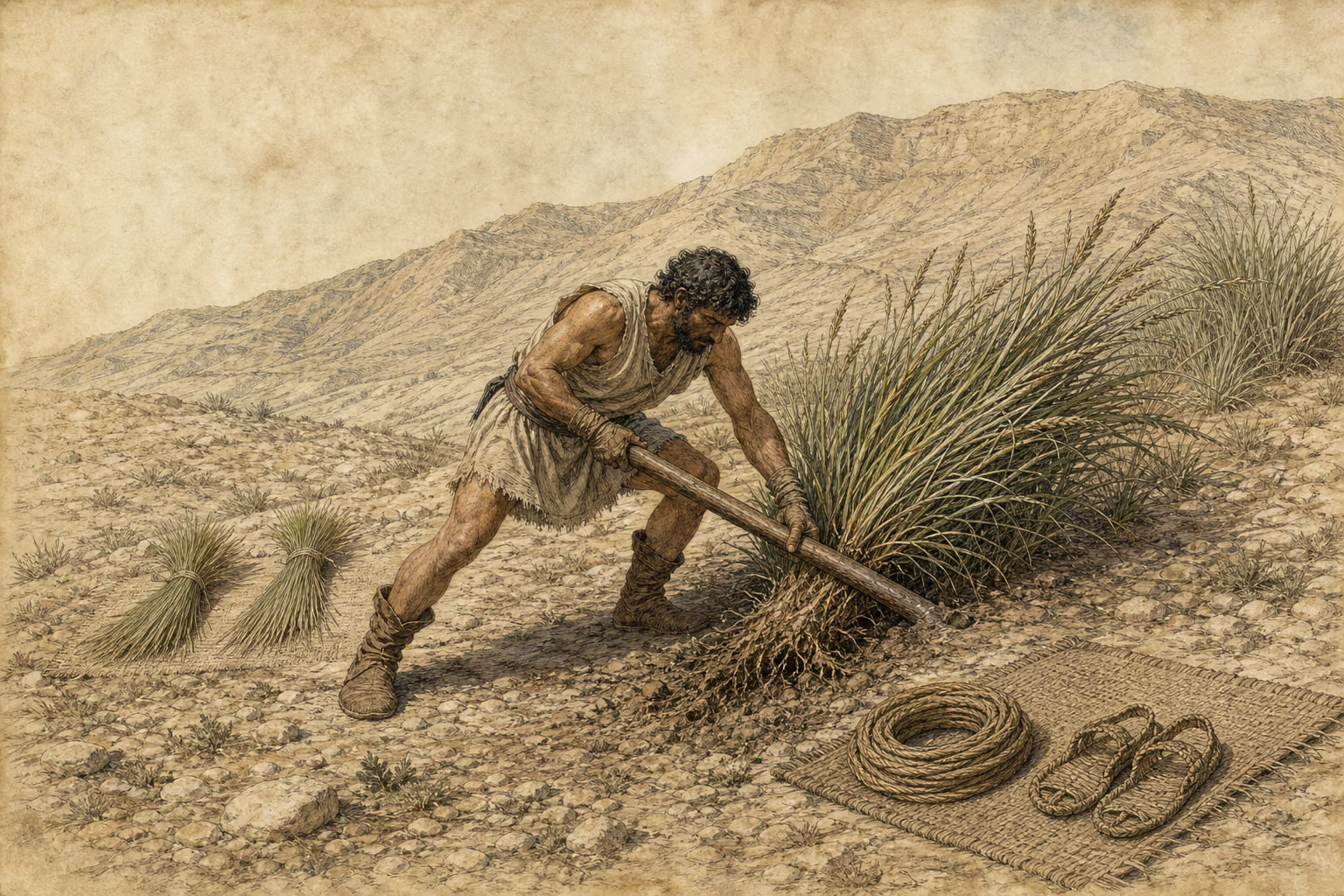
Sparti quidem usus multa post saecula coeptus est, nec ante Poenorum arma, quae primum Hispaniae intulerunt. herba et haec, sponte nascens et quae non queat seri, iuncusque proprie aridi soli, uni terrae data vitio. namque id malum telluris est, nec aliud ibi seri aut nasci potest. in Africa exiguum et inutile gignitur. Carthaginiensis Hispaniae citerioris portio, nec haec tota, sed quatenus parit, montes quoque sparto operit. hinc strata rusticis eorum, hinc ignes facesque, hinc calceamina et pastorum vestes. animalibus noxium praeterquam cacuminum teneritate. ad reliquos usus laboriose evellitur ocreatis cruribus manuque textis manicis convoluta, osseis iligneisve conamentis, nunc iam in hiemem iuxta, facillime tamen ab idibus Mais in Iunias. hoc maturitatis tempus.
Volsum fascibus in acervo alligatum biduo, tertio resolutum spargitur in sole siccaturque et rursus in fascibus redit sub tecta. postea maceratur, aqua marina optime, sed et dulci, si marina desit, siccatumque sole iterum rigatur. si repente urgueat desiderium, perfusum calida in solio ac siccatum stans conpendium operae fatetur. hoc autem tunditur, ut fiat utile, praecipue in aquis marique invictum. in sicco praeferunt e cannabi funes, set spartum alitur etiam demersum, veluti natalium sitim pensans. est quidem eius natura interpolis, rursusque quam libeat vetustum novo miscetur. verumtamen complectatur animo qui volet miraculum aestimare, quanto sit in usu omnibus terris navium armamentis, machinis aedificationum aliisque desideriis vitae. ad hos omnes usus quae sufficiant, minus XXX passuum in latitudinem a litore Carthaginis Novae minusque c??? in longitudinem esse reperientur. longius vehi impendia prohibent.
lunco Graecos ad funes usos nomini credamus, quo herbam eam appellant, postea palmarum foliis philuraque manifestum est. inde translatum a Poenis sparti usum perquam simile veri est.
Theophrastus auctor est esse bulbi genus circa ripas amnium nascens, cuius inter summum corticem eamque partem, qua vescuntur, esse laneam naturam, ex qua inpilia vestesque quaedam conficiantur. sed neque regionem, in qua id fiat, nec quicquam diligentius praeterquam eriophoron id appellari in exemplaribus, quae equidem invenerim, tradit, neque omnino ullam mentionem habet sparti cuncta magna cura persecutus cccxc annis ante nos, ut iam et alio loco diximus, quo apparet post id temporis spatium in usum venisse spartum.
Et quoniam a miraculis rerum coepimus, sequemur eorum ordinem, in quibus vel maximum est aliquid nasci ac vivere sine ulla radice. tubera haec vocantur undique terra circumdata nullisque fibris nixa aut saltem capillamentis, nec utique extuberante loco, in quo gignuntur, aut rimas sentiente. neque ipsa terrae cohaerent, cortice etiam includuntur, ut plane nec terram esse possimus dicere neque aliud quam terrae callum. siccis haec fere et sabulosis locis frutectosisque nascuntur. excedunt saepe magnitudinem mali cotonei, etiam librali pondere. duo eorum genera: harenosa dentibus inimica, in altero sincera. distinguntur et colore, rufo nigroque et intus candido, laudatissima Africae. crescant anne vitium id terrae—neque enim aliud intellegi potest—ea protinus globetur magnitudine, qua futurum est, et vivat necue, non facile arbitror intellegi posse. putrescendi enim ratio 35 communis est cumr ligno. Lartio Licinio praetorio viro iura reddenti in Hispania Carthagine paucis his annis scimus accidisse mordenti tuber, ut deprehensus intus denarius primos dentes inflecteret, quo manifestum erit terrae naturam in se globari. quod certum est, ex his erunt, quae nascantur et seri non possint.
English · Bostock & Riley 1855–57
For the fact is that spartum did not begin to be employed till many ages after the time of Homer; indeed, not before the first war that the Carthaginians waged in Spain. This, too, is a plant that grows spontaneously, and is incapable of being reproduced by sowing, it being a species of rush, peculiar to a dry, arid soil, a morbid production confined to a single country only; for in reality it is a curse to the soil, as there is nothing whatever that can be sown or grown in its vicinity. There is a kind of spartum grown in Africa, of a stunted nature, and quite useless for all practical purposes. It is found in one portion of the province of Carthage in Nearer Spain, though not in every part of that; but wherever it is produced, the mountains, even, are covered all over with it.
This material is employed by the country-people there for making their beds; with it they kindle their fires also, and prepare their torches; shoes also, and garments for the shepherds, are made of it. As a food for animals, it is highly injurious, with the sole exception of the tender tops of the shoots. When wanted for other uses, it is pulled up by the roots, with considerable labour; the legs of the persons so employed being protected by boots, and their hands with gloves, the plant being twisted round levers of bone or holm-oak, to get it up with the greater facility. At the present day it is gathered in the winter, even; but this work is done with the least difficulty between the ides of May and those of June, that being the period at which it is perfectly ripe.
When taken up it is made into sheaves, and laid in heaps for a couple of days, while it retains its life and freshness; on the third day the sheaves are opened out and spread in the sun to dry, after which it is again made up into sheaves, and placed under cover. It is then put to soak in sea-water, this being the best of all for the purpose, though fresh water will do in case sea-water cannot be procured: this done, it is again dried in the sun, and then moistened afresh. If it is wanted for immediate use, it is put in a tub and steeped in warm water, after which it is placed in an upright position to dry: this being universally admitted to be the most expeditious method of preparing it. To make it ready for use, it requires to be beaten out. Articles made of it are proof, more particularly, against the action of fresh or sea-water; but on dry land, ropes of hemp are generally preferred. Indeed, we find that spartum receives nutriment even from being under water, by way of compensation, as it were, for the thirst it has had to endure upon its native soil.
By nature it is peculiarly well adapted for repairing, and however old the material may be, it unites very well with new. The person, indeed, who is desirous duly to appreciate this marvellous plant, has only to consider the numerous uses to which, in all parts of the world, it is applied: from it are made, the rigging of ships, various appliances of mechanism employed in building, and numerous other articles which supply the wants of daily life. To suffice for all these requirements, we find it growing solely on a tract of ground which lies upon the sea-line of the province of New Carthage, somewhat less than thirty miles in breadth by one hundred in length. The expense precludes its being transported to any very considerable distance.
The Greeks used formerly to employ the rush for making ropes; so, at least, we are led to believe, from the name given by them to that plant; and at a later period they made them, it is very clear, from the leaves of the palm, and the inner bark of the linden-tree. It seems to me very probable, too, that it was from them that the Carthaginians borrowed the first hint for applying spartum to a similar purpose.
Theophrastus informs us, that there is a kind of bulb, which grows on the banks of rivers, and which encloses between the outer coat and the portion that is eaten a sort of woolly substance, of which felt socks, and other articles of dress, are made; but, in the copies, those at least which have fallen in my way, there is no mention made of the country in which it grows, or of any details in connection with it, beyond the fact that the name given to it is “eriophoron.” As to spartum, he makes no mention of it whatever, although he has given the history, with the greatest exactness, of all the known plants, three hundred and ninety years before our time—a fact to which I have already alluded on other occasions: from this it would appear that spartum has come into use since his day.
As we have here made a beginning of treating of the marvels of Nature, we shall proceed to examine them in detail; and among them the very greatest of all, beyond a doubt, is the fact that any plant should spring up and grow without a root. Such, for instance, is the vegetable production known as the truffle; surrounded on every side by earth, it is connected with it by no fibres, not so much as a single thread even, while the spot in which it grows, presents neither protuberance nor cleft to the view. It is found, in fact, in no way adhering to the earth, but enclosed within an outer coat; so much so, indeed, that though we cannot exactly pronounce it to be composed of earth, we must conclude that it is nothing else but a callous concretion of the earth.
Truffles generally grow in dry, sandy soils, and spots that are thickly covered with shrubs; in size they are often larger than a quince, and are found to weigh as much as a pound. There are two kinds of them, the one full of sand, and consequently injurious to the teeth, the other free from sand and all impurities. They are distinguished also by their colour, which is red or black, and white within; those of Africa are the most esteemed. Whether the truffle grows gradually, or whether this blemish of the earth—for it can be looked upon as nothing else—at once assumes the globular form and magnitude which it presents when found; whether, too, it is possessed of vitality or not, are all of them questions, which, in my opinion, are not easy to be solved. It decays and rots in a manner precisely similar to wood.
It is known to me as a fact, that the following circumstance happened to Lartius Licinius, a person of prætorian rank, while minister of justice, a few years ago, at Carthage in Spain; upon biting a truffle, he found a denarius inside, which all but broke his fore teeth—an evident proof that the truffle is nothing else but an agglomeration of elementary earth. At all events, it is quite certain that the truffle belongs to those vegetable productions which spring up spontaneously, and are incapable of being reproduced from seed.