LIBER XIX · CAPUT 3
MISY; ITON; AND GERANION
Latine · Mayhoff 1906
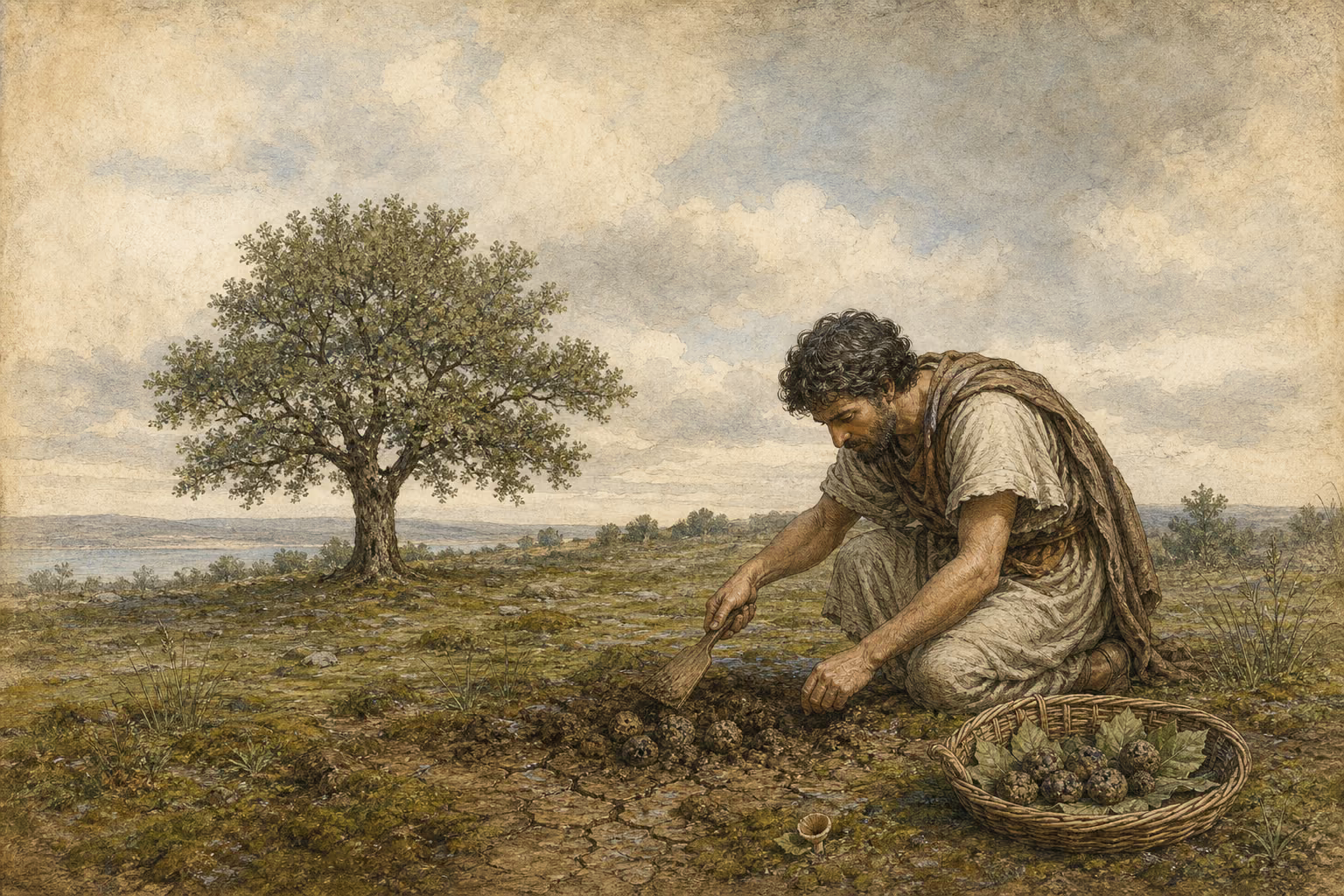
Simile est et quod in Cyrenaica provincia vocant misy, praecipuum suavitate odoris ac saporis, sed carnosius, et quod in Threcia iton et quod in Graecia geranion.
De tuberibus haec traduntur peculiariter: cum fuerint imbres autumnales ac tonitrua crebra, tune nasci et maxime tonitribus, nec ultra annum durare, tenerrima autem verno esse. quibusdam locis acceptatantum riguis feruntur, sicut Mytilenis negant nasci nisi exundatione fluminum invecto semine ab Tiaris. est autem is locus, in quo plurima nascuntur. Asiae nobilissima circa Lampsacum et Alopeconnesum, Graeciae vero circa Elim.
Sunt et in fungorum genere Graecis dicti pezicae, qui sine radice ant pediculo nascuntur.
Ab his proximum dicetur auctoritate clarissimum laserpicium, quod Graeci silphion vocant, in Cyrenaica provincia repertum, cuius sucus laser vocatur, magnificum in usu medicamentisque et ad pondus argentei denarii repensum. multis iam annis in ea terra non invenitur, quoniam publicani, qui pascua conducunt, maius ita lucrum sentientes depopulantur pecorum pabulo. unus omnino caulis nostra memoria repertus Neroni principi missus est. si quando incidit pecus in spem nascentis, hoc deprehenditur signo: ove, cum comederit, dormiente protinus, capra sternuente crebrius. diuque iam non aliud ad nos invehitur laser, quam quod in Perside aut Media et Armenia nascitur large, sed multo infra Cyrenaicum, id quoque adulteratum cummi aut sacopenio aut faba fracta; quo minus omittendum videtur C. Valerio M. Herennio cos. Cyrenis advecta Romam publice laserpicii pondo XXX, Caesarem vero dictatorem initio belli civilis inter aurum argentumque protulisse ex aerario laserpicii pondo MD.
Id apud auctores Graeciaecertissimos invenimus natum imbre piceo repente madefacta tellure circa Hesperidum hortos Syrtimque maiorem septem annis ante oppidum Cyrenarum, quod conditum est urbis nostrae anno CXLIII, vim autem illam per IIIIstadium Africae valuisse. in ea laserpicium gigni solitum, rem feram ac contumacem et, si coleretur, in deserta fugientem, radice multa crassaque, caule ferulaceo ac simili crassitudine. huius folia maspetum vocabant, apio maxime similia. semen erat foliaceum, folium ipsum vere deciduum. vesci pecora solita primoque purgari, mox pinguescere, care mirabilem in modum iucunda. post folia amissa caule ipso et homines vescebantur *modis omnibus* decocto, elixo assoque, eorum quoque corpora XL primis diebus purgante*. sucus duobus modis capiebatur, e radice atque caule, et haec duo erant nomina, rhizias atque caulias, vilior illo ac putrescens. radici cortex niger. ad mercis adulteria sucum ipsum in vasa coiectum admixto furfure subinde concutiendo ad maturitatem perducebant, ni ita fecissent, putrescentem. argumentum erat maturitatis colos siccitasque sudore finito. alii tradunt laserpicii radicem fuisse maiorem cubitali, tuberque in ea supra terram. hoc inciso profluere solitum sucum ceu lactis, supernato caule, quem magydarim vocarunt. folia aurei coloris pro semine fuisse, cadentia a canis ortu austro flante. ex his laserpicium nasci solitum, annuo spatio et radice et caule consummantibus sese. hi et circumfodi solitum prodidere, nec purgari pecora, sed aegra sanari aut protinus mori, quod in paucis accidere. Persico silphio prior opinio congruit.
Alterum genus eius est, quod magydaris vocatur, tenerius et minus vehemens, sine suco, quod circa Syriam nascitur, non proveniens in Cyrenaica regione. gignitur et in Parnaso monte copiosum, quibusdam laserpicium. vocantibus per quae omnia adulteratur rei saluberrimae utilissimaeque auctoritas. probatio sinceri prima in colore modice rufo et, cum frangatur, intus candido, mox tralucente gutta quaeque saliva celerrime liquescat. usus in multis medicaminibus.
Sunt etiamnum duo genera non nisi sordido nota volgo, cum quaestu multum polleant, in primis rubia, tinguendis lanis et coriis necessaria. laudatissima Italica et maxime suburbana, et omnes paene provinciae scatent ea. sponte provenit seriturque, similitudine erviliae, verum spinosisfoliis et caule. geniculatus hic est quinis circa articulos in orbe foliis. semen eius rubrum, postremo nigrum, radix rubra est. quos in medicina usushabeat dicemus suo loco.
At quae vocatur radicula lavandis demum lanis sucum habet, mirum quantum conferens candori mollitiaeque. nascitur sativa ubique, sed sponte praecipua in Asia Syriaque, saxosis et asperis locis, trans Euphraten tamen laudatissima, caule ferulaceo, tenui et ipso, cibis indigenarum expetito et unguentis, quicquid sit cum quo decoquatur, folio oleae. struthion Graeci vocant. floret aestate, grata aspectu, verum sine odore, spinosae caule lanuginis. semen ei nullum, radix magna, quae conciditur ad quer dictum est usum.
English · Bostock & Riley 1855–57
Of a similar nature, too, is the vegetable production known in the province of Cyrenaica by the name of “misy,” remarkable for the sweetness of its smell and taste, but more fleshy than the truffle: the same, too, as to the iton of the Thracians, and the geranion of the Greeks.
The following peculiarities we find mentioned with reference to the truffle. When there have been showers in autumn, and frequent thunder-storms, truffles are produced, thunder contributing more particularly to their developement; they do not, however, last beyond a year, and are considered the most delicate eating when gathered in spring. In some places the formation of them is attributed to water; as at Mytilene, for instance, where they are never to be found, it is said, unless the rivers overflow, and bring down the seed from Tiara, that being the name of a place at which they are produced in the greatest abundance. The finest truffles of Asia are those found in the neighbourhood of Lampsacus and Alopeconnesus; the best in Greece are those of the vicinity of Elis.
Belonging to the mushroom genus, also, there is a species, known to the Greeks by the name of “pezica,” which grows without either root or stalk.
Next to these, laserpitium claims our notice, a very remarkable plant, known to the Greeks by the name of “silphion,” and originally a native of the province of Cyrenaica. The juice of this plant is called “laser,” and it is greatly in vogue for medicinal as well as other purposes, being sold at the same rate as silver. For these many years past, however, it has not been found in Cyrenaica, as the farmers of the revenue who hold the lands there on lease, have a notion that it is more profitable to depasture flocks of sheep upon them. Within the memory of the present generation, a single stalk is all that has ever been found there, and that was sent as a curiosity to the Emperor Nero. If it so happen that one of the flock, while grazing, meets with a growing shoot of it, the fact is easily ascertained by the following signs; the sheep, after eating of it, immediately falls asleep, while the goat is seized with a fit of sneezing. For this long time past, there has been no other laser imported into this country, but that produced in either Persis, Media, or Armenia, where it grows in considerable abundance, though much inferior to that of Cyrenaica; and even then it is extensively adulterated with gum, sacopenium, or pounded beans. I ought the less then to omit the facts, that in the consulship of C. Valerius and M. Herennius, there was brought to Rome, from Cyrenæ, for the public service, thirty pounds’ weight of laserpitium, and that the Dictator Cæsar, at the beginning of the Civil War, took from out of the public treasury, besides gold and silver, no less than fifteen hundred pounds of laserpitium.
We find it stated by the most trustworthy among the Greek writers, that this plant first made its appearance in the vicinity of the gardens of the Hesperides and the Greater Syrtis, immediately after the earth had been soaked on a sudden by a shower as black as pitch. This took place seven years before the foundation of the city of Cyrenæ, and in the year of Rome 143. The virtues of this remarkable fall of rain extended, it is said, over no less than four thousand stadia of the African territory; and upon this soil laserpitium began universally to grow, a plant that is in general wild and stubborn, and which, if attempted to be cultivated, will leave the spot where it has been sown quite desolate and barren. The roots of it are numerous and thick, the stalk being like that of fennel-giant, and of similar thickness. The leaves of this plant were known as “maspetum,” and bore a considerable resemblance to parsley; the seeds of it were foliaceous, and the plant shed its leaves every year. They used to feed the cattle there upon it; at first it purged them, but afterwards they would grow fat, the flesh being improved in flavour in a most surprising degree. After the fall of the leaf, the people themselves were in the habit of eating the stalk, either roasted or boiled: from the drastic effects of this diet the body was purged for the first forty days, all vicious humours being effectually removed.
The juices of this plant were collected two different ways, either from the root or from the stalk; in consequence of which these two varieties of the juice were known by the distinguishing names of “rhizias” and “caulias,” the last being of inferior quality to the other, and very apt to turn putrid. Upon the root there was a black bark, which was extensively employed for the purposes of adulteration. The juice of the plant was received in vessels, and mixed there with a layer of bran; after which, from time to time it was shaken, till it had reached a proper state of maturity; indeed, if this precaution was neglected, it was apt to turn putrid. The signs that it had come to maturity were its colour, its dryness, and the absorption of all humidity.
There are some authors, however, who state that the root of laserpitium was more than a cubit in length, and that it presented a tuberosity above the surface of the earth. An incision, they say, was made in this tuberosity, from which a juice would flow, like milk in appearance; above the tuberosity grew a stalk, to which they give the name of “magydaris;” the leaves that grew upon this stalk were of the colour of gold, and, falling at the rising of the Dog-star, when the south winds begin to prevail, they acted as seed for the purposes of reproduction. It was from these leaves, too, they say, that laserpitium was produced, the root and the stalk attaining their full growth in the space of one year. The same writers also state, that it was the practice to turn up the ground about the plant, and that it had no such effect as purging the cattle that were fed upon it; though one result of using it as food was, that such cattle as were ailing were either cured of their distempers, or else died immediately upon eating of it, a thing, however, that but rarely happened. The first description, however, is found to agree more nearly with the silphium that comes from Persis.
There is another variety of this plant, known as “magydaris,” of a more delicate nature, less active in its effects, and destitute of juice. It grows in the countries adjacent to Syria, but is not to be found in the regions of Cyrenaica. There grows also upon Mount Parnassus, in great abundance, a plant to which some persons give the name of “laserpitium:” by means of all these varieties, adulterations are effected of a production that is held in the highest esteem for its salutary qualities and its general usefulness. The chief proofs of its genuineness consist in its colour, which ought to be slightly red without, and when broken quite white and transparent within; the drops of it, too, should melt very rapidly on the application of spittle. It is extensively employed for medicinal purposes.
There are two other plants also, which are but little known to any but the herd of the sordid and avaricious, and this because of the large profits that are derived from them. The first of these is madder, the employment of which is necessary in dyeing wool and leather. The madder of Italy is the most esteemed, and that more particularly which is grown in the suburbs of the City; nearly all our provinces, too, produce it in great abundance. It grows spontaneously, but is capable of reproduction by sowing, much after the same manner as the fitch. The stem, however, is prickly, and articulated, with five leaves arranged round each joint: the seed is red. Its medicinal properties we shall have occasion to mention in the appropriate place.
The plant known to us by the name of “radicula,” is the second of these productions. It furnishes a juice that is extensively employed in washing wool, and it is quite wonderful how greatly it contributes to the whiteness and softness of wool. It may be produced anywhere by cultivation, but that which grows spontaneously in Asia and Syria, upon rugged, rocky sites, is more highly esteemed. That, however, which is found beyond the Euphrates has the highest repute of all. The stalk of it is ferulaceous and thin, and is sought by the inhabitants of those countries as an article of food. It is employed also for making unguents, being boiled up with the other ingredients, whatever they may happen to be. In leaf it strongly resembles the olive. The Greeks have given it the name of “struthion.” It blossoms in summer, and is agreeable to the sight, but entirely destitute of smell. It is somewhat thorny, and has a stalk covered with down. It has an extremely diminutive seed, and a large root, which is cut up and employed for the purposes already mentioned.