LIBER XIX · CAPUT 4
THE PLEASURES OF THE GARDEN
Latine · Mayhoff 1906
<1> Ab his superest reverti ad hortorum curam et suapte natura memorandam et quoniam antiquitas nihil prius mirata est, quam Hesperidum hortos ac regum Adonidis et Alcinoi itemque pensiles, sive illos Semiramis sive Assyriae rex Syrus fecit, de quorum opere alio volumine dicemus. Romani quidem reges ipsi coluere; quippe etiam Superbus nuntium ilium saevum atque sanguinarium filio remisit ex horto. in XII tabulis legum nostrarum nusquam nominatur villa, semper in significatione ea hortus, in horti vero heredium; quam ob rem comitata est et religio quaedam, hortoque et foro tantum contra invidentium effascinationes dicari videmus in remedio saturica signa, quamquam hortos tutelae Veneris adsignante Plauto. iam quidem hortorum nomine in ipsa urbe delicias agros villasque possident. primus hoc instituit Athenis Epicurus otii magister; usque ad eum moris non fuerat in oppidis habitari rura.
Romae quidem per se hortus ager pauperis erat. <2> ex horto plebei macellum, quanto innocentiore victu! mergi enim, credo, in profunda satius est et ostrearum genera naufragio exquiri, aves ultra Phasim amnem peti ne fabuloso quidem terrore tutas, immo sic pretiosiores, alias in Numidiam atque Aethiopiae sepulchra, aut pugnare cum feris mandique capientem quod mandat alius. at, Hercules, quam vilia haec, quam parata voluptati satietatique, nisi eadem, quae ubique, indignatio occurreret! ferendum sane fuerit exquisita nasci poma, alia sapore, alia magnitudine, alia monstro pauperibus interdicta, inveterari vina saccisque castrari, nec cuiquam adeo longam esse vitam, ut non ante se genita potet, e frugibus quoque quondam alicam sibi excogitasse luxuriam ac medulla tantum earum superque pistrinarum operibus et caelaturis vivere, alio pane procerum, alio volgi, tot generibus usque ad infimam plebem descendente annonona. etiamne in herbis discrimen inventum esse, opesque differentiam facere in cibo etiam uno asse venali? in his quoque aliqua sibi nasci tribus negant, caule in tantum saginato, ut pauperis mensa non capiat. silvestres fecerat natura corrudas, ut passim quisque demeteret. ecce altiles spectantur asparagi, et Ravenna ternos libris rependit. heu prodigia ventris! mirum esset non licere pecori carduis vesci: non licet plebei! aquae quoque separantur, et ipsa naturae elementa vi pecuniae discreta sunt. hi nives, illi glaciem potant poenasque montium in voluptatem gulae vertunt. servatur rigor aestibus, excogitaturque ut alienis mensibus nix algeat. decocunt alii aquas, mox et illas hiemant. nihil utique homini sic, quomodo rerum naturae, placet. etiamne herba aliqua diviti tantum pascitur? nemo Sacros Aventinosque montes et iratae plebis secessus circumspexerit? macelluum certe aequabit quos pecunia separaverit. itaque, Hercules, nullumn macelli vectigali maius fuit Romae clamore plebis incusantis apud omnes principes, done re- is missum est portorium mercis huius, conpertumque non aliter quaestuosius censum haberi aut tutius ac minore fortunae iure: cum credatur pensio ea pauperrumis, in solo sponsor est et sub die reditus superficiesque caelo quocumque gaudens.
<3> Hortorum Cato praedicat caules. hinc primum agricolae aestimabant prisci et sic statim faciebant iudicium, nequam esse in domo matrem familias—etenim haec cura feminae dicebatur —, ubi indiligens esset hortus, quippe e carnario aut macello vivendum esse. nec caules, ut nunc maxime, probabant, damnantes pulmentaria quae egerent alio pulmentario: id erat oleo parcere, nam gari desideria etiam in exprobratione erant. horti maxime placebant quae non egerent igni parcerentque ligno, expedita res et parata semper, unde et acetaria appellantur, facilia concoqui nec oneratura sensus cibo et quae minime accenderent desiderium panis. pars eorum ad condimenta pertinens fatetur domi versuram fieri solitam atque non Indicum piper quaesitum quaeque trans maria petimus. iam in fenestris suis plebs urbana imagine hortorum cotidiana oculis rura praebebant, antequam praefigi prospectus omnes coegit multitudinis innumerae saeva latrocinatio. quamobrem sit aliquis et his honos, neve auctoritatem rebus vilitas adimat, cumn praesertim etiam cognomina procerum inde nata videamus Lactucinosque in Valeria familia non puduisse appellari, et contingat aliqua gratia operae curaeque nostrae Vergilio quoque confesso, quam sit difficile verborum honorem tam parvis perhibere.
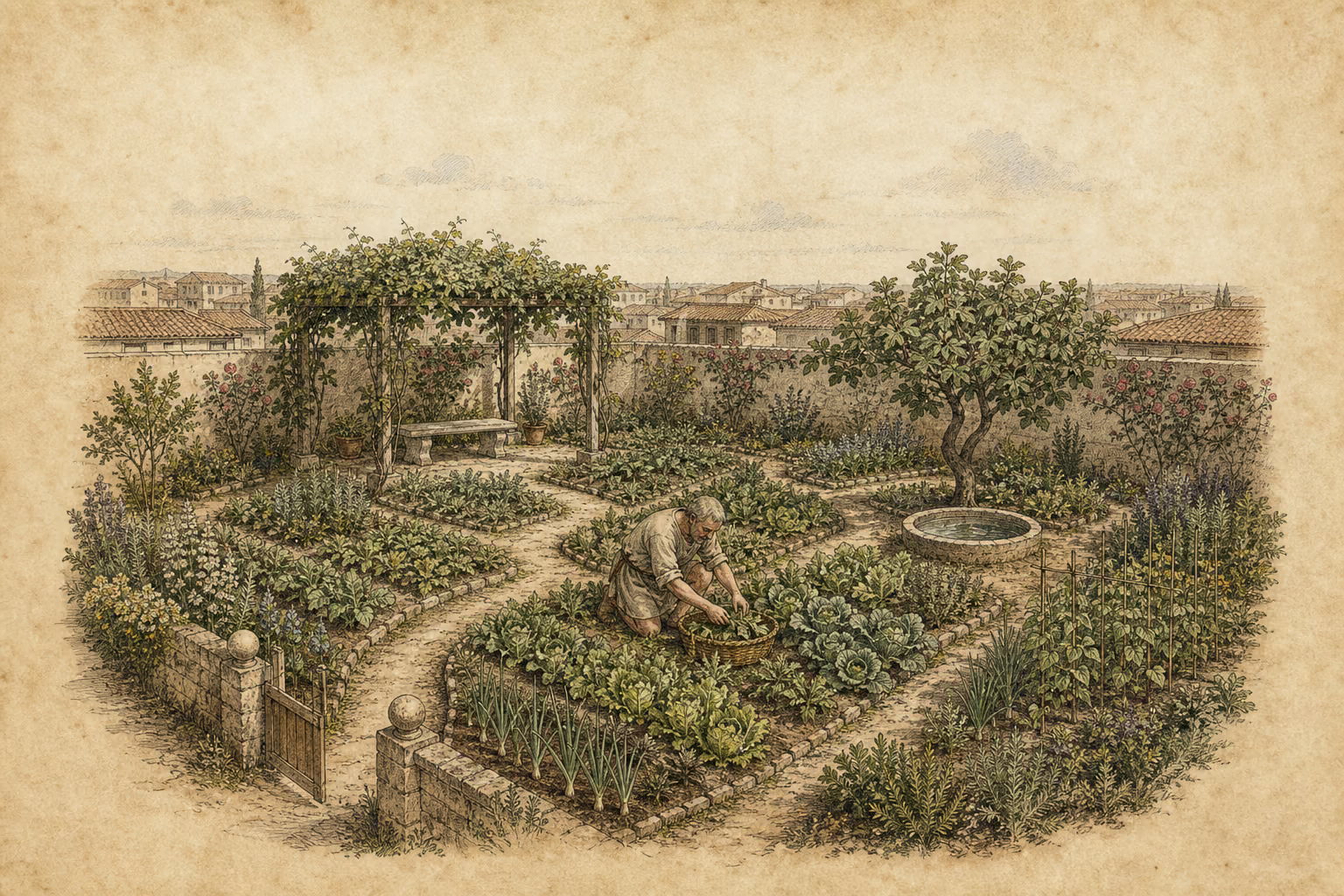
Hortos villae iungendos non est dubium riguosque maxime habendos, si contingat, praefluo amne, si minus, e puteo rota organisve pneumaticis vel tollenonum haustu rigatos. solum proscindendum a favonio in autumnum praeparantibus post XIIII dies iterandumque ante brumam. VIII iugerum operis palari iustum est, fimum III pedes alte cum terra misceri, areis distingui easque resupinis pulvinorum toris, ambiri singulas tramitum sulcis, qua detur accessus homini scatebrisque decursus.
In hortis nascentium alia bulbo commendantur, alia capite, alia caule, alia folio, alia utroque, alia semine, alia cartilagine, alia carne aut utroque, alia cortice aut cute et cartilagine, alia tunicis carnosis.
Aliorum fructus in terra est, aliorum et extra, aliorum non nisi extra. quaedam iacent crescuntque, ut cucurbitae et cucumis; eadem pendent, quamquam graviora multo etiam iis, quae in arboribus gignuntur. sed cucumis cartilagine et carne constat, cucurbita cortice et cartilagine; cortex huic uni maturitate transit in lignum. terra conduntur raphani napique et rapa, atque alio modo inulae, siser, pastinacae. quaedam vocabimus ferulacea, ut anetum, malvas. namque tradunt auctores [in Arabia] malvas septimo mense arborescere baculorumque usum praebere. exemplo est arbor malvae in Mauretania Lixi oppidi aestuario, ubi Hesperidum horti fuisse produntur, CC passibus ab oceano iuxta delubrum Herculis antiquius Gaditano, ut ferunt. ipsa altitudinis pedum XX, crassitudinis quam circumplecti nemo possit. in simili genere habebitur et cannabis. nec non et carnosa aliqua appellabimus, ut spongeas in umore pratorum enascentes. fungorum enim callum in ligni arborumque natura diximus et alio genere tuberum paulo ante.
English · Bostock & Riley 1855–57
Having made mention of these productions, it now remains for us to return to the cultivation of the garden, a subject recommended by its own intrinsic merits to our notice: for we find that in remote antiquity, even, there was nothing looked upon with a greater degree of admiration than the gardens of the Hesperides, those of the kings Adonis and Alcinoüs, and the Hanging Gardens, whether they were the work of Semiramis, or whether of Cyrus, king of Assyria, a subject of which we shall have to speak in another work. The kings of Rome cultivated their gardens with their own hands; indeed, it was from his garden that Tarquinius Superbus sent to his son that cruel and sanguinary message of his. In our laws of the Twelve Tables, we find the word “villa,” or “farm,” nowhere mentioned; it is the word “hortus” that is always used with that signification, while the term “heredium” we find employed for “garden.”
There are certain religious impressions, too, that have been attached to this species of property, and we find that it is in the garden and the Forum only that statues of satyrs are consecrated, as a protection against the evil effects of spells and sorcery; although in Plautus, we find the gardens spoken of as being under the tutelage of Venus. At the present day, under the general name of gardens, we have pleasure-grounds situate in the very heart of the City, as well as extensive fields and villas.
Epicurus, that connoisseur in the enjoyments of a life of ease, was the first to lay out a garden at Athens; up to his time it had never been thought of, to dwell in the country in the middle of the town. At Rome, on the other hand, the garden constituted of itself the poor man’s field, and it was from the garden that the lower classes procured their daily food—an aliment how guiltlessly obtained! But still, it is a great deal better, no doubt, to dive into the abysses of the deep, and to seek each kind of oyster at the risk and peril of shipwreck, to go searching for birds beyond the river Phasis even, which, protected as they are by the terrors invented by fable, are only rendered all the more precious thereby—to go searching for others, again, in Numidia, and the very sepulchres of Æthiopia, or else to be battling with wild beasts, and to get eaten one’s self while trying to take a prey which another person is to eat! And yet, by Hercules! how little do the productions of the garden cost us in comparison with these! How more than sufficient for every wish and for every want!—were it not, indeed, that here, as in every thing else, turn which way we will, we find the same grounds for our wrath and indignation. We really might be content to allow of fruits being grown of the most exquisite quality, remarkable, some of them for their flavour, some for their size, some, again, for the monstrosities of their growth, morsels all of them forbidden to the poor! We might allow of wines being kept till they are mellowed with age, or enfeebled by being passed through cloth strainers, of men, too, however prolonged their lives, never drinking any but a wine that is still older than themselves! We might allow of luxury devising how best to extract the very aroma, as it were, and marrow only from grain; of people, too, living upon nothing but the choicest productions of the confectioner, and upon pastes fashioned in fantastic shapes: of one kind of bread being prepared for the rich, and another for the multitude; of the yearly produce of the field being classified in a descending scale, till it reaches the humble means of the very lowest classes—but do we not find that these refined distinctions have been extended to the very herbs even, and that riches have contrived to establish points of dissimilarity in articles of food which ordinarily sell for a single copper coin?
In this department even, humble as it is, we are still destined to find certain productions that are denied to the community at large, and the very cabbages pampered to such an enormous extent that the poor man’s table is not large enough to hold them. Asparagus, by Nature, was intended to grow wild, so that each might gather it where he pleased—but, lo and behold! we find it in the highest state of cultivation, and Ravenna produces heads that weigh as much as three pounds even! Alas for the monstrous excess of gluttony! It would be surprising indeed, for the beasts of the field to be forbidden the thistle for food, and yet it is a thing forbidden to the lower classes of the community! These refined distinctions, too, are extended to the very water even, and, thanks to the mighty influence of money, there are lines of demarcation drawn in the very elements themselves. Some persons are for drinking ice, others for quaffing snow, and thus is the curse of the mountain steep turned into an appetizing stimulus for the palate! Cold is carefully treasured up for the summer heats, and man’s invention is racked how best to keep snow freezing in months that are not its own. Some again there are who first boil the water, and then bring it to the temperature of winter—indeed, there is nothing that pleases man in the fashion in which Nature originally made it.
And is it the fact, then, that any herb of the garden is reared only for the rich man’s table? It is so—but still let no one of the angered populace think of a fresh secession to Mount Sacer or Mount Aventine; for to a certainty, in the long run, all-powerful money will bring them back to just the same position as they were in when it wrought the severance. For, by Hercules! there was not an impost levied at Rome more grievous than the market-dues, an impost that aroused the indignation of the populace, who repeatedly appealed with loud clamours to all the chief men of the state to be relieved from it. At last they were relieved from this heavy tax upon their wares; and then it was found that there was no tax more lucrative, more readily collected, or less obnoxious to the caprices of chance, than the impost that was levied in exchange for it, in the shape of a property-tax, extended to the poorest classes: for now the very soil itself is their surety that paid the tax will be, their means are patent to the light of day, and the superficial extent of their possessions, whatever the weather may chance to be, always remains the same.
Cato, we find, speaks in high praise of garden cabbages:—indeed, it was according to their respective methods of garden cultivation that the agriculturists of early times were appreciated, and it was immediately concluded that it was a sign of a woman being a bad and careless manager of her family, when the kitchen-garden—for this was looked upon as the woman’s department more particularly—was negligently cultivated; as in such case her only resource was, of course, the shambles or the herb-market. But cabbages were not held in such high esteem in those days as now: indeed, all dishes were held in disrepute which required something else to help them down, the great object being to economize oil as much as possible; and as to the flesh-market, so much as a wish even to taste its wares was visited with censure and reproach. The chief thing that made them so fond of the garden was the fact that its produce needs no fire and ensures economy in fuel, and that it offers resources which are always ready and at hand. These articles of food, which from their peculiar nature we call “vinegar-diets,” were found to be easy of digestion, by no means apt to blunt and overload the senses, and to create but little craving for bread as an accompaniment. A portion of them which is still used by us for seasonings, attests that our forefathers used only to look at home for their resources, and that no Indian peppers were in request with them, or any of those other condiments which we are in the habit of seeking beyond the seas. In former times the lower classes of Rome, with their mimic gardens in their windows, day after day presented the reflex of the country to the eye, when as yet the multitudes of atrocious burglaries, almost innumerable, had not compelled us to shut out all such sights with bars to the passers by.
Let the garden, then, have its due meed of honour, and let not things, because they are common, enjoy for that the less share of our consideration—and the more so, as we find that from it men of the very highest rank have been content to borrow their surnames even; thus in the Valerian family, for instance, the Lactucini have not thought themselves disgraced by taking their name from the lettuce. Perhaps, too, our labours and research may contribute some slight recommendation to this our subject; although, with Virgil, we are ready to admit how difficult it is, by language however elevated, to ennoble a subject that is so humble in itself.
There is no doubt that the proper plan is, to have the gardens adjoining the country-house; and they should be watered, more particularly, by a river running in front of it, if possible; or else with water drawn from a well by the aid of a wheel or of pumps, or by swipes. The ground should be opened just as the west winds are beginning to prevail; fourteen days after which it should be got ready for autumn, and then before the winter solstice it should have another turning up. It will require eight men to dig a jugerum, manure being mixed with the earth to a depth of three feet: the ground, too, should be divided into plots or beds with raised and rounded edges, each of which should have a path dug round it, by means of which access may be afforded to the gardener and a channel formed for the water needed for irrigation.
Among the garden plants there are some that recommend themselves by their bulbs, others by the head, others by the stalk, others by the leaf, others by both: some, again, are valued for their seed, others for the outer coat, others for their membranous tissues, others for their cartilaginous substance, others for the firmness of their flesh, and others for the fleshy tunics in which they are enveloped.
Of some plants the fruits are in the earth, of others both in the earth and out of it, and of others, again, out of the earth solely. Some of them increase as they lie upon the ground, gourds and cucumbers, for instance; the same products will grow also in a hanging position, but they are much heavier even then than any of the fruits that grow upon trees. The cucumber, however, is composed of cartilage and a fleshy substance, while the gourd consists of rind and cartilage: this last is the only vegetable production the outer coat of which becomes of a ligneous nature, when ripe. Radishes, turnips, and rape are hidden in the earth, and so, too, are elecampane, skirrets, and parsnips, though in a different manner. There are some plants, again, to which we shall give the name of “ferulaceous,” anise and mallows, for instance; indeed, we find it stated by some writers that in Arabia the mallow becomes arborescent at the sixth month, so much so, in fact, as to admit of its being used for walking-sticks. We have another instance, again, in the mallow-tree of Mauretania, which is found at Lixus, a city built upon an æstuary there; and at which spot, it is said, were formerly the gardens of the Hesperides, at a distance of two hundred paces from the Ocean, near the shrine of Hercules, more ancient, tradition says, than the temple at Gades. This mallow-tree is twenty feet in height, and of such a thickness that there is not a person in existence who is able with his arms to span its girth.
In the class of ferulaceous plants we must include hemp also. There are some plants, again, to which we must give the appellation of “fleshy;” such as those spongy productions which are found growing in damp meadows. As to the fungus, with a hard, tough flesh, we have already made mention of it when speaking of wood and trees; and of truffles, which form another variety, we have but very recently given a description.