LIBER XIX · CAPUT 5
VEGETABLES OF A CARTILAGINOUS NATURE—CUCUMBERS. PEPONES
Latine · Mayhoff 1906
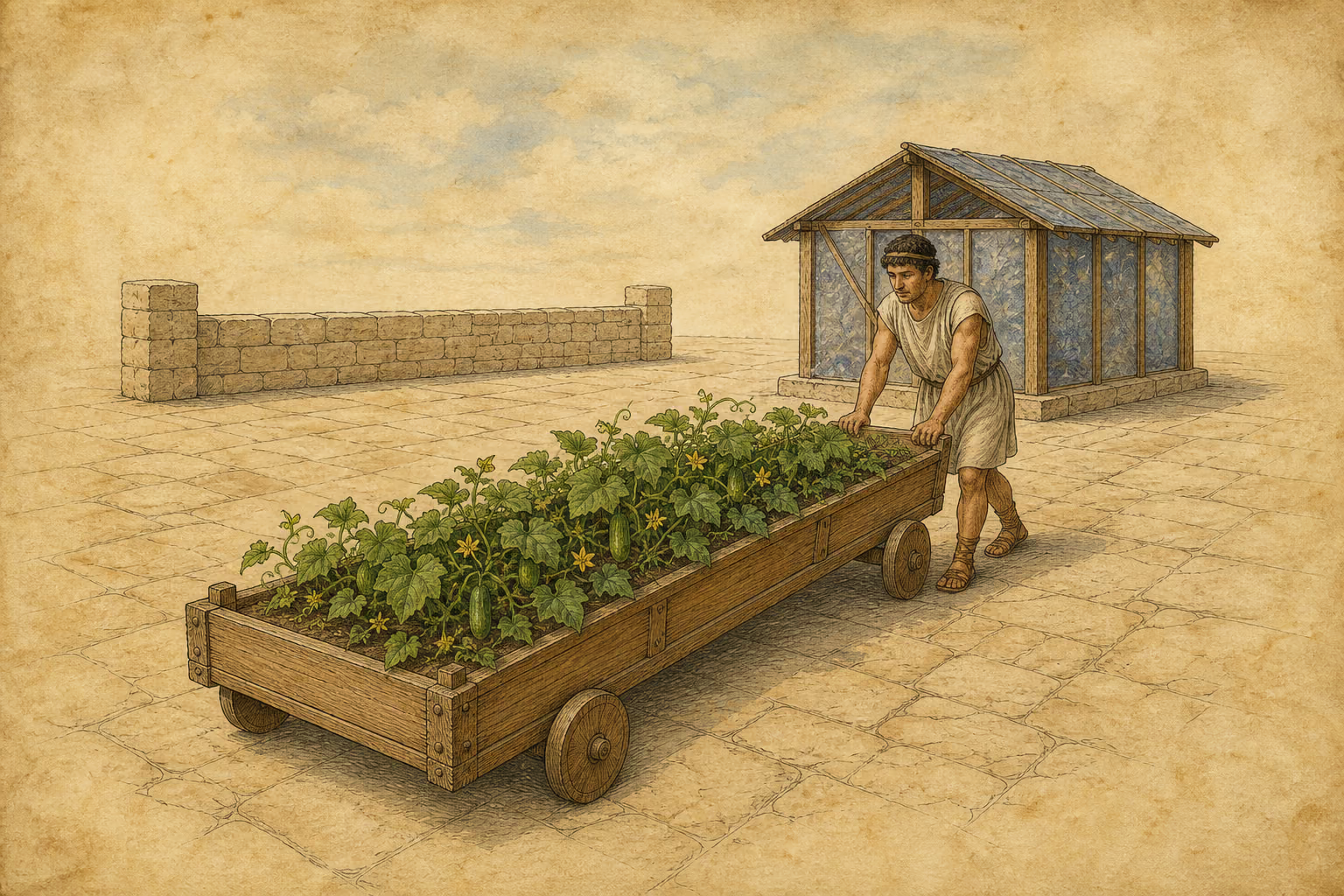
Cartilaginum generis extraque terrain est cucumis, mira voluptate Tiberio principi expetitus. nullo quippe non die contigit ei, pensiles eorum hortos promoventibus in solem rotis olitoribus rursusque hibernis diebus intra specularium munimenta revocantibus. quin et lacte mulso semine eorum biduo macerato apud antiquos Graeciae auctores scriptum est seri oportere, ut dulciores fiant. crescunt qua coguntur forma. in Italia virides et quam minimi, in provinciis quam maximi et cerini aut nigri placent. copiosissimi Africae, grandissimi Moesiae. cum magnitudine excessere, pepones vocantur. vivunt hausti in stomacho in posterum diem nec perfici queunt in cibis, non insalubres tamen plurimum. natura oleum odere mire nec minus aquas diligunt, desecti quoque. ad eas modice distantes adrepunt, contra oleum refugiunt aut, si quid obstet vel si pendeant, curvantur intorquenturque. id vel una nocte deprehenditur, si vas cum aqua subiciatur, a quattuor digitorum intervallo descendentibus ante posterum diem, at si oleum eodem modo sit, in hamos curvatis. iidem in fistulam flore demisso mira longitudine crescunt. ecce cum maxime nova forma eorum in Campania provenit mali cotonei effigie. forte primo natum ita audio unum, mox semine ex illo genus factum, melopeponas vocant. non pendent hi, sed humi rotundantur, colore aureo. mirum in his praeter figuram coloremque et odorem, quod maturitatem adepti, quamquam non pendentes, statim a pediculo recedunt. Columella suum tradit commentum, ut toto anno contingant, fruticem rubi quam vastissimum in apricum locum transferre et recidere duum digitorum relicta stirpe circa vernum aequinoctium. ita in medulla rubi semine cucumeris insito terra minuta fimoque circumaggeratas resistere frigori radices. cucumerum Graeci tria genera fecere, Laconicum, Scytalicum, Boeotium; ex his tantum Laconicum aqua gaudere. sunt qui herba, nomine quae vocatur culix, trita semen eorum maceratum seri iubeant, ut sine semine nascantur.
Similis et cucurbitis natura, dumtaxat in nascendo. aeque hiemem odere, amant rigua ac fimum. seruntur ambo semine in terra sesquipedali fossura, inter aequinoctium vernum et solstitium, Parilibus tamen aptissime; aliqui malunt ex kal. Mart. cucurbitas et nonis, cucumis et per Quinquatrus serere. simili modo reptantibus flagellis scandentis parietum aspera in tectum usque natura sublimitatis avida. vires sine adminiculo standi non sunt, velocitas pernix, levi umbra camaras ac pergulas operiens. inde haec prima duo genera, camararium et plebeium, quod humi crescit; in priore mire tenui pediculo libratur pondus immobile aurae. cucurbita quoque omni modo fastigatur, vaginis maxime vitilibus, coniecta in eas postquam defloruit, crescitque qua cogitur forma, plerumque [et] draconis intorti figura. libertate vero pensili concessa iam visa est VIIII pedum longitudinis. particulatim cucumis floret, sibi ipse superflorescens, et sicciores locos patitur, candida lanugine obductus magisque, dum crescit.
Cucurbitarum numerosior usus. et primus caulis in cibo, atque ex eo in totum natura diversa. nuper in balnearum usum venere urceorum vice, iam pridem vero etiam cadorum ad vina condenda. cortex viridi tener, deraditur nihilominus in cibis. cibus saluber ac lenis pluribus modis, ex his tamen, qui perfici humano ventre non queant, sed non intumescant. semina, quae proxima collo fuerunt, proceras pariunt, item ab imis, sed non comparandas supra dictis; quae in medio, rotundas; quae in lateribus, crassas brevioresque. siccantur in umbra et, cum libeat serere, in aqua macerantur. cibis quo Iongiores tenuioresque, eo gratiores, et ob id salubriores quae pendendo crevere, minimumque seminis tales habent, duritia eius in cibis gratiam terminante. eas, quae semini serventur, ante hiemem praecidi non est mos, postea fumo siccantur condendis hortensiorum seminibus, rusticae supellectili. inventa est ratio, qua cibis quoque servarentur — eodemque modo cucumis—usque ad alios paene proventus; et id quidem muria fit. sed et scrobe opaco in loco harena substrato fenoque sicco operto ac deinde terra virides servari tradunt. sunt et silvestres in utroque genere et omnibus fere hortensiis. sed et his medica tantum natura est, quam ob rem differentur in sua volumina.
Reliqua cartilaginum naturae terra occultantur omnia. in quibus de rapis abunde dixisse poteramus videri, nisi medici masculini sexus facerent in his rotunda, latiora vero et concava feminini, praestantiora suavitate et ad condiendum faciliora; saepius sata transeunt in marem. iidem naporum quinque genera fecere, Corinthium, Cleonaeum, Liothasium, Boeotium et quod per se viride dixerunt. ex his in amplitudinem adolescit Corinthium, nuda fere radice. solum enim hoc genus superne tendit, non, ut cetera, in terram. Liothasium quidam Thracium appellant, frigorum patientissimum. ab eo Boeotium dulce est, rotunditate etiam brevi notabile, neque, ut Cleonaeum, praelongum. in totum quidem quorum levia folia, ipsi quoque dulciores; quorum scabra et angulosa et horrida, amariores. est praeterea genus silvestre, cuius folia sunt erucae similia. palma Romae Amiterninis datur, dein Nursinis, tertia nostratibus. cetera de satu eorum in rapis dicta sunt.
<1> Cortice et cartilagine constant raphani, multisque eorum cortex crassior etiam quam quibusdam arborum. amaritudo plurima illis est pro crassitudine corticis —cetera quoque aliquando lignosa—et vis mira colligendi spiritum laxandique ructum. ob id cibus inliberalis, utique si proxilme olus mandatur; si vero ipse cum olivis druppis, rarior ructus fit minusque faetidus. Aegypto mire celebratur olei propter fertilitatem, quod e semine eius faciunt. hoc maxime cupiunt serere, si liceat, quoniam et quaestus plus quam e frumento et minus tributi est nullumque ibi copiosius oleum. <2> Genera raphani Graeci fecere tria foliorum differentia: crispi atque levis et tertium silvestre. atque huic levia quidem, sed breviora ac rotunda copiosaque ac fruticosa, sapor autem asper et medicamenti instar ad eliciendas alvos. et in prioribus tamen differentia semine, quoniam aliqua peius, aliqua admodum exiguum ferunt. haec vitia non cadunt nisi in crispa folia. <3> Nostri alia fecere genera: Algidense a loco, longum atque tralucidum, alterum rapi figura, quod vocant Syriacum, suavissimum fere ac tenerrimum hiemisque patiens praecipue. verum tamen e Syria non pridem advectum apparet, quoniam apud auctores non reperitur; id autem tota hieme durat. etiamnum unum silvestre Graeci cerain vocant, Pontici armon, alii leucen, nostri armoraciam, fronde copiosius quam corpore. in omnibus autem probandis maxime spectantur caules, inmitium enim rotundiores crassioresque ac longis canalibus; folia ipsa tristiora et angulis horrida.
<4> Seri vult raphanus terra soluta, umida. fimum odit palea contentus. frigore adeo gaudet, ut in Germania infantium puerorum magnitudinem aequet. seritur post id. Feb., ut vernus sit, iterumque circa Vulcanalia, quae satio melior. multi et Martio et Aprili serunt et Septembri. incipiente incremento confert alterna folia circumobruere, ipsos vero adcumulare, nam qui extra terram emersit, durus fit atque fungosus. Aristomachus detrahi folia per hiemem iubet et, ne lacunae stagnent, accumulari; ita in aestatem grandescere. quidam prodidere, si palo adacto caverna palea insternatur sex digitorum altitudine, deinde in semen fimumque et terra congeratur, ad magnitudinem scrobis crescere. praecipue tamen salsis aluntur; itaque etiam talibus aquis rigantur et in Aegypto nitro sparguntur, ubi sunt suavitate praecipui. in totum quoque salsugine amaritudo eorum eximitur, fiuntque coctis similes. namque et cocti dulcescunt et in naporum vicem transeunt. crudos medici suadent ad colligenda acria viscerum cum sale ieiunis esse, atque ita vomitionibus praeparant meatum. tradunt et praecordiis necessarium hunc sucum, quando φθειρίασιν cordi intus inhaerentem non alio potuisse depelli conpertum sit in Aegypto, regibus corpora mortuorum ad scrutandos morbos insecantibus. atque, ut est Graeca vanitas, fertur in templo Apollinis Delphis adeo ceteris cibis praelatus raphanus, ut ex auro dicaretur, beta ex argento, rapum e plumbo. scires non ibi genitum M'. Curium imperatorem, quem hospitum legatis aurum repudiaturo adferentibus rapum torrentem in foco inventum annales nostri prodidere. scripsit et Moschion Graecus unum de raphano volumen. utilissimi in cibis hiberno tempore existimantur, iidemque dentibus semper inimici, quoniam adterant; ebora certe poliunt. odium is cum vite maximum, refugitque iuxta satos.
Lignosiora sunt reliqua in cartilaginum genere a nobis posita, mirumque omnibus vehementiam saporis esse. ex his pastinacae unum genus agreste sponte provenit, alterum Graeciae seritur radice vel semine vere primo vel autumno, ut Hygino placet, Februario, Augusto, Septembri, Octobri, solo quam altissime refosso. annicula utilis esse incipit, bima utilior, gratior autumno patinisque maxime, et sic quoque virus intractabile illi est. hibiscum a pastinaca gracilitate distat, damnatum in cibis, sed medicinae utile. est et quartum genus in eadem similitudine pastinacae, quam nostri Gallicam vocant, Graeci vero daucon, cuius genera etiam quattuor fecere, inter medicamenta dicendum.
Siser et ipsum Tiberius princeps nobilitavit flagitans omnibus annis e Germania. Gelduba appellatur castellum Rheno inpositum, ubi generositas praecipua, ex quo apparet frigidis locis convenire. inest longitudine nervus, qui decoctis extrahitur, amaritudinis tamen magna parte relicta, quae mulso in cibis temperata etiam in gratiam vertitur. nervus idem et pastinacae maiori, dumtaxat anniculae. siseris satus mensibus Februario, Martio, Aprili, Augusto, Septembri, Octobri.
Brevior his est et torosior amariorque inula per se stomacho inimicissima, eadem dulcibus mixtis saluberrima. pluribus modis austeritate victa gratiam invenit. namque et in pollinem tunditur arida liquidoque dulci temperatur, et decocta posca aut adservata vel macerata pluribus modis et tune mixta defruto aut subacta melle uvisve passis aut pinguibus caryotis. alio rursus modo cotoneis malis vel sorbis aut prunis, aliquando pipere aut thymo variata defectus praecipue stomachi excitat, inlustrata maxime Iuliae Augustae cotidiano cibo. supervacuum eius semen, quoniam oculis ex radice excisis, ut harundo, seritur, et haec autem et siser et pastinaca utroque tempore, vere et autumno, magnis seminum intervallis, inula ne minus quam ternorum pedum, quoniam spatiose fruticat. siser transferre melius.
Proxima hinc est bulborum natura, quos Cato in primis serendos praecipit celebrans Megaricos. verum nobilissima est scilla, quamquam medicamini nata exacuendoque aceto. nec ulli amplitudo maior, sicuti nec vis asperior. duo genera medicae, masculae albis foliis, feminae nigris. set tertium genus est cibis gratum, Epimenidu vocatur, angustius folio ac minus asperum. seminis plurimum omnibus; celerius tamen proveniunt satae bulbis circa latera natis et, ut crescant, folia, quae sunt his ampla, deflexa circa obruuntur; ita sucum omnem in se trahunt capita. sponte nascuntur copiosissimae in Baliaribus Ebusoque insulis ac per Hispanias. unum de eis volumen condidit Pythagoras philosophus, colligens medicas vires, quas proximo reddemus libro. reliqua genera bulborum differunt colore, magnitudine, suavitate, quippe cum quidam crudi mandantur, ut in Cherroneso Taurica. post hos in Africa nati maxime laudantur, mox Apuli. genera Graeci haec fecere: bolbinen, setanion, opitiona, cyica, aegilopa, sisyrinchion. in hoc mirum imas eius radices crescere hieme, verno autem, cum apparuerit viola, minui ac contrahi, tunc deinde bulbum pinguescere. est inter genera et quod in Aegypto aron vocant, scillae proximum amplitudine, foliis lapathi, caule recto duum cubitorum, baculi crassitudine, radice mollioris naturae, quae estur et cruda. effodiuntur bulbi ante ver aut deteriores illico fiunt. signum maturitatis est folia inarescentia ab imo, vetustioresque improbant, item longos ac parvos; contra rubicundis rotundioribusque laus et grandissimis. amaritudo plerisque in vertice est, media eorum dulcia. bulbos non nasci nisi e semine priores tradiderunt, sed in Praenestinis campis sponte nascuntur ac sine modo etiam in Remorum arvis.
English · Bostock & Riley 1855–57
The cucumber belongs to the cartilaginous class of plants, and grows above the ground. It was a wonderful favourite with the Emperor Tiberius, and, indeed, he was never without it; for he had raised beds made in frames upon wheels, by means of which the cucumbers were moved and exposed to the full heat of the sun; while, in winter, they were withdrawn, and placed under the protection of frames glazed with mirror-stone. We find it stated, also, by the ancient Greek writers, that the cucumber ought to be propagated from seed that has been steeped a couple of days in milk and honey, this method having the effect of rendering them all the sweeter to the taste. The cucumber, while growing, may be trained to take any form that may be wished: in Italy the cucumbers are green and very small, while those grown in some of the provinces are remarkably large, and of a wax colour or black. Those of Africa, which are also remarkably prolific, are held in high esteem; the same, too, with the cucumbers of Mœsia, which are by far the largest of all. When the cucumber acquires a very considerable volume, it is known to us as the “pepo.” Cucumbers when eaten remain on the stomach till the following day, and are very difficult of digestion; still, for all that, in general they are not considered very unwholesome. By nature they have a wonderful hatred to oil, and no less affection for water, and this after they have been cut from the stem even. If water is within a moderate distance of them, they will creep towards it, while from oil, on the other hand, they will shrink away; if any obstacle, too, should happen to arrest their progress, or if they are left to hang, they will grow curved and crooked. Of these facts we may be satisfactorily convinced in a single night even, for if a vessel filled with water is placed at four fingers’ distance from a cucumber, it will be found to have descended to it by the following morning; but if the same is done with oil, it will have assumed the curved form of a hook by the next day. If hung in a tube while in blossom, the cucumber will grow to a most surprising length. It is only of late, too, that a cucumber of entirely new shape has been produced in Campania, it having just the form of a quince. It was quite by accident, I am told, that the first one acquired this shape in growing, and it was from the seed of this that all the others have been reproduced. The name given to this variety is “melopepo.” These last do not grow hanging, but assume their round shape as they lie on the ground. A thing that is very remarkable in them, in addition to their shape, colour, and smell, is the fact that, when ripe, although they do not hang from the stem, they separate from it at the stalk.
Columella has given us a plan of his, by which we may have cucumbers the whole year round: the largest bramble-bush that can be procured is transplanted to a warm, sunny spot, and then cut down, about the time of the vernal equinox, to within a couple of fingers of the ground; a cucumber-seed is then inserted in the pith of the bramble, and the roots are well moulded up with fine earth and manure, to withstand the cold. According to the Greeks, there are three kinds of cucumbers, the Laconian, the Scytalic, and the Bœotian, the Laconian being the only one among them that is fond of the water.
There are some persons who recommend steeping the seed of the cucumber in the juice of the herb known as the “culix;” the produce, they say, will be sure to grow without seeds.
Gourds resemble the cucumber in nature, at least in their manner of growing; they manifest an equal aversion to the winter, too, while they require constant watering and manure. Both cucumbers and gourds are sown in holes a foot and a half deep, between the vernal equinox and the summer solstice, at the time of the Parilia more particularly. Some persons, however, think it better to sow gourds after the calends of March, and cucumbers after the nones, and at the time of the Quinquatria. The cucumber and the gourd climb upwards in a precisely similar manner, their shoots creeping along the rough surface of the walls, even to the very roof, so great is their fondness for elevated spots. They have not sufficient strength, however, to support themselves without the aid of stays. Shooting upwards with the greatest rapidity, they soon cover with their light shade the arched roofs of the houses and the trellises on which they are trained. From this circumstance it is that we find the gourd classified into two primary kinds, the roof-gourd, and the common gourd, which creeps upon the ground. In the first kind, from a stalk of remarkable thinness is suspended a fruit of considerable weight and volume, and quite immoveable by the action of the wind. The gourd, too, as well as the cucumber, admits of being lengthened to any extent, by the aid of osier tubes more particularly. Just after the blossom has fallen off, the plant is introduced into these tubes, and as it grows it can be made to assume any form that may be wished, that of a serpent coiled up being the one that is mostly preferred; if left at liberty to grow as it hangs, it has been known before now to attain to no less than nine feet in length.
The cucumber flowers gradually, blossom succeeding blossom; and it adapts itself perfectly well to a dry soil. It is covered with a white down, which increases in quantity as the plant gains in size.
The gourd admits of being applied to more numerous uses than the cucumber even: the stem is used as an article of food when young, but at a later period it changes its nature, and its qualities become totally different: of late, gourds have come to be used in baths for jugs and pitchers, but for this long time past they have been employed as casks for keeping wine. The rind is tender while the fruit is green, but still it is always scraped off when the gourd is used for food. It admits of being eaten several ways, and forms a light and wholesome aliment, and this although it is one of those fruits that are difficult of digestion by the human stomach, and are apt to swell out those who eat of them. The seeds which lie nearest to the neck of the gourd produce fruit of remarkable length, and so do those which lie at the lower extremities, though not at all comparable with the others. Those, on the other hand, which lie in the middle, produce gourds of a round shape, and those on the sides fruit that are thick and short. The seeds are dried by being placed in the shade, and when wanted for sowing, are steeped in water first. The longer and thinner the gourd is, the more agreeable it is to the palate, and hence it is that those which have been left to grow hanging are reckoned the most wholesome: these, too, have fewer seeds than the others, the hardness of which is apt to render the fruit less agreeable for eating.
Those which are intended for keeping seed, are usually not cut before the winter sets in; they are then dried in the smoke, and are extensively employed for preserving garden seeds, and for making other articles for domestic use. There has been a method discovered, also, of preserving the gourd for table, and the cucumber as well, till nearly the time when the next year’s crop is ripe; this is done by putting them in brine. We are assured, too, that if put in a hole dug in a place well shaded from the sun, with a layer of sand beneath, and dry hay and earth on the top of them, they may be kept green for a very long time. We also find wild cucumbers and gourds; and, indeed, the same is the case with pretty nearly all the garden plants. These wild varieties, however, are only possessed of certain medicinal properties, and for this reason we shall defer any further mention of them till we come to the Books appropriated to that subject.
The other plants that are of a cartilaginous nature are concealed, all of them, in the earth. In the number of these is the rape, a subject upon which it would almost appear that we have treated at sufficient length already, were it not that we think it as well to observe, that medical men call those which are round “male,” while those which are larger and more elongated, are known to them as “female” rape: these last are superior in sweetness, and better for keeping, but by successive sowings they are changed into male rape.
The same authors, too, have distinguished five different varieties of the turnip: the Corinthian, the Cleonæan, the Liothasian, the Bœotian, and the one which they have characterized as peculiarly the “green,” turnip. The Corinthian turnip grows to a very large size, and the root is all but out of the ground; indeed, this is the only kind that, in growing, shoots upwards, and not as the others do, downwards into the ground. The Liothasian is known by some persons as the Thracian turnip; it is the one that stands extreme cold the best of all. Next to it, the Bœotian kind is the sweetest; it is remarkable, also, for the roundness of its shape and its shortness; while the Cleonæan turnip, on the other hand, is of an elongated form. Those, in general, which have a thin, smooth leaf, are the sweetest; while those, again, the leaf of which is rough, angular, and prickly, have a pungent taste. There is a kind of wild turnip, also, the leaves of which resemble those of rocket. At Rome, the highest rank is given to the turnips of Amiternum, and those of Nursia; after them, those grown in the neighbourhood of the City are held in the next degree of esteem. The other particulars connected with the sowing of the turnip have been already mentioned by us when speaking of the rape.
Radishes are composed of an outer coat and a cartilaginous substance, and in many instances the rind is found to be thicker than the bark of some trees. This plant is remarkable for its pungency, which increases in proportion to the thickness of the rind: in some cases, too, the surface of it assumes a ligneous nature. Radishes are flatulent to a remarkable degree, and are productive of eructations; hence it is that they are looked upon as an aliment only fit for low-bred people, and this more particularly if coleworts are eaten directly after them. If, on the other hand, they are eaten with green olives, the eructations produced are not so frequent, and less offensive. In Egypt the radish is held in very high esteem, on account of the abundance of oil that is extracted from the seed. Indeed, the people of that country sow this plant in preference to any other, whenever they can get the opportunity, the profits derived from it being larger than those obtained from the cultivation of corn, and the imposts levied upon it considerably less: there is no grain known that yields a larger quantity of oil.
The Greeks have distinguished the radish into three different kinds, according to the characteristic features of the leaves, there being the crisped leaf, the smooth leaf, and the wild radish, the leaf of which is smooth, but shorter than that of the others; it is round also, grows in great abundance, and spreads like a shrub. The taste of this last variety is acrid, and it acts medicinally as a strong purgative. In the first kind, again, there are certain differences, determined by the seed, for in some varieties the seed is of an inferior quality, and in others remarkably small: these defects, however, are only found to exist in the kind that has the crisped leaf.
Our own people, again, have found other varieties of the radish: there is the Algidan radish, long and transparent, so called from the place of its growth: another, similar to the rape in form, is known as the Syrian radish; it is pretty nearly the mildest and the most tender of them all, and is well able to bear the winter. The very best of all, however, is the one that has been brought from Syria, very recently it would seem, as we do not find it mentioned by any of our writers: it lasts the whole of the winter through. In addition to these kinds, there is another, a wild variety, known by the Greeks as “agrion,” and to the people of Pontus as “armon,” while others, again, call it “leuce,” and our people “armoracia;” it has more leaves, however, than root.
In testing the quality of the radish, it is the stem more particularly, that is looked at; in those which are acrid to the taste, for instance, it is rounder and thicker than in the others, and grooved with long channels, while the leaves are more unsightly to the eye, being angular and covered with prickles.
The radish requires to be sown in a loose, humid soil, has a great aversion to manure, and is content with a dressing solely of chaff: so fond is it of the cold, that in Germany it is known to grow as large as an infant in size. For the spring crop, it is sown immediately after the ides of February; and then again about the time of the Vulcanalia, this last crop being looked upon as the best: many persons, however, sow radishes in March, April, and September. When the plant begins to grow to any size, it is considered a good plan to cover up the leaves successively, and to earth up the root as well; for the part of it which appears above ground is apt to become hard and pithy. Aristomachus recommends the leaves to be taken off in winter, and the roots to be well moulded up, to prevent the water from accumulating about them; and he says, that by using these precautions, they will be all the finer in summer. Some authors have mentioned a plan of making a hole with a dibble, and covering it at the bottom with a layer of chaff, six fingers in depth; upon this layer the seed is put, and then covered over with manure and earth; the result of which is, according to their statement, that radishes are obtained full as large as the hole so made. It is salt, however, that conduces more particularly to their nutriment, and hence it is that they are often watered with brine; in Egypt, too, the growers sprinkle nitre over them, the roots being remarkable for their mildness. The salt, too, has the similar effect of removing all their pungency, and when thus treated, they become very similar in their qualities to radishes that have been boiled: for when boiled they become sweet and mild, and eat, in fact, just like turnips.
Medical men recommend raw radishes to be eaten fasting, with salt, for the purpose of collecting the crude humours of the viscera; and in this way they prepare them for the action of emetics. It is said, too, that the juices of this plant are absolutely necessary for the cure of certain diseases of the diaphragm; for it has been found by experiment, in Egypt, that the phthiriasis which attaches itself to the internal parts of the heart, cannot possibly be eradicated by any other remedy, the kings of that country having ordered the bodies of the dead to be opened and examined, for the purpose of enquiring into certain diseases.
Such, too, is the frivolity of the Greeks, that, in the temple of Apollo at Delphi, it is said, the radish is so greatly preferred to all other articles of diet, as to be represented there in gold, the beet in silver, and the rape in lead.—You might be very sure that Manius Curius was not a native of that country, the general whom, as we find stated in our Annals, the ambassadors of the Samnites found busy roasting rape at the fire, when they came to offer him the gold which he so indignantly refused. Moschion, too, a Greek author, has written a volume on the subject of the radish. These vegetables are considered a very useful article of food during the winter, but they are at all times very injurious to the teeth, as they are apt to wear them away; at all events, they give a polish to ivory. There is a great antipathy between the radish and the vine; which last will shrink from the radish, if sown in its vicinity.
The other kinds which have been classified by us among the cartilaginous plants, are of a more ligneous nature; and it is a singular thing, that they have, all of them, a strong flavour. Among these, there is one kind of wild parsnip which grows spontaneously; by the Greeks it is known as “staphylinos.” Another kind of parsnip is grown either from the root transplanted, or else from seed, at the beginning of spring or in the autumn; Hyginus says that this may be done in February, August, September, and October, the ground being dug to a very considerable depth for the purpose. The parsnip begins to be fit for eating at the end of a year, but it is still better at the end of two: it is reckoned more agreeable eating in autumn, and more particularly if cooked in the saucepan; even then, however, it preserves its strong pungent flavour, which it is found quite impossible to get rid of.
The hibiscum differs from the parsnip in being more slender: it is rejected as a food, but is found useful for its medicinal properties. There is a fourth kind, also, which bears a similar degree of resemblance to the parsnip; by our people it is called the “gallica,” while the Greeks, who have distinguished four varieties of it, give it the name of “daucus.” We shall have further occasion to mention it among the medicinal plants.
The skirret, too, has had its reputation established by the Emperor Tiberius, who demanded a supply of it every year from Germany. It is at Gelduba, a fortress situate on the banks of the Rhenus, that the finest are grown; from which it would appear that they thrive best in a cold climate. There is a string running through the whole length of the skirret, and which is drawn out after it is boiled; but still, for all this, a considerable proportion of its natural pungency is retained; indeed, when modified by the addition of honied wine, this is even thought to impart to dishes an additional relish. The larger parsnip has also a similar sting inside, but only when it is a year old. The proper time for sowing the skirret is in the months of February, March, April, August, September, and October.
Elecampane is not so elongated as the preceding roots, but more substantial and more pungent; eaten by itself it is very injurious to the stomach, but when mixed with other condiments of a sweet nature, it is extremely wholesome. There are several methods employed for modifying its natural acridity and rendering it agreeable to the palate: thus, for instance, when dried it is reduced to a fine flour, and then mixed with some sweet liquid or other, or else it is boiled in vinegar and water, or kept in soak in it; it is also steeped in various other ways, and then mixed with boiled grape-juice, or else incorporated with honey or raisins, or dates with plenty of meat on them. Other persons, again, have a method of preparing it with quinces, or else sorbs or plums, while sometimes the flavour is varied by the addition of pepper or thyme.
This plant is particularly good for weakness of the stomach, and it has acquired a high reputation from the circumstance that Julia Augusta used to eat it daily. The seed of it is quite useless, as the plant is reproduced, like the reed, from eyes extracted from the root. This vegetable, as well as the skirret and the parsnip, is sown both in spring and autumn, a considerable distance being left between the plants; indeed, for elecampane, a space of no less than three feet is required, as it throws out its shoots to a very considerable distance. Skirrets, however, are best transplanted.
Next in affinity to these plants are the bulbs, which Cato, speaking in high terms of those of Megara, recommends most particularly for cultivation. Among these bulbs, the squill, we find, occupies the very highest rank, although by nature it is medicinal, and is employed for imparting an additional sharpness to vinegar: indeed, there is no bulb known that grows to a larger size than this, or is possessed of a greater degree of pungency. There are two varieties of it employed in medicine, the male squill, which has white leaves, and the female squill, with black ones. There is a third kind also, which is good to eat, and is known as the Epimenidian squill; the leaf is narrower than in the other kinds, and not so rough. All the squills have numerous seeds, but they come up much more quickly if propagated from the offsets that grow on the sides. To make them attain a still greater size, the large leaves that grow around them are turned down and covered over with earth; by which method all the juices are carried to the heads. Squills grow spontaneously and in vast numbers in the Baleares and the island of Ebusus, and in the Spanish provinces. The philosopher Pythagoras has written a whole volume on the merits of this plant, setting forth its various medicinal properties; of which we shall have occasion to speak more at length in the succeeding Book.
The other species of bulbs are distinguished by their colour, size, and sweetness; indeed, there are some that are eaten raw even—those found in the Tauric Chersonesus, for instance. Next to these, the bulbs of Africa are held in the highest esteem, and after them those of Apulia. The Greeks have distinguished the following varieties: the bulbine, the setanion, the opition, the cyix, the leucoion, the ægilips, and the sisyrinchion —in the last there is this remarkable feature, that the extremities of the roots increase in winter, but during the spring, when the violet appears, they diminish in size and gradually contract, and then it is that the bulb begins to increase in magnitude.
Among the varieties of the bulb, too, there is the plant known in Egypt by the name of “aron.” In size it is very nearly as large as the squill, with a leaf like that of lapathum, and a straight stalk a couple of cubits in length, and the thickness of a walking-stick: the root of it is of a milder nature, so much so, indeed, as to admit of being eaten raw.
Bulbs are taken up before the spring, for if not, they are apt to spoil very quickly. It is a sign that they are ripe when the leaves become dry at the lower extremities. When too old they are held in disesteem; the same, too, with the long and the smaller ones; those, on the other hand, which are red and round are greatly preferred, as also those of the largest size. In most of them there is a certain degree of pungency in the upper part, but the middle is sweet. The ancients have stated that bulbs are reproduced from seed only, but in the champaign country of Præneste they grow spontaneously, and they grow to an unlimited extent in the territory of the Remi.