LIBER XIX · CAPUT 6
THE ROOTS, FLOWERS, AND LEAVES OF ALL THESE PLANTS. GARDEN PLANTS WHICH LOSE THEIR LEAVES
Latine · Mayhoff 1906
Hortensiis omnibus fere singulae radices, ut raphano, betae, apio, malvae, amplissima autem lapatho, ut quae descendat ad tria cubita—silvestri minor —, et umida effossa quoque diu vivit. quibusdam tamen capillatae, ut apio, malvae, quibusdam surculosae, ut ocimo, aliis carnosae, ut betae, ut magis etiamnum croco; aliquis ex cortice et came constant, ut raphano, rapis; quorundam geniculatae sunt, ut graminis. quae rectam non habent radicem, statim plurimis nituntur capillamentis, ut atriplex et blitum. scilla autem et bulbi et cepae et alium non nisi in rectum radicantur. sponte nascentium quaedam numerosiora sunt radice quam folio, ut spalax, perdic ium, crocum. florent confertim serpullum, habrotonum, napi, raphani, menta, ruta, et cetera quidem, cum coepere, deflorescunt, ocimum autem particulatim et ab imo incipit, qua de causa diutissime floret. hoc et in heliotropio herba evenit. flos aliis candidus, aliis luteus, aliis purpureus. folia cadunt a cacuminibus origano, inulae et aliquando rutae iniuria laesae. maxime concava sunt cepae, getio.
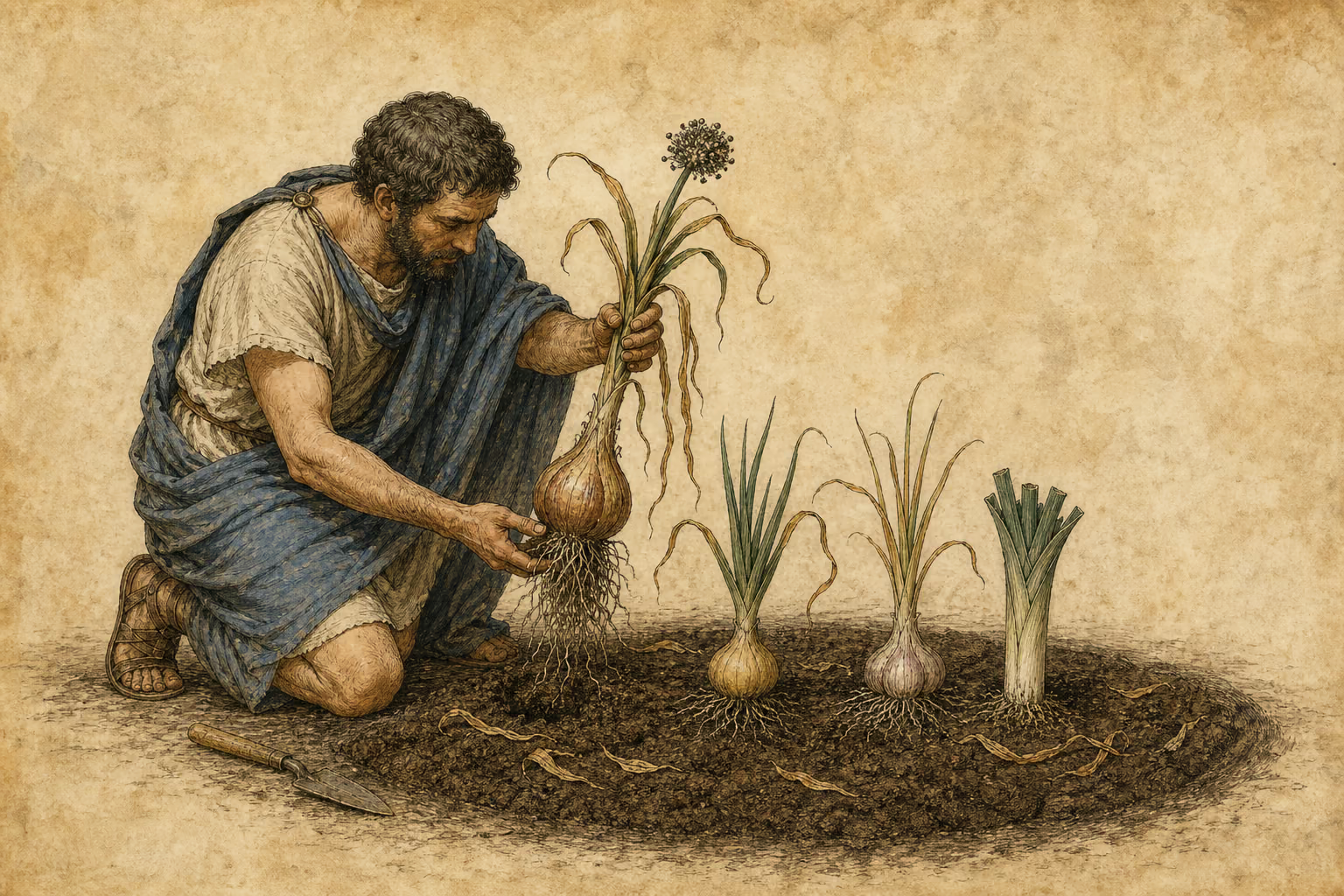
Alium cepasque inter deos in iureiurando habet Aegyptus. cepae genera apud Graecos Sarda, Samothracia, Alsidena, setania, schista, Ascalonia, ab oppido Iudaeae nominata. omnibus etiam odor lacrimosus et praecipue Cypriis, minime Cnidiis. omnibus corpus totum pingui tunicarum cartilagine. e cunctis setania minima, excepta Tusculana, sed dulcis. schista autem et Ascalonia condiuntur. schistam hieme cum coma sua relincunt, vere folia detrahunt, et alia subnascuntur iisdem divisuris, unde et nomen. hoc exemplo reliquis quoque generibus detrahi iubent, ut in capita crescant potius quam in semen. Ascaloniarum propria natura. etenim velut steriles sunt ab radice, et ob id semine seri illas, non deponi iussere Graeci, praeterea serius circa ver, at cum germinent, transferri, ita crassescere et properare cum praeteriti temporis pensitatione. festinandum autem in iis est, quoniam maturae celeriter putrescunt. si deponantur, caulem emittunt et semen ipsaeque evanescunt. est et colorum differentia; in Isso enim et Sardibus candidissimae proveniunt. sunt in honore et Creticae, de quibus dubitant, an eaedem sint quae Ascaloniae, quoniam satis capita crassescunt, depositis caulis et semen. distant sapore tantum dulci. apud nos duo prima genera: unum condimentariae, quam illi getion, nostri pallacanam vocant, seritur mensibus Martio, Aprili, Maio, alterum capitatae, quae ab aequinoctio autumni vel a favonio. genera eius austeritatis ordine: Africana, Gallica, Tusculana, Ascalonia, Amiternina, optima autem quae rotundissima. item rufa acrior quam candida, et sicca quam viridis, et cruda quam cocta sicut quam condita. seritur Amiternina frigidis et umidis locis, et sola alii modo capite, reliquae semine proximaque aestate nullum semen emittunt, sed caput tantum, quod increscit. sequenti autem anno permutata ratione semen gignitur, caput ipsum corrumpitur. ergo omnibus annis separatim semen cepae causa seritur, separatim cepa seminis. servantur autem optimein paleis. getium paene sine capite est, cervicis tantum longae et ideo totum in fronde, saepiusque resecatur, ut porrum. ideo et illud serunt, non deponunt. cetero cepas ter fosso seri iubent extirpatis radicibus herbarum, in iugera denas libras, intermisceri satureiam, quoniam melius proveniat, runcari praeterea et sariri, si non saepius, quater. Ascaloniam mense Februario serunt nostri. semen ceparum nigrescere incipiens, antequam inarescat, metunt.
Et de porro in hac cognatione dici conveniat, praesertim cum sectivo auctoritatem nuper fecerit princeps Nero vocis gratia ex oleo statis mensum omnium diebus nihilque aliud ac ne pane quidem vescendo. seritur semine ab aequinoctio autumno, si sectivum facere libuit, densius. in eadem area secatur, donec deficiat, stercoraturque semper, si nutriatur in capita, antequam secetur. cum increvit, in aliam aream transfertur, summis foliis leviter recisis ante medullam et capitibus retractis tunicisve extremis. antiqui silice vel testa subiecta capita dilatabant—hoc item in bulbis —, nunc sarculo leviter convelluntur radices,ut delumbatae alant neque distrahant. insigne quod, cum fimo laetoque solo gaudeat, rigua odit. et tamen proprietate quaedam soli constant: laudatissimum Aegypto, mox Ostiae atque Ariciae. sectivi duo genera: herbaceum folio, incisuris eius evidentibus, quo utuntur medicamentarii, alterum genus flavidioris folii rotundiorisque, levioribus incisuris. fama est Melam equestris ordinis, reum ex procuratione a Tiberio principe accersitum, in summa desperatione suco porri ad trium denariorum argenteorum pondus hausto confestim expirasse sine cruciatu. ampliorem modum negant noxium esse.
Alium ad multa ruris praecipue medicamenta prodesse creditur. tenuissimis et quae spernantur universum velatur membranis, mox pluribus coagmentatur nucleis, et his separatim vestitis, asperi saporis; quo plures nuclei fuere, hoc est asperius. taedium huic quoque halitu, ut cepis, nullum tamen coctis. generum differentia in tempore—praecox maturescit LX diebus—, tum in magnitudine. ulpicum quoque in hoc genere Graeci appellavere alium Cyprium, alii ἀντισκόροδον, praecipue Africae celebratum inter pulmentaria ruris, grandius alio. tritum in oleo et aceto mirum quantum increscit spuma. quidam ulpicum et alium in piano seri vetant, castellatimque grumulis inponi distantibus inter se pedes ternos. inter grana digiti IIII interesse debent, simul atque tria folia eruperunt, sariri. grandescunt, quo saepius sariuntur. maturescentium caules depressi in terrain obruuntur; ita cavetur, ne in frondem luxurient. in frigidis utilius vere seri quam autumno. cetero ut odore careant, omnia haec iubentur seri, cum luna sub terra sit, colligi, cum in coitu. sine his Menander e Graecis auctor est alium edentibus, si radicem betae in pruna tostam superederint, odorem extingui. sunt qui et alium et ulpicum inter Compitalia ac Saturnalia seri aptissime putent. alium et semine provenit, sed tarde. primo enim anno porri crassitudinem capite efficit, sequenti dividitur, tertio consummatur, pulchriusque tale existimant quidam. in semen exire non debet, sed intorqueri caulis satus gratia, ut caput validius fiat. quod si diutius alium cepamque inveterare libeat, aqua salsa tepida capita unguenda sunt; ita diuturniora fient melioraque usui et in satu sterilia. alii contenti sunt primo super prunas suspendisse abundeque ita profici arbitrantur, ne germinent, quod facere alium cepamque extra terram quoque certum est et cauliculo acto evanescere. aliqui et alium palea servari optime putant. alium est et in arvis sponte nascens—alum vocant —, quod adversus improbitatem alitum depascentium semina coctum, ne renasci possit, abicitur, statimque quae devoravere aves stupentes manu capiuntur et, si paulum commorere, sopitae. est et silvestre, quod ursinum vocant, odore simili, capite praetenui, foliis grandibus.
English · Bostock & Riley 1855–57
Nearly all the garden plants have a single root only, radishes, beet, parsley, and mallows, for example; it is lapathum, however, that has the longest root of them all, it attaining the length of three cubits even. The root of the wild kind is smaller and of a humid nature, and when up it will keep alive for a considerable period. In some of these plants, however, the roots are fibrous, as we find the case in parsley and mallows, for instance; in others, again, they are of a ligneous nature, as in ocimum, for example; and in others they are fleshy, as in beet, and in saffron even more so. In some, again, the root is composed of rind and flesh, as in the radish and the rape; while in others it is jointed, as in hay grass. Those plants which have not a straight root throw out immediately a great number of hairy fibres, orage and blite, for instance: squills again, bulbs, onions, and garlic never have any but a vertical root. Among the plants that grow spontaneously, there are some which have more numerous roots than leaves, spalax, for example, pellitory, and saffron.
Wild thyme, southernwood, turnips, radishes, mint, and rue blossom all at once; while others, again, shed their blossom directly they have begun to flower. Ocimum blossoms gradually, beginning at the lower parts, and hence it is that it is so very long in blossom: the same is the case, too, with the plant known as heliotropium. In some plants the flower is white, in others yellow, and in others purple. The leaves fall first from the upper part in wild-marjoram and elecampane, and in rue sometimes, when it has been injured accidentally. In some plants the leaves are hollow, the onion and the scallion, more particularly.
Garlic and onions are invoked by the Egyptians, when taking an oath, in the number of their deities. The Greeks have many varieties of the onion, the Sardian onion, the Samothracian, the Alsidenian, the setanian, the schistan, and the Ascalonian, so called from Ascalon, a city of Judæa. They have, all of them, a pungent smell, which draws tears from the eyes, those of Cyprus more particularly, and those of Cnidos the least of all. In all of them the body is composed of a cartilage of an unctuous nature. The variety known as the setanian is the smallest of them all, with the exception of the Tusculan onion, but it is sweet to the taste. The schistan and the Ascalonian kinds are used for storing. The schistan onion is left during the winter with the leaves on; in the spring it is stripped of them, upon which offsets make their appearance at the same divisions as the leaves; it is to this circumstance that this variety owes its name. Taking the hint from this fact, it is recommended to strip the other kinds of their leaves, to make them bulb all the better, instead of running to seed.
The Ascalonian onion is of a peculiar nature, being barren in some measure in the root; hence it is that the Greeks have recommended it to be reproduced from seed, and not from roots: the transplanting, too, they say, should be done later in the spring, at the time the plant germinates, the result being that it bulbs with all the greater rapidity, and hastens, as it were, to make up for lost time; great dispatch, however, is requisite in taking it up, for when ripe it rots with the greatest rapidity. If propagated from roots, it throws out a long stalk, runs rapidly to seed, and dies.
There are considerable differences, too, in the colour of the onion; the whitest of all are those grown at Issus and Sardes. The onions, too, of Crete are held in high esteem, but there is some doubt whether they are not the same as the Ascalonian variety; for when grown from seed they produce a fine bulb, but when planted they throw out a long stalk and run to seed; in fact, they differ from the Ascalonian kind only in the sweetness of their flavour.
Among us there are two principal varieties known of the onion; the scallion, employed for seasonings, is one, known to the Greeks by the name of “gethyon,” and by us as the “pallacana;” it is sown in March, April, and May. The other kind is the bulbed or headed onion; it is sown just after the autumnal equinox, or else after the west winds have begun to prevail. The varieties of this last kind, ranged according to their relative degrees of pungency, are the African onion, the Gallic, the Tusculan, the Ascalonian, and the Amiternian: the roundest in shape are the best. The red onion, too, is more pungent than the white, the stored than the fresh, the raw than the cooked, and the dried than the preserved. The onion of Amiternum is cultivated in cold, humid localities, and is the only one that is reproduced from heads, like garlic, the other kinds being grown from seed. This last kind yields no seed in the ensuing summer, but a bulb only, which dries and keeps; but in the summer after, the contrary is the case, for seed is produced, while the bulb very quickly spoils. Hence it is that every year there are two separate sowings, one of seed for the reproduction of bulbs, and one of bulbs for the growth of seed; these onions keep best in chaff. The scallion has hardly any bulb at all, but a long neck only—hence it is nothing but leaf, and is often cut down, like the leek; for this reason, too, like the leek, it is grown from seed, and not from plants.
In addition to these particulars, it is recommended that the ground intended for sowing onions should be turned up three times, care being taken to remove all roots and weeds; ten pounds of seed is the proper proportion for a jugerum. Savory too, they say, should be mixed with them, the onions being all the finer for it; the ground, too, should be stubbed and hoed four times at least, if not oftener. In Italy, the Ascalonian onion is sown in the month of February. The seed of the onion is gathered when it begins to turn black, and before it becomes dry and shrivelled.
While upon this subject, it will be as well, too, to speak of the leek, on account of the affinity which it bears to the plants just mentioned, and more particularly because cut-leek has recently acquired considerable celebrity from the use made of it by the Emperor Nero. That prince, to improve his voice, used to eat leeks and oil every month, upon stated days, abstaining from every other kind of food, and not touching so much as a morsel of bread even. Leeks are reproduced from seed, sown just after the autumnal equinox; if they are intended for cutting, the seed is sown thicker than otherwise. The leeks in the same bed are cut repeatedly, till it is quite exhausted, and they are always kept well manured. If they are wanted to bulb before being cut, when they have grown to some size they are transplanted to another bed, the extremities of the leaves being snipped off without touching the white part, and the heads stripped of the outer coats. The ancients were in the habit of placing a stone or potsherd upon the leek, to make the head grow all the larger, and the same with the bulbs as well; but at the present day it is the usual practice to move the fibrous roots gently with the weeding-hook, so that by being bent they may nourish the plant, and not withdraw the juices from it.
It is a remarkable fact, that, though the leek stands in need of manure and a rich soil, it has a particular aversion to water; and yet its nature depends very much upon the natural properties of the soil. The most esteemed leeks are those grown in Egypt, and next to them those of Ostia and Aricia. Of the leek for cutting, there are two varieties: that with grass-green leaves and incisions distinctly traced on them, and the leek with paler and rounder leaves, the incisions being more lightly marked. There is a story told, that Mela, a member of the Equestrian order, being accused of mal-administration by order of the Emperor Tiberius, swallowed in his despair leek-juice to the amount of three denarii in weight of silver, and expired upon the spot without the slightest symptom of pain. It is said, however, that a larger dose than this is productive of no injurious effects whatever.
Garlic is generally supposed, in the country more particularly, to be a good specific for numerous maladies. The external coat consists of membranes of remarkable fineness, which are universally discarded when the vegetable is used; the inner part being formed by the union of several cloves, each of which has also a separate coat of its own. The flavour of it is pungent, and the more numerous the cloves the more pungent it is. Like the onion, it imparts an offensive smell to the breath; but this is not the case when it is cooked. The various species of garlic are distinguished by the periods at which they ripen: the early kind becomes fit for use in sixty days. Another distinction, too, is formed by the relative size of the heads. Ulpicum, also, generally known to the Greeks as “Cyprian garlic,” belongs to this class; by some persons it is called “antiscorodon,” and in Africa more particularly it holds a high rank among the dishes of the rural population; it is of a larger size than ordinary garlic. When beaten up with oil and vinegar, it is quite surprising what a quantity of creaming foam is produced.
There are some persons who recommend that neither ulpicum nor garlic should be sown on level ground, but say that they should be planted in little mounds trenched up, at a distance of three feet apart. Between each clove, they say, there should be a distance of four fingers left, and as soon as ever three leaves are visible, the heads should be hoed; the oftener they are hoed, the larger the size they will attain. When they begin to ripen, the stalks are bent downwards, and covered over with earth, a precaution which effectually prevents them from running to leaf. In cold soils, it is considered better to plant them in spring than in autumn.
For the purpose of depriving all these plants of their strong smell, it is recommended to set them when the moon is below the horizon, and to take them up when she is in conjunction. Independently of these precautions, we find Menander, one of the Greek writers, recommending those who have been eating garlic to eat immediately afterwards a root of beet roasted on hot coals; if this is done, he says, the strong smell of the garlic will be effectually neutralized. Some persons are of opinion, that the proper period for planting garlic and ulpicum is between the festival of the Compitalia and that of the Saturnalia. Garlic, too, can be grown from seed, but it is very slow, in such case, in coming to maturity; for in the first year, the head attains the size only of that of a leek, in the second, it separates into cloves, and only in the third it arrives at maturity; there are some, however, who think that garlic grown this way is the best. Garlic should never be allowed to run to seed, but the stalk should be twisted, to promote its growth, and to make the head attain a larger size.
If garlic or onions are wanted to keep some time, the heads should be dipped in salt water, made luke-warm; by doing this, they will be all the better for keeping, though quite worthless for reproduction. Some persons content themselves with hanging them over burning coals, and are of opinion that this is quite sufficient to prevent them from sprouting: for it is a well-known fact, that both garlic and onions sprout when out of the ground, and that after throwing out their thin shoots they shrivel away to nothing. Some persons are of opinion, too, that the best way of keeping garlic is by storing it in chaff. There is a kind of garlic that grows spontaneously in the fields, and is known by the name of “alum.” To preserve the seeds that are sown there from the remorseless ravages of the birds, this plant is scattered over the ground, being first boiled, to prevent it from shooting. As soon as ever they have eaten of it, the birds become so stupefied as to be taken with the hand even, and if they remain but a few moments only on the spot, they fall fast asleep. There is a wild garlic, too, generally known as “bear’s” garlic; it has exactly the smell of millet, with a very small head and large leaves.