LIBER II · CAPUT 23
OF THE DIMENSIONS OF THE WORLD
Latine · Mayhoff 1906
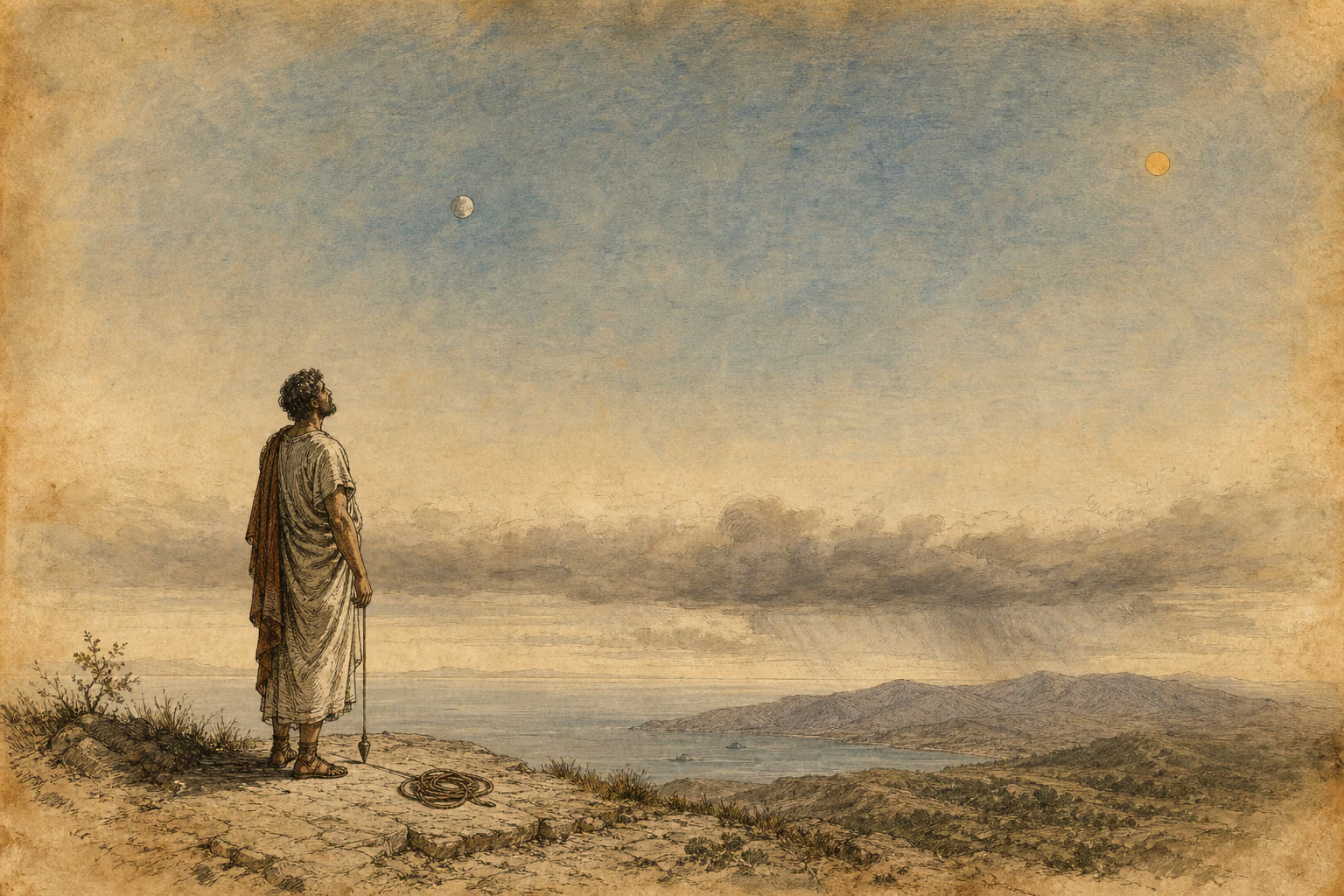
Stadium XXV nostros efficit passus, hoc est pedes DCXXV. Posidonius non minus XL stadiorum a terra altitudinem esse, in quam nubila ac venti nubesque perveniant, inde purum liquidumque et inperturbatae lucis aëra, sed a turbido ad lunam viciens C milia stadiorum, inde ad solem quinquiens miliens, et spatio fieri, ut tam inmensa eius magnitudo non exurat terras. plures autem DCCCC in altitudinem nubes subire prodiderunt. inconperta haec et inextricabilia, sed prodenda, quia sunt prodita, in quis tamen una ratio geometricae collectionis numquam fallacis possit non repudiari, si cui libeat altius ista persequi, nec ut mensura — id enim velle paene dementis otii est —, sed ut tantum aestimatio coniectanti constet animo. nam cum CCCLX et fere sex partibus orbis solis ex circuitu eius patere appareat circulum, per quem meat, semperque dimetiens tertiam partem ambitus ettertiae paulo minus septimam colligat, apparet dempta eius dimidia, quoniam terra centralis interveniat, sextam fere partem huius inmensi spatii, quod circa terram circuli spatio R2E2v. -tii r solaris animo conprehenditur, inesse altitudinis spatio, lunae vero duodecimam, quoniam tanto breviore quam sol ambitu currit. ita fieri eam in medio solis ac terrae. miror quo procedat inprobitas cordis humani parvolo aliquo invitata successu, sicut in supra dictis occasionem inpudentiae ratio largitur. ausique divinare solis ad terrain spatia eadem ad caelum agunt, quoniam sit medius sol, ut protinus mundi quoque ipsius mensura veniat in digitos. quantas enim dimetiens habeat septimas, tantas habere circulum duoetvicesimas, tamquam plane a perpendiculo mensura caeli constet. Aegyptia ratio, quam Petosiris et Nechepsos ostendere, singulas partes in lunari circulo, ut dictum est, minimo XXXIII stadiis paulo amplius patere colligit, in Saturni amplissimo duplum, in solis, quem medium esse diximus, utriusque mensurae dimidium. quae computatio plurimum habet pudoris, quoniam ad Saturni circulum addito signiferi ipsius intervallo nec numerabilis multiplicatio efficitur.
English · Bostock & Riley 1855–57
The stadium is equal to 125 of our Roman paces, or 625 feet. Posidonius supposes that there is a space of not less than 40 stadia around the earth, whence mists, winds and clouds proceed; beyond this he supposes that the air is pure and liquid, consisting of uninterrupted light; from the clouded region to the moon there is a space of 2,000,000 of stadia, and thence to the sun of 500,000,000. It is in consequence of this space that the sun, notwithstanding his immense magnitude, does not burn the earth. Many persons have imagined that the clouds rise to the height of 900 stadia. These points are not completely made out, and are difficult to explain; but we have given the best account of them that has been published, and if we may be allowed, in any degree, to pursue these investigations, there is one infallible geometrical principle, which we cannot reject. Not that we can ascertain the exact dimensions (for to profess to do this would be almost the act of a madman), but that the mind may have some estimate to direct its conjectures. Now it is evident that the orbit through which the sun passes consists of nearly 366 degrees, and that the diameter is always the third part and a little less than the seventh of the third of the circumference. Then taking the half of this (for the earth is placed in the centre) it will follow, that nearly one-sixth part of the immense space, which the mind conceives as constituting the orbit of the sun round the earth, will compose his altitude. That of the moon will be one-twelfth part, since her course is so much shorter than that of the sun; she is therefore carried along midway between the sun and the earth. It is astonishing to what an extent the weakness of the mind will proceed, urged on by a little success, as in the above-mentioned instance, to give full scope to its impudence! Thus, having ventured to guess at the space between the sun and the earth, we do the same with respect to the heavens, because he is situated midway between them; so that we may come to know the measure of the whole world in inches. For if the diameter consist of seven parts, there will be twenty-two of the same parts in the circumference; as if we could measure the heavens by a plumb-line!
The Egyptian calculation, which was made out by Petosiris and Necepsos, supposes that each degree of the lunar orbit (which, as I have said, is the least) consists of little more than 33 stadia; in the very large orbit of Saturn the number is double; in that of the sun, which, as we have said, is in the middle, we have the half of the sum of these numbers. And this is indeed a very modest calculation, since if we add to the orbit of Saturn the distance from him to the zodiac, we shall have an infinite number of degrees.